
Personal Finance in Nigeria: The Complete 2026 Hub (Saving, Investing, Tax, Banking and Avoiding Scams)


Last updated: 4 November 2026 · By Naijatipsland Editorial Team · Editorial policy
Inflation, a weaker naira, new tax rules and a flood of fintech apps have made managing money in Nigeria more complicated than ever. Good decisions still follow a simple order: know where your money goes, build a cushion, avoid expensive debt, then save and invest in regulated places. This hub brings together every Naijatipsland personal finance guide so you can work through that order step by step.
Our guides use current figures from the Central Bank of Nigeria, the Securities and Exchange Commission, the NDIC and the tax authorities, and they are dated so you can see when each was last checked. Rates on treasury bills, savings apps and fixed deposits move frequently, so always confirm the current rate before you commit.
The short version: keep an emergency fund in an insured, easy-access account; invest only through licensed platforms; understand the new personal income tax bands; and treat any offer of guaranteed high returns as a scam until proven otherwise.
Start here: saving and budgeting
These guides cover the basics: practical saving steps that work during high inflation, the mistakes that keep Nigerians broke, and a checklist to test your own financial habits.
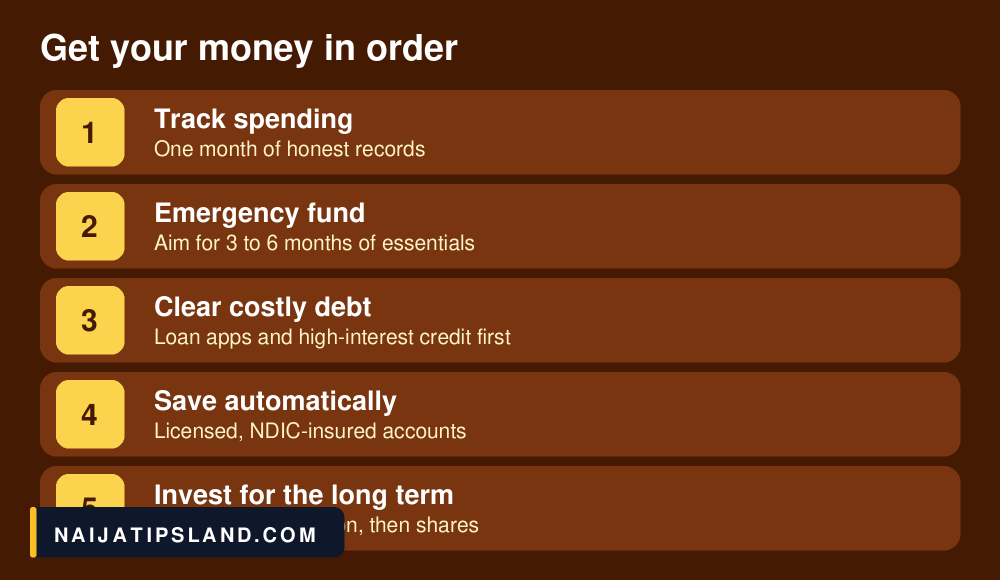
- How to Save Money in Nigeria in 2026: 10 Practical Steps and Safe Places to Keep It: How to save money in Nigeria in 2026: 10 practical steps, safe places to keep savings, NDIC and SEC protections, and a reality check on inflation.
- 7 Best Saving Tips Nigeria: Practical Steps for Young Adults: Discover the 7 best saving tips Nigeria for young adults. Learn practical strategies that make saving money easy and boost your financial stability today.
- Financial Literacy Checklist for Young Nigerian Adults (2026): A practical financial literacy checklist for young Nigerian adults: budgeting, emergency fund, NDIC limits, safe borrowing and investing, 2026 tax bands and pension.
- 6 Common Money Mistakes Nigerians Make (and How to Fix Them in 2026): Six common money mistakes Nigerians make, from no emergency fund to loan apps and Ponzi schemes, with practical fixes and current 2026 rules and rates.
- Best Savings Apps in Nigeria: Safety, Interest and Withdrawal Rules (2026): Compare Nigerian savings apps on licence, NDIC cover, interest rates and early withdrawal rules: PiggyVest, Cowrywise, Kuda, FairMoney, Renmoney, PalmPay and OPay.
Investing for beginners
Start with lower-risk, regulated options and move up the risk ladder only when you have an emergency fund in place. Our comparisons use worked examples so you can see what a given amount might earn after tax.
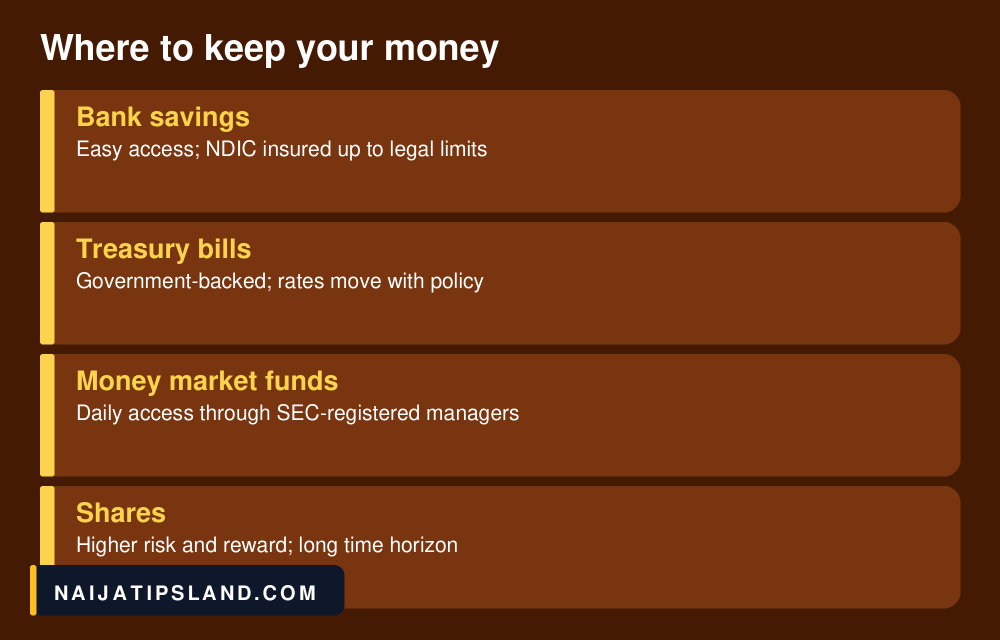
- Best Investment Opportunities in Nigeria for Beginners (2026): Low-Risk Options, Real Rates and Scams to Avoid: Beginner investing in Nigeria: money market funds, treasury bills, savings bonds, pension, shares and land, with current rates, risks and scam red flags.
- Treasury Bills vs Fixed Deposits vs Savings Bonds in Nigeria (2026): Compare treasury bills, fixed deposits and FGN savings bonds in Nigeria: October 2026 rates, minimums, tax, risks and worked examples on N1 million.
- Best Nigerian Stocks for Long-Term Investing in 2026 (and How to Buy Them on Your Phone): Long-term investing in Nigerian stocks in 2026: how the NGX performed, which dividend payers investors research, the risks, and how to buy shares on your phone.
- How to Buy Dangote Refinery IPO Shares in Nigeria (Offer Closed 27 October 2026): Price, Minimum and How It Worked: The Dangote Refinery IPO closed on 27 October 2026. See the price, minimum subscription, how to apply and what to watch next on allotment and listing.
- 5 Investment Options for Your Pension in Nigeria (2026 Guide): How to invest for retirement in Nigeria in 2026: pick the right RSA fund, add voluntary contributions, and compare FGN Savings Bonds, money market funds and dividend stocks.
Tax: what you owe in 2026
Nigeria’s tax reforms changed how employees and small businesses are taxed, including a tax-free band for lower earners and the use of your NIN as your tax ID. These guides explain the new bands, PAYE and VAT in plain English.
- Personal Income Tax in Nigeria 2026: New Bands and What Employees Pay: Nigeria personal income tax 2026: the N800,000 tax-free band, 15% to 25% rates, rent relief, PAYE steps and worked examples for employees.
- How to Get a Tax Identification Number (TIN) in Nigeria in 2026: Your NIN is now your Tax ID in Nigeria. See who needs one, how to retrieve your 13-digit Tax ID online, the bank account rules and the portal confusion in 2026.
- VAT in Nigeria 2026: Rate, Registration, Filing and Penalties: VAT in Nigeria 2026: the 7.5% rate, who must register, filing by the 21st, zero-rated vs exempt, input VAT claims and reported penalties.
Banking, BVN and transfer problems
When a transfer goes wrong, speed matters. These guides tell you exactly what to do if you send money to the wrong account, get debited for a failed POS transaction or lose your card or phone, and how to escalate a complaint to the CBN.
- How to Check Your BVN and Link It to Your Bank Accounts (2026): Check your BVN with *565*0#, your bank app or NIBSS, link it to your accounts, and see the new 2026 CBN rules, including the one-time phone number change.
- How to Recover Money Sent to the Wrong Account in Nigeria: Sent money to the wrong account? Learn how to report it, get a hold, when the recipient must consent, when you need a court order, and the failed-transfer rule.
- POS Transaction Failed but You Were Debited? What to Do (2026): POS transaction failed but you were debited in Nigeria? CBN refund timelines, what evidence to keep, how to complain to your bank and escalate to the CBN.
- How to Block Your ATM Card or Bank Account After Theft or Fraud: Stolen card or phone? Block your ATM card or account fast, lock your SIM, report to your bank and escalate to the CBN. Bank codes and contacts for Nigeria.
- Bank Transfer Charges in Nigeria: What Banks and Fintechs Charge (2026): What a bank transfer costs in Nigeria in 2026: the N10 and N50 fee tiers, the N50 stamp duty paid by the sender, worked examples and fees at OPay, Kuda and more.
- Nigeria’s Cashless Policy in 2026: Current CBN Limits, Fees and How to Adapt: Nigeria's cashless policy in 2026: the CBN's N500,000 weekly limit for individuals, N5 million for corporates, 3% and 5% excess fees, and how to adapt.
Fintech, loan apps and microfinance
Fintech apps have made banking easier, but licence types and deposit insurance differ. Learn how to check that an app or lender is licensed before you hand over your money or your contacts.
- Best Fintech Apps in Nigeria 2026: OPay, PalmPay, Moniepoint and Kuda Compared: OPay, PalmPay, Moniepoint and Kuda compared on licence type, NDIC cover and safety, with the January 2026 national licence upgrades and a checklist.
- What Is Fintech? How Financial Technology Works in Nigeria (2026): What fintech is, the main types, how it works in Nigeria, who regulates it, the risks and how to use it safely, with 2025 and 2026 figures.
- How to Check That a Bank, Fintech or Loan App Is Licensed in Nigeria (2026): How to check that a bank, microfinance bank, fintech or loan app is licensed in Nigeria: CBN lists, *959#, NDIC cover, FCCPC rules and the 46 revoked MFB licences.
- Loan Apps in Nigeria: How to Check If One Is Approved and Report Harassment (2026): Check if a Nigerian loan app is on the FCCPC register, spot red flags, learn the 2025 DEON rules and penalties, and how to report harassment step by step.
- Microfinance Banks in Nigeria: How They Work, What They Cost and Their Real Impact (2026): How microfinance banks work in Nigeria: licensing, NDIC cover of N2 million, what loans really cost, what research shows and how to spot fake lenders.
Crypto and forex: know the rules
Crypto and forex trading attract both genuine investors and many scams. Our guides explain what the SEC allows, how crypto is taxed and how to buy safely if you choose to.
- How to Buy Bitcoin and USDT in Nigeria (2026 Guide): How to buy Bitcoin in Nigeria and USDT in 2026: is crypto legal, exchange options, P2P safety, scam warning signs and how crypto is taxed.
- Cryptocurrency Explained: How It Works, Nigeria’s Rules and How to Stay Safe (2026): Cryptocurrency explained for Nigerians: how it works, the main types, the 2026 SEC and tax rules, common scams and how to protect your coins.
- Is Forex Trading Legal and Safe in Nigeria? (2026 Guide): Is forex trading legal in Nigeria? What the SEC says under ISA 2025, the September 2026 draft rules, common forex scams and how to check a broker.
Avoid money scams
Fraudsters adapt quickly. These guides cover the scams our members report most often, from fake credit alerts and WhatsApp account takeovers to Ponzi schemes and POS fraud, and where to report them.
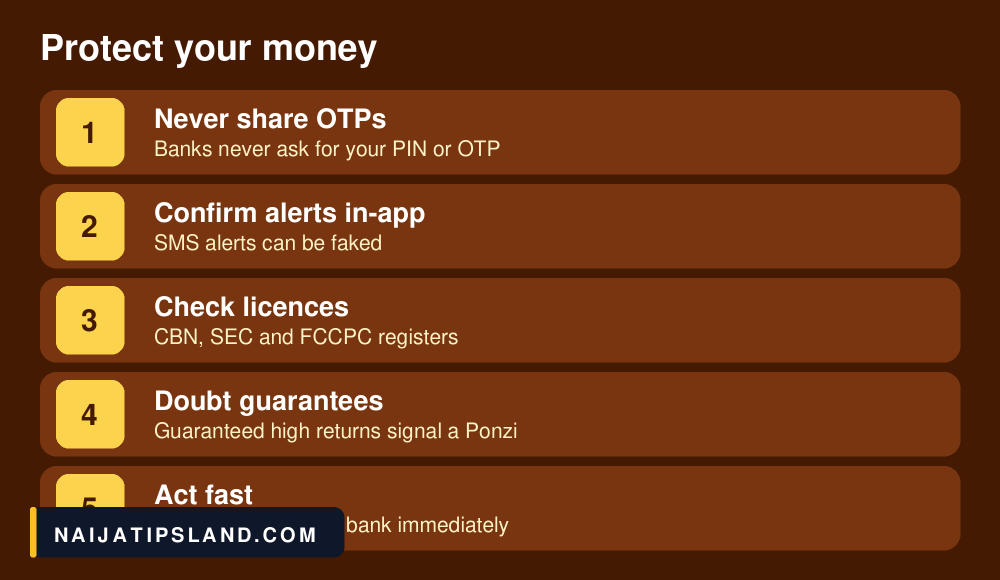
- Ponzi Schemes in Nigeria: Warning Signs Before You Invest (2026): Ponzi schemes in Nigeria: SEC warnings in 2026, the CBEX case, red flags such as guaranteed returns, how to verify a platform and what to do if caught.
- Fake Credit Alerts and Phishing SMS: How to Check a Transfer Is Real: Fake credit alerts and phishing SMS in Nigeria: how the scams work, how to confirm a transfer in your bank app, CBN and NITDA warnings, and what to do if tricked.
- How to Avoid POS Agent Fraud in Nigeria: 2026 Safety Guide: How to avoid POS agent fraud in Nigeria: common scams, the CBN's agent banking limits and rules, red flags, and what to do if you are scammed.
- Common WhatsApp Scams in Nigeria (2026): How to Spot and Avoid Them: Common WhatsApp scams in Nigeria in 2026: account takeover, GhostPairing, fake jobs and loans, impersonation. How to spot them, stay safe and report.
- How to Avoid Internet Scams in Nigeria: Types, Red Flags and What to Do (2026): How to avoid internet scams in Nigeria in 2026: the most common types, red flags, how to verify offers, what to do if you are scammed and where to report, with enforcement facts.
- How to Report Cybercrime in Nigeria: Police, EFCC and Your Bank: How to report cybercrime in Nigeria: the police cybercrime portal, EFCC, your bank and the CBN, what evidence to keep and what to do in the first hours.
Frequently Asked Questions
What is the safest place to save money in Nigeria?
Licensed banks and microfinance banks insured by the NDIC, government securities such as treasury bills and FGN savings bonds, and SEC-regulated money market funds are generally the safest options. Check the licence of any app before using it.
How much should I have in an emergency fund?
A common target is three to six months of essential expenses such as rent, food, transport and school fees. Start with one month if that feels more achievable, and build from there.
Do I have to pay income tax on a small salary in Nigeria?
Under the new personal income tax rules, the first N800,000 of annual taxable income is tax-free, with rates rising in bands above that. See our personal income tax guide for worked examples.
How can I tell if an investment platform is a Ponzi scheme?
Warning signs include guaranteed high returns, payments that depend on recruiting others, no SEC registration and pressure to invest quickly. Check the SEC’s list of registered operators and its public warnings.
What should I do if I sent money to the wrong account?
Contact your bank immediately with the transaction details and ask them to place a hold. Our guide explains the process, what the recipient’s bank can and cannot do and when a court order is needed.
Explore our other guide hubs
- 2027 Nigeria Election Hub: Dates, Timetable, Candidates and Latest News
- Make Money Online in Nigeria: The Complete 2026 Hub (Freelancing, Content, Digital Products and Getting Paid)
- Learn Tech Skills in Nigeria: The Complete 2026 Hub (Coding, AI, Cybersecurity and Digital Skills)
- Japa Guide 2026: The Complete Hub for Nigerians Moving Abroad (Visas, Jobs, Study, Costs and Scams)
- Diaspora Money Guide 2026: The Complete Hub for Nigerians Abroad (Sending Money, Banking and Investing Back Home)
- Start a Business in Nigeria: The Complete 2026 Hub (Ideas, CAC Registration, NAFDAC, Tax and Growth)
How we keep this hub updated
Interest rates, CBN rules and tax figures change often. We review these guides regularly and add new ones when members raise questions in the forum. If a figure looks out of date, let us know in the comments below.
Join the discussion
Have you tried this, or do you have a question we did not answer? 1 reader has already shared their view. Naijatipsland members help each other with real, first-hand experience.









Money questions are welcome here. Ask about saving, investing, tax or a bank problem in the comments and we will point you to the right guide or cover it in a new one. – Ade