Last updated: 16 October 2026 · By Naijatipsland Editorial Team · Editorial policy
If someone has scammed you online, hacked your account, blackmailed you with photos or taken money from your bank account, the first question is where to report it. In Nigeria there is no single desk for everything: your bank, the Nigeria Police Force cybercrime centre, the Economic and Financial Crimes Commission (EFCC) and the Central Bank of Nigeria (CBN) each handle a different part. This guide sets out who to contact, in what order, what evidence to keep, what to expect afterwards, and the traps that catch victims for a second time. It is general information, not legal advice.
For what counts as a crime and the penalties, see our guide to cybercrime laws in Nigeria. For spotting scams before they happen, see how to avoid internet scams.
The short answer
- Money left your account? Call your bank first, immediately. Recovery depends on speed.
- Report the crime to the Nigeria Police Force National Cybercrime Centre (NPF-NCCC) through its online portal at nccc.npf.gov.ng, and/or to the EFCC for fraud and financial crime.
- Bank has not fixed it? After the bank’s deadline, usually about two weeks, you can escalate to the CBN’s Consumer Protection Department.
- Keep every piece of evidence and do not delete chats, even embarrassing ones.
- Do not pay anyone who offers to recover your money for a fee.
Where to report, in order
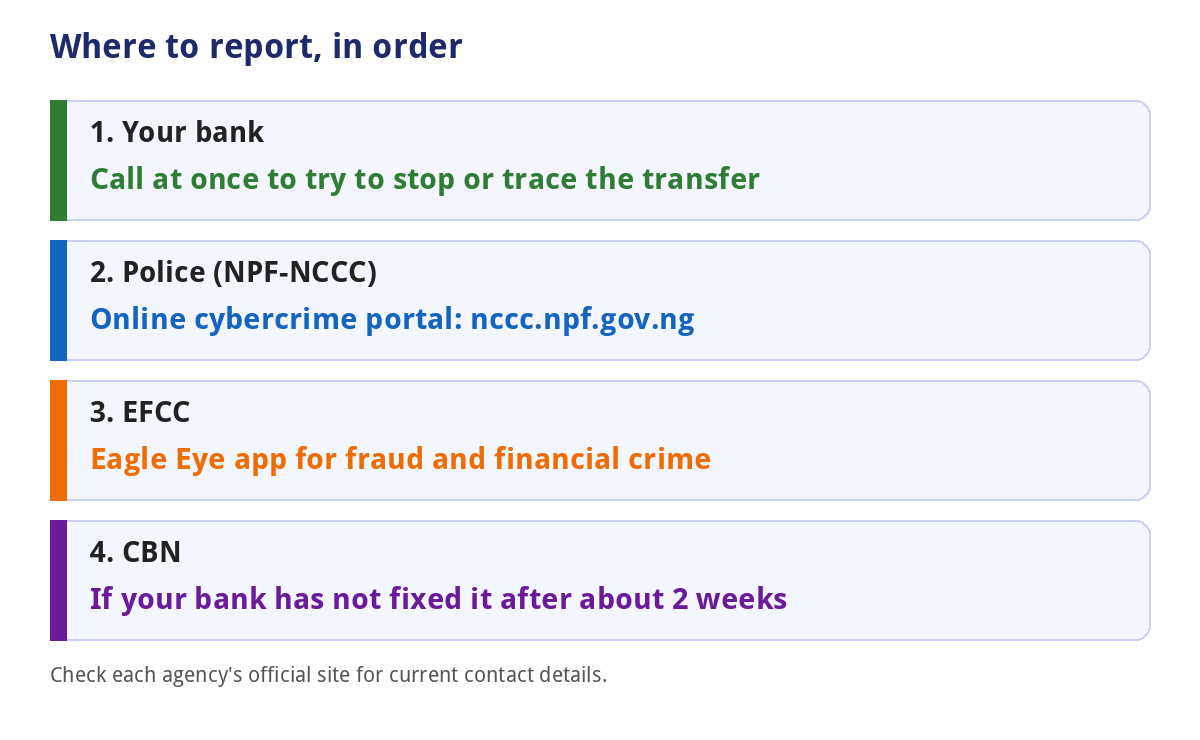
1. Your bank or fintech (if money moved)
Call the bank straight away, then confirm in writing or through the app. Tell them it is a fraud, give the exact time, amount, transaction reference and the beneficiary’s account details, and ask them to try to stop or trace the transfer. An independent Nigerian news site, the Ministry of Cyber Affairs, advises asking for a restriction on the recipient account and a recall, and getting a complaint tracking number. Whether a bank can do this depends on how fast you act and where the money has gone. Our guide to recovering money sent to the wrong account explains how banks usually handle disputes, and our guide to blocking your ATM card helps if your card is the problem.
2. The Nigeria Police Force National Cybercrime Centre (NPF-NCCC)
The NPF-NCCC runs the police’s national cybercrime reporting portal at nccc.npf.gov.ng. In May 2024 the police launched an enhanced version of the platform, with better security and case tracking, replacing an older site, and the Inspector-General of Police urged the public to use it. The portal’s own pages did not load their full content when we checked, so we cannot describe the form fields; open the official portal and follow its steps. You can also report at a police station, but a station may not have a cybercrime unit.
3. The EFCC
The EFCC handles financial crimes such as advance-fee fraud, investment scams and romance scams. In 2021 it launched Eagle Eye, an app for reporting crimes, which it said offers anonymity to those who fear being identified. Check the EFCC’s official website for its current reporting options and contact details before you use any of them, because fake EFCC pages and numbers exist.
4. The Central Bank of Nigeria
The CBN will not investigate the criminal, but it handles complaints against banks and other institutions it regulates. Under its guide to lodging complaints, you must complain to the bank first and allow about two weeks, or 30 days for excess charges and loans. After that you can write to the CBN’s Consumer Protection Department, by email to cpd@cbn.gov.ng or by letter to the Director, Consumer Protection Department in Abuja, with your details, the transaction history, the amount, supporting documents and proof you complained to the bank first. Never include your PIN or passwords.
5. The platform where it happened
Report the profile, post or message to WhatsApp, Facebook, Instagram, X, TikTok, Telegram or the website itself, so the account can be removed. See our guide to WhatsApp scams for how to report on WhatsApp.
6. Other places, depending on the case
- Your telecoms provider for fraudulent calls, SMS or SIM swaps.
- The agency being impersonated. For fake job offers, see our guide to fake job ads and our guide to recruitment scams.
- Your employer or school if the case involves a work or school account.
- A lawyer if you have lost a lot of money or are being blackmailed.
What to do in the first hours
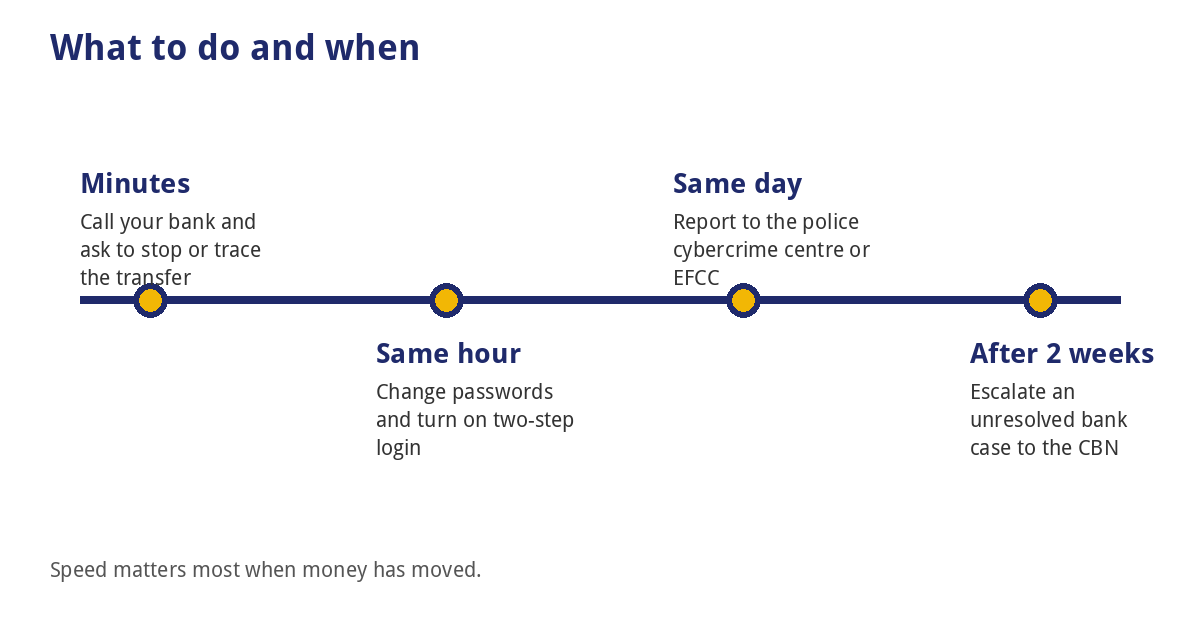
- Call your bank if money moved, even at night. Use the number on the back of your card or in the official app, not one the scammer gave you.
- Stop contact with the scammer, and do not pay any “release” or “recovery” fee.
- Secure your accounts. Change passwords on email, banking, social media and WhatsApp, use a different password for each, and turn on two-step login.
- Check your phone for unfamiliar apps and remove them. Think about whether you shared an OTP, PIN, BVN or NIN.
- Save evidence (below) before the scammer deletes their account.
- Report to the police and/or the EFCC, then to the platform.
- Write down reference numbers from every report and follow up.
The evidence to keep
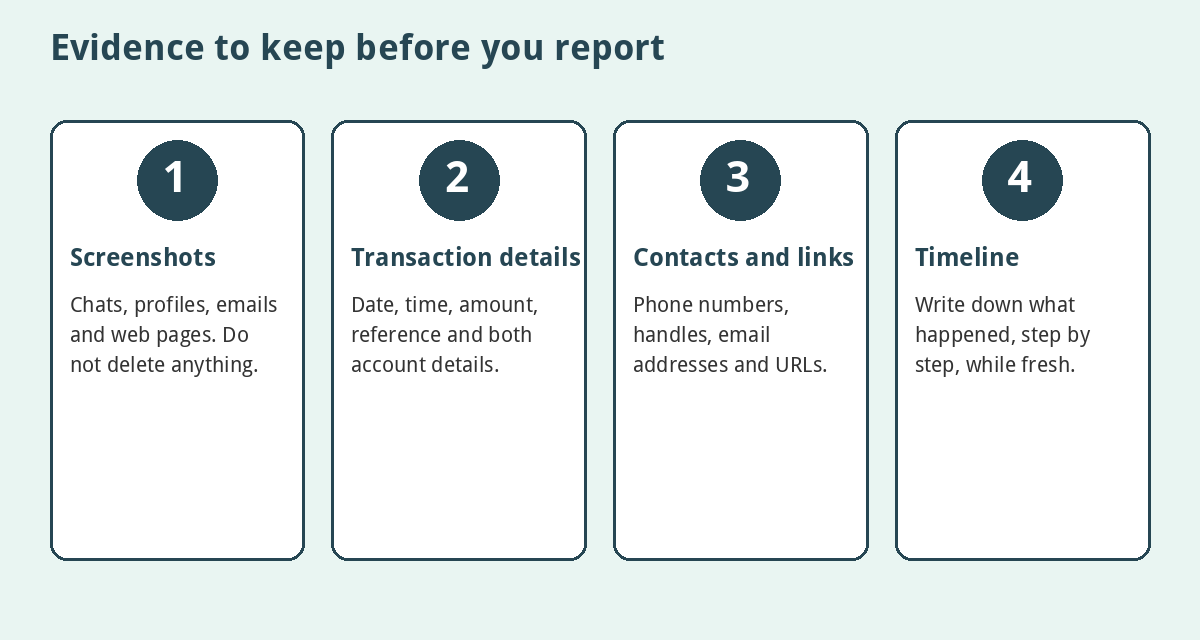
- Screenshots of chats, profiles, emails, adverts and websites, showing the date and time.
- Phone numbers, usernames, email addresses, links and account details.
- Transaction details: date, time, amount, reference or session ID, and both account numbers.
- Debit alerts, receipts and the bank’s complaint tracking number.
- A timeline written while it is fresh, with names, dates and what was promised.
- Copies of your ID, but only to agencies you have verified.
Do not edit screenshots, and do not delete the chat, even if you are embarrassed. If you lose your phone, keep a note of the number and the time.
If your identity or personal data was misused
If scammers have your NIN, BVN, ID or photos, watch for new accounts, loans or SIM registrations in your name and tell your bank. See our guides on data privacy in Nigeria, your BVN and verifying your NIN.
Blackmail, sextortion and harassment
Do not pay, and do not send more photos. Take screenshots, block and report the account to the platform, and report to the police cybercrime centre. Being a victim is not a crime, and you can ask for help from a lawyer or a trusted adult. Our guide to online safety has more.
What to expect after reporting
- You may be asked for more information, your statement, or to come in person.
- Cases can take time, and recovery of money is not guaranteed. The Ministry of Cyber Affairs notes that recovery depends on funds being frozen before they are withdrawn, that there is no automatic refund scheme, and that a bank is generally not obliged to refund a transfer you authorised, though unauthorised debits are a stronger case. Treat these as general guidance, not a promise.
- A report still helps the authorities see patterns and act against groups.
Common mistakes
- Waiting days to call the bank.
- Paying a “recovery agent” or “hacker” who promises to get money back, a common second scam.
- Deleting chats or blocking the scammer before saving evidence.
- Reporting to a page or number you found in a comment or a direct message.
- Using contact details from a stranger on social media instead of the official site.
- Not keeping reference numbers.
- Skipping the platform report.
Frequently asked questions
How do I report cybercrime in Nigeria?
Use the police’s NPF-NCCC online portal, the EFCC for financial crime, your bank if money moved and the CBN if the bank does not resolve it.
Is there a hotline?
We could not verify a current official hotline from the agencies’ own pages. Use the contacts on their official websites, and be careful of numbers posted by strangers.
Should I report to the police or the EFCC?
Report online fraud, hacking and harassment to the police cybercrime centre, and large financial fraud to the EFCC. Reporting to both is acceptable, and keep the references.
Can I report anonymously?
The EFCC says its Eagle Eye app offers anonymity, but giving your details usually helps an investigation. Check the current terms in the official app or site.
How long do I have?
Report as soon as possible. Money is easiest to trace in the first minutes and hours.
Will I get my money back?
Not always. Speed, how the money moved and whether the debit was authorised all matter.
Can a bank reverse a transfer I made?
Sometimes it can try, but it cannot promise it. Contact the bank immediately.
What if I am afraid to report?
Many victims feel ashamed, which scammers rely on. A report protects others.
Bottom line
Move quickly: call your bank, secure your accounts, save evidence and report through the official channels, starting with the police cybercrime centre and the EFCC. Use only contact details from official websites, never pay anyone for “recovery”, and keep your reference numbers. If your bank fails you, take it to the CBN.
Sources
- Techeconomy: Nigeria Police launches platform for reporting cybercrime (31 May 2024)
- NPF-NCCC: National Cybercrime Centre e-reporting portal
- TheCable: EFCC launches Eagle Eye online app for reporting crime (14 Jul 2021)
- Central Bank of Nigeria: How to lodge a complaint
- Central Bank of Nigeria: Complaints management
- Ministry of Cyber Affairs: How to report fraud in Nigeria (7 Jun 2026) (independent news site, not a government body)