Last updated: 13 October 2026. Crypto prices and rules change fast. This is education, not investment or tax advice, and you can lose all the money you put in.
Cryptocurrency is digital money that is not issued or controlled by a government or a bank. Instead, thousands of computers around the world keep a shared record of who owns what. That record is called a blockchain. Bitcoin, launched in 2009, was the first, and today there are thousands of coins and tokens, each with different aims and different risks.
How it works in plain English
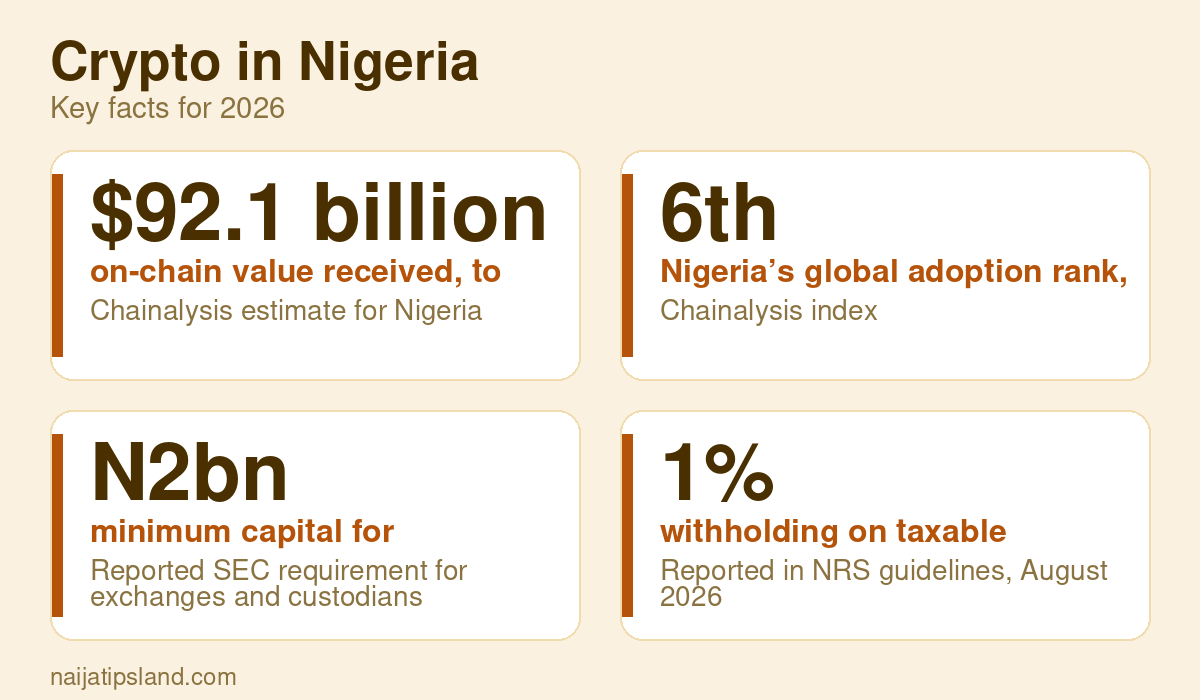
Imagine a notebook that everyone can read but nobody can secretly edit. Every transaction is written into the notebook, checked by many computers and then locked in. If you own crypto, what you hold is a private key, a long secret code that lets you move what the notebook says is yours. Lose the key and you lose access, and if someone else gets it, they can take your coins. That is why wallet security matters so much. Our guide to blockchain technology goes deeper.
The main types
- Bitcoin: the original, often compared to digital gold, and the most widely held.
- Ether: the coin of the Ethereum network, which supports apps and smart contracts.
- Stablecoins: tokens such as USDT and USDC that aim to track the dollar. Widely used in Nigeria for saving and sending money.
- Altcoins and memecoins: thousands of others, many of them extremely risky or worthless.
Why Nigerians use it
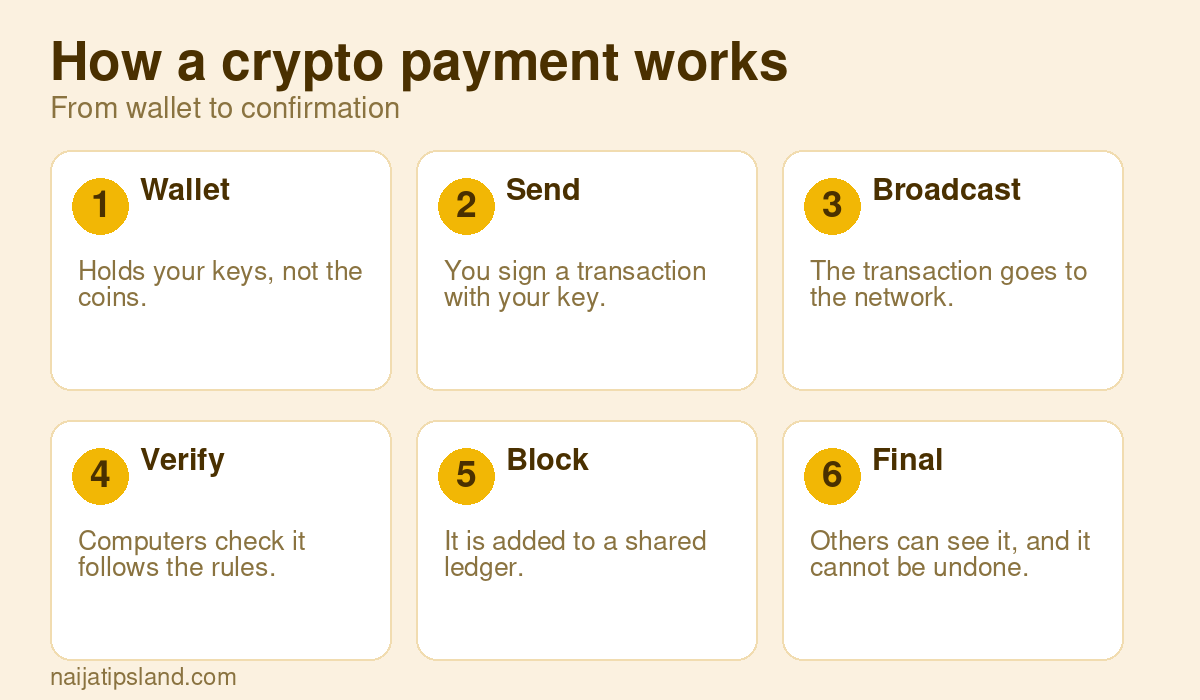
Nigeria is one of the world’s largest crypto markets. Chainalysis estimated about $92.1 billion in on-chain value received from July 2024 to June 2025, and ranked Nigeria sixth in its 2025 adoption index, down from second. Stablecoins are especially popular because people use them to protect savings from inflation and to move money across borders. Our guide on buying Bitcoin and USDT in Nigeria explains the practical steps.
The rules in 2026
Regulation: the Investments and Securities Act 2025 recognises digital assets as securities and puts exchanges and other service providers under the SEC. Operators must be registered, and reported capital requirements are ₦2 billion for exchanges and custodians, ₦1 billion for offering platforms and ₦500 million for intermediaries. The SEC has been admitting more operators to its regulatory incubation programme this year, and proposed new digital asset rules for 2026 that were still awaiting adoption when we checked.
Tax: from 1 January 2026, profits from selling crypto are chargeable gains under the Nigeria Tax Act 2025, not the old flat 10% capital gains tax. On 4 August 2026 the Nigeria Revenue Service issued guidelines requiring exchanges and peer-to-peer marketplaces to collect, report and remit tax. According to reports, they withhold 1% on taxable disposals, with stablecoin sales exempt from that withholding, and they report customers’ details including their tax IDs. Keep records of what you paid, when and for how much.
Scams and risks
Crypto is a favourite tool of fraudsters. CBEX, an unregistered platform that promised 100% returns in 30 days, collapsed in April 2025 with huge losses, and the SEC continues to warn about unregistered schemes on WhatsApp, Telegram, TikTok and other platforms. Common traps include fake investment platforms, giveaway scams, fake support agents, romance scams, impersonated exchanges and “staking” offers that promise daily income. Read our guides on internet scams and passive income.
Staying safe
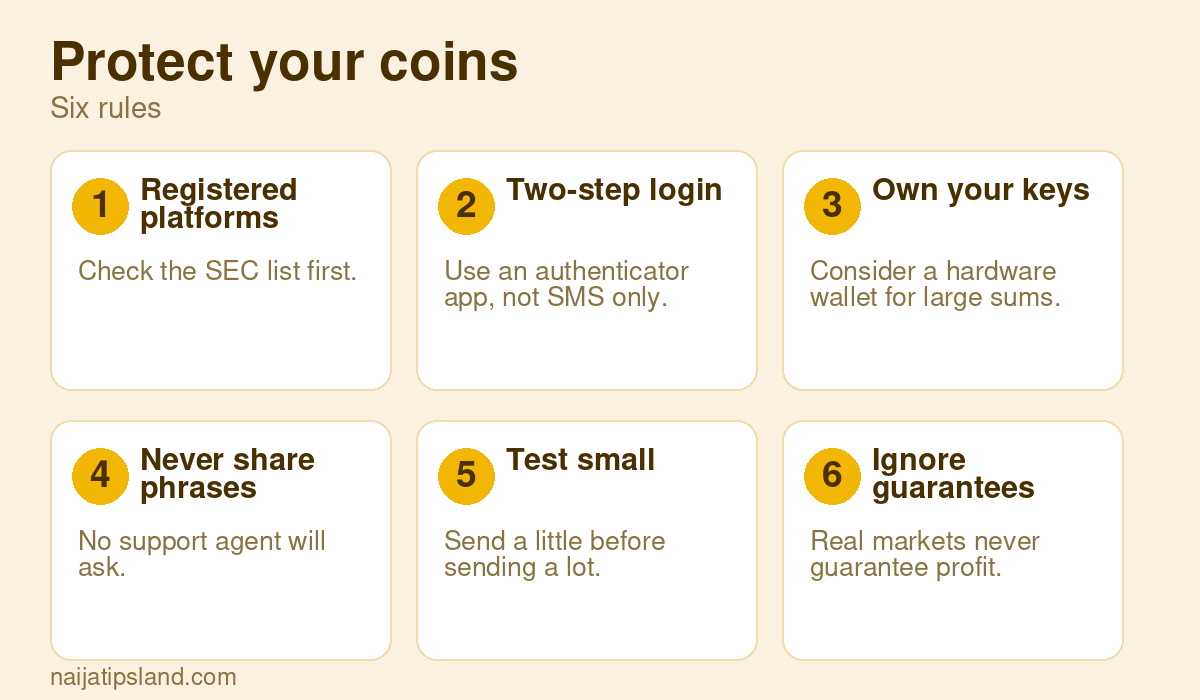
- Use only platforms registered with the SEC, and check the exact web address.
- Turn on two-step login and use a unique password.
- For larger holdings, learn about hardware wallets.
- Never share your recovery phrase, and never click links in unexpected messages.
- Be careful with peer-to-peer trades: confirm the payment arrived in your own account before you release crypto.
- Avoid leverage. See our report on leverage in Bitcoin futures.
What it means for the wider economy
Crypto sits alongside the CBN’s own digital naira, which has struggled, and fast bank transfers and fintech apps. Read what digital currency means and what fintech is for the full picture.
Beginner’s Checklist Before You Buy
- Decide why you want crypto: saving in dollars, sending money, long-term investing or curiosity. Each goal points to different choices.
- Set an amount you can afford to lose completely, and keep your emergency fund elsewhere. See our saving guide.
- Choose a platform registered with the SEC, and read its fees and withdrawal rules.
- Complete identity checks with your own details. Platforms now report to the tax authority.
- Buy a small amount first, and practise sending and receiving.
- Write down your recovery phrase offline, and store it safely.
- Record every trade for tax.
Words You Will Hear
- Wallet: software or a device that holds your private keys.
- Private key and recovery phrase: the secret that controls your coins.
- Exchange: a platform where you buy and sell crypto.
- Peer-to-peer (P2P): trading directly with another person through a marketplace.
- Gas or network fee: what you pay for a transaction to be processed.
- Stablecoin: a token designed to hold a steady value.
- Leverage: trading with borrowed money, which magnifies gains and losses.
The Costs Beginners Overlook
- The spread: the gap between the buying and selling price on a platform.
- Trading and withdrawal fees: small charges that add up if you trade often.
- Network fees: they change with congestion.
- P2P exchange rates: rates quoted by sellers can differ from the market rate, so compare before you trade.
- Tax: gains are taxable, and platforms withhold on some disposals.
How Nigeria’s Policy Changed
In February 2021 the CBN told banks to stop servicing crypto exchanges, which pushed trading towards peer-to-peer markets. That restriction was reversed in December 2023, when the CBN issued revised guidelines for banks dealing with virtual asset providers. The SEC issued its rules on digital assets in 2022, the Investments and Securities Act 2025 gave them a statutory base, and the 2026 tax rules complete the picture. In short, crypto moved from grey area to regulated activity in about five years.
Mistakes Beginners Make
- Buying because of a viral post or a friend’s profit.
- Putting in rent or school fee money.
- Using unregistered platforms that promise easy returns.
- Storing a screenshot of the recovery phrase in a phone gallery.
- Trading with leverage before understanding it.
- Forgetting that the tax authority can now see platform data.
Bitcoin, Ether and Stablecoins: What Each Is For
- Bitcoin is mainly held as a store of value and as a speculative asset. Its supply is limited by design, and it is the most widely traded coin.
- Ether powers the Ethereum network, where developers build apps and financial products. Its price depends on how much the network is used and on wider market mood.
- Stablecoins are used mostly to move and park value, not to grow it. Their risk is in the issuer and the platform, not in price swings.
What Moves Crypto Prices
Prices respond to supply and demand, news about regulation, big institutions buying or selling, interest rates and the mood of global markets, and leverage. When traders borrow heavily and the price turns, forced selling can make a fall much sharper, as our report on Bitcoin open interest and leverage explains. Nobody can predict these moves reliably, which is why advice that promises to do so should be treated with suspicion.
Long-Term Holding Versus Trading
Holding means buying and keeping through ups and downs, which suits people who can ignore the price. Trading means buying and selling often, which takes time, skill and nerve, and most beginners lose money at it once fees and taxes are counted. Whichever you choose, write down your reason for buying and your limit for losses before you start.
Frequently Asked Questions
Is crypto legal in Nigeria?
Yes, owning and trading are allowed, but platforms must be registered with the SEC and gains are taxable.
Is Bitcoin safe?
The network has operated for years, but the price is volatile and your own mistakes or scams are the biggest risks.
How do I know an exchange is legitimate?
Check the SEC’s registration database, read independent reviews and avoid anyone who guarantees returns.
What is the minimum I can start with?
Exchanges often allow small purchases, but start with an amount you can afford to lose and learn first.
Sources
- AllBusiness Africa: Crypto and stablecoins in Africa (Chainalysis data)
- Technext: Nigeria slips to 6th in Chainalysis 2025 index
- TechCabal: What the Investments and Securities Act means for Nigeria’s crypto ecosystem
- BusinessDay: The evolution of digital asset governance in Nigeria
- Cointelegraph: Nigeria sets crypto tax collection rules for digital asset platforms
- Afriwise (Aluko and Oyebode): Nigeria’s digital asset regulatory reset
- The Sun: SEC urges Nigerians to report illegal investment schemes after CBEX collapse