Last updated: 16 October 2026 · By Naijatipsland Editorial Team · Editorial policy
Nigeria’s new personal income tax rules took effect on 1 January 2026 under the Nigeria Tax Act 2025. The first N800,000 you earn a year is now tax-free, the old Consolidated Relief Allowance is gone, and the rates climb in bands from 15% to 25%. This guide sets out the bands, how PAYE (the tax your employer deducts) is worked out, and what employees at different salary levels can expect to pay.
The worked examples are our own calculations, with the assumptions stated. They are simplified, because pension and other deductions depend on your pay structure. One of the guides we checked listed bands that do not match the law, so we did not use it. This is general information, not tax advice. Confirm your figures with your employer’s payroll or your state tax office.
The short answer
- The Nigeria Tax Act 2025, signed in June 2025, took effect on 1 January 2026, according to Safeguard Global.
- The first N800,000 of annual taxable income is taxed at 0%, up from a previous exempt threshold of N300,000.
- The bands then rise: 15% up to N3 million, 18% up to N12 million, 21% up to N25 million, 23% up to N50 million and 25% above that. Each rate applies only to the slice of income inside its band.
- People earning the national minimum wage or less (N70,000 a month, or N840,000 a year) are exempt, per CountryTaxCalc.
- Rent relief: 20% of annual rent, capped at N500,000, if you can prove you paid it.
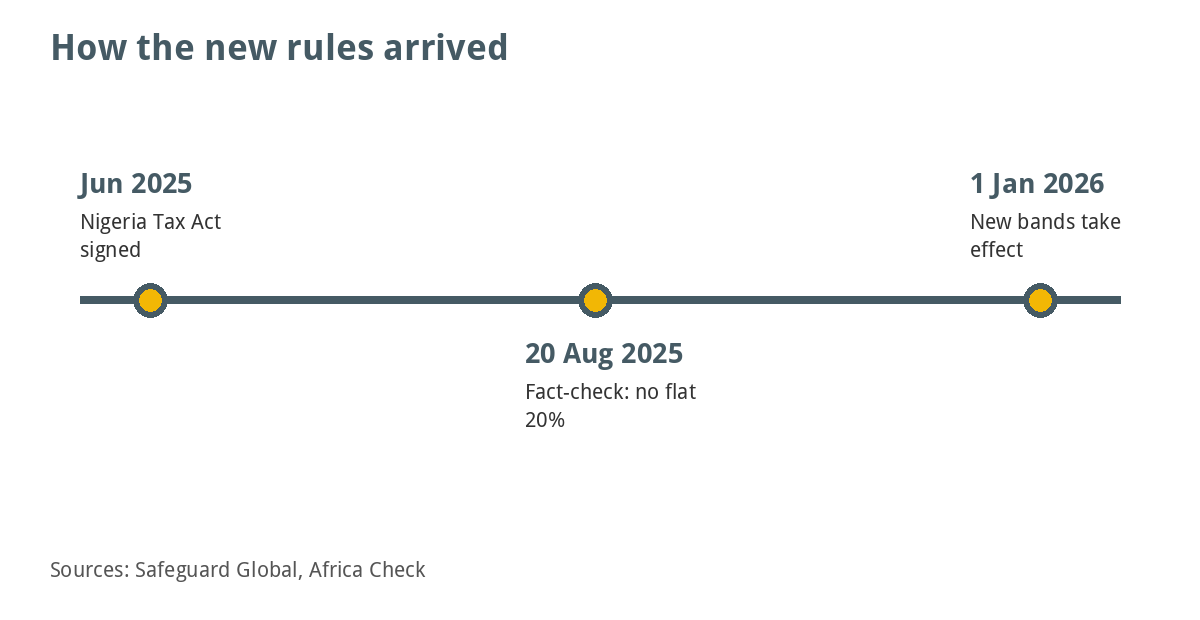
- It is not a flat 20% tax. Africa Check called that viral claim false.
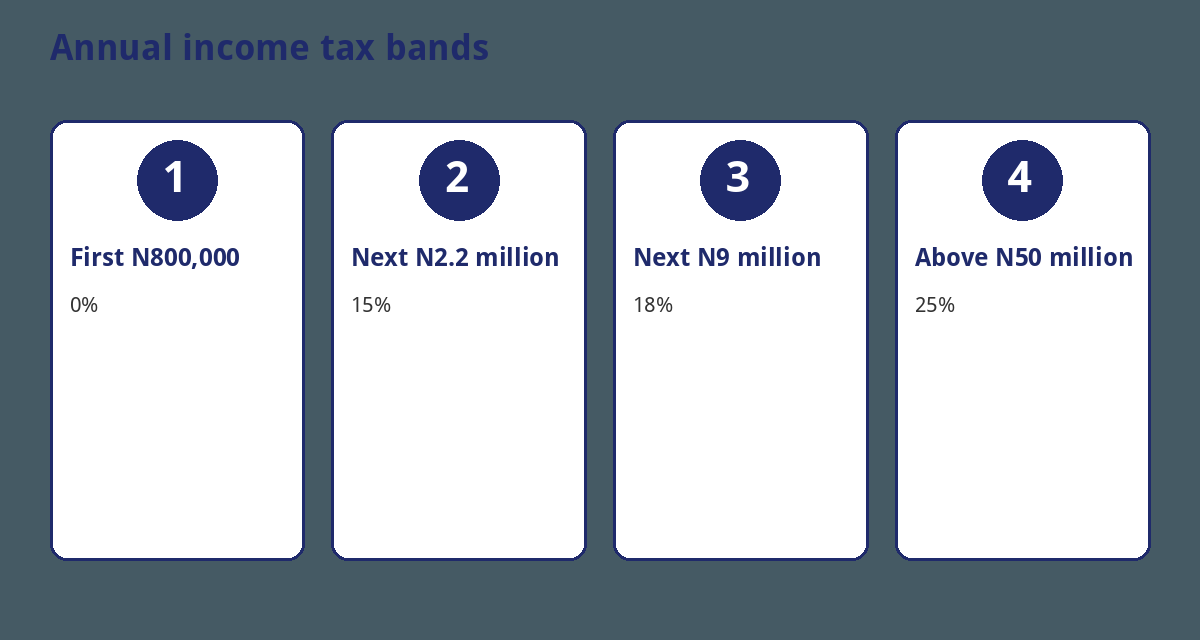
The 2026 tax bands
- First N800,000: 0%.
- Next N2.2 million (up to N3 million): 15%.
- Next N9 million (up to N12 million): 18%.
- Next N13 million (up to N25 million): 21%.
- Next N25 million (up to N50 million): 23%.
- Above N50 million: 25%.
These figures are the same in Safeguard Global, Africa Check, Zikoko and BusinessDay. Africa Check describes the 0% band as applying after rent relief, which is consistent with the deductions below.
What changed from the old system
- Higher tax-free amount: N800,000, up from N300,000.
- No Consolidated Relief Allowance (CRA): CountryTaxCalc says it was abolished from 1 January 2026 and replaced by rent relief that you must claim.
- Rent relief is not automatic. Employees give rent information to their employer, and the self-employed apply directly to the tax authority, per Forvis Mazars. Joint tenants can each claim up to N500,000 on the part of the rent they paid.
- Deductions for pension, National Housing Fund (NHF) and National Health Insurance Scheme (NHIS) contributions must be claimed with documents, according to Safeguard Global.
How PAYE is worked out
- Start with your gross annual pay: basic salary, housing, transport and other allowances.
- Deduct your pension contribution (8% for the employee, and employers pay at least 10%, per CountryTaxCalc), plus NHF (2.5% of basic salary), NHIS and rent relief where they apply.
- Apply the bands to what is left, which is your chargeable income.
- Your employer deducts one-twelfth of the annual tax each month and remits it to the state internal revenue service, or the federal authority for federal employees, by the 10th of the following month.
Worked examples (our calculations)
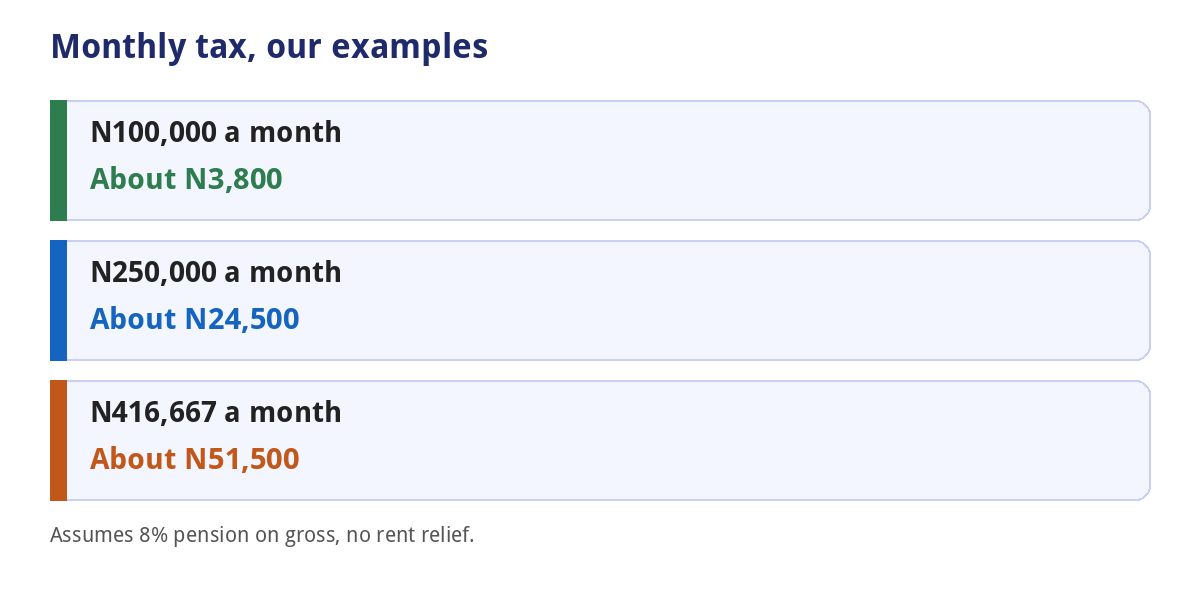
For simplicity we take pension as 8% of gross pay, we assume no NHF or NHIS, and we start without rent relief. Actual pension is calculated on basic salary, housing and transport, so yours may be lower.
- N100,000 a month (N1.2 million a year): pension N96,000, so taxable income is N1,104,000. Tax is 15% of the N304,000 above N800,000, which is N45,600 a year or about N3,800 a month.
- N250,000 a month (N3 million a year): pension N240,000, taxable income N2,760,000. Tax is 15% of N1,960,000, which is N294,000 a year or about N24,500 a month.
- N5 million a year (about N416,667 a month): pension N400,000, taxable income N4,600,000. Tax is 15% of N2.2 million (N330,000) plus 18% of N1.6 million (N288,000), a total of N618,000 a year or N51,500 a month. CountryTaxCalc shows the same N618,000 for this case.
Now add rent relief. If the person on N5 million pays N1,000,000 rent a year, 20% is N200,000, which is below the N500,000 cap. Taxable income falls to N4,400,000. Tax is N330,000 plus 18% of N1,400,000 (N252,000), a total of N582,000, which is N36,000 less a year.
A guide that gets the bands wrong
One online PAYE guide we read lists seven bands (0%, 7%, 11%, 15%, 19%, 21% and 24%), a flat N4,000 levy and a rent relief of N200,000. That does not match the Act as described by Safeguard Global, Africa Check, Zikoko, BusinessDay and Forvis Mazars, so we did not use it. If a calculator gives very different answers, check its bands against the list above.
Who has to file a return
BusinessDay says Nigerian tax residents with taxable income above N800,000 must pay tax, including freelancers, self-employed people, business owners and remote workers. Residency, not nationality, decides, and it can apply if you spend 183 days or more in Nigeria in 12 months. Salaried people usually pay through PAYE. Zikoko adds that employees must still file an annual return declaring all income, which is usually a confirmation step. Self-employed people file self-assessment returns with the state internal revenue service where they live, and every taxpayer needs a tax ID. Our guide to getting your Tax ID explains how your NIN now works as one.
- BusinessDay says remittances, gifts, loans and bank deposits are not treated as taxable income, and that bank interest on deposits is subject to 10% withholding tax. Our guide to treasury bills, fixed deposits and savings bonds covers how that affects returns.
- Freelancers, consultants and sole proprietors are taxed as individuals, because the N100 million turnover exemption applies only to registered companies, per Zikoko.
How to check your payslip
- Find your gross pay, your pension (8%) and your PAYE line.
- Multiply your PAYE by 12 and compare it with the bands above using your chargeable income.
- Give your employer a rent receipt or tenancy proof if you pay rent, so relief is added.
- Ask payroll to explain any big gap.
- Keep records, since employers must retain rent documents for audits by the Nigeria Revenue Service and state authorities.
Frequently asked questions
Do I pay tax if I earn N800,000 a year or less?
No. That band is taxed at 0%, and minimum wage earners are exempt.
Is it a flat 20% for everyone earning above N800,000?
No. Africa Check says the claim is false. Rates rise in bands from 15% to 25%.
Is rent relief automatic?
No. You must declare your rent and, per Zikoko, give a receipt to your employer.
What is the pension contribution?
CountryTaxCalc gives 8% for the employee and at least 10% for the employer.
Do freelancers pay personal income tax?
Yes, on income above the threshold, filed with their state internal revenue service.
Bottom line
Most low earners pay little or nothing, and a typical mid-range employee pays between about N3,800 and N51,500 a month in our examples. Claim your rent relief, check your payslip against the bands, and keep your records.
Sources
- Safeguard Global: Nigeria Tax Act 2025 goes into effect on 1 January 2026
- Africa Check: Nigerians earning N800,000 or more will not pay a flat 20% (August 2025)
- Forvis Mazars: Rent relief allowance under the 2025 Nigeria Tax Act
- Zikoko: New Nigerian tax laws 2026, what they mean for your wallet
- CountryTaxCalc: Nigeria PAYE guide 2026
- BusinessDay: Who is required to pay personal income tax in Nigeria under the 2026 reforms