
How to Save Money on a Low Salary in Nigeria (2026): A Practical Plan, Real Prices and Safe Places to Save

Last updated: 5 November 2026 · By Naijatipsland Editorial Team · Editorial policy
Saving money on a small salary in Nigeria is not about being perfect. It is about making a few unglamorous decisions early in the month, before rent, transport, data and family requests eat everything. Official figures show headline inflation easing to 14.63 percent in September 2026 (down from 15.39 percent in August), but food inflation was still 19.59 percent year on year, so most workers still feel squeezed. This guide gives you a practical, step-by-step system to save on a low income, with current 2026 numbers and honest warnings about where savings apps and “high-yield” offers can go wrong.
How to read the figures: prices, rates and examples below come from dated reports and provider pages (mostly June to October 2026). Rates and prices change often, so treat them as guides and check live before you commit money. The budget example is an illustration, not financial advice, and I am not a licensed financial adviser.
Why saving feels impossible right now (and why it still works)
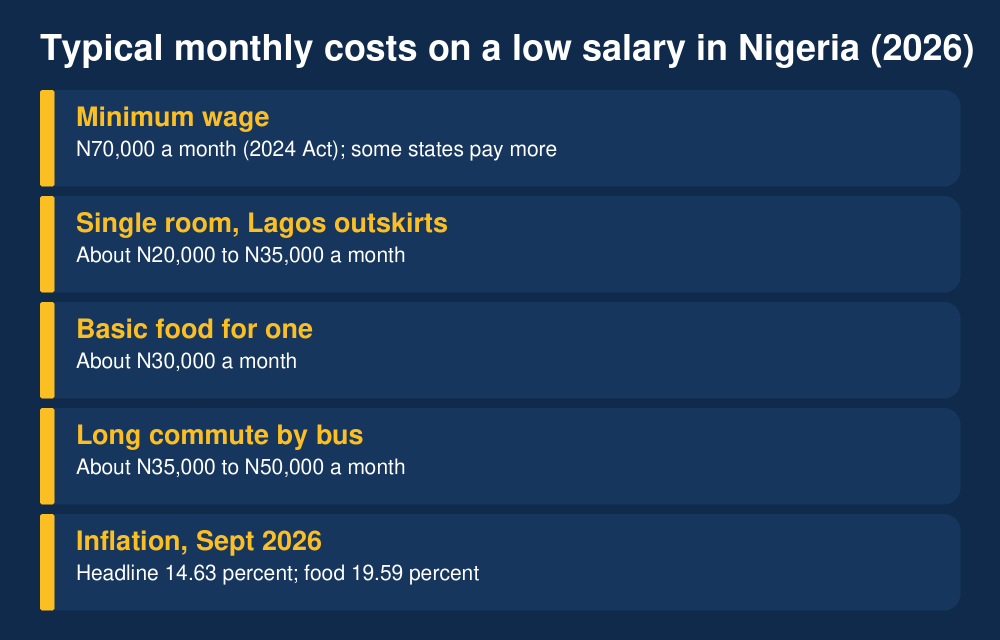
The statutory national minimum wage is N70,000 a month, set by the National Minimum Wage Amendment Act 2024, and some states pay more. Guides to the 2026 pay structure describe a single room in areas such as Ikorodu or Ojota at roughly N20,000 to N35,000 a month, basic food for one person at about N30,000, and a monthly bus budget of N35,000 to N50,000 for a long commute. Add data, electricity and family support and a N70,000 salary disappears on paper before the month begins.
That is exactly why saving needs to be automatic and small. Even N3,000 a week becomes N156,000 in a year, before any interest. The goal is not a perfect budget; it is a habit that survives a bad month.
Step 1: Know exactly where your money goes
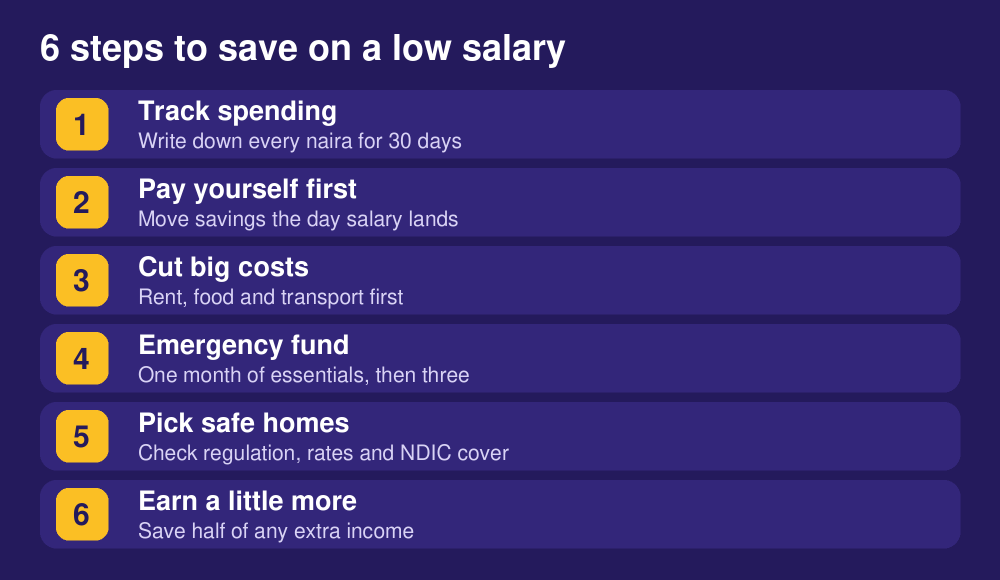
For the next 30 days, write down every naira you spend, even the N200 for pure water. Use a notebook, a notes app or your bank app’s spending view. Most people find three or four leaks: transfers fees, daily takeaway lunches, airtime and data bundles that are bigger than needed, and small “help” transfers they did not plan for. You cannot cut what you cannot see.
Step 2: Pay yourself first, even if it is tiny
The classic mistake is saving what is left. In Nigeria, nothing is ever left. Instead, move a fixed amount the day your salary lands. Start with 5 percent if 10 or 20 percent feels impossible. On N100,000 that is just N5,000, and you can raise it by one percentage point every month as you adjust.
A simple illustrative split for a N100,000 take-home salary is below. Change the numbers to fit your life; the principle is the order, with savings coming second only to rent.
- Rent and utilities: about N30,000 to N35,000
- Food and household: about N25,000 to N30,000
- Transport: about N10,000 to N15,000
- Savings and emergency fund: N10,000 (10 percent)
- Data, phone and personal: about N5,000 to N8,000
- Family support and buffer: the remainder, decided in advance
Step 3: Cut the three big costs first
Housing
Rent is the biggest lever. If you can, share a flat, move a little further out where rents are lower, or negotiate paying quarterly instead of annually only if it does not carry a premium. Our guide to the cheapest states to live in Nigeria in 2026 shows how much living costs vary by location, which matters if your job is remote or flexible.
Food
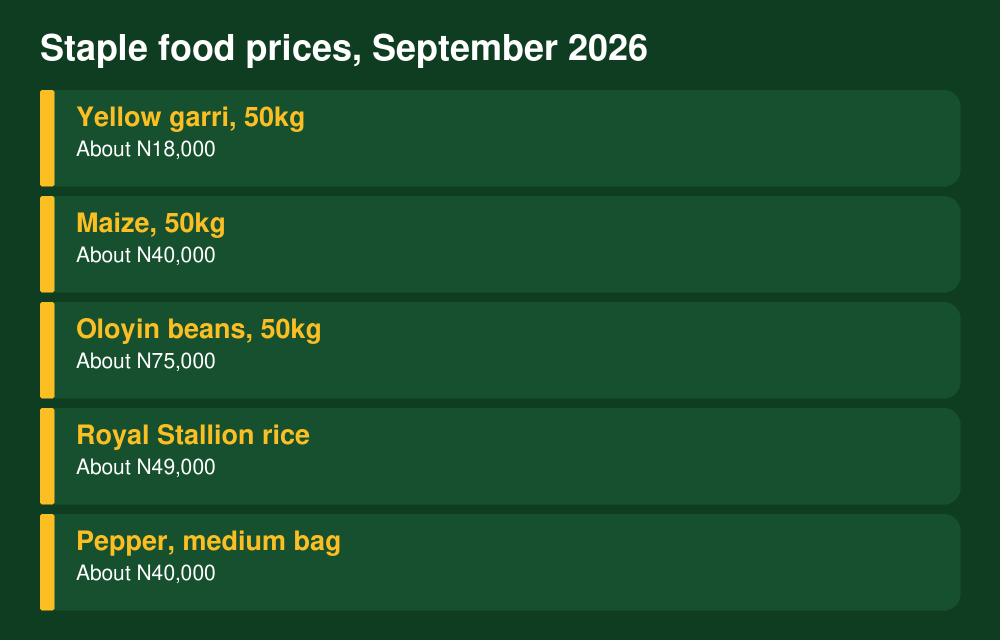
Food is where smart buying pays. In September 2026, a Lagos market survey and price trackers reported a 50kg bag of yellow garri around N18,000, a 50kg bag of white or yellow maize around N40,000, a 50kg bag of Oloyin beans around N75,000, and short-grain rice such as Royal Stallion around N49,000. These had all dipped from August, but prices swing. Buying staples in bulk with colleagues or neighbours, shopping at open markets rather than convenience stores, and planning meals around cheaper protein can cut your food bill noticeably.
Transport
If your commute costs N800 to N1,200 each way, that is a big chunk of salary. Compare routes, use shared rides, look at living near work, and ask whether you can work from home one or two days a week.
Step 4: Build a small emergency fund before anything else
Your first target is one month of essential costs, then three. Keep it somewhere you can reach within a day but where you will not spend it casually: a separate account or a flexible savings plan. This fund stops a medical bill or rent shortfall from forcing you into a high-interest loan.
Step 5: Choose where to keep your savings
Ordinary bank savings accounts pay very little. A June 2026 review of savings accounts put rates for big banks around 1.25 to 1.75 percent a year, and neobank savings at roughly 2 to 5 percent, with locked fixed plans higher. Savings and investment apps advertise much more, for example up to 16 percent on locked plans and up to 10 percent on flexible plans at PiggyVest, and 12 to 16 percent on some Cowrywise naira plans. Treat these as indicative: the rates move, and the review itself warns they may be out of date.
Government securities are another route. At the 14 October 2026 Nigerian treasury bills auction the 364-day stop rate rose five basis points to 15.90 percent, after 15.85 percent at the 7 October auction (91-day bills were 15.50 percent). Through a bank or app you can often buy with a small minimum, though you should confirm the minimum, fees and withdrawal rules first.
- Tax: a 10 percent withholding tax is typically deducted from interest on savings accounts, fixed deposits and treasury bills, so a 16 percent gross rate is closer to 14.4 percent in your pocket.
- Deposit insurance: the Nigeria Deposit Insurance Corporation covers up to N5 million per depositor at a deposit money bank and N2 million at a microfinance bank. Savings apps that are investment products are generally not covered by NDIC deposit insurance, so check what actually holds your money.
- Beware of guarantees: any scheme promising fixed, very high monthly returns is a red flag. Check that the provider is regulated by the CBN or SEC.
For a deeper comparison, read our guide to the best savings apps in Nigeria, and our Personal Finance in Nigeria hub for tax, investing and avoiding scams.
Step 6: Earn a little more without burning out
On a low salary, a second small income beats endless cutting. Options include a skill-based side hustle, freelancing, or a tiny home business. See our guides to side hustles in Nigeria for civil servants, profitable businesses you can start from home and the Make Money Online in Nigeria hub. Put at least half of any extra income straight into savings before it becomes part of your lifestyle.
Common mistakes to avoid
- Keeping everything in your spending account. Money you can see gets spent.
- Chasing the highest rate blindly. A slightly lower rate at a regulated, accessible provider beats a high rate you cannot withdraw.
- Joining informal “double your money” schemes. If it sounds too good, it is usually a Ponzi.
- Ignoring small debts. Loan-app interest can wipe out your savings gains. Clear the most expensive debt first.
- Giving up after one bad month. Restart with a smaller amount rather than stopping.
Frequently asked questions
How much should I save from a N70,000 salary?
Start with whatever you can keep consistent, even 5 percent (N3,500). Raise it gradually as you cut costs or earn extra. A habit matters more than the amount at first.
Is it better to save in naira or dollars?
Naira savings earn higher nominal interest, but a weaker naira can erode value. Many people hold mostly naira for near-term bills and consider a small dollar allocation for long-term goals. Check the fees and rules of any dollar product.
Are savings apps like PiggyVest safe?
They are regulated investment and savings platforms, not banks, and their products are generally not covered by NDIC deposit insurance. Use reputable, licensed providers and do not put in money you cannot afford to have tied up.
What is the safest way to save in Nigeria?
A savings account at a licensed bank is covered by NDIC up to the stated limits. Government treasury bills are widely seen as low risk, though returns and lock-ins vary.
How can I save when my family keeps asking for money?
Decide a monthly support amount in advance and treat it as a fixed bill. It is easier to say “my budget for this month is done” than to refuse each request on the spot.
Should I invest or build an emergency fund first?
Build a basic emergency fund first. Investing with no cushion often leads to selling at the wrong time.
Disclaimer: this article is general information, not personal financial advice. Rates, prices and regulations change; verify with your bank, app or the CBN, SEC and NDIC before acting.
Join the discussion
Have you tried this, or do you have a question we did not answer? 2 readers have already shared their views. Naijatipsland members help each other with real, first-hand experience.








Ade here. This guide is built around one idea: save first, even if it is only a few thousand naira, because waiting for money to be left over never works. If you have a budgeting trick that has worked for you on a small salary, share it below. Remember that rates and prices quoted here were checked in October 2026 and can change, so confirm with your bank or app before you move money. – Ade Adeniyi
Ade here. This guide is built around one idea: save first, even if it is only a few thousand naira, because waiting for money to be left over never works. If you have a budgeting trick that has worked for you on a small salary, share it below and I will add the best ones to the article. Remember that rates and prices quoted here were checked in October 2026 and can change, so confirm with your bank or app before you move money. – Ade Adeniyi