Last updated: 16 October 2026 · By Naijatipsland Editorial Team · Editorial policy
If you have spare naira and want it to earn interest, three safe-sounding options come up again and again in Nigeria: Treasury bills, bank fixed deposits and FGN savings bonds. They look similar but differ in how they pay, how long your money is locked, who guarantees it and how the interest is taxed. This guide compares them using the rates reported in October 2026, with worked examples.
Rates change at every auction and offer, tax treatment has been in flux, and some sources conflict, so we flag where. This is general information, not financial advice. Check current rates and terms with your bank, broker or the Debt Management Office (DMO) before you invest.
The short answer
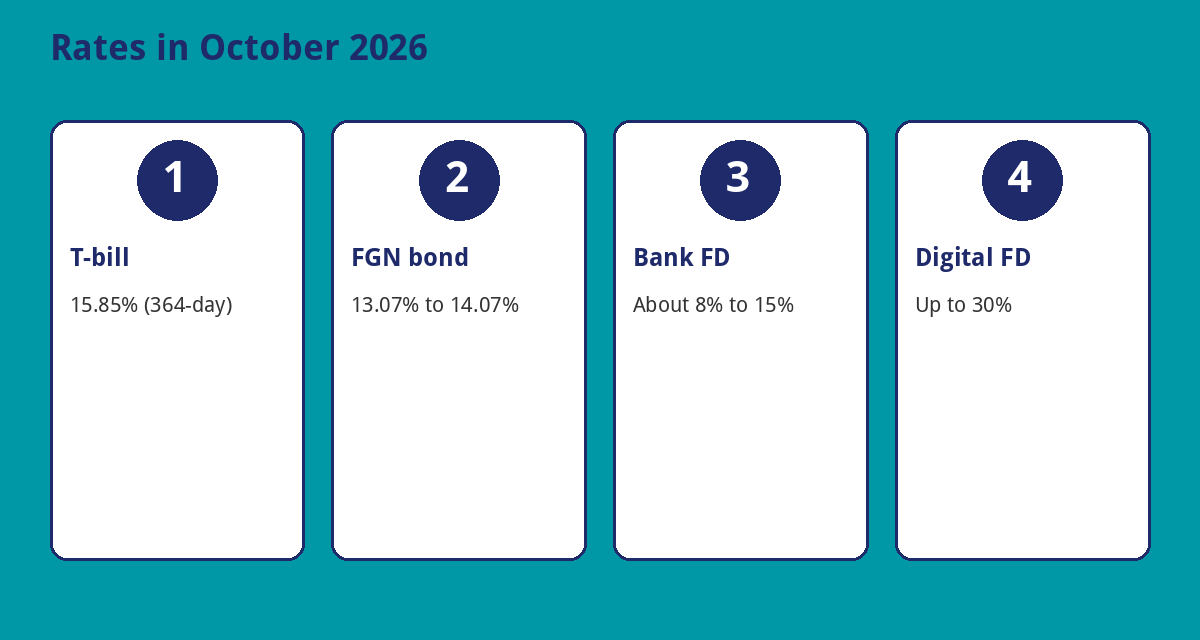
- Treasury bills (T-bills) are short-term government bills of 91, 182 or 364 days. At the 7 October 2026 auction, the 364-day bill cleared at 15.85%, the 182-day at 15.80% and the 91-day at 15.50%, according to Nairametrics.
- FGN savings bonds run for two or three years and pay interest every quarter. The October 2026 offer paid 13.071% (2-year) and 14.071% (3-year), with a minimum of N5,000.
- Bank fixed deposits are indicated at roughly 8% to 15% at big commercial banks, and 15% to 23% at some merchant banks, in a June 2026 report. Digital platforms advertise up to 30% with different risks.
- Falling government yields: the 364-day T-bill rate has dropped from 17.70% in July to 15.85% in October.
- For comparison, inflation was reported at 15.69% in April 2026, so a rate below that may not protect the buying power of your money.
Treasury bills
T-bills are issued by the Central Bank of Nigeria on behalf of the federal government. You buy them at a discount and receive the full face value at maturity. The auction rate (the stop rate) is a discount rate, so your real return is higher than the headline number. Kobo Terminal gives an example: at 15.85%, N100,000 of 364-day bills costs about N84,200, a true yield of roughly 19%. We checked this: N100,000 x (1 – 0.1585 x 364/365) is about N84,190, and the gain of N15,810 on that price works out to about 18.8%.
- How to buy: through a bank or licensed dealer, a stockbroker, or a money market fund that holds T-bills. Direct retail purchases through most banks typically start around N100,000, and funds can start from a few thousand naira.
- Liquidity: you can sell before maturity on the secondary market at the prevailing price, which may be lower if yields have risen.
- Risk: government-backed, with interest-rate and reinvestment risk. Demand is high: the 7 October auction drew about N1.77 trillion in subscriptions against a N900 billion offer.
FGN savings bonds
The DMO sells these to individuals every month. The October 2026 offer opened on 5 October, closed on 9 October and settled on 14 October. The 2-year bond (due 14 October 2028) paid 13.071% a year and the 3-year bond (due 14 October 2029) paid 14.071%, down from 15.12% on the 3-year in September, according to Nairametrics. Coupons are paid quarterly on 14 January, 14 April, 14 July and 14 October. The minimum is N5,000 in multiples of N1,000, up to N50 million.
Bonds suit people who want regular income and can leave the money for two or three years. Selling early depends on finding a buyer, so they are less flexible than T-bills.
Bank fixed deposits
You lock a sum with a bank for 30 days to a year or more. A June 2026 Withinnigeria report put tier-one commercial banks (Zenith, GTBank, Access, UBA, Fidelity) at roughly 8% to 15% with typical minimums of N50,000 to N500,000, merchant banks at 15% to 23%, and Providus at about 23.66%. nairaCompare lists indicative commercial bank rates of 7% to 14% and says rates are indicative and should be verified.
- Penalties: most banks allow early withdrawal but may take part or all of the accrued interest. Some do not allow it at all.
- Safety: the Nigeria Deposit Insurance Corporation (NDIC) covers up to N5 million per depositor at commercial banks and N2 million at microfinance banks, since May 2024. Digital platforms and asset managers may not carry the same cover, so ask.
- Higher advertised rates: CredPal (up to 30%) and Rank Capital (about 27%) are not traditional bank deposits. A higher rate usually comes with a different risk, so read the terms.
How the interest is taxed
This is the part that changed recently, and the sources do not all agree:
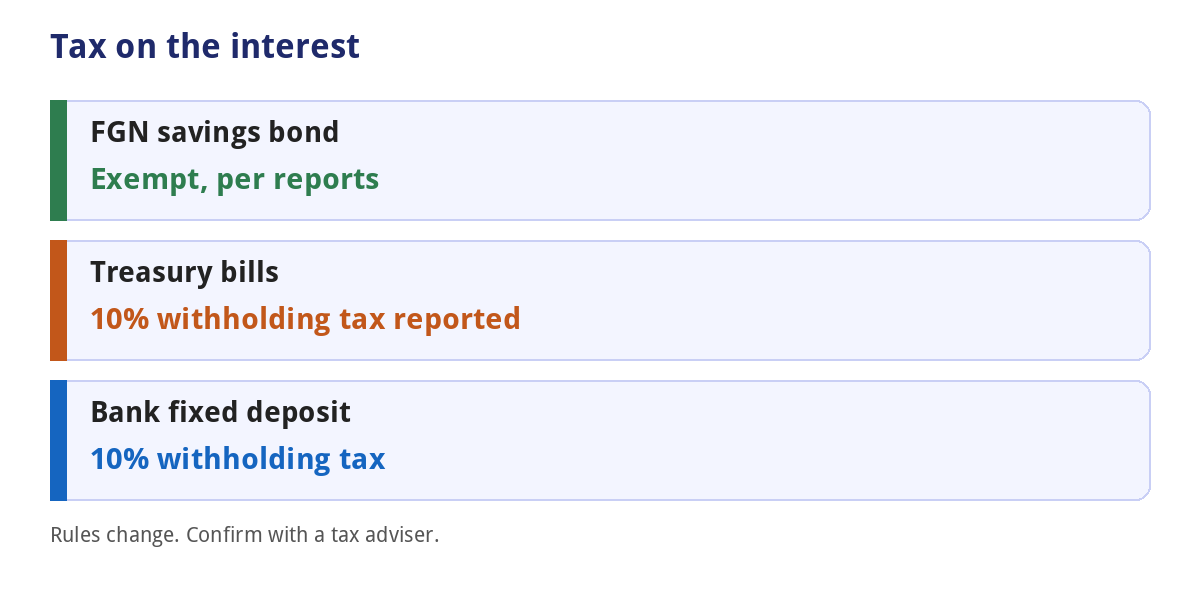
- FGN bonds: reported as exempt from withholding tax by BusinessDay (January 2026), and KPMG’s summary of a FIRS notice (December 2025) says interest on federal government bonds remains exempt.
- T-bills: BusinessDay says a 10% withholding tax now covers short-term government securities. KPMG says the FIRS notice lists them among instruments that may be covered but does not confirm it. An older guide says T-bill interest is exempt, so confirm the current rule.
- Bank fixed deposits: a 10% withholding tax is deducted at source, per nairaCompare.
BusinessDay’s example: an 18% T-bill yield taxed at 10% leaves 16.2%, and 15% leaves 13.5%. The lower the yield, the more the tax matters in relative terms.
Worked examples on N1,000,000
These are our calculations from the reported rates, not guarantees:
- 364-day T-bill at 15.85%: you pay about N841,900 and receive N1,000,000 at maturity, a gain of about N158,100. If a 10% withholding tax applies to that gain, you keep about N142,300.
- 3-year FGN bond at 14.071%: interest of about N140,710 a year, paid in four instalments of about N35,178, with the principal back after three years.
- Bank fixed deposit at 10% for a year (illustrative rate): N100,000 interest, N90,000 after a 10% withholding tax.

Side-by-side
- Best for flexibility: T-bills or a money market fund, since bills can be sold early.
- Best for regular income: FGN savings bonds, which pay every quarter.
- Best for a fixed deadline: a fixed deposit that matures when you need the money, if the bank’s early-exit terms are clear.
- Best for small amounts: FGN bonds from N5,000, or a money market fund.
- Most important check: whether the rate you see is the discount rate, a true yield, or after tax.
Things to watch
- Rates are falling, so locking a longer tenor now may help if you expect them to keep dropping, but you cannot know.
- Compare the rate to inflation, which was 15.69% in April 2026 per Withinnigeria.
- Do not put money with a platform you cannot verify. Check that it is licensed and what insurance applies.
- Keep an emergency fund in an account you can reach fast. If your debit card is stolen, see our guide on blocking your card or account, and note that transfers carry small charges, covered in our guide to bank transfer charges.
Frequently asked questions
Which pays more, a T-bill or a fixed deposit?
At the October 2026 auction the 364-day T-bill cleared at 15.85%, which is above what the big commercial banks were reported to pay on fixed deposits. Merchant banks and digital platforms can advertise more.
What is the minimum for an FGN savings bond?
N5,000, in multiples of N1,000, and up to N50 million, in the October 2026 offer.
Are T-bills tax free?
Older guides say yes, but BusinessDay reported in January 2026 that a 10% withholding tax now covers short-term government securities. Confirm with your broker or a tax adviser.
Is my fixed deposit insured?
At commercial banks, up to N5 million per depositor by the NDIC. Check non-bank platforms separately.
Can I sell a savings bond early?
Only if you can find a buyer, so treat it as a two or three year commitment.
Bottom line
Government instruments currently pay about the same as or more than big-bank fixed deposits, but rates have been falling for months. Match the product to when you need the money, check the after-tax return, and confirm current rates before you commit.
Sources
- Nairametrics: DMO raises N968.47 billion as 364-day stop rate falls to 15.85% (7 October 2026)
- Nairametrics: FGN Savings Bond rates fall to 13.07%, 14.07% as October offer opens
- Kobo Terminal: Nigerian Treasury Bills rates today and how to buy
- BusinessDay: Falling yields amplify impact of 10% withholding tax
- KPMG: Nigeria guidance on withholding tax on interest from short-term securities
- Withinnigeria: Best fixed deposit rates in Nigeria 2026
- nairaCompare: Best fixed deposit accounts in Nigeria
- Techeconomy: NDIC raises bank deposit insurance coverage to N5m
Related: best savings apps in Nigeria.
Related: how to check if a loan app is approved and report harassment.