
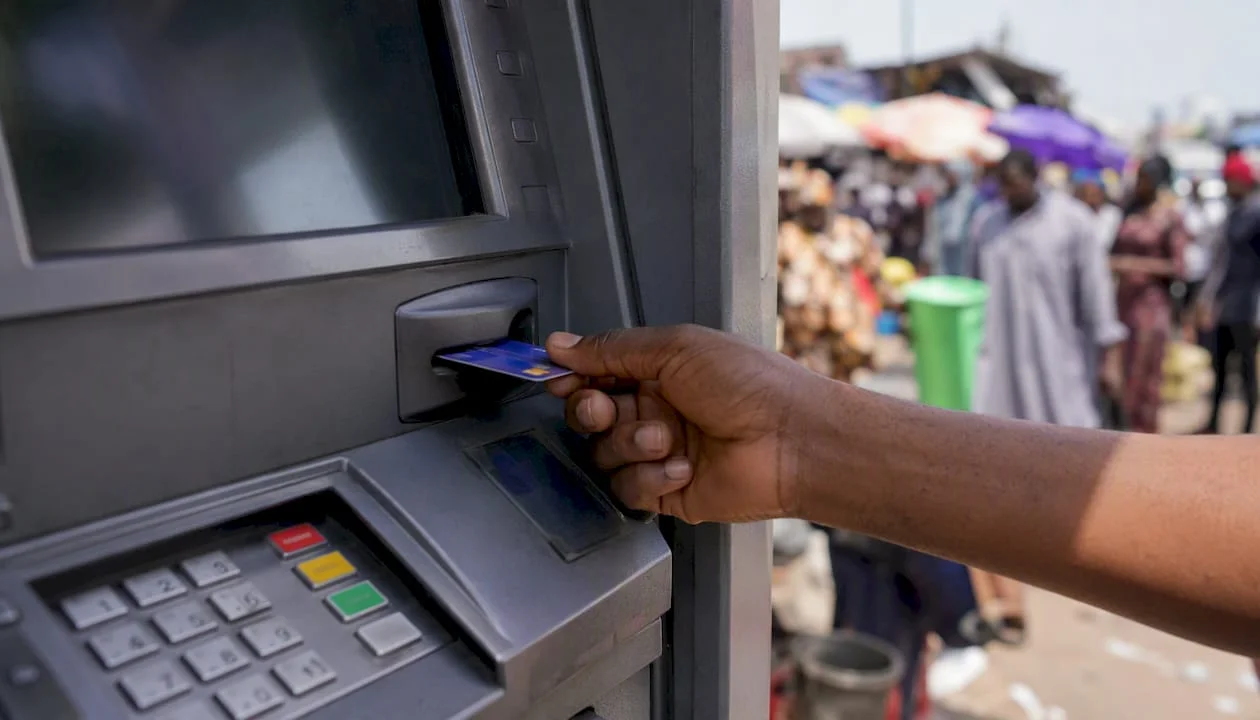
Nigeria’s cashless policy is a Central Bank of Nigeria (CBN) directive that discourages high-volume cash transactions by imposing a cash-handling charge on daily cumulative withdrawals above a stated free limit: currently ₦500,000 per day for individuals and ₦3,000,000 per day for corporate accounts, as documented on the CBN’s Cash-less Nigeria page. The policy does not ban cash. It makes carrying and withdrawing large amounts of cash more expensive, nudging consumers and businesses toward electronic channels.
Three things to understand immediately:
- Who pays the charge: The account holder bears the cash-handling fee whenever their daily cumulative withdrawals exceed the free threshold.
- What channels count: Over-the-counter withdrawals, ATM transactions, third-party cheque encashment, and cash-in-transit (CIT) services all count toward the daily cumulative total.
- What “cumulative” means in practice: Every naira you withdraw across all channels in a single day adds up. Hit ₦500,000 across three ATM visits and one counter withdrawal, and the excess attracts a charge.
Key Takeaways
Nigeria’s cashless policy imposes a cash-handling charge on daily cumulative withdrawals above ₦500,000 for individuals and ₦3,000,000 for corporates, covering all channels, with electronic payments the practical way to avoid those charges.
| Point | Details |
|---|---|
| Daily free limits | Individuals: ₦500,000; corporates: ₦3,000,000 cumulative across all channels per day. |
| Electronic channels avoid charges | Transfers, POS payments, and mobile money do not count as cash withdrawals under the policy. |
| MDA cash ban from January 2026 | Federal government offices must use POS or electronic receipts; physical cash payments are prohibited. |
| Open Banking expands options | CBN’s Open Banking framework allows customer-permissioned data sharing to improve credit access and payment products. |
| Official guidance | Consult the CBN’s Cash-less Nigeria page and NDIC’s MMO list for current thresholds, rates, and licensed operators. |
Stay current on Nigeria’s cashless policy and related current affairs topics impacting Nigeria through Naijatipsland’s ongoing coverage.
Table of Contents
- What does Nigeria’s cashless policy actually require?
- Why did the Central Bank introduce the cashless policy?
- How was the cashless policy rolled out across Nigeria?
- Which payment channels and operators power the cashless shift?
- What benefits were promised, and what has actually changed?
- What are the main challenges slowing the cashless transition?
- How do Open Banking and new regulations change the payment environment?
- How should individuals, SMEs, and corporates adapt to the cashless rules?
- Where the cashless policy has helped and where more work is needed
- Primary sources and further reading
- Sources
What does Nigeria’s cashless policy actually require?
The policy sets a daily free withdrawal threshold, then applies a percentage charge on any amount above it. The CBN’s official guidance confirms the thresholds and the cumulative calculation method.
How the charge is calculated: If you are an individual and you withdraw ₦700,000 in a single day across any combination of channels, the charge applies to the ₦200,000 excess above your ₦500,000 free limit. The charge rate is set by the CBN and can be updated by circular; always verify the current rate directly with your bank or on the CBN cashless guidance page.
Channels covered by the cumulative rule:
- Over-the-counter (OTC) cash withdrawals at bank branches
- ATM withdrawals
- Third-party cheque encashment
- Cash-in-transit (CIT) services
A short example: An SME owner withdraws ₦1,500,000 at the counter and ₦800,000 via a CIT company in the same day. Total: ₦2,300,000. The corporate free limit is ₦3,000,000, so no charge applies that day. The next day, a ₦3,200,000 OTC withdrawal alone would attract a charge on the ₦200,000 excess.
Exemptions from the charge:
- Government revenue accounts
- Primary Mortgage Institutions (PMIs)
- Microfinance Banks (MFBs)
- Embassies and diplomatic missions
| Account type | Daily free limit | Channels covered | Charge treatment | Key exceptions |
|---|---|---|---|---|
| Individual | ₦500,000 | OTC, ATM, cheque, CIT | Applied to excess above limit | Exempt account categories listed above |
| Corporate | ₦3,000,000 | OTC, ATM, cheque, CIT | Applied to excess above limit | Government revenue accounts, PMIs, MFBs |
Why did the Central Bank introduce the cashless policy?
The CBN launched the cashless policy with a set of interconnected goals, all tied to modernizing Nigeria’s payment system and reducing the economic drag of a cash-heavy economy.
Official policy objectives:
- Reduce the volume of physical cash in circulation
- Lower cash-related crime, including robbery and counterfeiting
- Cut the high cost of cash management for banks and businesses
- Increase the adoption of electronic payment channels
- Improve financial inclusion by drawing unbanked Nigerians into formal payment systems
- Reduce revenue leakage and improve tax collection for government
The practical benefits flow in three directions. For consumers, the shift to e-payments means faster transactions, a digital record of spending, and access to credit products that require transaction history. For businesses, electronic settlements reduce cash-handling costs, shrink shrinkage risk, and open access to working capital. For government, e-collection at revenue points reduces leakage and improves fiscal transparency.
The Better Than Cash Alliance’s summary of Nigeria’s cashless policy frames these objectives within a broader global push toward digital payments, noting that the policy was designed to reduce physical cash rather than eliminate it entirely.
How was the cashless policy rolled out across Nigeria?
The CBN used a phased approach, starting with a controlled pilot before expanding nationally. That sequencing was deliberate: it gave regulators time to observe infrastructure performance and gave banks time to scale their electronic channels.
Key implementation dates:
- January 2012: Lagos pilot launched. Cash-handling charges took effect for Lagos-based accounts, making it the first state to operate under the new rules.
- July 2013: The pilot expanded to five additional states: Anambra, Ogun, Kano, Abia, and Rivers, plus the Federal Capital Territory (Abuja).
- Subsequent phases: The CBN progressively extended the policy nationwide, with full national coverage following the phased state rollouts.
The phased rollout reflected a recognition that Lagos, as Nigeria’s commercial hub, had the densest banking infrastructure and the highest volume of electronic transactions. Rolling out there first generated real-world data before the policy reached states with thinner agent and ATM coverage.
The most recent enforcement escalation came in November 2025, when the Federal Government issued a circular banning physical cash payments to Ministries, Departments, and Agencies (MDAs). The directive ordered POS terminal installation at all Federal revenue points within 45 days and required the Treasury to begin issuing electronic receipts from January 1, 2026. This marks a significant tightening: what was once a deterrent charge on excess cash is now an outright prohibition at government revenue points.
Which payment channels and operators power the cashless shift?
The cashless economy in Nigeria runs on a network of channels and licensed operators. Understanding each one helps you choose the right tool for your situation.
Payment channels and what to expect:
- ATMs: Widely available in urban areas; useful for withdrawals within your daily free limit. Downtime and network failures remain a known issue, particularly outside major cities.
- Point-of-Sale (POS) terminals: Deployed at retail outlets and agent banking points. POS transactions count as electronic payments and do not trigger cash-handling charges.
- Mobile money: Allows transfers, bill payments, and cash-in/cash-out via a mobile phone. Particularly useful for Nigerians without a traditional bank account.
- Agent banking: Bank agents operate in markets, neighborhoods, and rural areas, providing cash-in, cash-out, and transfer services. The agent network is critical for financial inclusion.
- Cash-in-transit (CIT) companies: Licensed firms that collect, transport, and process large cash volumes for businesses. Only CBN/licensed CIT firms can legally provide this service; using an unlicensed operator exposes your business to regulatory sanction.
Mobile money operators (MMOs) recognized by regulators:
The NDIC’s list of mobile money operators identifies both bank-led and non-bank-led MMOs operating in Nigeria. Representative names on that list include Abeg, Cellulant, Chams, E-tranzact, Fortis, and Nomba. These are examples of licensed operators, not endorsements. Always confirm an operator’s current license status with the NDIC or CBN before transacting.
Pro Tip: Before using any mobile money agent, verify their license status on the NDIC or CBN website. A licensed agent gives you recourse if a transaction fails; an unlicensed one does not.
The Nigeria Inter-Bank Settlement System (NIBSS) sits at the center of this infrastructure, processing interbank transfers and e-payment settlements. NIBSS transaction data is the primary measure of how much the cashless economy has grown, and its volume figures are regularly cited by the CBN and industry analysts as evidence of adoption progress.
What benefits were promised, and what has actually changed?
The CBN and international observers projected significant gains from the cashless policy. The evidence shows real progress in some areas and persistent gaps in others.
Promised benefits:
- Reduced cost of cash management for banks and businesses
- Lower incidence of cash-related crime
- Faster access to credit through digital transaction histories
- Improved government revenue collection
- Broader financial inclusion for unbanked Nigerians
Measured effects:
NIBSS data has consistently shown growth in electronic payment volumes since the policy’s launch, reflecting increased use of transfers, POS, and mobile channels. Nigeria’s digital economy has grown at a notable pace, with mobile money agent networks expanding significantly in urban and peri-urban areas.
The Better Than Cash Alliance notes that the policy’s design successfully reduced physical cash as a share of transactions in formal channels, particularly in Lagos and other major cities.
Academic appraisal offers a more measured verdict. A peer-reviewed study covering the period 2012–2024, published in the CONCRESCENCE Journal of Multi-Disciplinary Research, found that while e-payment adoption increased, the policy also created social strain for populations without reliable access to electronic channels. The study concluded that measurable gains in financial inclusion were real but unevenly distributed, with rural and low-income Nigerians bearing a disproportionate share of the adjustment costs.
On crime reduction, the evidence is mixed. Cash-related robbery at banks declined in areas with strong e-payment adoption, but the shift also created new fraud vectors in mobile and online channels.
What are the main challenges slowing the cashless transition?
The cashless policy has faced persistent implementation problems that affect ordinary Nigerians every day. Understanding them helps you plan around them rather than be caught off guard.
Major challenges:
- Infrastructure deficits: Network connectivity failures, ATM downtime, and POS terminal outages are common, particularly outside Lagos and Abuja. A failed transaction at a POS terminal can leave a customer without cash or a completed payment.
- Limited agent coverage in rural areas: Agent banking networks are concentrated in urban centers. Rural Nigerians often travel significant distances to reach a functioning agent or ATM.
- Public misunderstanding of charges: Many Nigerians believe the policy bans cash entirely. This misunderstanding creates unnecessary anxiety and sometimes leads people to avoid banks altogether.
- Cash dependence in the informal economy: A large share of Nigeria’s economic activity happens in informal markets where cash is the only accepted payment. Transitioning these sectors requires more than a regulatory directive.
- POS settlement delays: Merchants sometimes experience delays between a completed POS transaction and the credit appearing in their account, creating cash-flow problems for small businesses.
- Premature rollout: The academic appraisal of the policy (2012–2024) concluded that the policy was introduced before adequate infrastructure was in place, creating strain on both the public and the banking system.
Pro Tip: Build a relationship with at least two licensed mobile money agents in your area. When your primary agent’s network is down or their float is exhausted, a backup agent prevents a wasted trip and keeps your transactions moving.
For fintech concepts and how they apply to Nigerian payments, understanding the underlying technology helps you make better decisions about which channels to trust.
How do Open Banking and new regulations change the payment environment?
The CBN has moved beyond the original cashless policy framework to build a broader regulatory architecture for digital payments. Two frameworks matter most right now.
Open Banking in Nigeria:
The CBN’s Operational Guidelines for Open Banking in Nigeria establish a customer-permissioned data-sharing system. Under this framework, you can authorize a licensed third-party fintech to access your bank transaction data through a secure API. That access enables better credit scoring, personalized financial products, and faster loan approvals, particularly for SMEs that lack traditional collateral.
The Regulatory Framework for Open Banking defines participant tiers based on risk management maturity, covering banks, Payment Service Providers (PSPs), and other regulated entities. Each tier carries specific API security and data protection requirements.
Key Open Banking principles:
- Customer consent is required before any data is shared with a third party
- API standards and security protocols are mandatory for all participants
- Risk management maturity determines which data access tier a participant qualifies for
- The framework is designed to increase competition and expand financial product options
Treasury e-collection directive:
The November 2025 government circular banning cash at MDA revenue points represents a direct enforcement escalation. From January 1, 2026, Federal revenue collection is electronic only. Any business or individual paying fees, levies, or taxes at a Federal government office must use a POS terminal or electronic transfer. This raises the operational stakes significantly for businesses that interact with government agencies regularly.
Open Banking’s data-sharing principles, combined with the mandatory e-collection directive, are pushing Nigeria’s mobile payments ecosystem toward a point where electronic transactions are not just cheaper but often the only legal option at government counters.
How should individuals, SMEs, and corporates adapt to the cashless rules?
Avoiding cash-handling charges is straightforward once you understand the cumulative rule and set up the right channels. Here are concrete steps for different reader types.
For individuals:
- Track your daily withdrawals across all channels. Your ATM withdrawals, OTC withdrawals, and any third-party cheque encashments all count toward your ₦500,000 daily free limit.
- Use bank transfers, USSD codes, or mobile apps for payments wherever possible. These do not count as cash withdrawals and do not trigger charges.
- Register for a mobile money account if you do not already have one. It gives you a cash-out option through agents without necessarily triggering a bank-level cash-handling charge.
- Verify that any agent you use is licensed by the CBN or NDIC before handing over cash.
- Keep a record of your daily transaction totals. Most banking apps show a running balance; use it.
For SMEs and corporates:
- Set up e-collection options: accept transfers, POS payments, and mobile money from customers. This reduces your own cash-handling volume and the associated charges.
- Work only with CBN-licensed CIT companies for large cash pickups. Unlicensed operators expose your business to regulatory sanction.
- Reconcile your electronic settlements daily. POS and transfer credits sometimes arrive with a delay; daily reconciliation catches discrepancies early.
- Plan your cash logistics to stay within the ₦3,000,000 corporate daily free limit. If your business regularly exceeds this, negotiate a structured cash-management arrangement with your bank.
- For businesses that pay fees at Federal government offices, install or confirm access to POS terminals or electronic transfer options before January 2026 deadlines.
- Review your supplier payment terms and shift to electronic transfers where possible to reduce the total cash volume your business handles.
That buffer gives you time to switch to electronic channels before accidentally triggering a charge.*
For small merchants and service providers, cashless payment setup guidance covers practical steps for accepting contactless and electronic payments without complex infrastructure.
If you are charged in error, contact your bank’s customer service immediately with your transaction reference numbers. Banks are required to investigate and reverse erroneous charges; document every transaction to support your dispute.
Where the cashless policy has helped and where more work is needed
The CBN’s cashless policy has delivered real results in Nigeria’s formal payment sector. Electronic transaction volumes have grown substantially since 2012, and the fintech sector has expanded rapidly in response to the demand for digital payment tools. The policy created the regulatory pressure that pushed banks to invest in POS infrastructure, mobile apps, and agent networks that millions of Nigerians now use daily.
But the gains are concentrated. Urban residents with smartphones, bank accounts, and reliable internet access have benefited most. Rural Nigerians, informal traders, and low-income households have often experienced the policy as a cost rather than a benefit, facing charges they do not fully understand and channels they cannot reliably access.
The The November 2025 MDA directive is a step in the right direction for government revenue collection, but it will only work if the POS terminals installed at Federal offices are maintained, connected, and functional. A directive without infrastructure follow-through repeats the original rollout mistake.
What policymakers and industry should prioritize:
- Sustained investment in network infrastructure, particularly in rural and underserved states
- Expansion of licensed agent banking networks beyond urban centers
- Clear, consistent public communication that distinguishes the charge rule from a cash ban
- Alignment of Open Banking safeguards with consumer protection requirements, so data sharing benefits users rather than exposing them to fraud
- Affordable fee structures that do not penalize low-income users for small, frequent withdrawals
The policy’s foundation is sound. The execution gap between the regulatory intent and the daily experience of ordinary Nigerians is where the real work remains.
Primary sources and further reading
- Cash-less Nigeria | Central Bank of Nigeria — Official policy page with thresholds, cumulative rules, exemptions, and pilot dates.
- Operational Guidelines for Open Banking in Nigeria (CBN) — API standards, data-sharing principles, and participant security requirements.
- Regulatory Framework for Open Banking in Nigeria (CBN) — Risk management tiers and access levels for banks, PSPs, and other participants.
- List of mobile money operators | NDIC — Regulator-endorsed list of bank-led and non-bank-led MMOs, including Abeg, Cellulant, Chams, E-tranzact, Fortis, and Nomba.
- An Appraisal of Nigeria’s Cashless Policy, 2012–2024 | CONCRESCENCE Journal — Peer-reviewed study using interviews and fieldwork; covers implementation challenges and social impacts.
- FG bans cash payments to MDAs | Punch — News coverage of the November 2025 circular mandating POS installation and electronic receipts at Federal revenue points from January 2026.
- Nigeria’s “Cashless” policy | Better Than Cash Alliance — Accessible overview of policy design, objectives, and international context.
This article is general information, not a substitute for advice from a qualified financial advisor. Consult a qualified financial professional about your own circumstances before acting on anything here.
Sources
- Cash-less Nigeria | Central Bank of Nigeria
- Operational Guidelines for Open Banking in Nigeria
- FG bans cash payments to MDAs, orders installation of POS terminals
- An Appraisal of Nigeria’s Cashless Policy, 2012-2024 | CONCRESCENCE JOURNAL OF MULTI-DISCIPLINARY RESEARCH
- List of mobile money operators | NDIC
- Nigeria’s “Cashless” policy | Better Than Cash Alliance