
Last updated: 18 October 2026 · By Naijatipsland Editorial Team · Editorial policy
If you work for a company in Nigeria, part of your salary already goes into a pension. Every month, your employer pays at least 10% of your monthly pay and you pay at least 8% into your Retirement Savings Account (RSA). That money is invested for you by a Pension Fund Administrator (PFA). By the end of August 2026, Nigeria’s pension assets had grown to a record N31.8 trillion, held for about 11.4 million RSA holders, according to National Pension Commission (PenCom) figures.
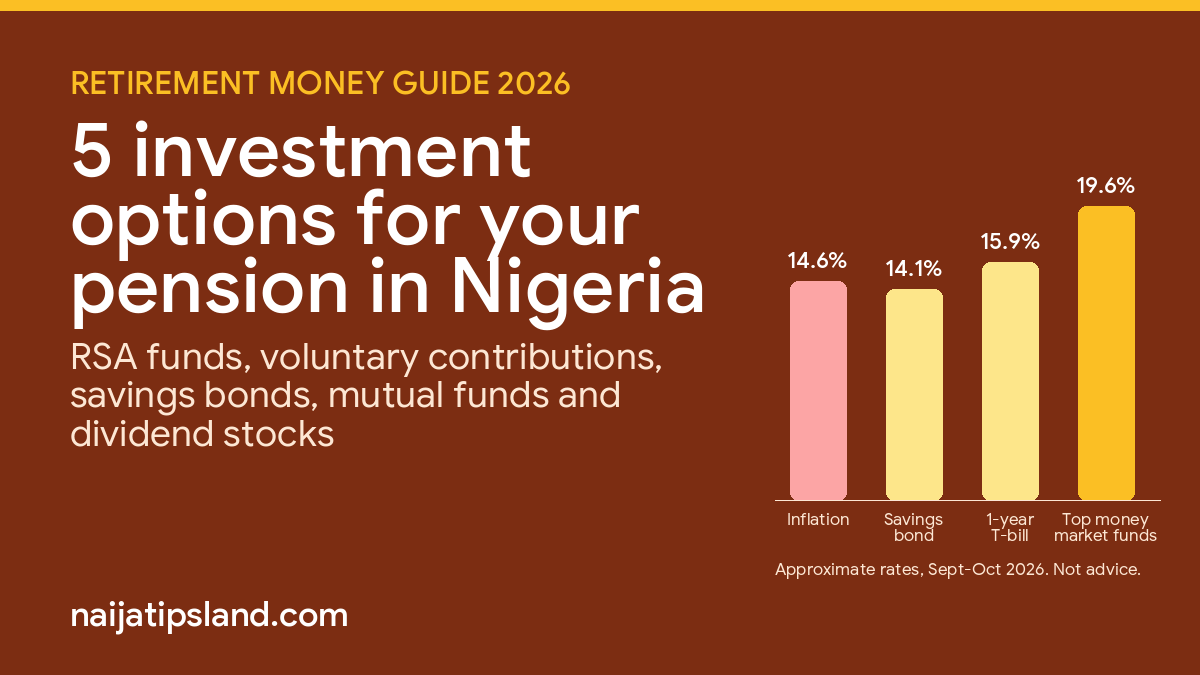
Most workers never look at how that money is invested, and many never save anything beyond the mandatory deduction. With inflation still at 14.63% in September 2026, that is a risk: money that grows slower than prices loses buying power every year. This guide covers five practical ways to invest for retirement in Nigeria in 2026, starting with the pension you already have and moving to options you can add yourself, with the rules, current rates and risks for each.
This article is general information, not personal financial advice. Rates quoted were correct in September and October 2026 and change often.
The short answer
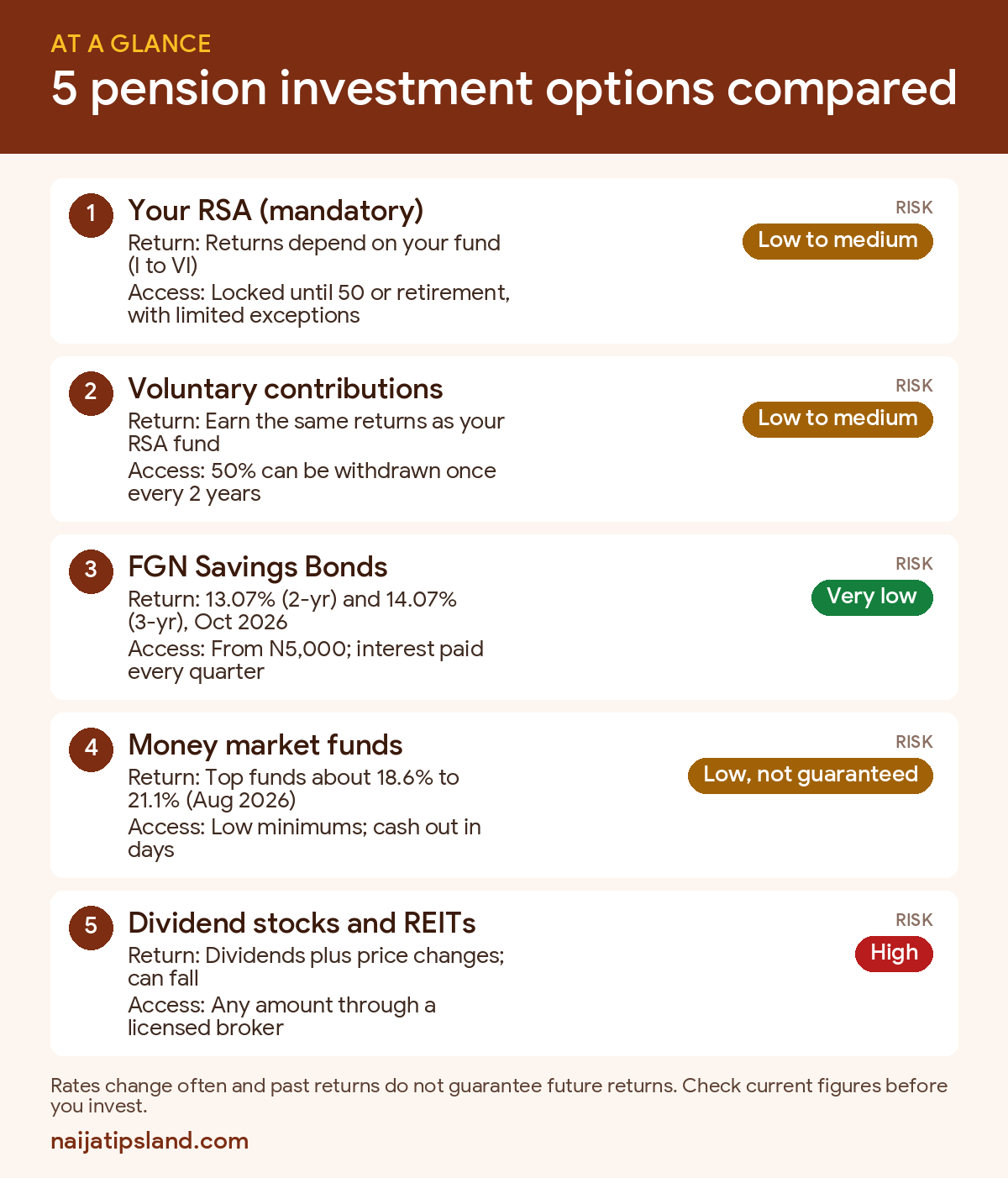
- Start with your RSA. Check which of PenCom’s six funds you are in and whether it suits your age.
- Add voluntary contributions if you can. They earn the same returns as your RSA, and you can take out half of them once every two years.
- FGN Savings Bonds paid 13.07% (two-year) and 14.07% (three-year) in the October 2026 offer, from N5,000, with interest every quarter.
- Money market funds are flexible: the best-performing funds reported yields of about 18.6% to 21.1% to August 2026, though returns are not guaranteed.
- Dividend stocks and REITs on the Nigerian Exchange can grow faster over many years but can also fall sharply. Keep them to money you will not need soon.
1. Your Retirement Savings Account, and choosing the right fund
Your RSA is the base of your retirement plan, and it is the one investment you cannot skip if you are in formal employment. Under the Pension Reform Act 2014, employers with three or more staff must register them under the Contributory Pension Scheme and pay contributions every month. You can usually access the money from age 50 or at retirement. If you lose your job, the law lets you withdraw up to 25% of your balance after four months without work, so the RSA also acts as a limited safety net.
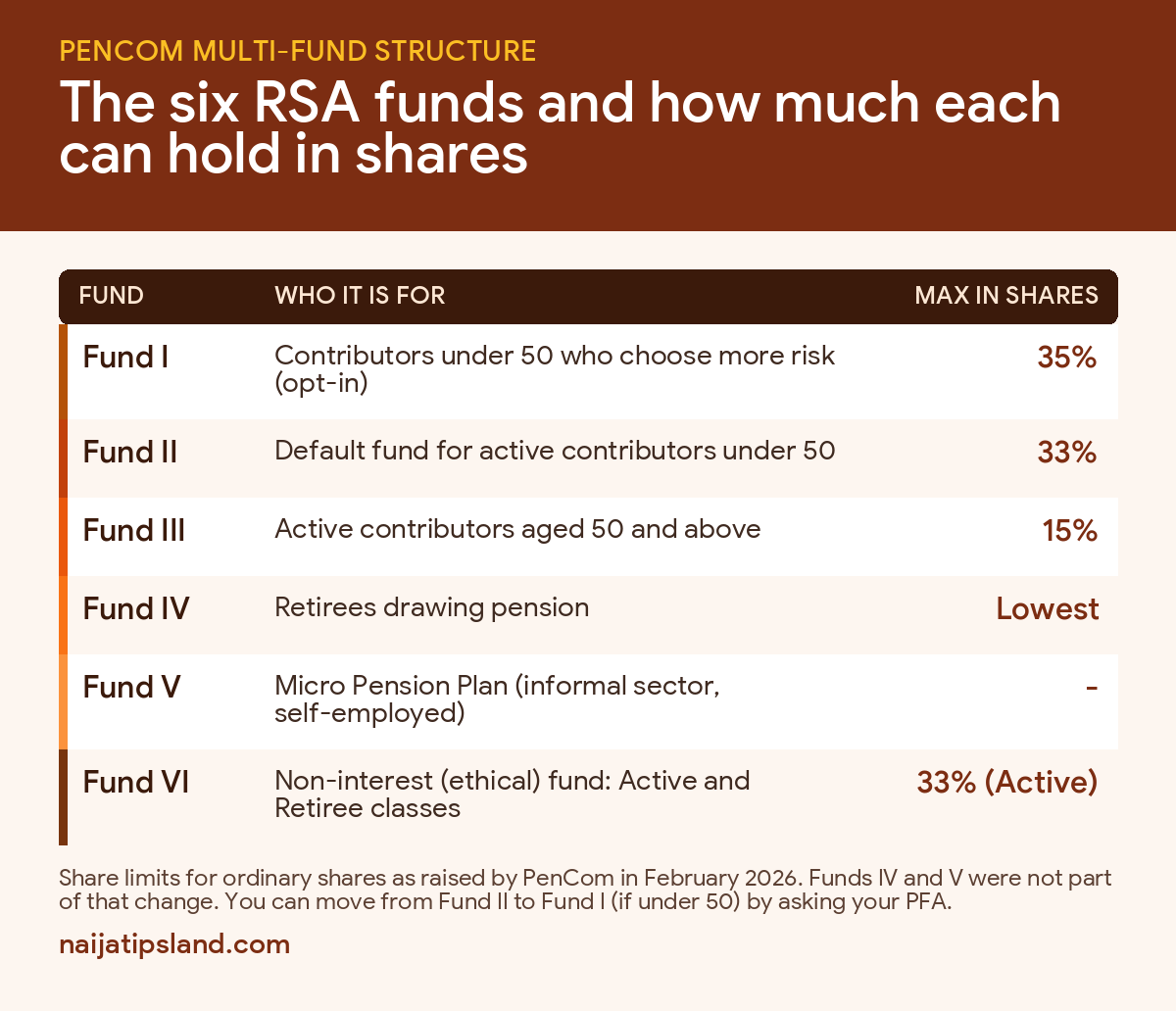
What most people miss is that PenCom splits RSA money into several funds, each with a different level of risk. Your PFA puts you in a fund based on your age, but you have some choice.
| Fund | Who it is for | Maximum in ordinary shares |
|---|---|---|
| Fund I | Active contributors under 50 who opt in for more risk | 35% |
| Fund II | The default for active contributors under 50 | 33% |
| Fund III | Active contributors aged 50 and above | 15% |
| Fund IV | Retirees | Lowest; income-focused |
| Fund V | Micro Pension Plan contributors (informal sector) | Not part of the 2026 change |
| Fund VI | Non-interest fund, with Active and Retiree classes | 33% (Active) |
The share limits above come from a February 2026 addendum to PenCom’s revised investment regulation, which raised how much the growth-oriented funds may hold in quoted shares. In practice, most RSA money still sits in Federal Government securities: about N17.8 trillion of the N31.8 trillion total at the end of August 2026, against about N6.3 trillion in Nigerian shares.
What you can do:
- Check your fund. Your statement, the PFA’s app or a call to customer service will tell you which fund your money is in.
- Consider Fund I if you are under 50. It can hold more shares, which tends to help over long periods but means bigger swings from year to year. Ask your PFA to move you; you can move back to Fund II later.
- Compare PFAs. Returns differ between PFAs. Since November 2021, PenCom has allowed contributors to move to a different PFA once a year through the transfer window, if they are unhappy with performance or service.
- Make sure contributions are actually paid. Check your statement every quarter. An employer that deducts pension from your salary and does not remit it is breaking the law, and you can report it to PenCom.
2. Voluntary contributions: top up your RSA
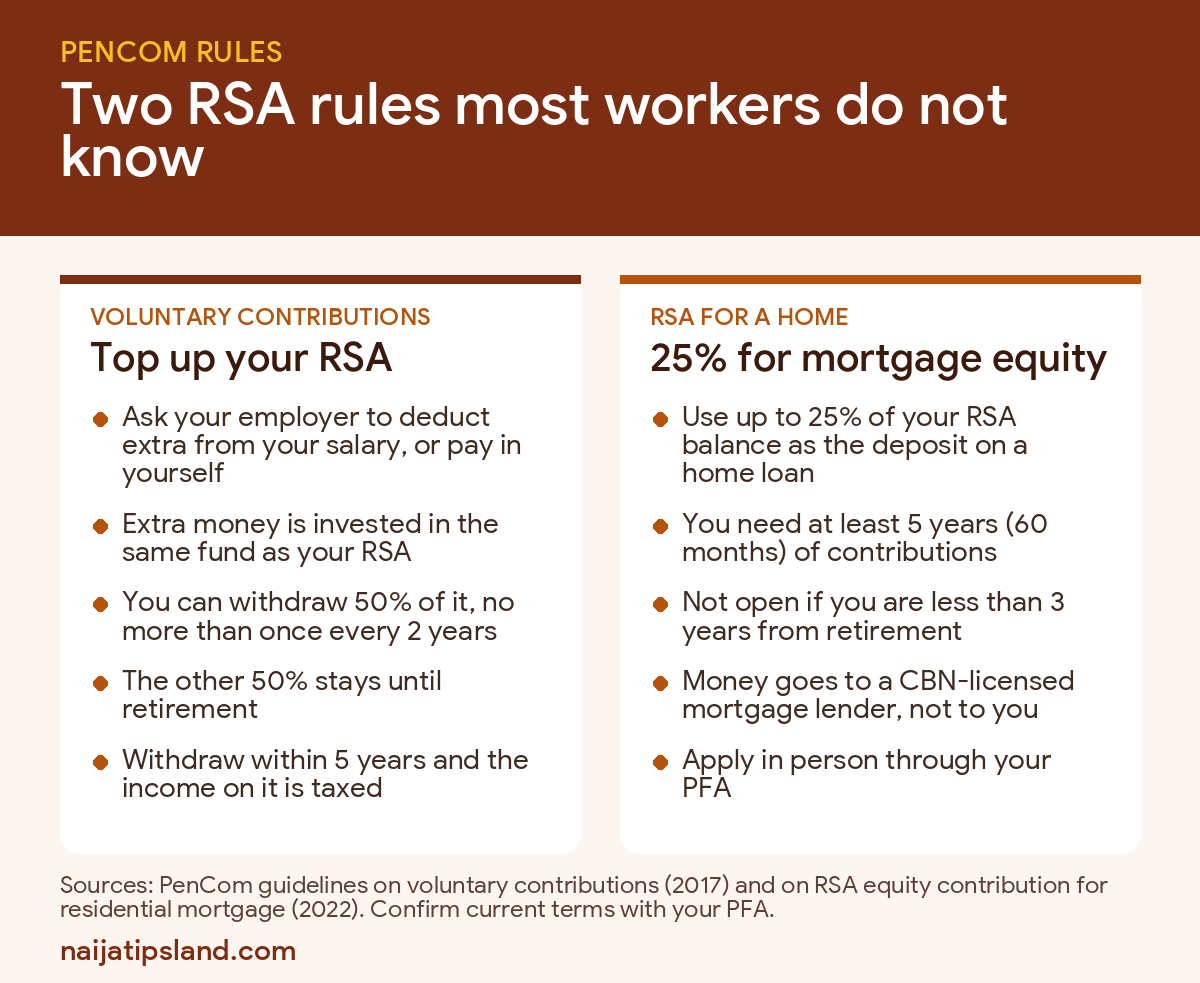
Voluntary contributions (VC) are extra payments on top of the mandatory 18%. You can ask your employer to deduct an extra amount from your salary, or pay directly into your RSA if you are self-employed. The money is invested in the same fund as the rest of your RSA, so it earns the same return.
The main reason to use VC instead of an ordinary savings account is discipline: the money is harder to spend on impulse, but not completely locked away. Under PenCom’s guidelines:
- Mandatory contributors can withdraw 50% of their voluntary contributions, no more than once every two years.
- The other 50% is added to your retirement benefit and stays until you retire.
- If you withdraw within five years of contributing, the income earned on that money is taxed, so VC works best as long-term money.
Voluntary contributions can also help you buy a home. If your mandatory balance is not enough for a mortgage deposit, PenCom lets you use the “contingency” part of your VC as well.
Using your RSA for a home
Since 2022, PenCom has allowed RSA holders to use up to 25% of their mandatory RSA balance as the equity contribution (deposit) on a residential mortgage. You need at least 60 months of contributions, you cannot be within three years of retirement, and the money is paid to a mortgage lender licensed by the Central Bank of Nigeria, not to you. Applications are made in person through your PFA. Owning your home before you retire can cut one of the biggest costs of old age, so this is worth knowing about even if it is not strictly an “investment”.
3. FGN Savings Bonds
FGN Savings Bonds are issued every month by the Debt Management Office (DMO) on behalf of the Federal Government. They are designed for ordinary savers, and they are about as safe as a naira investment gets, because the government guarantees them.
In the October 2026 offer, the DMO priced the bonds at:
- Two-year bond: 13.071% a year, maturing 14 October 2028.
- Three-year bond: 14.071% a year, maturing 14 October 2029.
The minimum is N5,000, in multiples of N1,000, up to N50 million. Interest is paid every quarter, which suits retirees who want regular income. You buy through a stockbroker or bank registered as a distribution agent with the DMO. Rates change every month, and they have been falling in 2026, so check the current month’s offer on the DMO website before you buy.
For shorter-term money, Treasury bills are another government-backed option: the one-year bill cleared at 15.90% at the 14 October 2026 auction. We compare them in our guide to Treasury bills, fixed deposits and savings bonds.
4. Money market and fixed income mutual funds
A money market fund pools money from many investors and puts it into short-term, low-risk instruments such as Treasury bills, commercial papers and bank deposits. Fund managers registered with the Securities and Exchange Commission (SEC) run them, and most let you add or withdraw money within a few working days.
Returns have been strong in 2026 because interest rates are high. SEC data reviewed by Nairametrics put the year-to-date yields of the ten best-performing money market funds between about 18.6% and 21.1% at the end of August 2026. Average funds paid less, and yields will fall if interest rates come down.
Money market funds suit money you want to keep safe but reachable: an emergency fund, savings for a goal within two or three years, or a parking place while you decide where to invest. They are not guaranteed by the government, so:
- Buy only from fund managers registered with the SEC. Our guide on checking whether a financial company is licensed shows how.
- Compare fees and past yields, not just this month’s headline figure.
- Be wary of “funds” promising fixed returns far above Treasury bill rates. That is a classic Ponzi scheme warning sign.
Many savings apps now offer money market funds through licensed partners. Our review of the best savings apps in Nigeria explains what to check before you deposit.
5. Dividend-paying stocks and REITs
Over long periods, shares in solid companies have usually beaten inflation, through rising share prices and dividends. Many Nigerian banks, telecoms and consumer goods companies listed on the Nigerian Exchange (NGX) pay regular dividends, and reinvesting those dividends can add significantly to long-term returns.
Real Estate Investment Trusts (REITs) let you own a slice of a property portfolio without buying a building. Two REITs trade on the NGX, UPDC REIT and UHomes REIT, and SEC data also lists several REIT mutual funds. UHomes and UPDC were up about 40% and 19% respectively in 2026 by April, but some of that came from property revaluations rather than rental income, and their dividends can change from year to year.
Shares and REITs carry more risk than every other option here:
- Prices can fall sharply and stay down for years, as Nigerian shares did after 2008.
- Dividends are not guaranteed; companies cut them in bad years.
- You need a licensed stockbroker and a CSCS account, and you pay brokerage fees on every trade.
A sensible rule is to put into shares only money you will not need for at least five years, and to spread it across several companies or use an equity mutual fund rather than betting on one stock.
How your mix usually changes with age
There is no single right mix: it depends on your income, debts, dependants and when you plan to stop working. But the general pattern is to take more growth risk when retirement is far away and to protect what you have as it gets close. The RSA fund structure itself follows that pattern.
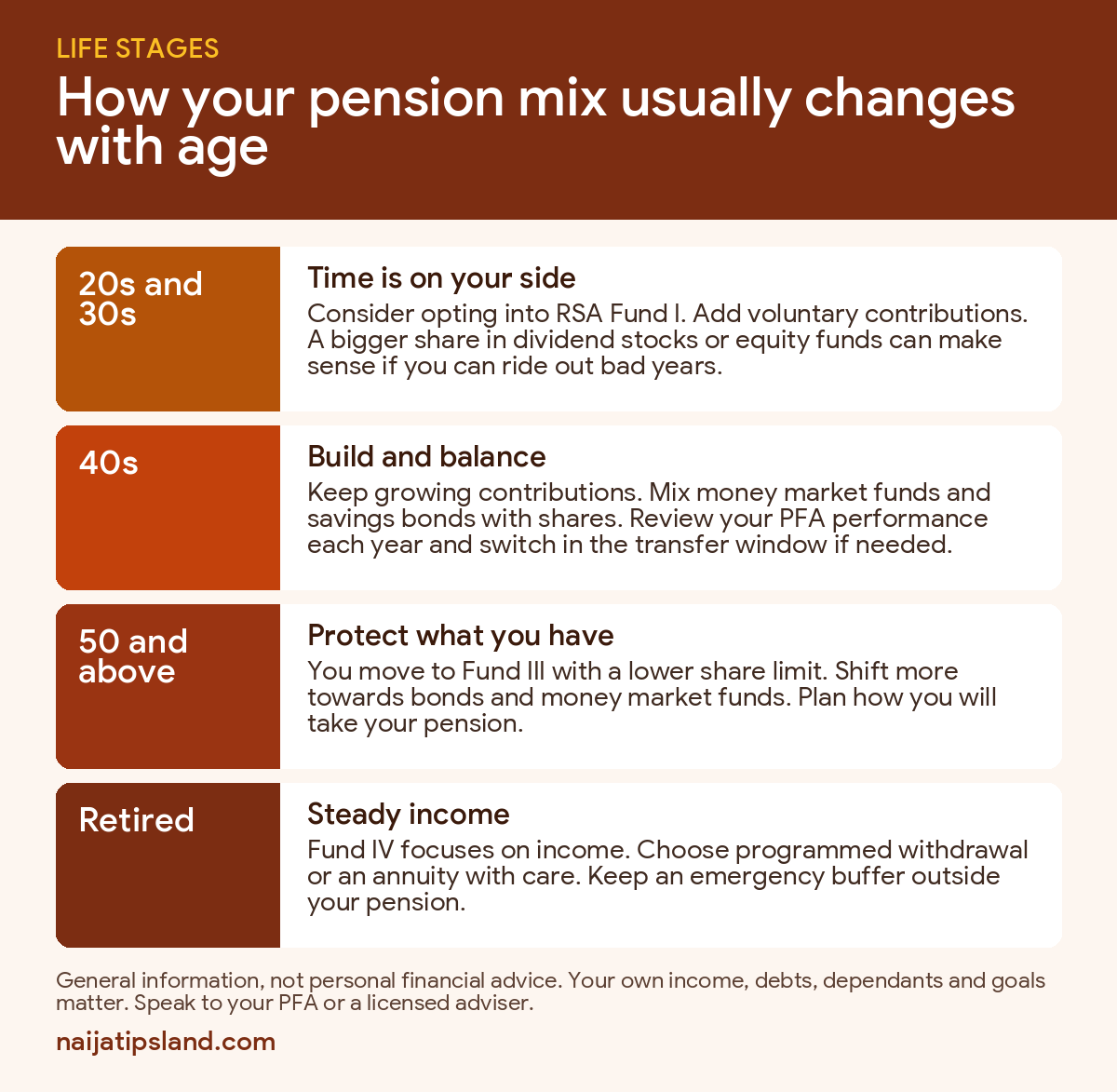
- In your 20s and 30s: you have time to recover from bad years. Fund I, voluntary contributions and some dividend shares can make sense.
- In your 40s: keep raising contributions, add safer assets such as savings bonds and money market funds, and review your PFA each year.
- From 50: your RSA moves to Fund III. Lean towards bonds and money market funds, and plan how you will take your pension.
- In retirement: your RSA moves to Fund IV. You choose between programmed withdrawal from your PFA or an annuity from a life insurer, so compare both carefully.
Mistakes to avoid
- Never checking your RSA. Unremitted contributions are common. Check your statement and chase gaps early.
- Keeping everything in a current account. With inflation at 14.63%, cash that earns nothing loses value every year.
- Chasing “guaranteed” high returns. Schemes promising 5% or 10% a month are not investments. If it sounds too good to be true, it is.
- Using pension money for short-term spending. Withdrawing voluntary contributions early is allowed, but each withdrawal shrinks your retirement pot.
- Ignoring the naira. All the options here are in naira. If you also hold dollar savings, our dollar to naira rate tracker shows how the exchange rate is moving.
Frequently asked questions
What is the best pension investment in Nigeria?
There is no single best option. For most workers, the RSA is the foundation, with voluntary contributions on top. Savings bonds and money market funds add safety and flexibility, and shares add long-term growth for those who can accept the risk.
Can I choose how my pension is invested?
Partly. You cannot pick individual investments, but if you are under 50 you can ask your PFA to move you from Fund II to the higher-growth Fund I, and you can switch PFA once a year through PenCom’s transfer window.
How much can I withdraw from voluntary contributions?
Mandatory contributors can withdraw 50% of their voluntary contributions, no more than once every two years. Income on withdrawals made within five years is taxed.
Can I use my pension to buy a house?
Yes. You can use up to 25% of your mandatory RSA balance as the deposit on a residential mortgage, if you have contributed for at least five years and are more than three years from retirement.
Are FGN Savings Bonds safe?
They are backed by the Federal Government, which makes them one of the safest naira investments. The main risk is that inflation rises above the interest rate while you hold them.
Can self-employed people get a pension in Nigeria?
Yes. The Micro Pension Plan (Fund V) is for workers in the informal sector and the self-employed. You can open an RSA with any PFA and contribute what you can, when you can.
Bottom line
Your pension is probably one of the biggest sums of money you will ever own, so it is worth an hour of attention each year. Check that your contributions are being paid, make sure you are in the right RSA fund, add voluntary contributions if you can, and spread any extra savings across safe options such as savings bonds and money market funds and, for the long term, carefully chosen shares.
Sources
- Pension assets hit N31.8 trillion as of August 2026 (PenCom data, October 2026)
- PenCom raises equity investment limits for RSA funds (February 2026)
- Nairametrics: PenCom guidelines on withdrawals from voluntary contributions
- The Will: PenCom approves 25% of RSA balance for mortgages (2022)
- TheCable: PenCom opens the RSA transfer window (2021)
- Nairametrics: FGN Savings Bond rates for October 2026
- Nairametrics: Best-performing money market funds to August 2026
- Nigeria Housing Market: UHomes vs UPDC REIT in 2026
- Technext: Nigeria’s inflation drops to 14.63% in September 2026
This guide is general information, not financial advice. Naijatipsland is not a licensed investment adviser. Speak to your PFA or a licensed adviser before making investment decisions.
Join the discussion
Have you tried this, or do you have a question we did not answer? Be the first to share your experience. Naijatipsland members help each other with real, first-hand experience.