Last updated: 11 October 2026. Crypto rules in Nigeria are changing quickly, so we update this guide as regulators publish new information. This is general information, not financial, legal or tax advice.
Quick answers
- Is crypto legal in Nigeria? Yes, for individuals. It is not legal tender, so you cannot use it in place of the naira for official payments.
- Who regulates it? The Securities and Exchange Commission (SEC) treats digital assets as securities under the Investments and Securities Act 2025. The Central Bank of Nigeria (CBN) oversees payments-related activity.
- Is any Nigerian exchange fully licensed? Not yet. As of 15 August 2026, 14 firms were in the SEC’s incubation programme, and the SEC says an Approval-in-Principle is not a licence.
- Can I still buy crypto with naira on Binance? No. Binance ended naira services in March 2024.
- Is crypto taxed? Yes. Gains are taxed, and new guidelines issued on 31 July 2026 set out how they are calculated (details below).
Is Crypto Legal in Nigeria in 2026?
Yes. Individuals can buy, hold and trade cryptocurrency in Nigeria. The confusion comes from a 2021 directive in which the CBN told banks to stop serving crypto exchanges. That restriction applied to financial institutions, not to ordinary owners, and the CBN lifted it with a circular in December 2023 that allows banks to open accounts for licensed virtual asset service providers.
The legal framework has moved quickly since then:
- Investments and Securities Act 2025. This law defines digital assets as securities and gives the SEC express authority over digital asset exchanges, custodians and other service providers. Promoting or operating prohibited or unregistered schemes is a criminal offence under the Act.
- Executive Order on Virtual Assets Coordination (July 2026). It created a Virtual Asset Council chaired by the CBN Governor, with the SEC and the Nigeria Revenue Service as vice-chairs. The CBN supervises virtual assets used for payments, settlement and custody, while the SEC regulates those that behave like securities.
- Tax guidelines (31 July 2026). The Nigeria Revenue Service published rules on how virtual asset gains are taxed.

What the SEC licensing status really means
Many websites call Nigerian exchanges ‘SEC licensed’. The accurate position is more cautious. Busha and Quidax received Approval-in-Principle from the SEC in August 2024 as part of its Accelerated Regulatory Incubation Programme (ARIP), and the SEC has said that this is not a final licence. In July 2026 the SEC admitted nine more firms, including Luno and KuCoin Nigeria, and in August it admitted Yellow Card, Blockchain Africa (BC Access Nigeria) and Pisi Payments. As of 15 August 2026 the programme had 14 firms.
Being in the programme means the SEC is monitoring the firm while it works towards full registration. It is a better sign than no regulatory contact at all, but it is not the same as a finished licence. Check the SEC’s own website (sec.gov.ng) for the current position before you deposit money.
Bitcoin vs USDT: Which One Should You Buy?
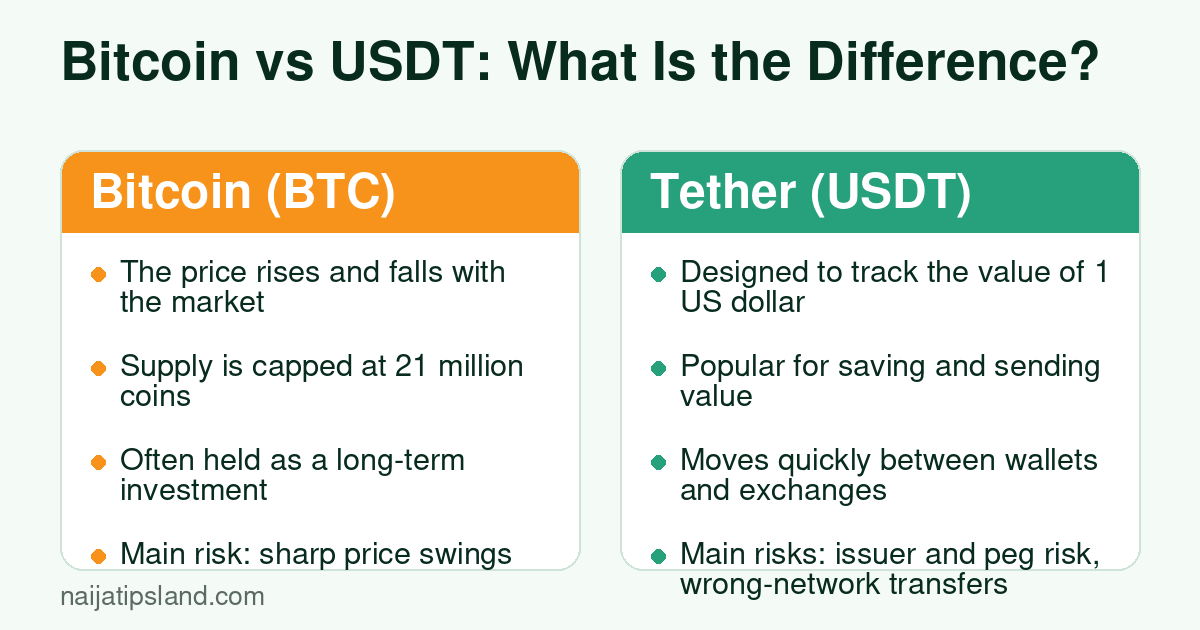
Bitcoin (BTC) is the original cryptocurrency. Its price moves with market demand and can swing sharply in a short time. Its supply is capped at 21 million coins, and many people hold it as a long-term investment.
USDT (Tether) is a stablecoin designed to track the value of one US dollar. Many Nigerians use it to protect savings from naira swings, to send value quickly, or to move money between exchanges. A stablecoin is not risk-free. The main risks are that the coin loses its peg, problems at the company behind it, and mistakes such as sending it on the wrong network.
Where Can Nigerians Buy Bitcoin and USDT?
Your realistic options in 2026 fall into three groups. The table below summarises what has been reported about each. Fees and availability change often, so confirm them inside the app before you trade.
| Platform | Type | Naira funding | Regulatory position (as reported) | Things to know |
|---|---|---|---|---|
| Quidax | Local exchange | Direct bank deposits, instant swaps, order book | Approval-in-Principle since August 2024 | Ended its P2P service on 23 January 2026. A taker fee of 0.1% has been reported. |
| Busha | Local exchange | Buy and sell with naira | Approval-in-Principle since August 2024 | Aimed at simple fiat-to-crypto purchases. |
| Luno | Exchange with instant buy and sell | Bank transfer and voucher deposits | Admitted to the SEC programme in July 2026 | Instant buy/sell costs more than the exchange. A 0.10% exchange taker fee and a 2% entry-level instant fee have been reported. |
| Yellow Card | Pan-African platform | Bank transfer and local payment methods | Admitted to the SEC programme in August 2026 | Also useful if you need to move money across other African countries. |
| Bybit, Bitget, MEXC | Offshore P2P marketplaces | Pay another user directly, with escrow | No Nigerian SEC authorisation found in sources checked | Naira availability changes, and P2P carries fraud and bank-freeze risk. |
| Binance | Global exchange | Not supported since March 2024 | Ended naira services | You would need to fund it from another source, so it is not a naira on-ramp. |
This table is for information, not a recommendation. We have no commercial relationship with any platform listed.
1. Local naira exchanges
Platforms such as Quidax, Busha, Luno and Yellow Card let you deposit naira by bank transfer and buy Bitcoin or USDT inside the app. They are the simplest route for beginners and are the platforms in closest contact with the SEC.
2. Peer-to-peer (P2P) marketplaces
On a P2P marketplace you trade directly with another user, and the platform holds the crypto in escrow until payment is confirmed. After Binance’s exit, several offshore platforms filled the gap. P2P can offer flexible rates, but the risks are higher, as explained in the safety section below.
3. Stablecoin and swap apps
Some newer apps pay naira straight into a Nigerian bank account when you sell USDT. Compare their fees and check who regulates them before you use them.
How to Buy Bitcoin or USDT With Naira: Step by Step
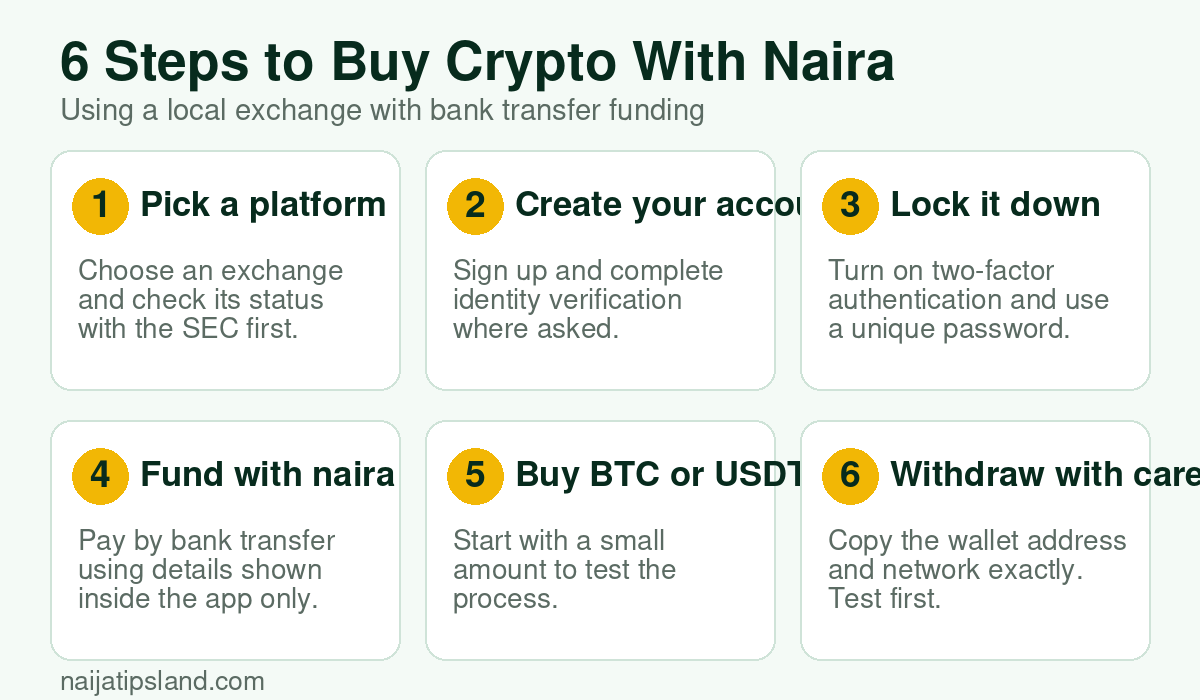
- Pick a platform. Check its status on the SEC’s website and read recent user reviews. Avoid any platform you cannot verify.
- Create your account and verify your identity. Regulated platforms ask for identity details such as your BVN or NIN. This is normal and part of anti-money-laundering rules.
- Secure the account. Use a strong, unique password and turn on two-factor authentication with an authenticator app rather than SMS where possible.
- Fund your wallet with naira. Use only the bank details shown inside the app for your own deposit. Never send money to a personal account because someone in a chat or on social media told you to.
- Buy your coins. An instant buy is simplest, while an order book usually costs less. Start with an amount you can afford to lose while you learn the process.
- Withdraw carefully if you move coins. Copy the wallet address exactly, choose the correct network, and send a small test amount first. Crypto transfers cannot be reversed.
Keeping your coins safe
Coins left on an exchange are held by that company, so you depend on its security. For larger amounts, many people move coins to a wallet they control. If you do, write down your recovery phrase on paper, store it offline, and never share it or type it into a website. Anyone who has the phrase controls the coins.
How to Trade P2P Without Getting Scammed
Most P2P losses come from a few repeated tricks. Follow these rules every time:
- Stay inside the platform. Keep all chat and payment instructions in the app so there is a record if you need to dispute a trade.
- Confirm the money in your own bank app. Never release crypto because of a screenshot, an SMS or an email. Check that the funds have actually landed.
- Only accept payment from an account in the buyer’s name. Third-party payments are a common route for fraud and can lead to your bank account being frozen.
- Be wary of unusually good rates. A price far better than the market is usually bait.
- Start small. Make a small first trade with a new counterparty and build up gradually.
Banks and fintech apps can review or restrict accounts that show unusual transaction patterns, so keep records of your trades in case you are asked to explain them.
Crypto Scams in Nigeria and How to Spot Them
The biggest warning in recent years is CBEX (Crypto Bridge Exchange), which presented itself as an AI-powered crypto trading platform. The SEC has stated that CBEX was never registered to operate as a digital asset exchange in Nigeria. The platform collapsed in April 2025, leaving users unable to withdraw, and the SEC later warned that it had resurfaced and was asking former subscribers for withdrawal fees. Enforcement action has followed, and the EFCC has said it arrested people linked to the scheme.
The pattern is not new. Earlier Ponzi schemes such as MMM used the same recipe of high promised returns, early payouts to build trust, and pressure to recruit friends. The SEC has said that, under the Investments and Securities Act 2025, promoters of Ponzi schemes can face up to 10 years in prison, and that people who help others join may also be exposed.
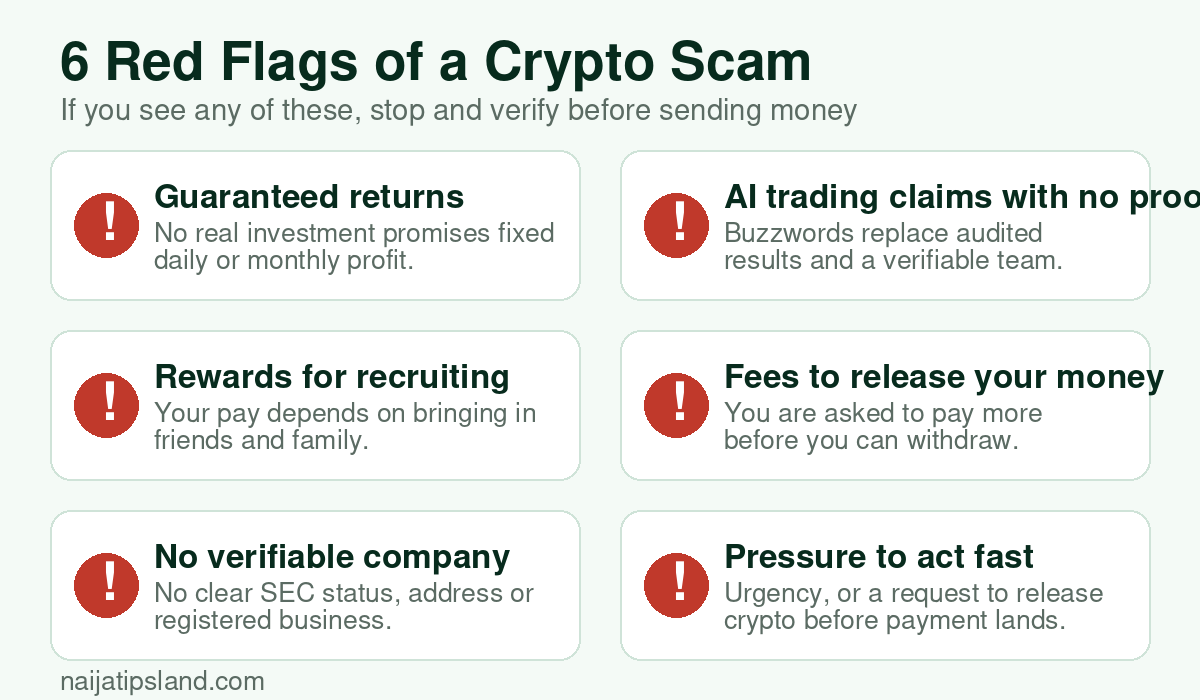
If you suspect an illegal scheme, you can report it to the SEC. A genuine exchange lets you buy and sell at market prices. It does not promise fixed profits.
How Is Crypto Taxed in Nigeria?
Since 1 January 2026, capital gains for individuals are taxed at your personal income tax band instead of the old flat 10%. Digital assets are among the assets covered. On 31 July 2026 the Nigeria Revenue Service (NRS) issued guidelines on taxing virtual assets. In summary:
- Gains are measured in dollars. Tax is calculated on the US dollar value when you acquire and when you dispose of the asset, and only the dollar gain is converted to naira at the rate on the day you sell. This means you are not taxed on a gain that comes only from the naira weakening.
- Cost basis. First-in, first-out (FIFO) is the default method. A weighted average is allowed if you choose it consistently from the start.
- Withholding tax. A 1% withholding tax on gross proceeds applies to Bitcoin and similar tokens, while stablecoins are exempt.
- Stamp duty. A 1.5% stamp duty applies to token and fiat transactions, remitted by providers.
- Losses. Crypto losses can only be set against crypto gains and can be carried forward.
- Not taxable: holding without selling, unrealised gains, and transfers between your own wallets.
Personal income tax bands now run from 0% on the first ₦800,000 up to 25% above ₦50 million, and the ₦800,000 threshold applies to your total income, not just your gains. The filing deadline is 31 March following the tax year.
Note that the accounting firm PwC has pointed out that the NRS guidelines impose obligations not expressly written in the Nigeria Tax Act and do not state a start date. Speak to a qualified tax adviser about your own situation and keep records of every purchase and sale.
What Could Change: Proposed SEC Rules
In August 2026 the SEC published two consultations. Neither is law yet, so be careful with any website that presents them as current rules. They propose mandatory registration, including for offshore firms serving Nigerians, minimum capital requirements for exchanges and custodians, regulator access to transaction data, and limits on how much retail investors can put into digital asset offerings. Keep an eye on SEC announcements, because the final rules could affect which platforms Nigerians can use.
Key Crypto Terms Explained
- Exchange: a platform where you buy, sell and trade crypto.
- P2P: peer-to-peer trading directly with another user, usually with escrow.
- Stablecoin: a crypto asset designed to hold a steady value, such as USDT, which tracks the US dollar.
- KYC: know your customer, the identity checks exchanges require.
- Wallet: software or a device that holds the keys to your coins.
- Recovery phrase: the secret words that restore your wallet. Never share them.
- VASP: virtual asset service provider, the term regulators use for exchanges and similar firms.
- ARIP: the SEC’s Accelerated Regulatory Incubation Programme for firms working towards registration.
Frequently Asked Questions
How do I buy Bitcoin in Nigeria?
Open an account on an exchange that supports naira, complete identity verification, deposit naira by bank transfer inside the app, and buy Bitcoin. Start with a small amount and enable two-factor authentication.
How do I buy USDT in Nigeria with naira?
The process is the same as buying Bitcoin. Choose USDT as the asset, check the price and fee before confirming, and make sure you use the correct network if you withdraw.
Is Binance still available in Nigeria?
You can still use Binance for crypto, but it stopped supporting naira deposits, withdrawals and naira trading pairs in March 2024. You would need another way to turn naira into crypto.
Which is the best crypto exchange in Nigeria?
There is no single best option. Compare regulatory status, naira funding methods, fees, security features and customer support, and test with a small amount first. Local platforms in the SEC programme are the ones in closest contact with the regulator.
Is it safe to use P2P trading?
It can be, if you use escrow, stay inside the platform, confirm payment in your own bank app and never release crypto early. It carries more risk than buying on a local exchange.
Do I pay tax when I sell crypto in Nigeria?
Selling is a taxable disposal. Under the NRS guidelines, your gain is calculated in dollars, and a 1% withholding tax and 1.5% stamp duty apply in the cases described above. Get advice from a tax professional.
Can I lose all my money in crypto?
Yes. Prices can fall sharply, platforms can fail, and scams are common. Only invest money you can afford to lose.
Related Crypto News
- Bitcoin ETFs’ momentum could ‘not last too long’
- XRP Ledger bug could have allowed hackers to create unlimited XRP
- Binance to restrict 8 services and delist 22 tokens in Brazil
Browse all our coverage in the Cryptocurrency section.
Risk warning: Cryptocurrency is volatile and unregulated products can lead to total loss. Nothing on this page is financial, legal or tax advice. Verify every platform and rule with the SEC, the CBN and the NRS before you act.
Sources
- TechCabal: SEC expands crypto sandbox to Yellow Card and Blockchain Africa
- Nairametrics: SEC admits three more crypto firms, taking ARIP participants to 14
- Daya: Nigeria’s money rules in 2026 (summary of the NRS virtual asset guidelines, tax changes and regulators)
- Nigeria Revenue Service: Guidelines on the Taxation of Virtual Assets, 31 July 2026
- Mariblock: Binance ends naira support in Nigeria
- BusinessDay: How to spot a Ponzi scheme, SEC
- Securities and Exchange Commission, Nigeria