Last updated: 16 October 2026 · By Naijatipsland Editorial Team · Editorial policy
Instant loan apps can be handy in an emergency, but Nigeria has also had a long run of apps that charge hidden fees, grab phone contacts and shame borrowers who fall behind. Since 2025 the Federal Competition and Consumer Protection Commission (FCCPC) has kept a register of digital lenders that are allowed to operate. This guide shows how to check whether a loan app is approved, the red flags to watch for, and how to report harassment.
The register and the rules have changed several times, and the sources we found give different counts and some different figures. We flag those below. This is general information, not legal advice.
The short answer
- Check the FCCPC register for the company name and the app name before you borrow. The FCCPC publishes approval lists for digital money lenders and for airtime and data lenders on its website.
- Report harassment through the FCCPC complaints portal (complaints.fccpc.gov.ng) or by email, and keep screenshots.
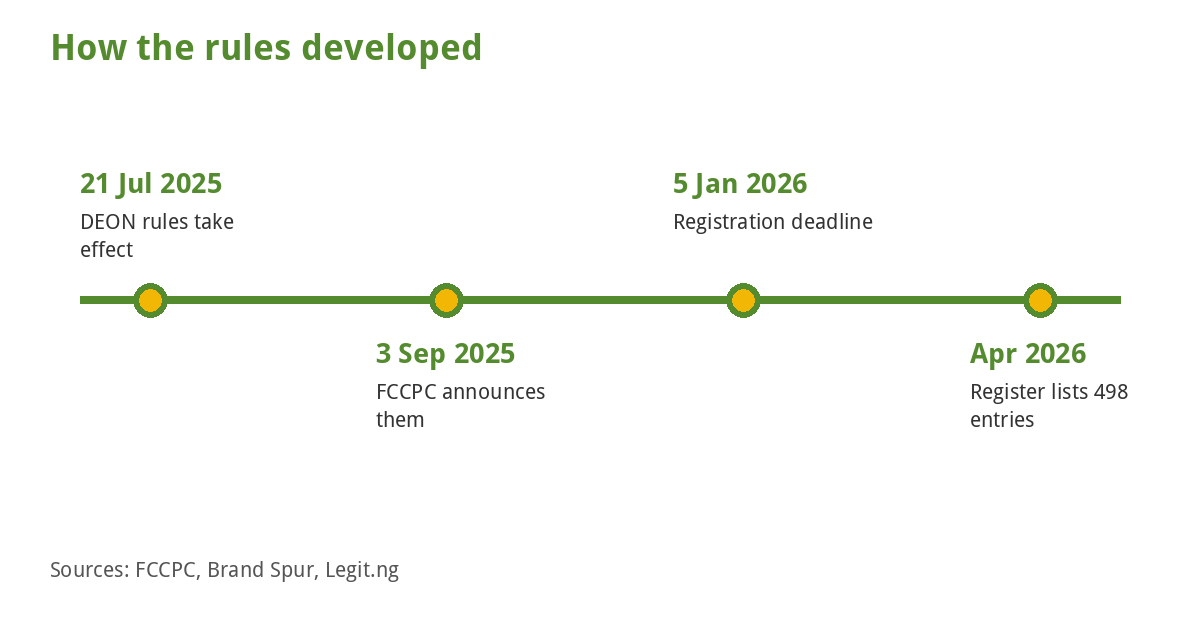
- The FCCPC’s DEON Consumer Lending Regulation, 2025 came into effect on 21 July 2025 and bans harassment and abusive loan recovery, according to the FCCPC.
- Penalties include fines of up to N100 million or 1% of turnover, and directors can be disqualified for up to five years, per the FCCPC release. One outlet says 19% of turnover, which looks like a typo, so we use the FCCPC’s figure.
- Counts differ by date and outlet: Brand Spur reported 457 approved apps, 35 on conditional approval and 103 unregistered apps on a watchlist in June 2026, while Legit.ng’s April 2026 list runs to 498 numbered entries and the FCCPC page table reaches entry 478.
How to check if a loan app is approved
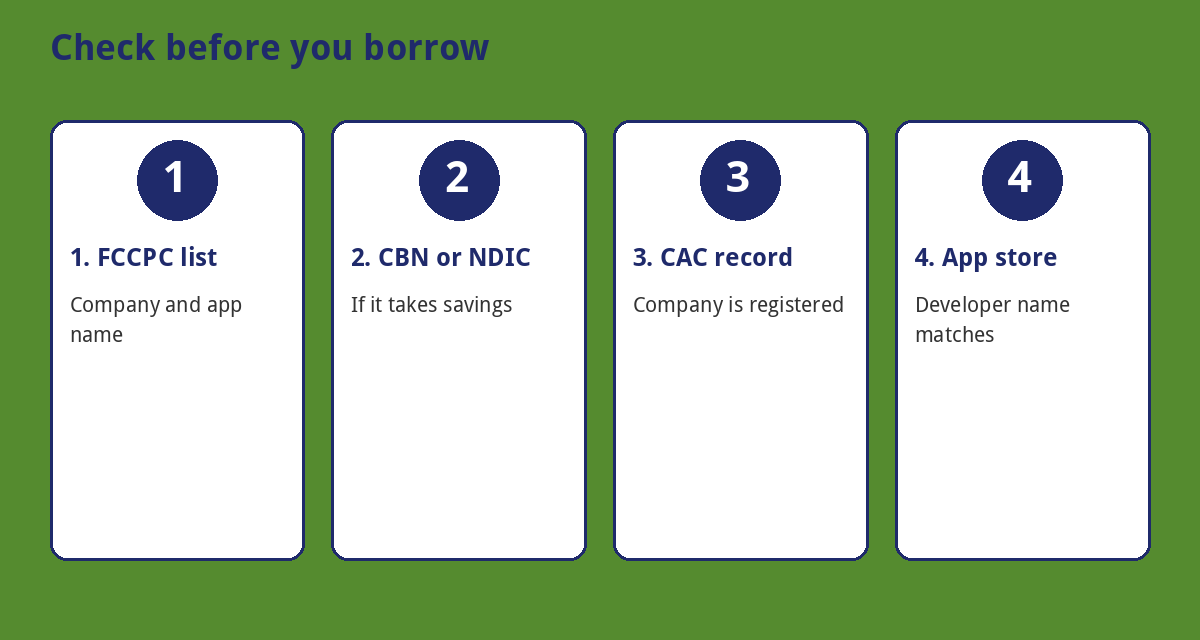
- Search the FCCPC register. Go to fccpc.gov.ng, open Registration of Digital Money Lenders, and look at the approvals list. Search for the company name, not just the app name, because one company can run many apps. For example, one registered company appears with several app names in Legit.ng’s reading of the list.
- Check the status. The register shows companies that are fully or conditionally approved. A conditional entry is not the same as full approval.
- If it calls itself a bank or takes savings, check that the CBN has licensed it, and check whether the NDIC insures deposits. Renmoney’s guide explains that FCCPC registration covers how lenders treat borrowers, while CBN licensing covers financial soundness and deposit insurance. Renmoney is a lender that promotes its own licensed status, so verify with the regulators directly.
- Check the company’s CAC registration and that the developer name in Google Play or the App Store matches the licensed company.
- Read the app’s permissions and the repayment terms before you accept.
Renmoney also notes there is no CBN list of loan apps. The CBN licenses institutions, and the FCCPC publishes the register of digital lenders.
Red flags
- The app or company is not on the FCCPC register, or is listed as watchlisted or removed.
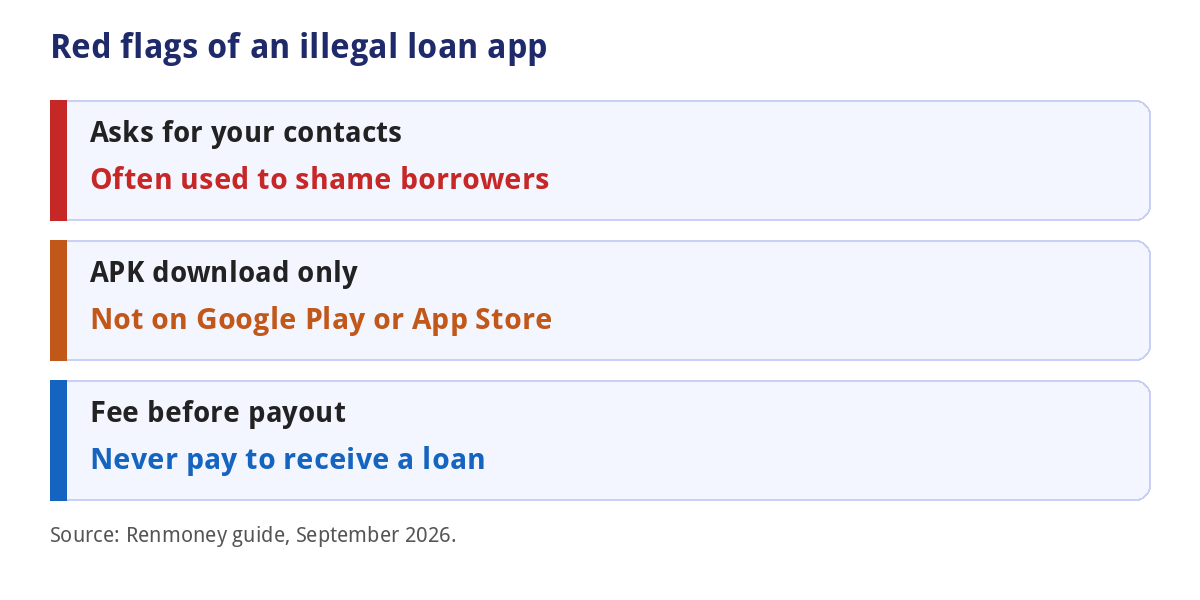
- It asks for access to your contacts, photos or messages.
- It is distributed as an APK file instead of through Google Play or the App Store.
- There is no verifiable company name, address or CAC number, and no privacy policy.
- It asks you to pay a fee before it sends any loan money.
- The charges are unclear or the terms change after you accept.
- You are pushed to take several loans at once, which Brand Spur warns can lead to a debt cycle.
What the rules say
The FCCPC says its DEON (Digital, Electronic, Online and Non-Traditional) Consumer Lending Regulation, 2025 was gazetted and announced on 3 September 2025, with commencement dated 21 July 2025. Lenders had to register within 90 days of commencement, and Brand Spur cites a 5 January 2026 compliance deadline, so the exact cut-off is unclear. The rules require clear disclosure of loan terms, fair rates, data privacy and ethical recovery. They prohibit pre-authorised or automatic lending, unethical marketing, and harassment and abusive recovery. The FCCPC’s CEO is quoted as saying no consumer should be harassed, defamed or lured into unsustainable debt.
The FCCPC release we read does not mention contact access or public shaming by name. Brand Spur says the regulation bars harassment, intimidation and public shaming, and Techeconomy reported in 2023 that lenders must have their privacy policies certified by the data protection regulator, the Nigeria Data Protection Commission (NDPC), as part of registration.
How to report harassment
- Collect evidence: screenshots of threats, call logs, messages sent to your contacts, the loan agreement, the app name, the company name and the amount. One guide asks for the app’s name and contact details, the loan amount and a description of the harassment.
- File a complaint with the FCCPC at complaints.fccpc.gov.ng, the general portal for filing and tracking complaints. The FCCPC release names lenderstaskforce@fccpc.gov.ng for unlawful or unregistered lenders, unfair rates or privacy violations, and a February 2025 guide gave contact@fccpc.gov.ng and a direct message on X. Confirm which channel is current on the FCCPC site.
- Report privacy abuse to the NDPC if the app took your contacts or shared your data. We did not find a verified complaint address, so check the NDPC website.
- Report the app to Google Play or the App Store if it is listed there.
- Warn your contacts that any messages about you from an unknown lender may be harassment, so they do not pay or share your details.
The guides we read do not give a response time for FCCPC complaints.
If you already owe the money
- A lender being rude does not cancel the debt, but harassment is not allowed under the rules above. Keep repaying through the official app or bank details, never to a personal account sent by a collector.
- Do not take a new loan to pay an old one.
- Write down what you owe and the date, and ask the lender in writing for a statement.
- If an unlicensed app is involved, report it and avoid giving it more access to your phone.
Safer ways to borrow
- Compare the total cost, including fees, before you tap accept.
- Look at licensed banks and microfinance banks first. Their savings and fixed products are covered in our guide to the best savings apps in Nigeria.
- Build an emergency fund with the options in our guide to treasury bills, fixed deposits and savings bonds.
- If a lender or scammer gets into your bank account, see how to block your card or account, and if you paid the wrong person, how to recover money sent to the wrong account.
Frequently asked questions
Is there a CBN list of approved loan apps?
Renmoney’s guide says no: the CBN licenses institutions, and the FCCPC publishes the digital lender register.
How many loan apps are approved?
It depends on the date. Brand Spur said 457 in June 2026, and Legit.ng’s April 2026 list had 498 numbered entries, including repeats. Check the live register.
Can a loan app call my contacts?
Access to contacts is listed as a red flag. The regulation bans harassment and abusive recovery, so report it.
What is the penalty for a lender that breaks the rules?
Fines of up to N100 million or 1% of turnover, and directors can be barred for up to five years, per the FCCPC.
Where do I complain?
Use complaints.fccpc.gov.ng, and attach your evidence.
Bottom line
Before you borrow, check the company on the FCCPC register, never give an app your contacts, and keep records. If a lender harasses you, report it with screenshots to the FCCPC.
Sources
- FCCPC: Registration of digital money lenders
- FCCPC: Digital lending, FCCPC tackles abuses and issues landmark regulations
- Legit.ng: Federal Government releases updated list of approved loan apps for 2026
- Brand Spur: FCCPC and CBN approve 457 loan apps in Nigeria 2026
- Renmoney: List of loan apps approved by CBN (September 2026)
- Step-by-step guide to report loan apps harassing you (February 2025)
- Techeconomy: New data law will safeguard Nigerians from loan sharks (2023)