Last updated: 16 October 2026 · By Naijatipsland Editorial Team · Editorial policy
Savings apps pay far more than a normal bank savings account, but the rate is only one part of the picture. Before you move money, you need to know who licenses the app, whether your balance is insured, and what it costs to take your money out early. This guide compares the main savings apps in Nigeria on safety, interest and withdrawal rules, using reports from 2025 and 2026.
Rates change often and the sources we found do not always agree, so we flag the conflicts. Treat every rate as indicative and confirm it inside the app before you save. This is general information, not financial advice.
The short answer
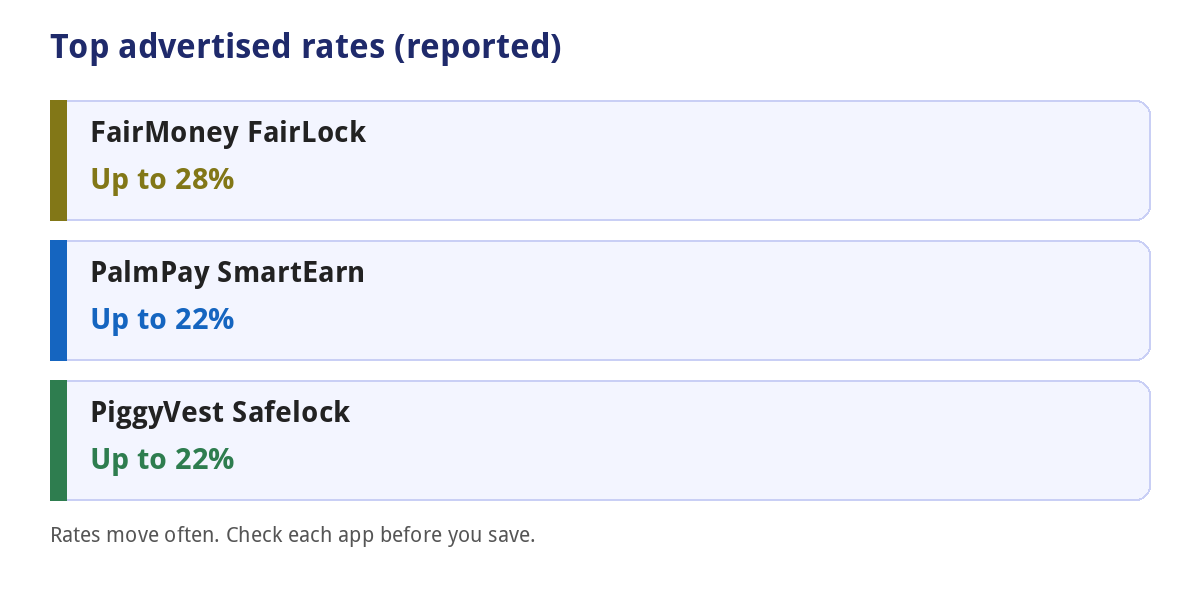
- Highest advertised rates: FairMoney’s FairLock (up to 28%) and Renmoney’s RenVault (up to 28%) for locked savings, and PalmPay’s SmartEarn (up to 22%) for flexible savings, per TechCabal and NaijaSabi.
- PiggyVest: Safelock paid 14% to 20% in a November 2025 TechCabal report, and up to 22% in a March 2026 NaijaSabi review.
- Safest-looking structure: apps run by CBN-licensed microfinance banks, which NaijaSabi says are NDIC insured, at Kuda up to N2 million per depositor. Investment platforms like PiggyVest and Cowrywise are SEC-regulated, but that review says they have no NDIC insurance.
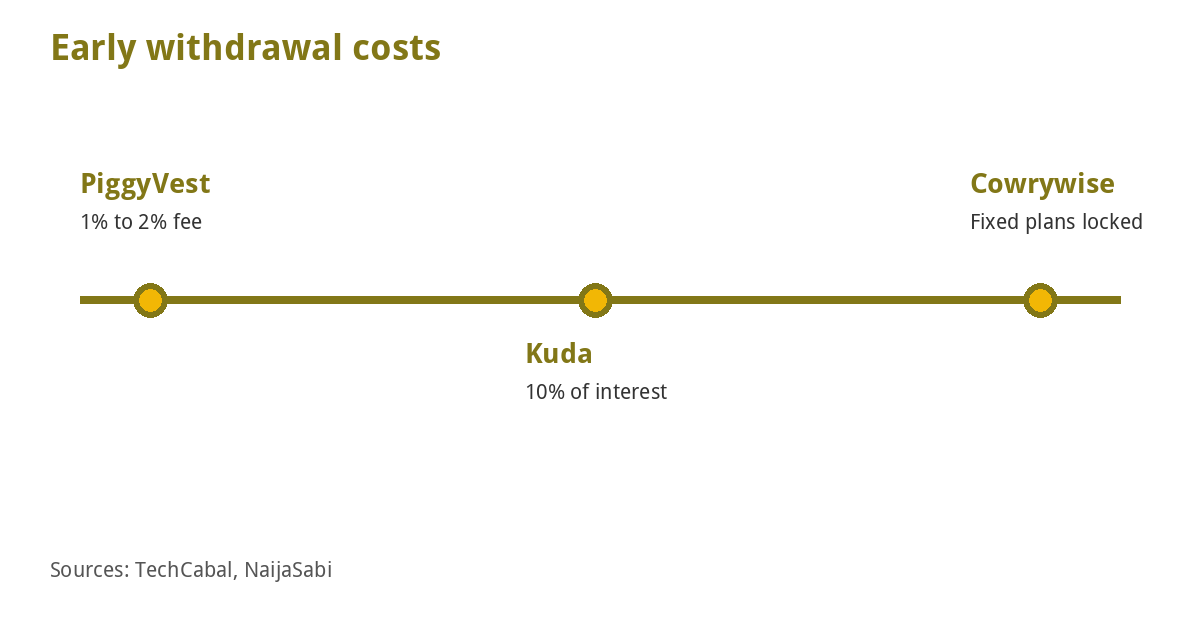
- Biggest hidden cost: early withdrawal. Fixed plans can cost you fees, interest, or access to the money entirely.
- New risk signal: on 1 July 2026 the CBN revoked the licences of 46 microfinance banks, including some bought by fintechs, per Condia and LaunchBase Africa.

Check the licence before the rate
Savings apps fall into groups, and the group tells you who protects your money:
- Microfinance bank apps (Kuda, Renmoney, FairMoney): licensed by the Central Bank of Nigeria (CBN). NaijaSabi lists these as NDIC insured, though MFB cover is lower than at commercial banks. The NDIC limit for microfinance banks is N2 million per depositor (N5 million at commercial banks), according to Techeconomy.
- SEC-registered platforms (PiggyVest, Cowrywise): regulated as investment or savings platforms. NaijaSabi says PiggyVest holds client funds in trust accounts and has no NDIC insurance. Its own table, however, lists CBN and SEC, so the review is inconsistent, and you should check the app’s own disclosures.
- Wallet apps (OPay, PalmPay): pay interest on balances. NaijaSabi lists OPay under CBN but does not say if NDIC applies.
The July 2026 revocations show why this matters. LaunchBase Africa reports the CBN cancelled 46 microfinance banks as part of a clean-up of fintechs that bought dormant charters, and that Sycamore, named in the report, says its lending and investment operations are unaffected and customer funds are secure. Neither source explained what happens to depositors at the revoked banks. Always check on the CBN or NDIC website that the licence in the app’s footer is real and current.
Savings app by savings app
PiggyVest
- Safelock (fixed): 14% to 20% in November 2025 per TechCabal, up to 22% paid upfront per NaijaSabi, for 10 to 365 days (up to 1,000 days).
- Piggybank/Flex: TechCabal says 17% with a free withdrawal once every 90 days. NaijaSabi gives up to 18% in the text and 8% in its table, so check the app.
- Target savings: about 12%, with an early-break fee of 1% (TechCabal) and loss of accrued interest.
- Emergency withdrawals: NaijaSabi lists a 2% penalty outside the free windows. TechCabal gives 1% as an example for breaking some plans.
Cowrywise
- Emergency fund plans: 13.27%. House rent, study and car plans: 13.85% (both sources).
- Regular plans have a minimum lock of about three months. The Stash plan is flexible, with a lower rate.
- SEC-regulated, no NDIC mentioned.
Kuda
- Save Frequently: up to 8%. Fixed savings: up to 12% (TechCabal) or up to 15% (NaijaSabi).
- TechCabal says breaking a fixed plan early deducts 10% of the accrued interest. NaijaSabi says Kuda Save has no early withdrawal, so rules may have changed.
- No account maintenance fee and 25 free transfers a month.
FairMoney and Renmoney
- FairMoney: FairSave (flexible) up to 17% to 18% with daily interest; FairLock up to 28%. TechCabal says FairLock lock periods were not stated; NaijaSabi says 7 days to 2 years. Minimum N100.
- Renmoney: RenVault up to 28% for 30 days to 12 months; RenFlex up to 17% flexible. Minimum N1,000.
- NaijaSabi also notes high rates may be partly funded by the lender’s loan book.
PalmPay and OPay
- PalmPay: Cashbox up to 20% and SmartEarn up to 22%, both flexible. TechCabal says SmartEarn has instant withdrawals and no redemption fees.
- OPay: daily interest on wallet balances with no lock-in. The rate was not stated.
Withdrawal rules to read first
- Locked plans: you may not be able to withdraw at all before maturity, or you may lose interest.
- Free withdrawal windows: some flexible products allow free withdrawals only at set times, then charge outside them.
- Interest paid upfront or at the end: some fixed plans pay at maturity only, so breaking early can mean you get none.
- Auto-save rules: round-up and spend-and-save features can move money out of your spending account without a prompt.
How to choose
- Verify the licence (CBN or SEC) in the app and on the regulator’s website.
- Check insurance: ask whether NDIC cover applies and up to how much.
- Match the product to the goal: flexible savings for emergencies, a locked plan for rent or school fees.
- Be wary of rates far above the market. Government treasury bills paid 15.85% at the 7 October 2026 auction, so a much higher rate usually means more risk. See our guide to treasury bills vs fixed deposits vs savings bonds.
- Split your savings. Do not keep more than the insured amount in any one provider, or more than you can afford to lock up.
- Protect the account. Use a strong PIN and know how to freeze things fast: see how to block your card or account and note the small fees explained in bank transfer charges in Nigeria.
Frequently asked questions
Which savings app pays the highest interest in Nigeria?
Reports put FairMoney’s FairLock and Renmoney’s RenVault at up to 28% for locked savings, and PalmPay’s SmartEarn at up to 22% for flexible savings. These are maximums, so your rate may differ.
Is PiggyVest safe?
It is SEC-regulated and, according to a March 2026 review, holds client funds in trust accounts. The same review says it has no NDIC insurance, though its summary table lists CBN as well. Read the app’s own disclosures.
Are savings apps insured by NDIC?
Microfinance bank apps such as Kuda, Renmoney and FairMoney are reported as NDIC insured (up to N2 million per depositor at MFBs). Investment platforms may not be.
What happens if I withdraw a fixed savings early?
It depends on the plan. Reported costs include a 1% to 2% fee at PiggyVest, 10% of accrued interest at Kuda per TechCabal, or no early access at all.
Should I worry about the CBN licence revocations?
They show that holding a licence is not a guarantee. Use apps with a current licence and keep amounts within the insured limit.
Bottom line
Pick the app by safety first, then by rate and withdrawal terms. Spread your money, keep an emergency amount in a flexible account, and be cautious about any rate far above the 15% to 16% that government securities pay.
Sources
- TechCabal: Interest rates for Nigerian savings apps (November 2025)
- NaijaSabi: Best savings apps in Nigeria 2026 (March 2026)
- LaunchBase Africa: Nigeria’s banking crackdown catches fintechs chasing microfinance licences (July 2026)
- Condia: CBN revokes licences of NowNow, Sycamore, OurPass and others
- Techeconomy: NDIC raises bank deposit insurance coverage to N5m
- Nairametrics: DMO raises N968.47 billion as 364-day stop rate falls to 15.85%
Related: how to check if a loan app is approved and report harassment.
Related: personal income tax in Nigeria in 2026.