Last updated: 16 October 2026 · By Naijatipsland Editorial Team · Editorial policy
Before you deposit money in a new app, apply for a loan or hand over your BVN, you should know whether the company is actually licensed. That sounds simple, but in 2026 it has become harder. In July the Central Bank of Nigeria (CBN) revoked the licences of 46 microfinance banks, and the NDIC began paying their depositors. In June the consumer protection commission (FCCPC) had to deny a false report that it had approved 48 new loan apps, because its digital lending rules were suspended by a court. This guide explains who regulates what, where to check, what the NDIC insures, how to handle loan apps while the rules are in dispute, and the red flags that should stop you. Official lists and rules change, so confirm on the regulator’s own site. This is general information, not financial or legal advice.
The short answer
- Banks, microfinance banks and other CBN-licensed institutions: check the CBN’s lists by category, and for microfinance banks the NDIC advises the CBN list plus the CBN USSD service on *959#.
- Deposit insurance: the NDIC says it insures up to N2 million per depositor in a failed microfinance bank. Money above that is paid only from what is recovered.
- Loan apps: the FCCPC is the consumer regulator, but its 2025 digital lending rules are on hold under a court order. Rely on its official channels, not on lists in blogs and WhatsApp.
- Investment platforms: only SEC-registered operators can legally offer investment services. See our guide to Ponzi schemes.
- Never trust a licence screenshot or a number shown by the company alone.
Who regulates what?
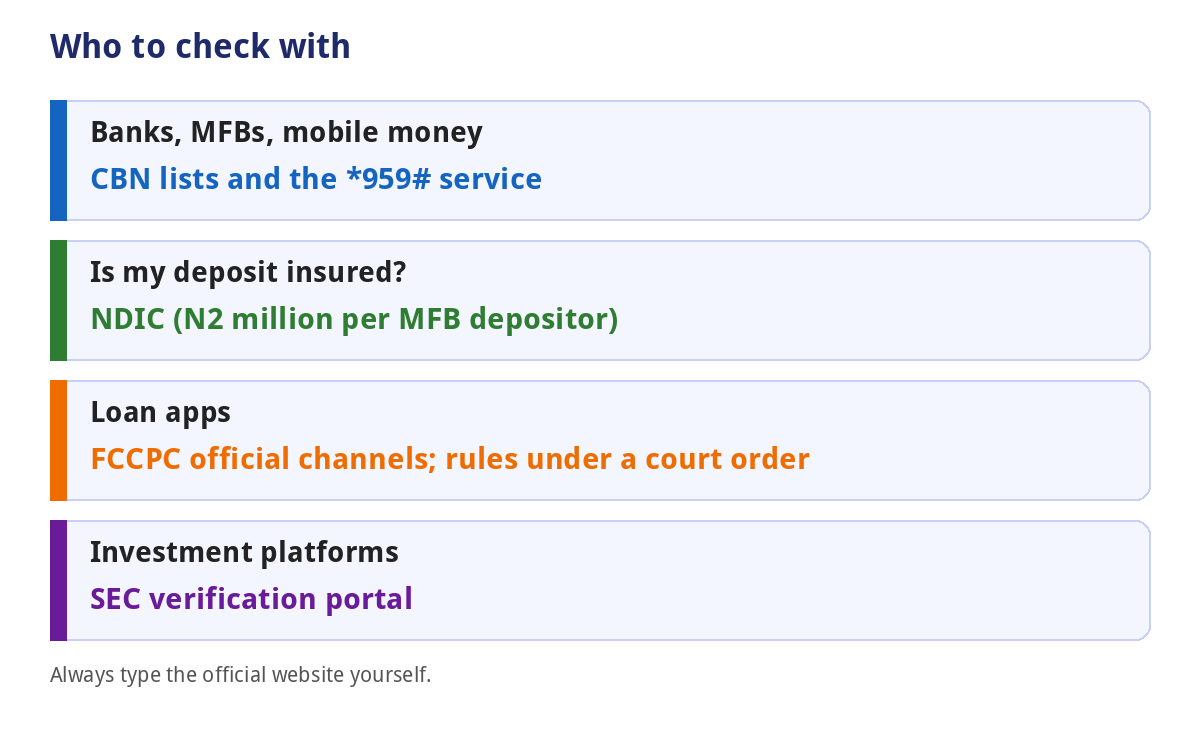
- CBN: commercial banks, merchant banks, microfinance banks, non-interest banks, payment service banks, mobile money operators, primary mortgage banks, finance companies, bureaux de change and others. The CBN publishes a category page for each type of institution.
- NDIC: insures deposits at licensed banks and microfinance banks and pays depositors when one fails.
- FCCPC: protects consumers of digital lenders and many other businesses.
- SEC: regulates investment platforms, capital market operators and, under the Investments and Securities Act 2025, online forex and digital asset platforms. See our guide to forex trading in Nigeria.
- NDPC: the data protection regulator. See our guide to data privacy.
Many fintech apps you use are not banks themselves. They may operate under a partner bank, a microfinance bank licence or a payment licence. Our guide to the best fintech apps in Nigeria compares popular ones, and you should still check who holds your money.
How to check a bank, microfinance bank or fintech
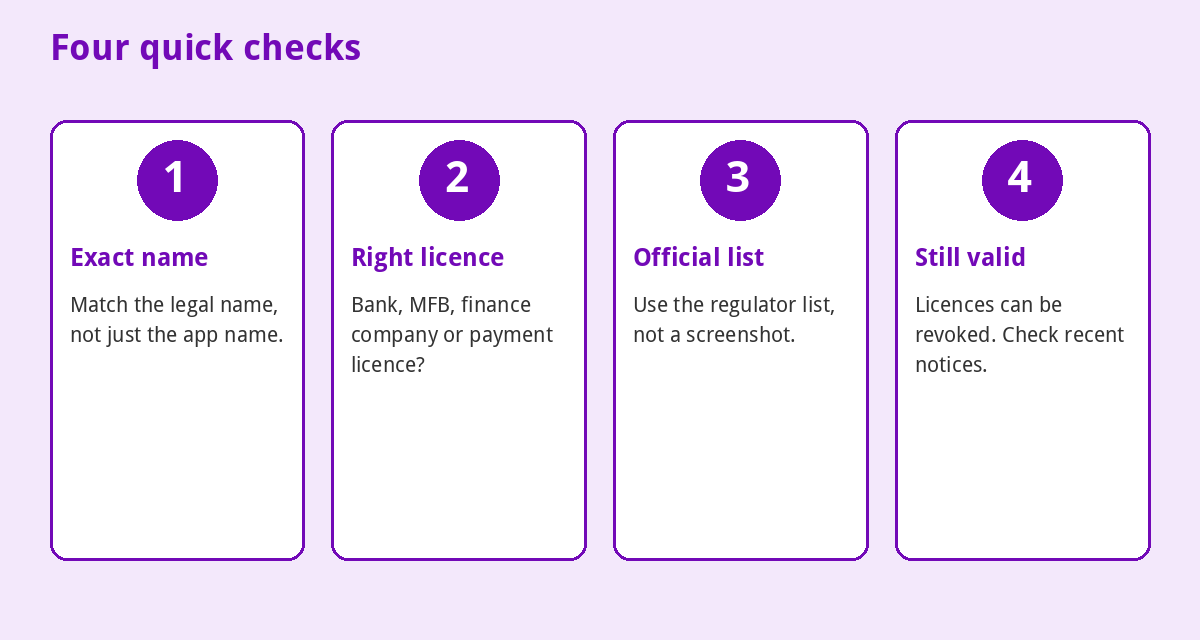
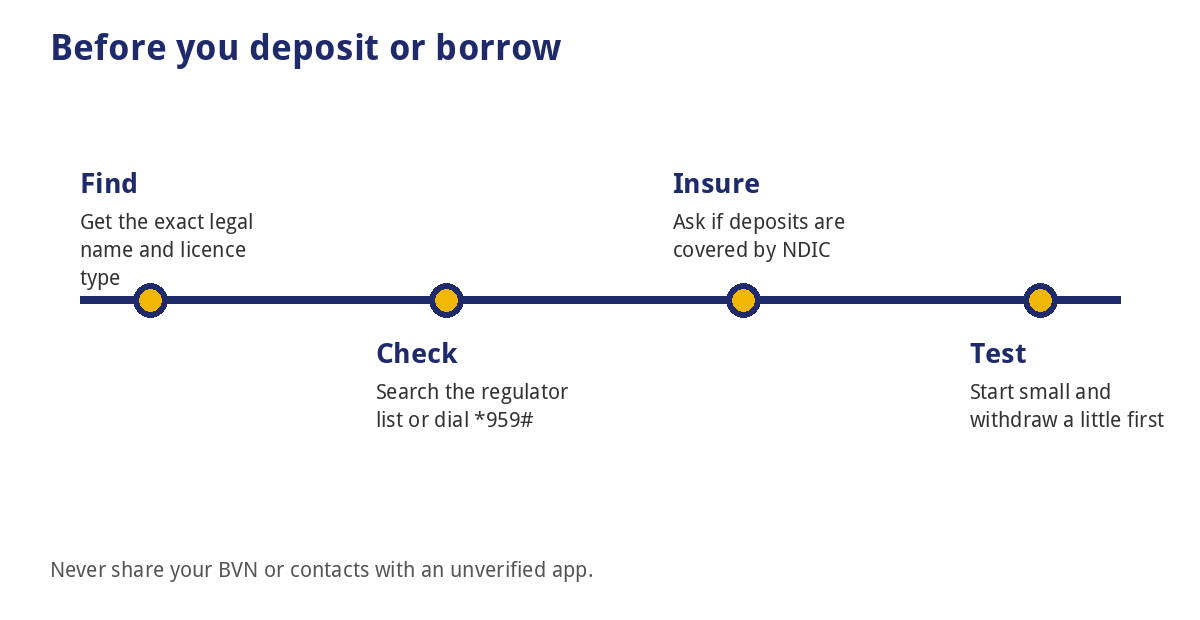
- Get the exact legal name. Look in the app’s terms, its “About” section or its website footer. A brand name is not enough, and the company that holds your money may have a different name.
- Find the licence type. Is it a bank, microfinance bank, finance company, mobile money operator or a payment licence? The type decides which list to use.
- Search the CBN’s list for that category on cbn.gov.ng. The CBN’s supervision section has a page for each type, including microfinance banks, mobile money operators, payment service banks, finance companies and bureaux de change. Type the address yourself.
- Use the CBN USSD service. The NDIC told depositors to dial *959# and follow the prompts to search for a bank by name, as reported by Africa Check in August 2026.
- Check recent notices. A company can lose a licence after once holding one. Look for recent CBN and NDIC announcements.
- Do not rely on screenshots or documents the institution gives you. The NDIC specifically advised using the official list.
- Ask whether your deposit is insured by the NDIC and for how much. Check the NDIC’s own directory or tools, and not the app’s marketing claim.
- Test it. Start with a small deposit, make a withdrawal and check that statements and alerts are correct before moving more money.
What happened to the 46 microfinance banks?
The NDIC’s managing director said the CBN revoked the licences of 46 microfinance banks on 1 July 2026, citing breaches including under-capitalisation and prolonged inactivity, according to Legit.ng. The NDIC began paying eligible depositors on 22 July through an automated process using NIBSS and customers’ BVNs, and customers whose accounts could not be traced were told to go to the nearest NDIC zonal office. The NDIC insures each depositor up to N2 million per microfinance bank. Balances above that are paid only from what the liquidator recovers.
The lessons are practical. Know which institution holds your money, do not park large sums in one microfinance bank, keep your statements and ID, and link your BVN properly so that you can be paid quickly. See our guide to the BVN.
Loan apps: what the FCCPC rules say and where they stand
The Digital, Electronic, Online and Non-Traditional Consumer Lending Regulations, 2025 took effect on 21 July 2025, with a compliance deadline of 5 January 2026. Nairametrics reported in January 2026 that 521 digital lenders were under FCCPC oversight: 457 with full approval, 35 with conditional approval and 29 licensed by the CBN but still within the framework, with 103 apps from unregistered companies on a watchlist. The FCCPC said it could delist apps, impose penalties of up to N100 million or 19% of turnover and disqualify directors for up to five years. The rules also bar apps from accessing customers’ contact lists, pictures and transactions.
Then the picture changed. The FCCPC said in late June 2026 that the regulations have been on hold since 15 April 2026 under a Federal High Court order in a suit brought by the Wireless Application Service Providers Association of Nigeria (WASPAN), that it is complying with the order, and that no new approvals or licences have been issued under them. It called a report of 48 new approvals and 505 licensed lenders “false, misleading” and told the public to rely only on its official channels. Neither report named a public register where you can check a lender yourself.
What that means for you:
- Do not trust lists of “approved” or “banned” loan apps on blogs, social media or WhatsApp, including lists that claim to be updated for 2026. We found one that gave no sources for its counts.
- A lender that is a CBN-licensed bank, microfinance bank or finance company can be checked on the CBN lists. An app that says it is licensed should give a company name and licence type that you can look up.
- Read the repayment terms. Look at the total repayment against the amount you actually receive, the tenor and any fees deducted upfront.
- Do not allow access to your contacts, photos or messages. The 2025 rules ban it, but a court-suspended rule does not stop a rogue app from asking.
- If a lender harasses you or your contacts, keep screenshots and report to the FCCPC and the police. See our guide on how to report cybercrime.
- Avoid any app that asks you to pay a fee before you receive the loan.
Red flags
- No company name, address, licence type or complaints channel.
- Guaranteed returns or very high interest on deposits. See our guide to internet scams.
- A “licence” you can only see in a screenshot or a document sent on WhatsApp.
- Pressure to move money quickly, or to pay a fee to withdraw.
- An app that asks for access to contacts, photos or SMS.
- Customer care only on WhatsApp or Telegram.
- A website address that is a slightly different spelling of a known brand. See our guide on fake alerts and phishing.
If your bank or fintech has a problem
- Complain to the institution first and keep a reference number. See our guide to recovering money sent to the wrong account.
- If it is not resolved, escalate to the CBN’s Consumer Protection Department, which expects you to have complained to the institution first and given it about two weeks.
- If the institution has been closed, follow NDIC announcements and use official channels only, because scammers target people waiting for refunds.
Common mistakes
- Assuming an app is a bank because it holds an account number.
- Putting everything in one microfinance bank.
- Taking a licence number from the app itself and not checking it.
- Believing blog lists of “CBN-approved” loan apps.
- Giving a loan app your contacts.
- Not keeping statements and receipts.
- Clicking links about refunds or licence updates in messages.
Frequently asked questions
How do I know if a bank is licensed in Nigeria?
Check the CBN’s list for that category on its website, or use the CBN USSD service on *959#, and confirm recent notices.
Is my money safe in a fintech app?
It depends on who holds it. Check which licensed bank or microfinance bank is behind it and whether deposits there are NDIC-insured.
How much does the NDIC insure?
For microfinance banks, up to N2 million per depositor per bank, according to the NDIC. Ask the NDIC about other institutions.
Are loan apps regulated?
Yes in principle, but the FCCPC says its 2025 digital lending rules are suspended by a court order, so no new approvals are being issued. Use caution.
Is there an official list of approved loan apps?
We did not find a public register named in the FCCPC’s own statements. Check its official channels, not blog lists.
What if my microfinance bank closes?
Follow NDIC announcements. If you have a BVN you may be paid automatically; otherwise visit an NDIC zonal office with your documents.
Who do I report a fake financial company to?
Report to the relevant regulator (CBN, SEC or FCCPC) and to the police or EFCC.
Bottom line
Check before you deposit, not after. Get the exact legal name, find it on the regulator’s own list, ask about NDIC cover, start small, and treat loan app lists on blogs with suspicion while the FCCPC rules are in court. If a company cannot show you who it is and who regulates it, keep your money and your BVN.
Sources
- Central Bank of Nigeria: Financial institutions (supervision)
- Africa Check: Explainer, Nigeria’s central bank revoked 46 microfinance bank licences (4 Aug 2026)
- Legit.ng: NDIC begins paying depositors of 46 failed microfinance banks (23 Jul 2026)
- Legit.ng: FCCPC denies approving 48 new loan apps (29 Jun 2026)
- Nairametrics: Loan apps, 521 companies now on FCCPC’s radar (7 Jan 2026)
- Templars: The FCCPC sets deadline for registration of digital lenders (18 Nov 2025)
- Central Bank of Nigeria: How to lodge a complaint
- Lagos Fintech Hub: Loan apps under regulatory action (1 Jul 2026) (commercial, monetised site; counts and licence labels unsourced and not used)