
How to Start a Cooperative Society in Nigeria (2026): Requirements, Registration Steps and the New Revalidation

Last updated 18 November 2026. Minimum numbers, fees and forms differ by state, so check with your state cooperative office before you pay anyone.
A cooperative society is the group-money tool most Nigerians already know. Workmates pool savings, farmers buy inputs together, a church group runs a loan fund. Many of these groups run for years on trust alone, then hit trouble the first time a member defaults, someone wants out, or a treasurer goes quiet. Registering the society gives it a legal footing, a set of rules everyone has signed, and a paper trail.
This guide covers how the process works in 2026, what the law says and what changed this year. I drew on the text of the Nigerian Co-operative Societies Act, a Lagos State registration guide, a law-firm note on the registration procedure and the federal announcement on cooperative revalidation in August. I am not a lawyer, and I could not find a current published fee schedule for any state, so read the cost section as a pointer rather than a quote.
Which law covers cooperatives
The Nigerian Co-operative Societies Act says it applies throughout the Federation. It provides for a Director of Co-operatives at federal level and for state directors appointed by governors. In practice you deal with your state ministry or department of cooperatives, which is why requirements differ from state to state.
A registered society is a body corporate with perpetual succession. The Act also says the Companies and Allied Matters Act does not apply to registered societies, so a cooperative is not registered with the Corporate Affairs Commission. If a company or business name suits your plan better, see our guides on how to register a limited company with CAC and how to register a business name.
Kinds of society you can form
The Act recognises primary societies, which are made up of individual members, industrial societies, and secondary societies, which are made up of registered societies. Most readers want a primary society. In everyday use these are grouped by purpose: thrift and credit societies that save and lend among members, farming and produce societies, consumer shops, housing societies and multipurpose societies that do several of these jobs. The purpose decides what your bye-laws need to say, and a lending society has extra rules that I cover below.
How many members you need
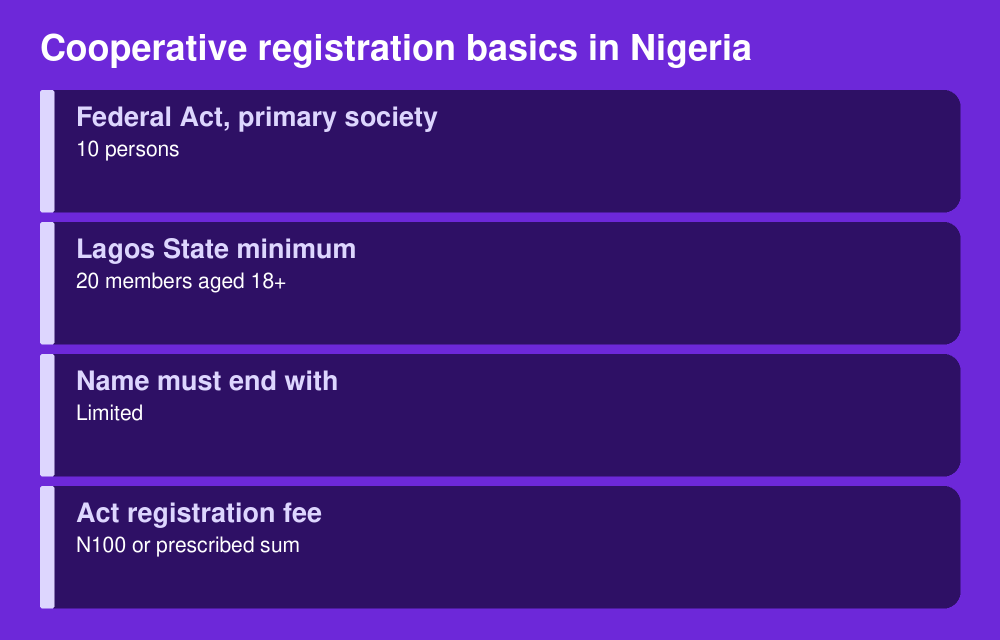
- Federal Act, primary society: at least 10 qualified persons.
- Federal Act, industrial society: at least 6 persons, and the society must be economically viable.
- Federal Act, secondary society: at least 5 registered societies.
- Lagos State guide: at least 20 members, each aged 18 or older, of good character and of sound mind.
The gap between 10 and 20 is real. The Act sets a floor and a state office can ask for more in its own procedure. A 2017 law-firm note I read quotes other figures again, 50 for an agricultural society and 20 for a savings and credit society, so ask your state office which number it applies to your type of society and get the answer in writing.
Membership age differs too. Section 22 of the Act says 16 or older, while the Lagos guide asks for 18. A primary society can be cancelled if its membership falls below the minimum, so recruit a few more people than the bare number.
Step by step
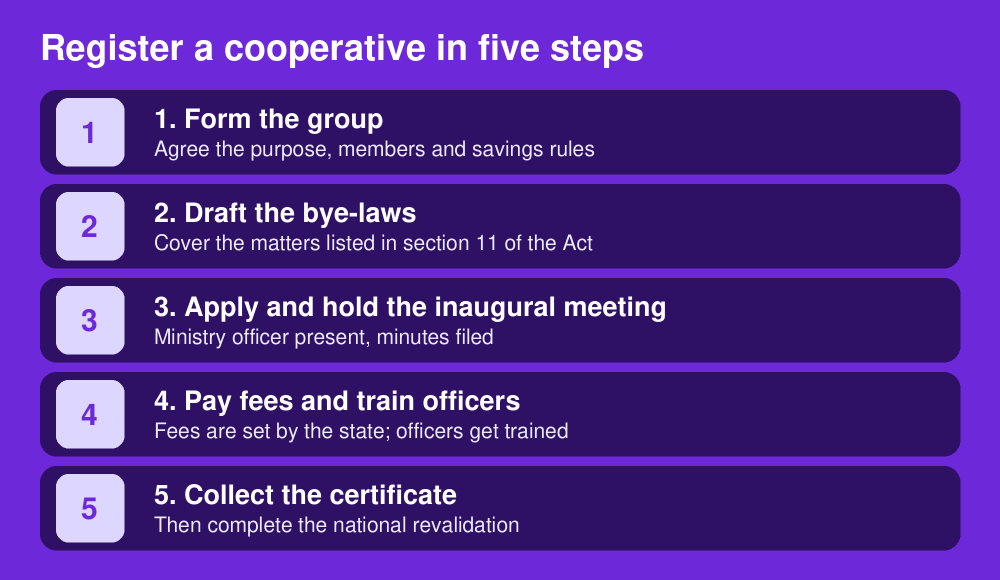
- Form the group and agree what it is for. Decide who can join, how much each member saves and how loans will work.
- Draft the bye-laws. Have a lawyer or your state cooperative office read them before you submit.
- Write to the state office. In Lagos the application goes to the Permanent Secretary of the Ministry of Commerce, Industry and Cooperatives, with a letter of intent, the application, an invitation to the inaugural meeting, a statement of objectives and a copy of the bye-laws. Other states have their own forms.
- Hold the inaugural meeting with a ministry representative present, then file the minutes.
- Pay the fees. The Lagos guide says fees are payable for registration and for training the board of trustees, and gives no amounts.
- Send your officers for induction. In Lagos the president, treasurer and secretary attend a course at the Lagos State Cooperative College.
- Wait out the monitoring period. Lagos monitors a new society for three months after induction and issues the certificate if it is satisfied.
Under the Act the Director must decide on an application within 60 days, and a refused society has 60 days to appeal. The older law-firm note describes a different route, in which a letter of recognition lets the society operate for three years before a full certificate is issued. Procedures vary, so plan for several months and ask what your office does.
What the bye-laws must cover
Section 11(2) of the Act lists the matters a society’s bye-laws have to deal with: the name, objects and area of operation, membership terms, how funds are used and invested, member liability, withdrawal and expulsion, transfer of shares, capital, meetings, committee powers, who signs for the society and how the yearly surplus is shared. A lending society adds interest rates, loan limits, repayment periods and what happens on default. The bye-laws may also allow fines for breaches, recoverable as a civil debt, and a change to them only takes effect once it is registered.
In my view the clauses that decide whether a group survives are the dull ones. Write down exactly how a member leaves and gets their savings back, and what happens when a loan goes bad, before you argue about anything else.
The name has rules as well. It must include “Co-operative” and end with “limited”, and only a central financing society may use “bank” or “banking”.
What it costs
The Act names a registration fee of N100 or a prescribed sum. That is the figure written into the law decades ago, and state fee schedules are set separately. Lagos charges a registration fee and a trustee training fee, but the guide I read gave no amounts, and the websites that quote exact naira prices gave no official source. Ask the state office for its written fee schedule, pay into a government account against a receipt and never hand cash to an “agent” who promises to speed things up.
Budget for the smaller costs as well: a lawyer to check the bye-laws, printing, a venue for the inaugural meeting and, once you are running, an auditor.
Running the society once it is registered
- The society must have its accounts audited every year by an auditor it approves in writing. The Director or an authorised person can inspect the books, the cash and the offices.
- The Director may prescribe returns. The Lagos guide adds statutory books of account, an annual statement of accounts and regular meetings, including an annual general meeting.
- Nobody outside the membership may hold more than one fifth of the share capital.
- A member who leaves stays liable for the society’s debts for two years. The same two-year rule applies to the estate of a member who dies.
- The Director can order an inquiry on the request of a majority of the committee or one third of members. If a committee is found inefficient, the Director can take over management for up to two years, and can surcharge people who misapply funds.
The fines in the Act are small by today’s standards, around N1,000 and up to six months in prison for misapplying society property, but the surcharge power is the one that matters, because it can force an officer to repay money with interest.
Tax and other benefits
The Act gives a registered society corporate status, exemption from stamp duties and registration fees on its instruments, and a first charge over members’ produce and similar assets for debts owed to the society. It also says registered societies are exempt from tax under section 26 of the Companies Income Tax Act. Nigeria rewrote its tax laws with effect from January 2026, so I could not confirm how that exemption reads today. Ask your state office or a tax adviser before you assume it.
The 2026 revalidation
On 12 August 2026, at a national workshop on cooperative digitalisation in Abuja, the Federal Ministry of Agriculture and Food Security, the Cooperative Federation of Nigeria and Seamfix Limited signed an agreement to deploy a national cooperative identity system. Aliyu Sabi Abdullahi, the Minister of State for Agriculture and Food Security who supervises cooperative affairs, spoke at the event.
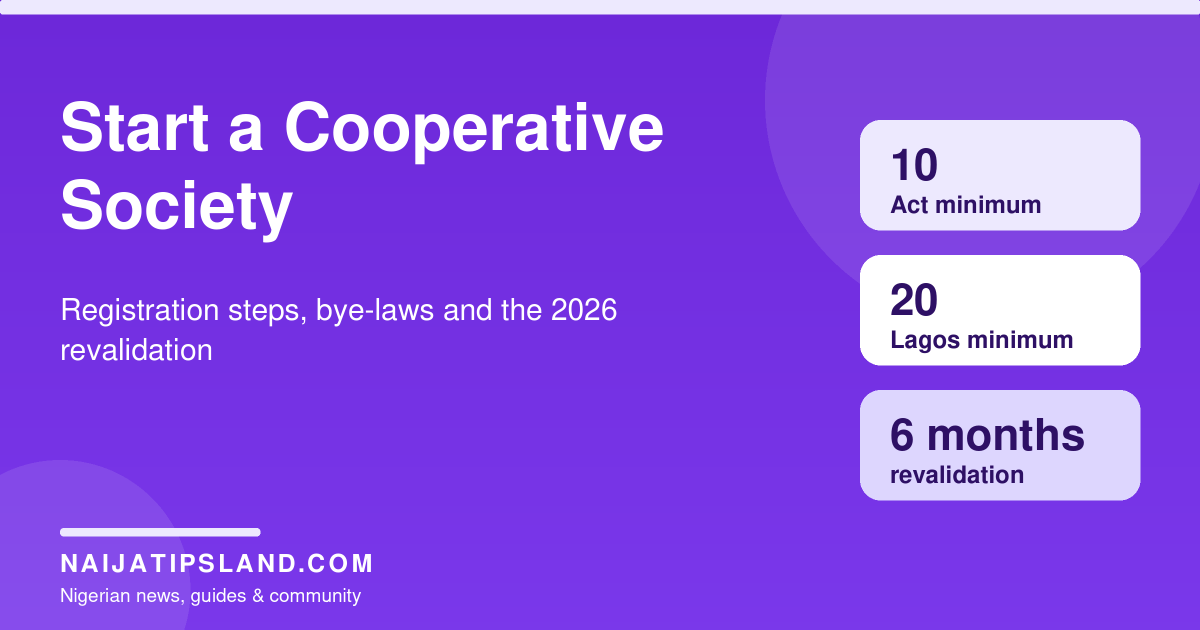
The system has a National Cooperative Smart Registry, a Cooperative Verification Number for each society and a CoopID for individual members, and it is meant to link with the CoopCHECK credit bureau. A six-month national revalidation and re-certification exercise for existing cooperatives started immediately. Societies are told to go to their State Department of Cooperatives to have their records verified, after which they are onboarded to the registry and issued a verification number. Members receive their CoopID progressively.
The announcement gave no exact deadline and no penalty. Six months from mid-August ends around mid-February 2027, so if you are an officer of an existing society, do not leave it to the last week. If you are starting a new one, ask the state office how new registrations are entered into the registry.
How to spot a fake cooperative
On 8 May 2026 the Securities and Exchange Commission warned Nigerians about unregistered online investment schemes promoted on WhatsApp, Instagram, Telegram, Facebook and TikTok, many of which showed the marks of Ponzi schemes. It told people to check a platform’s registration before sending money. Our guide to Ponzi schemes in Nigeria has the wider warning signs.
A genuine cooperative lends its members’ own money to members and shares the surplus under its bye-laws. Walk away if the group:
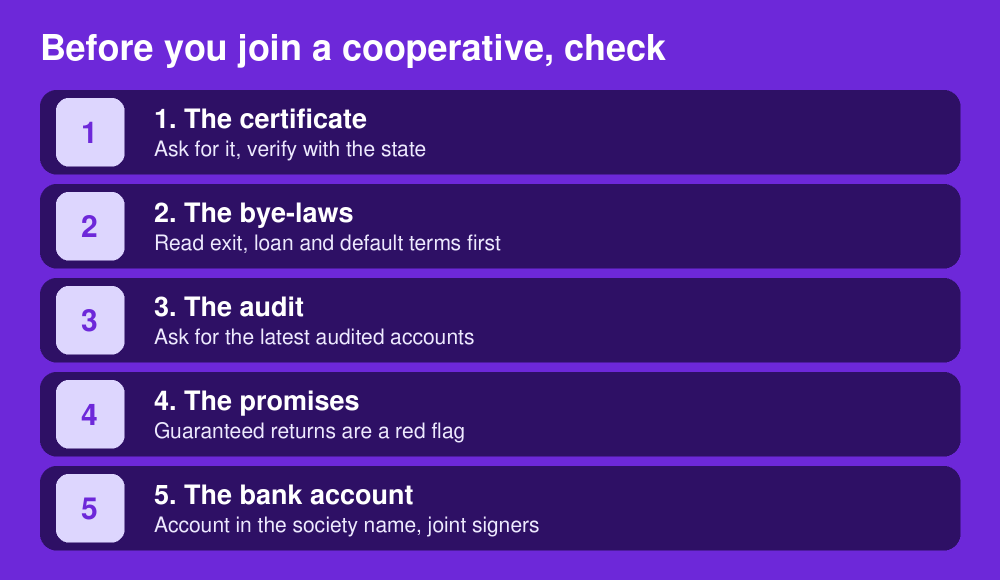
- promises guaranteed or fixed high returns;
- cannot show a registration certificate that the state office will confirm;
- asks you to pay into a personal account;
- has no audited accounts to show;
- recruits mainly through social media adverts.
If you are starting a business rather than a savings group, our start a business in Nigeria hub covers company registration, tax and licences, and the personal finance hub has more on saving safely.
Related guide (updated 18 November 2026)
How to Get a Small Business Loan in Nigeria (2026): Real Options, Rates and Safe Lenders Compare BOI RAPID, AGSMEIS, DBN and bank loans, see what a loan really costs after the September rate cut, and learn how to check a loan app is registered.
FAQ
Do I need a lawyer to register a cooperative?
None of the sources I read makes it compulsory. The bye-laws have to fit the Act, though, so a legal read-through before you submit can save you a rejection.
How long does registration take?
The Act gives the Director 60 days to decide on an application. Lagos adds a three-month monitoring period before the certificate is issued, so allow several months in total.
Is a cooperative registered with CAC?
No. Cooperatives register with the state cooperative office under the Co-operative Societies Act, and the Act says the Companies and Allied Matters Act does not apply to registered societies.
Can a cooperative call itself a bank?
No. Only a central financing society may use the words “bank” or “banking” in its name.
What happens if a member wants to leave?
Your bye-laws decide how withdrawal and the return of savings work. Under the Act a past member stays liable for the society’s debts for two years after leaving.
Does my existing cooperative need to do anything in 2026?
Yes. The federal government announced a six-month national revalidation in August 2026. Contact your State Department of Cooperatives to have your records verified and to get your verification number.
Sources
- Nigerian Co-operative Societies Act (Laws of Nigeria, PLAC)
- Federal Ministry of Information and National Orientation: FG signs MoU to deploy national cooperative digital identity system, announces 6-month revalidation (12 August 2026)
- Legal 500 / Mondaq: Registering a cooperative society in Lagos State
- Mondaq: Procedure for registration of cooperative society in Nigeria (4 April 2017)
- Nairametrics: SEC warns Nigerians against rising Ponzi schemes on WhatsApp, TikTok, Instagram (14 May 2026)
Join the discussion
Have you tried this, or do you have a question we did not answer? 1 reader has already shared their view. Naijatipsland members help each other with real, first-hand experience.





Editor note: have you run or joined a cooperative or thrift society? Tell us in the comments how it was registered, what the bye-laws said about leaving, and whether your state office asked you to revalidate. Please leave out names and account numbers. We read every comment. – Ade