How to Become a Content Creator in Nigeria and Get Brand Deals (2026): Platforms, Pay, Rules and Tax

Last updated 25 November 2026. Platform rules, brand rates and tax guidance change often, so check each platform’s own page and the tax authority before you rely on a figure. This is general information, not financial, legal or tax advice.
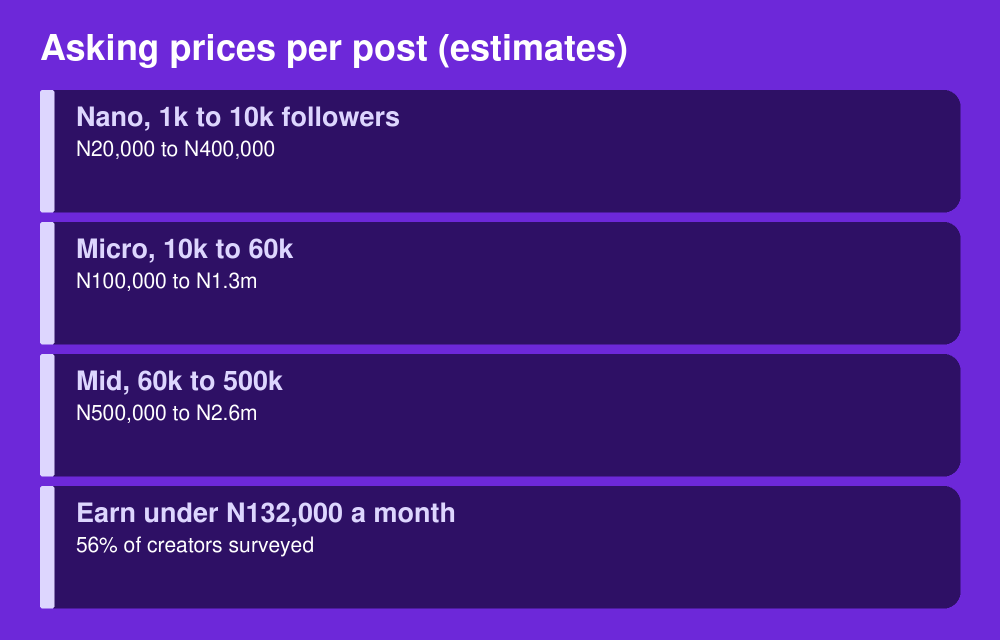
Plenty of Nigerians want to earn from making videos and posts. Very few do it full time. A creator survey quoted by Profolio found that 56.45% of surveyed Nigerian creators earned below ₦132,000 a month, about US$100, and only 3.23% earned more than ₦6.6 million. So the first thing to settle is what you want from this: a side income, a platform that wins you clients for another business, or a full-time career. Each needs a different plan.
This guide covers how to start, which platforms actually pay a creator in Nigeria, what brands tend to charge, how to find and keep brand deals, and the advertising and tax rules that now apply. If you want the wider picture of earning online, see our make money online in Nigeria hub.
Choose a niche and one main platform
A niche is the topic people come to you for. Food, phones, fashion, skincare, football, small business advice, comedy, parenting and life in the UK for Nigerians are all crowded, and all of them still work, because a brand wants an audience that already trusts you on its subject. A creator who talks about hair every week is easier to sponsor than one who posts about everything.
Pick one platform to be good on before you spread out. TikTok and Instagram Reels are the usual places to grow quickly. YouTube grows slower but pays you directly once you qualify. Facebook has started courting creators with its own payment schemes, covered below. Cut your best videos down for the other platforms once your main one is working.
What each platform pays in Nigeria
This is where many guides promise too much, so here is what the sources say.
TikTok
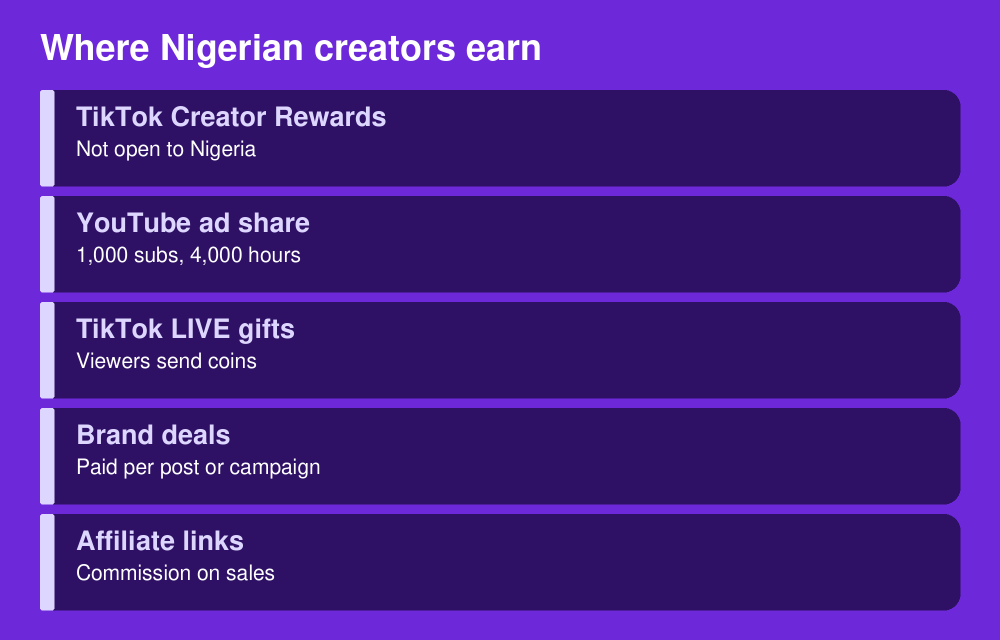
TikTok’s Creator Rewards Programme, the one that pays for qualified views, is not open to Nigeria. Business A.M. reported in December 2025 that Nigeria was left out of the 2025 update, which named only Morocco, Egypt and South Africa among African markets. Legit.ng’s guide lists the United States, United Kingdom, Germany, Japan, South Korea, France, Mexico and Brazil as the eligible countries for the main programme. I could not find a source showing that this changed in 2026, so check the TikTok app before you plan around it.
That does not mean TikTok is useless here. Nigerian creators earn through LIVE gifts, brand partnerships and affiliate links. Legit.ng also says TikTok Shop is not available in Nigeria, so creators sell their own products or services through their videos. Our TikTok guide for Nigerians goes deeper on what works.
YouTube
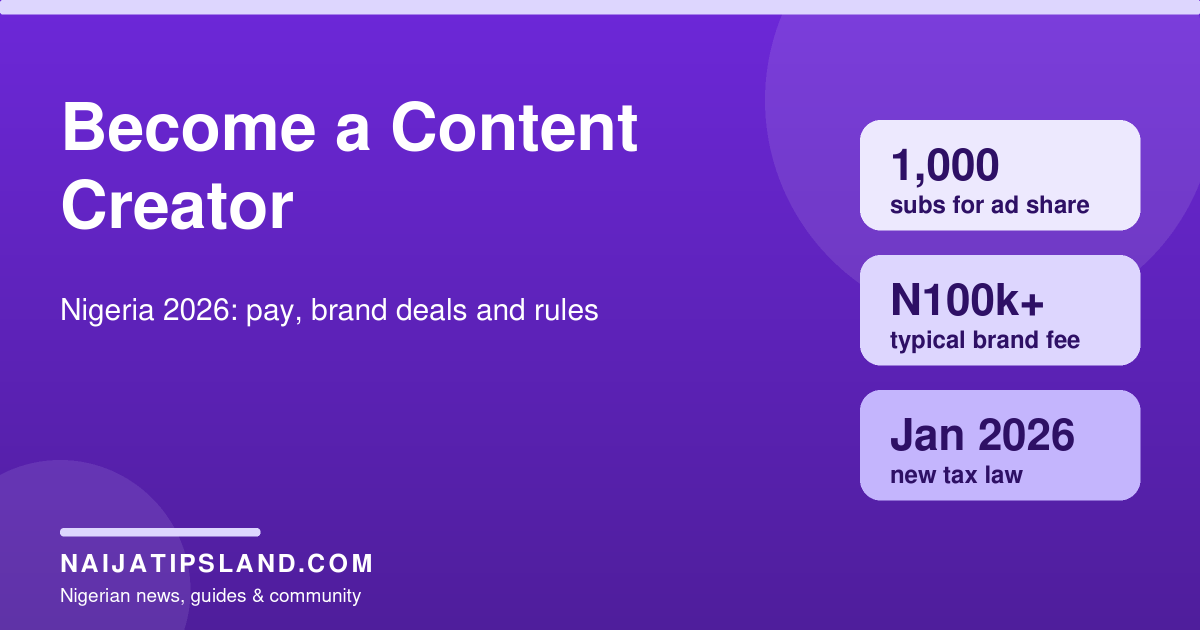
YouTube is the clearest route to platform income. To share in ad revenue you currently need 1,000 subscribers plus either 4,000 qualified public watch hours in the past 12 months or 10 million public Shorts views in the past 90 days. A smaller tier at 500 subscribers unlocks fan funding such as memberships and Super Chat.
BrandsPur Nigeria reported in August 2026 that the entry bar for new applicants rises on 1 February 2027 to 1,000 subscribers plus 8,000 watch hours or 20 million Shorts views, with existing members told to accept updated terms in YouTube Studio by 31 January 2027. That is a trade-press report, so check YouTube’s own Partner Programme page. If you are close to the current numbers, it is worth qualifying before the change. Our guide to starting a YouTube channel in Nigeria and getting monetised covers the application and AdSense payments.
allAfrica reported in March 2026 that Facebook has a Creator Fast Track scheme for people with existing followings elsewhere. It offers about $1,000 a month to creators with at least 100,000 followers on another platform, and up to $3,000 a month above 1 million, guaranteed for three months. The report does not say whether Nigerian creators can join, so treat it as something to check, not something to count on.
Instagram and everything else
For most Nigerian creators, Instagram income comes from brand deals rather than from the platform itself. The same goes for X and LinkedIn. That makes your pitch and your contract the most important skills you can learn.
How much brands pay in naira
Rates vary a lot, and published figures are asking prices, not proof of what was paid. Legit.ng puts brand partnerships at ₦100,000 to over ₦1 million per deal, depending on engagement and follower count. Profolio’s tables, which combine two Nigerian rate sources, list these asking prices per sponsored post, converted at ₦1,321.22 to the dollar (the CBN rate on 4 September 2026):
- Nano creators, 1,000 to 10,000 followers: about ₦20,000 to ₦400,000
- Micro creators, 10,000 to 60,000 followers: about ₦100,000 to ₦1.3 million
- Mid-tier creators, 60,000 to 500,000 followers: about ₦500,000 to ₦2.6 million, though the source gives no date for this band
The two Nigerian rate guides Profolio used differ by roughly threefold at the same follower level. Take that as a sign that you should price on your own results: your average views, your engagement, how well your audience matches the brand, and how many posts, stories or videos the brand wants. A single post with a one-day story costs less than three videos with full rights for six months. Say so in your quote.
How to get brand deals
Brands rarely find a new creator by accident. You usually have to go to them.
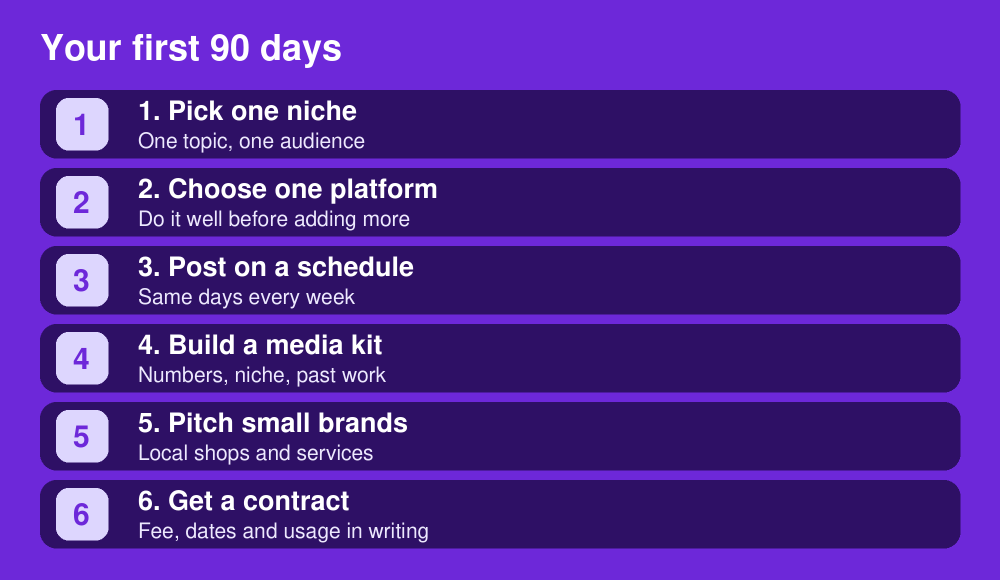
- Make a one-page media kit. Put your name, niche, platform links, audience location and age split, your average views on the last ten posts, and two or three examples of your best work. Keep it to a page and send it as a PDF.
- Start with brands near you. A hair salon, a restaurant, a phone shop or a tutor in your city is more likely to say yes to a small creator than a national company. A good result for them is the best reference you can get.
- Write a short pitch. Say who you are, why your audience fits their product, and what you propose to make. Name a price or a range. If you leave it open, brands will offer the lowest figure.
- Ask for a brief. A brand should tell you the message, any words to avoid, the posting dates and whether they want to reuse your content in their own ads.
- Keep proof. Save screenshots of views, comments and link clicks. Send a short results note after each campaign. Repeat clients are where most creator income comes from.
If you also sell services, such as editing, photography or social media management, those often pay more reliably than sponsored posts while your following is small. See our guide to freelance websites for Nigerians for places to find that work.
Advertising rules you need to know
TheCable reported that the Advertising Regulatory Council of Nigeria, ARCON, says influencers and content creators must get its approval before publishing advertisements, and that social media falls within its remit. An Afriwise overview of Nigerian influencer law gives the penalty as up to ₦1,000,000 per infraction, with vetting required for digital advertising too. Brands that work with agencies usually handle vetting themselves, but ask the brand whether the advert has been approved before you post it, and keep their answer in writing.
Disclosure matters as well. The same overview says influencers must clearly disclose paid partnerships so that promotions are not passed off as ordinary content, and that platforms’ own terms usually require it. Use the platform’s paid partnership label or a plain word such as “ad” or “sponsored” at the start of the caption, not buried in hashtags.
Consumer protection law applies to what you say. Do not promise results a product cannot deliver, invent testimonials or misstate prices. For health and skincare products in particular, repeat only what the brand can prove, and avoid promoting products that carry no NAFDAC number where one is required.
Contracts and getting paid
Get the deal in writing, even if it is a short email both sides confirm. It should cover the fee, the number and type of posts, the dates, how long the brand can reuse your content, who approves drafts, and the payment date. Ask for part of the fee upfront for larger jobs, for example half before you start and half on posting.
Dollar deals from international brands need a way to receive the money. Our guide on receiving international payments as a Nigerian freelancer compares Payoneer, Wise, Grey and bank domiciliary routes, and the dollar account guide covers opening one.
Tax on creator income from 2026
The Nigeria Tax Act 2025 began applying in January 2026. Legit.ng’s explainer says the law covers content creators and influencers, and lists these personal income tax bands: the first ₦800,000 a year at 0%, the next ₦2.2 million at 15%, the next ₦9 million at 18%, the next ₦13 million at 21%, the next ₦25 million at 23%, and income above ₦50 million at 25%. If you run your creator work as a registered company, company income tax rules apply instead.
TechCabal reports that self-employed people are expected to declare their income, work out their tax and pay it, and that the tax authority plans to match data from banks and large platforms. It gives penalties starting at ₦50,000 for minor offences. Keep a simple record of every payment you receive, the brand and the date. Our guides on personal income tax in 2026, getting a TIN and filing your personal tax return online walk through the steps. A qualified accountant can tell you which expenses you can claim.
Scams to avoid
- A “brand” asks you to pay a registration, verification or product fee before they pay you. A real brand pays creators, not the reverse.
- You are sent a cheque or transfer for more than the agreed fee and asked to forward the difference. The first payment is usually fake or reversed later.
- A messenger account offers huge pay for little work and pushes you to move to a private chat or install an app.
- A contract that gives the brand your content for ever, in every country, with no extra fee.
Check the company’s website, its social pages and its other creator campaigns before you reply. Never share your BVN, banking passwords or one-time codes with a brand.
FAQ
How many followers do I need to get brand deals in Nigeria?
There is no fixed number. Small shops and local services sometimes work with creators who have a few thousand engaged followers. Larger brands usually look for tens of thousands, or for a proven audience in their target group.
Does TikTok pay creators in Nigeria?
Not through its main Creator Rewards Programme, according to reports from late 2025. Nigerian creators earn through LIVE gifts, brand deals and affiliate links. Check the TikTok app for any change.
How many YouTube subscribers do I need to earn from ads?
Currently 1,000 subscribers plus 4,000 qualified watch hours in the past year, or 10 million public Shorts views in the past 90 days. A report says new applicants will need more from 1 February 2027, so confirm on YouTube’s page.
Do I pay tax on money from brand deals?
Under the Nigeria Tax Act 2025, income from content creation is taxable once it passes the annual threshold, which explainers put at ₦800,000 before the 0% band ends. Keep records and speak to an accountant for your case.
Do I need ARCON approval before I post an ad?
ARCON says advertisements need its vetting before publication and that this covers influencers. Ask the brand or agency whether the ad has been approved, and get the answer in writing.
How can I tell a real brand deal from a scam?
A real brand pays you and does not ask for money upfront. Check the company independently, read the contract, and do not share banking details or codes.
Sources
- Business A.M.: TikTok snubs Africa’s largest creator market as Nigeria missed in 2025 rewards rollout
- Legit.ng: Does TikTok pay Nigerian creators and how to monetise TikTok in Nigeria
- YouTube Help: Partner Programme overview and eligibility
- BrandsPur Nigeria: YouTube to double monetisation entry requirements from February 2027
- allAfrica: Facebook targets TikTok and YouTube creators with $3,000 monthly pay
- Profolio: How much do content creators earn in Nigeria
- TheCable: ARCON says influencers and content creators must obtain approval for advertisements
- Afriwise: Influencer and digital marketing regulation in Nigeria
- Legit.ng: 25 questions and answers on Nigerian tax law from January 2026
- TechCabal: Why freelancers and influencers can’t escape Nigeria’s new tax rules
Join the discussion
Have you tried this, or do you have a question we did not answer? Be the first to share your experience. Leave a comment below. Every comment is read by the editor before it appears.



Editor note: are you a creator in Nigeria or the diaspora, or thinking of starting? Tell us your niche, your main platform and what has been hardest so far, whether that is the first followers, getting paid or finding brands. Please leave out bank details and private contact information. – Ade