
How to File Your Personal Tax Return Online in Nigeria (2026): Step by Step

Last updated 19 November 2026. Tax rules, portals and deadlines change, and each state sets its own arrangements. Check your own state internal revenue service before you file. I am a writer, not a tax adviser, and I did not file through every portal myself, so the steps below follow published guides and official figures, which I list at the end.
Most people in Nigeria hear about tax returns twice a year: once when a bank or an employer mentions a Tax Identification Number, and again when a news story says the March deadline is close. If you have never filed, the process looks like a wall of forms. It is less bad than it sounds. For most employees and small traders it comes down to a Tax ID, an online account and about an hour with your payslips and bank statements.
This guide walks through who has to file, how to file online, what the new rates and reliefs look like for 2026, and what a missed deadline can cost. I use the Lagos portal for the worked steps because it is the best documented, and I say where other states differ.
Who has to file a return
In broad terms, anyone who earns income in Nigeria files an annual return for the year just ended. That includes salaried staff, freelancers and business owners. Employees are not excused just because PAYE comes out of the payslip. An employer files its own schedule of staff pay and tax, and many portals show that filing under your account, but you may still need to file your own return if you have other income, such as rent, side work or dividends, or if you want to claim a relief.
If you are not sure which camp you fall into, log in to your state portal and look at what the employer has already filed. Our guide to personal income tax in Nigeria for 2026 explains how PAYE is worked out and who counts as a taxpayer.
The deadline
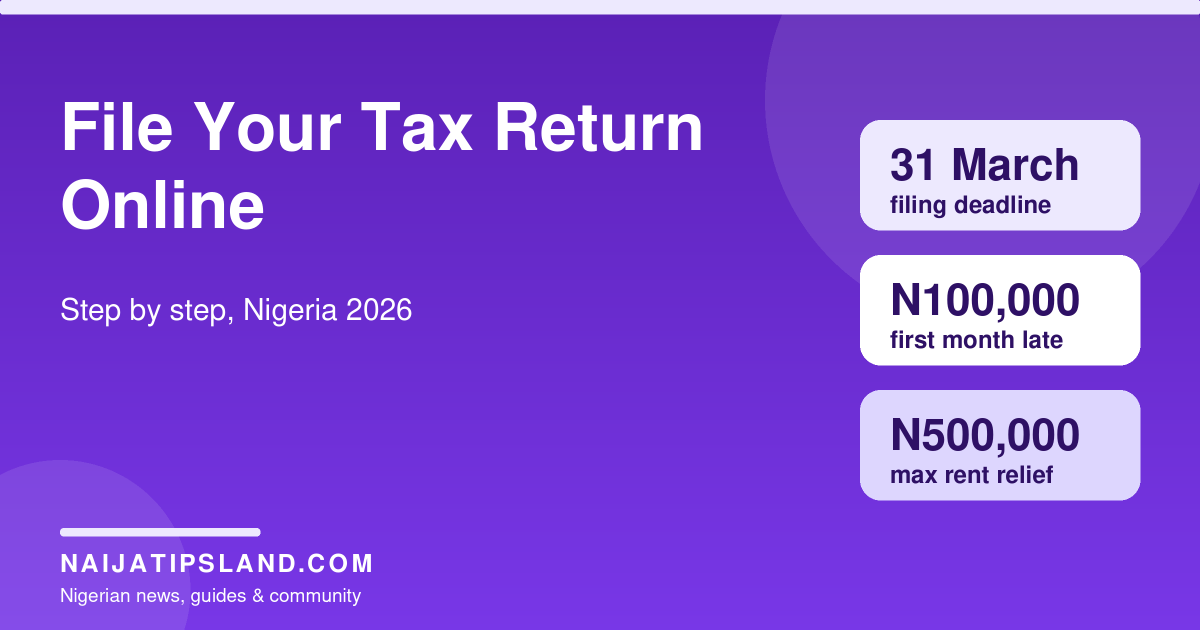
The usual deadline for individual annual returns is 31 March. The FCT Internal Revenue Service announced 31 March as its deadline for individual returns, and the Lagos State Internal Revenue Service (LIRS) used the same date before extending it. According to TechCabal’s April 2026 walkthrough, LIRS moved the filing date for 2025 income to 14 April 2026 and described that as a one-off extension. Do not plan around an extension that may not come. File early in the year, once your employer has issued your annual figures.
What you need before you start
- Your Tax Identification Number. In Lagos this is your Payer ID, and it starts with “N-”.
- Your BVN or your NIN. You only need one of them to register.
- Income records for January to December from every source.
- Payslips, bank statements, and business accounts if you trade.
- Proof for anything you want to claim: rent receipts, and evidence of pension, NHF, NHIS or life insurance payments.
- A recent passport photograph for your portal profile.
Step 1: get your TIN
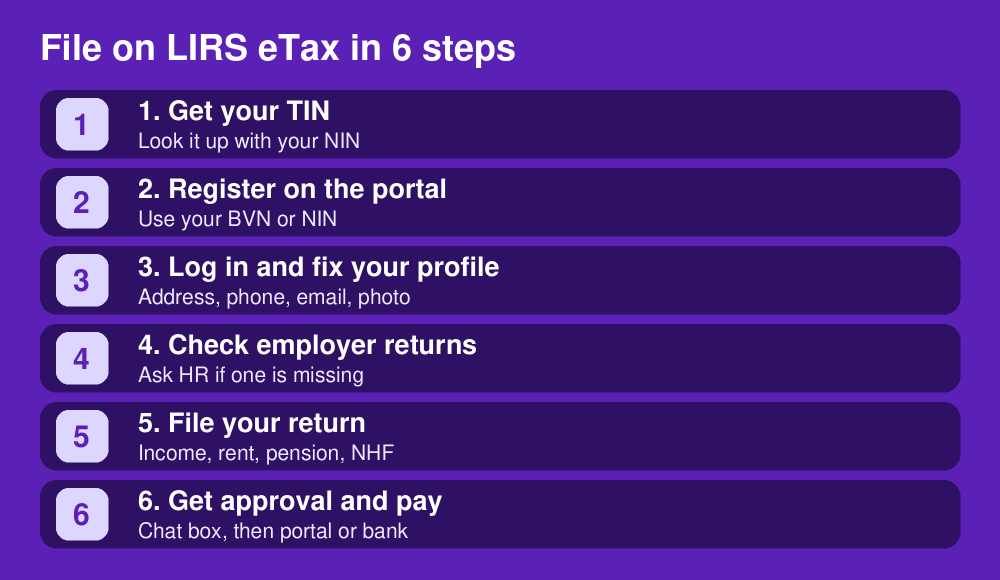
If you do not know your TIN, you can look it up using your National Identification Number. TechCabal points to the Joint Tax Board lookup at tin.jtb.gov.ng for this, and other guides say you can also get one through the Nigeria Revenue Service or your state revenue office. Your employer’s HR team may already hold it. Our full guide on how to get a TIN in Nigeria covers the lookup, what to do if the NIN check fails, and the scam warnings.
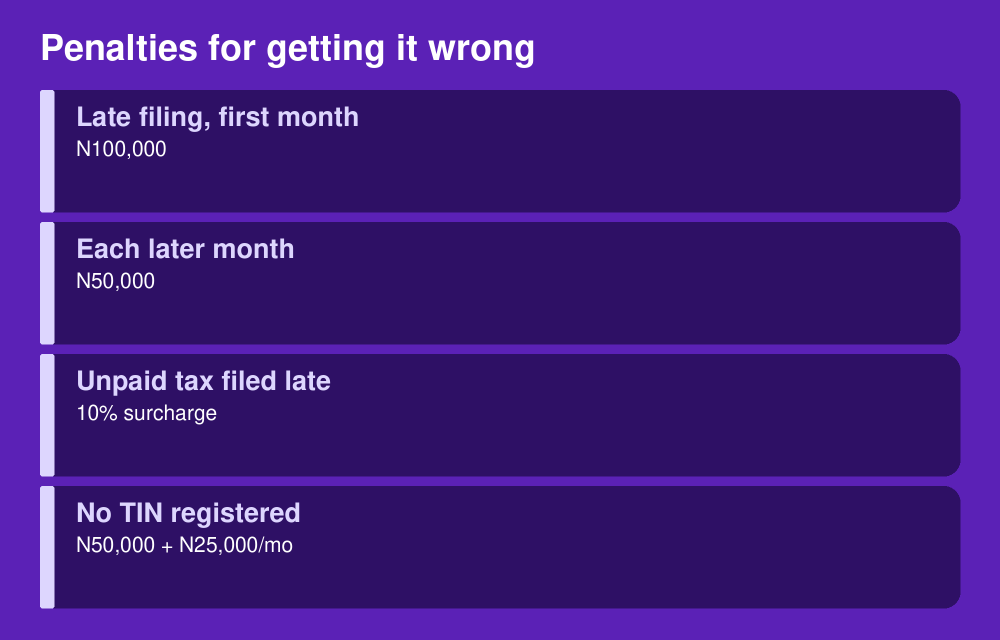
It is worth sorting this out early. Under the Nigeria Tax Administration Act 2025, failing to register can carry a penalty of N50,000 plus N25,000 for each month of default, according to the same TechCabal guide.
Step 2: register on your state portal
Individuals file with the internal revenue service of the state where they live or work. Lagos residents use LIRS eTax at etax.lirs.net. Other states run their own sites, and the Nigeria Revenue Service handles certain categories, such as residents of the FCT through its own arrangements, so find the official site for your state and type the address yourself.
On the Lagos portal the registration runs like this, as TechCabal describes it:
- Click “Register as Taxpayer” and choose “Individual”.
- Pick BVN or NIN, enter the number and your date of birth, and complete the captcha.
- Fill in your personal details, address and nearest tax station, then submit.
- Your Taxpayer ID arrives by email. Use it to set a password with the six-digit code sent to the same email.
Use an email address you will still have in three years. Tax portals send the codes and notices there.
Step 3: log in and tidy your profile
Choose “Taxpayer”, then enter your Payer ID and password. Confirm your address, phone number, email and photo. The Lagos portal also lets you add a spouse and children under family relations, which matters if you plan to claim anything that depends on them.
Step 4: check what your employer has filed
Go to Returns, then Employer Filed Returns, and look for the years you worked. Your employer files a schedule of staff pay and tax deducted, known as Form H1 on the Lagos portal. If a year is missing, tell HR now. A gap here can make your own filing look inconsistent, and it is the sort of thing that is much easier to fix in January than on the last day of March.
Step 5: file your return
On Lagos eTax, the path is Returns, then My Tax Returns, then File Returns Here. Then:
- Choose the assessment year. For income earned in 2025, that is 2025.
- Enter every source of income on the Statement of Income page.
- Complete the accommodation disclosure.
- Enter your reliefs and upload the supporting documents.
- Submit.
Declare everything. Salary, trading profit, rent you collect, dividends and income from abroad all belong on the form. Leaving something out saves nothing and creates a mismatch that revenue officers can see in your bank records.
What the new rates and reliefs look like
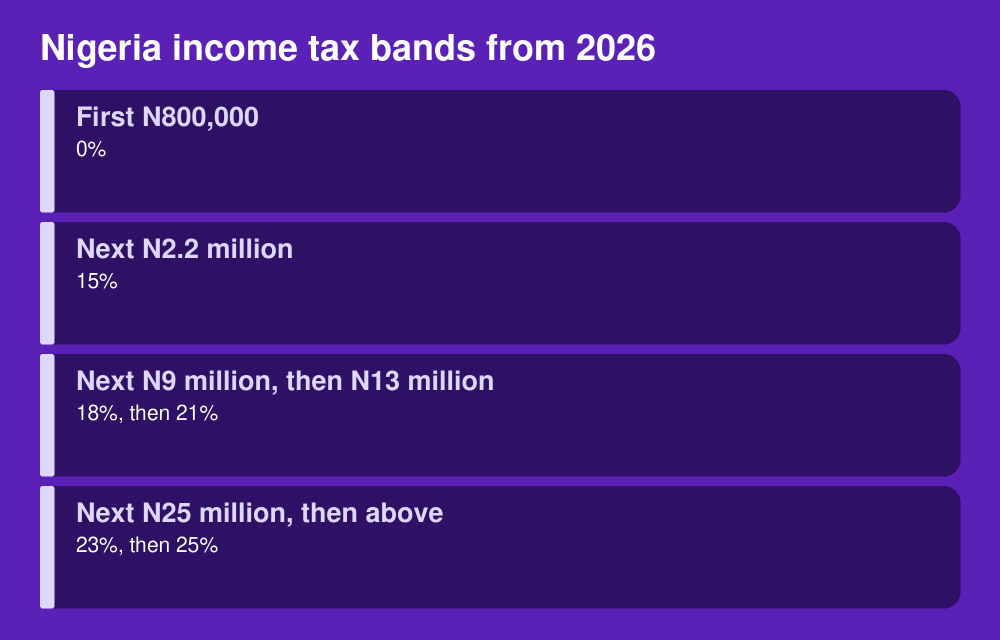
The Nigeria Tax Act changed personal income tax from 1 January 2026. PaySpace’s summary of the new bands, which match other published guides, runs as follows:
- The first N800,000 a year is taxed at 0%.
- The next N2.2 million is taxed at 15%.
- The next N9 million is taxed at 18%.
- The next N13 million is taxed at 21%.
- The next N25 million is taxed at 23%.
- Anything above N50 million is taxed at 25%.
The old Consolidated Relief Allowance is gone. In its place there is rent relief: 20% of the rent you paid in the year, capped at N500,000, and you have to document the rent. Pension and National Housing Fund contributions remain deductible, according to Legit.ng’s filing guide. Keep your rent receipts and the tenancy agreement, because the relief depends on disclosing accurate rent information.
One thing to keep in mind: the returns you file in early 2027 will cover income earned during 2026, which is the first year under these bands. That may be the first time your PAYE deductions and your annual return do not line up the way they used to, so read the figures slowly.
Step 6: get approval and pay any balance
After submitting on Lagos eTax, you request approval through the chat box at the bottom right of the screen. If tax is still owed, you can pay inside the portal or generate a bill reference and pay at a designated bank. Keep the approval and the payment receipt. You will need them for a tax clearance certificate, which banks, contractors and visa applications sometimes ask for. Lagos has a verification page for certificates at etax.lirs.net, so anyone you give one to can check it is real.
What a late return costs
TechCabal summarises the penalties under the Nigeria Tax Administration Act 2025 for individuals who file late or not at all:
- N100,000 for the first month of default, then N50,000 for every later month, whether or not you owe tax.
- A 10% surcharge on unpaid tax, plus interest at the Central Bank’s Monetary Policy Rate on what is outstanding.
- Possible administrative assessments, which become binding if you do not object within 30 days, and bank account recovery or asset seizure in serious cases.
- N10,000 for failing to keep proper books and records.
Those numbers are why filing a nil or small return on time beats staying quiet. A return with a tiny balance costs you an hour. A missed one can cost you more than the tax itself.
Mistakes I would avoid
- Waiting for the last week. Portals slow down in March and the chat box queues get long.
- Using a shared or old email address for registration.
- Forgetting a second income source, such as a side job paid into a different account.
- Claiming rent relief without receipts or a tenancy agreement.
- Paying a stranger who promises to “fast-track” your filing. Payments go through the official portal or a designated bank, and the portal itself should be the only place you enter your password. Our guide to avoiding internet scams in Nigeria has the usual warning signs.
If you are in the diaspora
Plenty of readers here in the UK still earn rent or business income at home. A Nigerian-source income can still be taxable in Nigeria even when you live abroad, and you may also have to report it on a UK return. I am not qualified to say how the two systems interact for your case, so get advice from an accountant who handles both before you file. The personal finance hub collects related money guides, and our business hub covers registration and tax for people starting a company.
FAQ
Can I file my tax return on my phone?
Yes, if the portal opens in your phone browser, which most do. Upload clear photos of your receipts and payslips, and check that the PDF or image formats are accepted.
Do I need a TIN to file?
Yes. You register for the portal with your BVN or NIN, and the portal issues or links your TIN.
I only have a salary. Do I still file?
Check the Employer Filed Returns section first. If your employer has filed and you have nothing else to declare or claim, confirm with your state revenue service whether anything more is required.
What is the deadline?
31 March for the previous year’s income is the usual date. Lagos extended its 2026 deadline once, to 14 April, and called it a one-off, so do not rely on that happening again.
Is there a fee to file?
Filing on an official state portal is free. You pay the tax you owe, not a fee to submit. Anyone asking for a filing fee outside the portal should be treated with suspicion.
What is a tax clearance certificate?
It is proof you have filed and paid what you owe. Banks, tenders and some visa applications ask for one. You apply for it through your state portal after you have filed.
This article gives general information and is not tax or legal advice. Rules and portals change, so confirm details with your state internal revenue service or the Nigeria Revenue Service.
Sources
- TechCabal: How to file tax on the LIRS eTax portal, a step-by-step guide for Lagos residents (2 April 2026)
- PaySpace: Nigeria tax reform 2026, key updates to personal income tax
- Legit.ng: March 31 deadline, simple guide to filing your personal income tax returns
- News Agency of Nigeria: FCT-IRS sets March 31 deadline for individual tax returns
- Nigeria Tax Administration Act 2025 (full text)
Join the discussion
Have you tried this, or do you have a question we did not answer? 1 reader has already shared their view. Naijatipsland members help each other with real, first-hand experience.





Editor note: have you filed your own return online yet? Tell us in the comments which state portal you used, what slowed you down and how long it took. Please leave out your TIN, BVN and NIN. We read every comment. – Ade