Last updated: 16 October 2026 · By Naijatipsland Editorial Team · Editorial policy
Every bank transfer in Nigeria can carry two separate charges: the bank’s own transfer fee, and a federal stamp duty. In 2026 both have been in the news, because stamp duty now falls on the sender and the Central Bank of Nigeria (CBN) has published a draft of a new guide to bank charges. This guide explains what you pay, with worked examples, what popular banks and fintech apps charge, and how to cut your costs.
Most of the 2026 fee changes below come from a draft guide released for public comment, and we did not find a report confirming a final version. Fees also differ by bank and app. Treat the figures as the reported framework and check your own bank’s current tariff.
The short answer
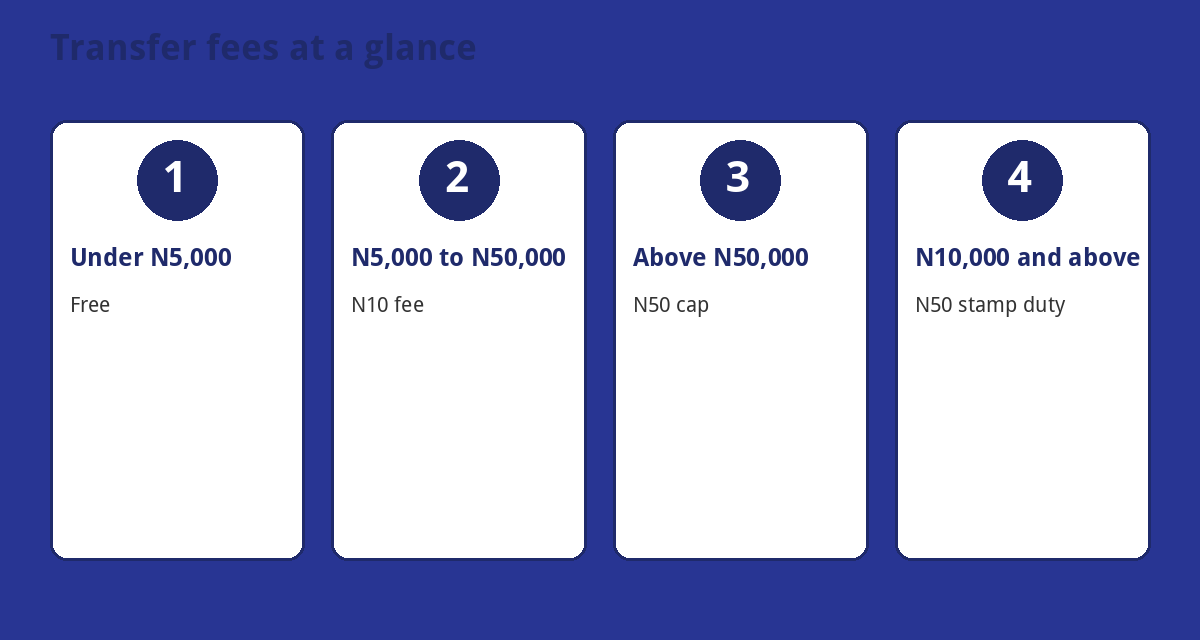
- Transfer fee (draft CBN guide): free under N5,000; N10 from N5,000 to N50,000; capped at N50 above N50,000. The same bands were reported by Nairametrics, the Guardian and Afriex.
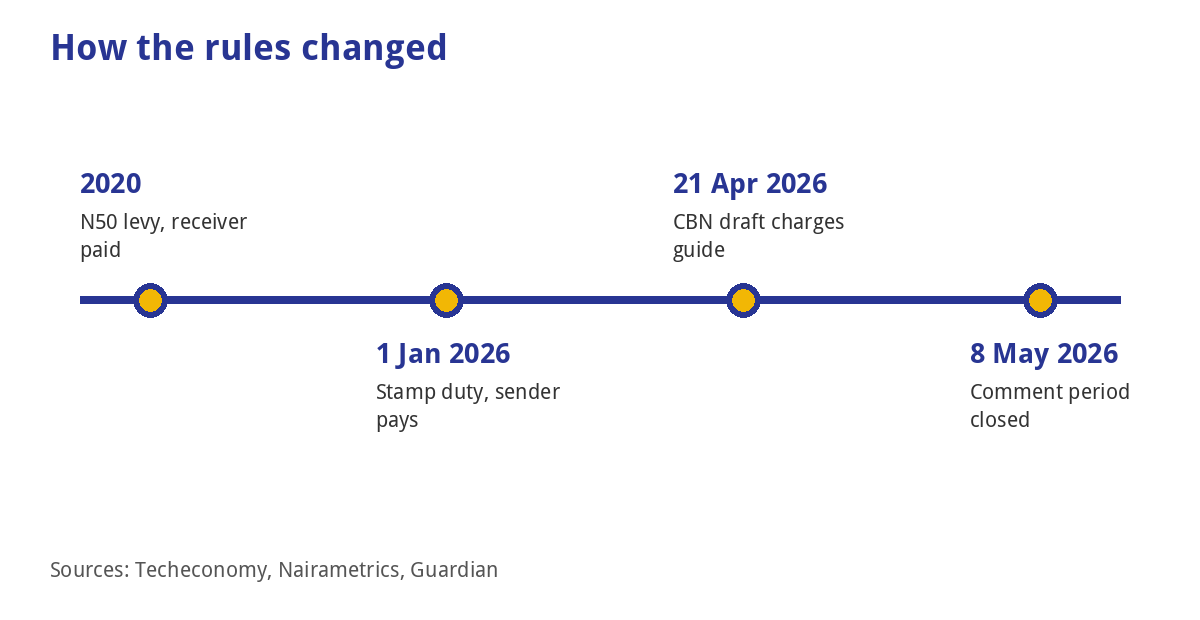
- Stamp duty: a flat N50 on electronic transfers of N10,000 and above, paid by the sender from 1 January 2026, replacing the old levy that the receiver paid, according to Techeconomy.
- Typical total on a large transfer: N100 (a N50 fee plus N50 stamp duty), by our calculation. TechCabal reported that transfers above N10,000 would cost at least N60 under the draft.
- Cheapest route: transfers inside the same app or bank are often free. For example OPay-to-OPay and PalmPay-to-PalmPay are free.
The two charges on a transfer
1. The bank or app transfer fee
This is the fee for sending money to another bank through the instant transfer system. The April 2026 draft guide, dated 21 April and open for comment until 8 May, keeps the tiers below, which Afriex says replaced a previous N10 to N25 band for mid-sized transfers:
- Under N5,000: no fee.
- N5,000 to N50,000: N10.
- Above N50,000: capped at N50.
Afriex notes that some banks may take weeks or months to apply new caps. Withinnigeria describes the same fees as unchanged from the earlier guide, so the draft may mostly confirm the existing structure.
2. Stamp duty
Techeconomy reports that a flat N50 stamp duty replaced the Electronic Money Transfer Levy (EMTL) on 1 January 2026 under the Nigerian Tax Act 2025. It applies to electronic transfers of N10,000 and above, is charged once per transaction, and is deducted from the sender. The old levy was N50 on receipts of N10,000 and above, and the receiver paid it. Reported exemptions are transfers below N10,000, salary payments and transfers between your own accounts at the same bank. Another report, from Afriex, says it applies to transfers “above” N10,000, so the exact N10,000 case is unclear. Check how your bank treats it.
Worked examples
These are our calculations using the reported draft tiers, so your bank may differ:
- Send N3,000 to another bank: no fee and no stamp duty, so N0.
- Send N8,000: N10 transfer fee, no stamp duty (below N10,000), so N10.
- Send N30,000: N10 fee plus N50 stamp duty, so N60. This matches TechCabal’s N60 figure.
- Send N500,000: N50 fee plus N50 stamp duty, so N100.

What popular apps charge
- OPay: N10 per transfer to other banks and free to other OPay users, according to a June 2026 Brands.ng guide. Agent withdrawals were listed at 0.6% (0.5% with preferred merchants), with a flat N120 above N20,000. A Techpoint guide says OPay’s interbank fee “starts at N5”, so check the app.
- PalmPay: free to other PalmPay users, per Techpoint. Its interbank fee was not stated.
- Kuda: 25 free transfers a month and zero maintenance fees, per Techpoint (April 2026).
- Moniepoint: N10 to N50, per Techpoint’s comparison table.
The stamp duty is a government charge, so no app can waive it.
Other charges to watch
- ATM withdrawals at another bank: the draft guide proposes N100 per N20,000 on-site, with off-site machines adding a surcharge of up to N500, to be disclosed at the machine.
- PoS withdrawals: TechCabal says the draft sets N100 per N20,000 for on-us transactions, down from up to N100 per N5,000. For not-on-us, the agent adds their own fee.
- Card issuance and maintenance: Withinnigeria reported the replacement card fee rising from N1,000 to N1,500 and the N50 monthly card maintenance fee being abolished. That article gives an effective date that looks like an error, so confirm with your bank.
- Merchant charges: capped at 0.5% per transaction, with a N10,000 maximum, and paid by merchants, not customers.
How to pay less
- Keep transfers under N5,000 where you can, since they carry no fee and no stamp duty.
- Send money between accounts in the same app or bank when possible.
- Compare apps with free monthly transfers if you send often, but read the fine print.
- Do not split one payment into several to dodge the N50 duty without checking your bank’s rules.
- Check every debit alert. If you see a charge that does not match your bank’s published tariff, ask the bank to explain it. See our guide on recovering money sent to the wrong account if a transfer goes astray, and blocking your card if you spot a suspicious debit.
Frequently asked questions
Who pays the N50 stamp duty on a transfer?
The sender, from 1 January 2026, according to Techeconomy. It replaced the old levy that the receiver paid.
Is a transfer under N5,000 really free?
The draft CBN guide and several reports say so, and stamp duty does not apply below N10,000. Some banks may still charge, so check your tariff.
Is the CBN guide final?
Reports in April 2026 describe it as a draft open for comment until 8 May 2026. We did not find a report that it had been finalised.
Why was I charged N60 on a N30,000 transfer?
That fits the draft tiers: N10 transfer fee plus N50 stamp duty.
Are salary payments charged stamp duty?
Techeconomy lists salary payments as exempt.
Bottom line
For most everyday transfers you will pay between nothing and about N100. The stamp duty is the part you cannot avoid on transfers of N10,000 and above, and the bank fee depends on the amount and your app. Check your bank’s current tariff because the CBN’s new guide was still a draft in the reports we found.
Sources
- TechCabal: Why transfers above N10,000 will cost N60 (April 2026)
- Techeconomy: Stamp duty replaces EMTL, sender to bear N50 charge
- Nairametrics: CBN caps bank fees in proposed guidelines (April 2026)
- The Guardian Nigeria: CBN unveils revised bank charges guide
- Afriex: Nigeria bank transfer fees 2026
- Withinnigeria: CBN ATM and card fee changes
- Brands.ng: OPay charges in Nigeria (2026)
- Techpoint Africa: Best mobile wallets in Nigeria
Related: treasury bills vs fixed deposits vs savings bonds in Nigeria.