Last updated: 11 October 2026. This is a living guide to Nigeria’s 2027 general elections, and we update it as INEC publishes new information.
2027 Nigerian elections at a glance
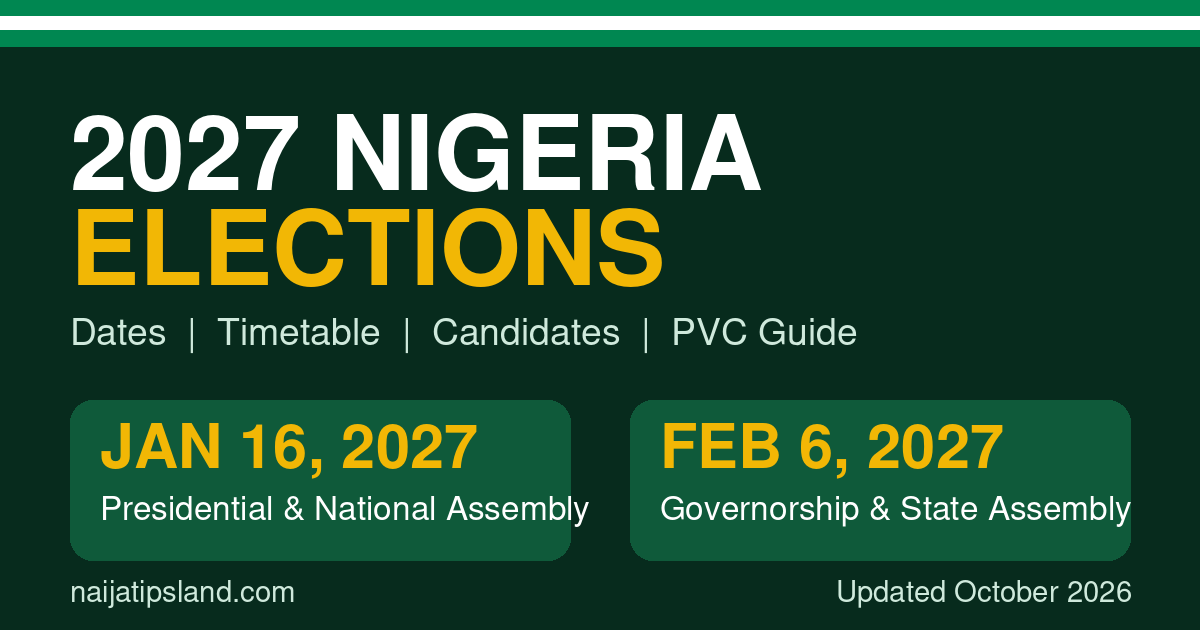
- Presidential and National Assembly elections: Saturday, 16 January 2027
- Governorship and State Houses of Assembly elections: Saturday, 6 February 2027
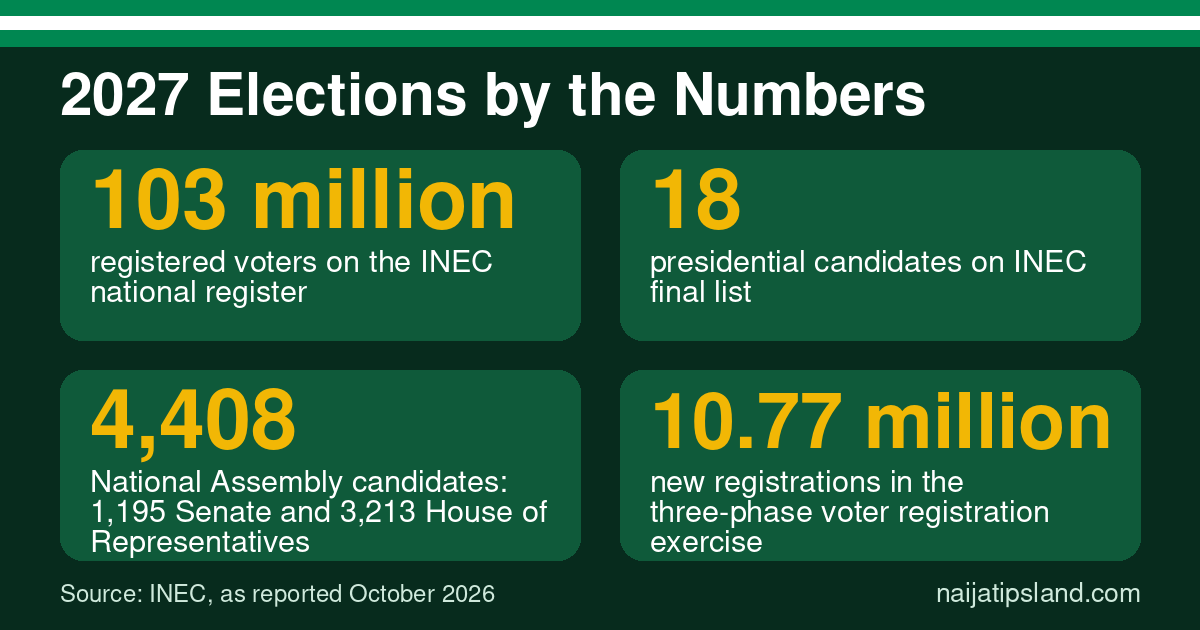
- Presidential candidates: 18 on INEC’s final list
- Registered voters: about 103 million
- National Assembly candidates: 4,408 (1,195 for the Senate and 3,213 for the House of Representatives)
- Governing law: Electoral Act 2026, signed on 18 February 2026
When Is the 2027 Election in Nigeria?
INEC issued the formal notice of election on 13 February 2026. Days later, on 18 February, President Bola Tinubu signed the Electoral Act 2026 into law, and the commission revised its timetable to fit the new legal framework. Under the revised schedule, Nigerians vote in two rounds, three weeks apart:
- Saturday, 16 January 2027: presidential and National Assembly (Senate and House of Representatives) elections.
- Saturday, 6 February 2027: governorship and State Houses of Assembly elections. States with off-cycle governorship elections hold theirs at other times.
The original dates, set under the repealed Electoral Act 2022, were 20 February and 6 March 2027. The terms of the president, vice-president and most state governors end in late May 2027.
2027 Election Timetable: Key Dates
- 13 February 2026: INEC issues the notice of election.
- 18 February 2026: the Electoral Act 2026 is signed and INEC revises the timetable.
- 23 April to 30 May 2026: political party primaries, including resolution of disputes.
- 27 June to 11 July 2026: submission of nomination forms for presidential and National Assembly candidates.
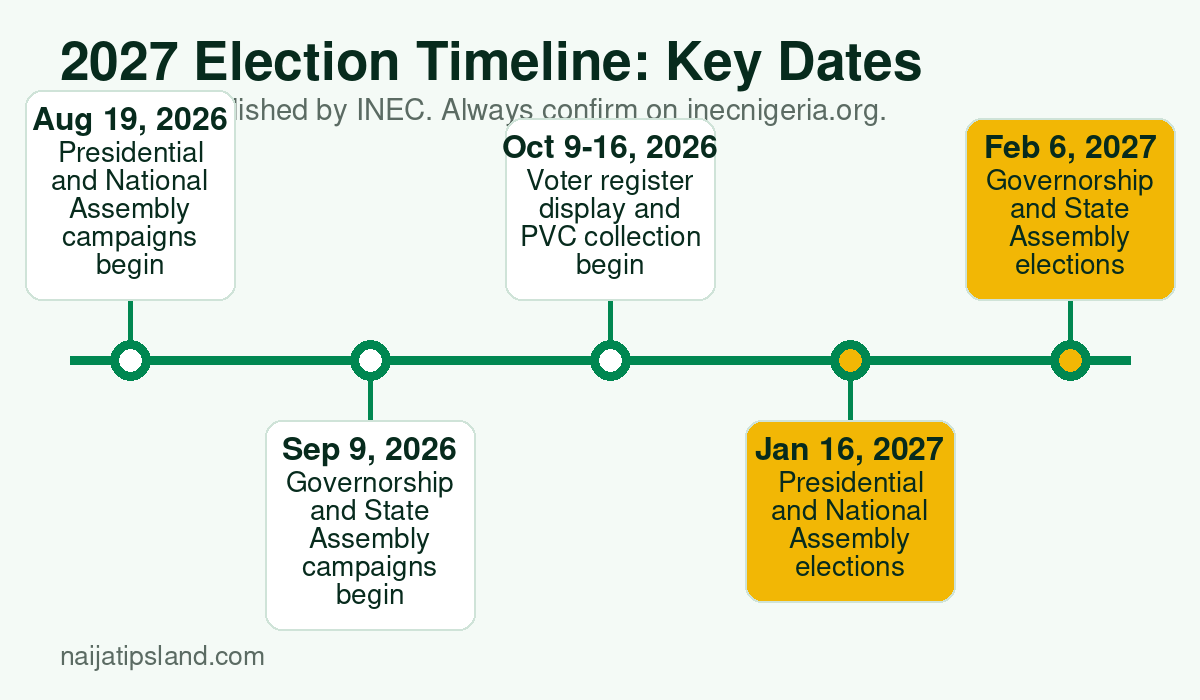
- 19 August 2026: campaigns begin for the presidential and National Assembly elections.
- 9 September 2026: campaigns begin for the governorship and State Assembly elections.
- 12 September 2026: INEC publishes the final list of presidential and vice-presidential candidates.
- 6 October 2026: INEC announces that the national register of voters has reached 103 million.
- 9 to 16 October 2026: nationwide display of the voter register for public scrutiny, with collection of newly issued PVCs starting on 9 October.
- 15 January 2027: presidential and National Assembly campaigns end, 24 hours before voting.
- 16 January 2027: presidential and National Assembly elections.
- 5 February 2027: governorship and State Assembly campaigns end.
- 6 February 2027: governorship and State Assembly elections.
INEC has changed its dates before, so confirm the latest version of the timetable on the official INEC website (inecnigeria.org).
2027 Presidential Candidates: Final INEC List
INEC published the final list of presidential and vice-presidential candidates on 12 September 2026, after party primaries ended. It contains 18 presidential candidates and their running mates. Two of the presidential candidates are women, Ada Elizabeth Fredrick Okwori of the National Democratic Party (NDP) and Nkem Esther Okereke of the National Rescue Movement (NRM). Presidential candidates range in age from 35 to 79.
| Party | Presidential candidate | Running mate |
|---|---|---|
| Action Alliance (AA) | Rufai Adekunle Omo-Aje | Shehu Hussaini |
| Action Democratic Party (ADP) | Abbas-Bin Aliyu | Ike Chinazam |
| Action Peoples Party (APP) | Yusuf Kabiru | Peace Egobia |
| African Action Congress (AAC) | Omoyele Sowore | Haruna Garba Magashi |
| African Democratic Congress (ADC) | Atiku Abubakar | Rotimi Amaechi |
| All Progressives Congress (APC) | Bola Ahmed Tinubu | Kashim Shettima |
| Allied Peoples Movement (APM) | Oluseyi Makinde | Musa Lawal Daura |
| Boot Party (BP) | Sunday Adenuga | Mustapha Usman Turaki |
| Democratic Labour Alliance (DLA) | Moses Olusoji Adebisi | Nafisat Usaku Abubakar |
| Labour Party (LP) | Sunday Chibuzo Okereke | Bintu Konto |
| National Democratic Party (NDP) | Ada Elizabeth Fredrick Okwori | Uchenna Anthony Chukwuemeka |
| National Rescue Movement (NRM) | Nkem Esther Okereke | Sulaiman Nasir Muhammed |
| Nigeria Democratic Congress (NDC) | Peter Obi | Rabiu Musa Kwankwaso |
| Peoples Democratic Party (PDP) | Sandy Ojang Onor | Umaru Babangida |
| Peoples Redemption Party (PRP) | Donald Duke | Rabiu Kabiru |
| Social Democratic Party (SDP) | Adewole Adebayo | Usman Bugaje |
| Young Progressives Party (YPP) | Peter Agada | Patience Key |
| Zenith Labour Party (ZLP) | Daniel Daberechukwu Nwanyanwu | Hassan Khalid |
Source: INEC final list of presidential candidates, as published on 12 September 2026.
The best-known names on the ballot include President Bola Tinubu (APC), former Vice President Atiku Abubakar (ADC), former Anambra State governor Peter Obi (NDC, with Rabiu Kwankwaso as his running mate), Oyo State governor Oluseyi Makinde (APM) and former Cross River State governor Donald Duke (PRP). Courts and parties can still change who appears on a ballot, so check INEC for the official position.
Governorship, Senate and House of Representatives Contests
The 18 presidential tickets are only part of the picture. INEC’s final lists contain 4,408 candidates for National Assembly seats: 1,195 for the Senate and 3,213 for the House of Representatives. Governorship candidate lists are published state by state ahead of the 6 February 2027 elections. Disputes over omitted names have already surfaced in some states, including Ogun and Gombe, where parties and aspirants are contesting what appears on INEC’s lists. Read our report on INEC’s final list of governorship candidates nationwide for the state-by-state names.
Who Can Vote? Nigeria’s 103 Million Registered Voters
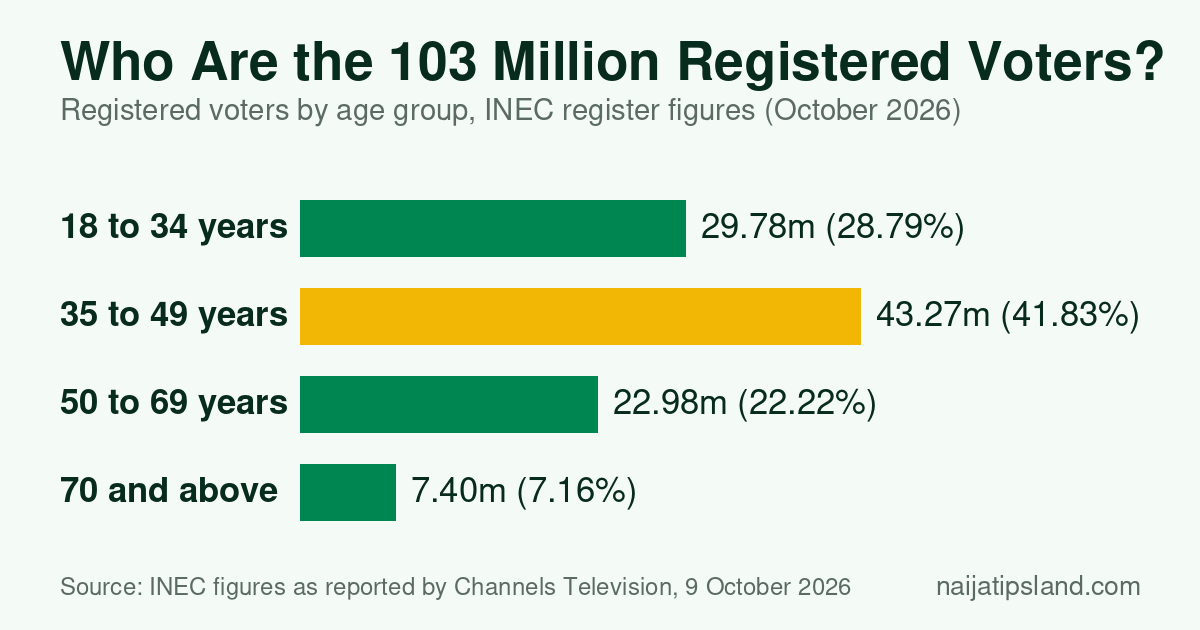
On 6 October 2026, INEC chairman Joash Amupitan announced that the national register of voters had reached 103 million after the three-phase Continuous Voter Registration (CVR) exercise and a final biometric clean-up. The exercise recorded 10,772,421 new registrations, which remain subject to verification through INEC’s Automated Biometric Identification System. The register breaks down as follows:
- Ages 35 to 49: 43,265,946 voters (41.83%), the largest group.
- Ages 18 to 34: 29,777,576 voters (28.79%).
- Ages 50 to 69: 22,982,900 voters (22.22%).
- Ages 70 and above: 7,402,291 voters (7.16%).
- Gender: men account for 51.75% of the register and women for 48.25%.
- Largest states: Lagos (7,488,633 voters), Kano (6,570,276) and Kaduna (4,662,640).
The register is far larger than the turnout in the last presidential election. In 2023, only about 24 million valid votes were recorded in the presidential contest, so the biggest question for 2027 is how many registered voters actually turn out.
Electoral Act 2026: What Has Changed
The Electoral Act 2026 repealed the 2022 Act and sets the rules for the 2027 elections. The main changes include:
- BVAS is mandatory. Section 47 requires presiding officers to use the Bimodal Voter Accreditation System, or another device prescribed by INEC, to accredit voters.
- Electronic transmission of results. Section 60(3) requires polling unit results to be transmitted electronically to INEC’s Result Viewing Portal (IReV). Where a network failure prevents this, the paper result sheet (Form EC8A) becomes the primary source for collation and declaration.
- Penalties. A presiding officer who wilfully frustrates electronic transmission faces six months in jail, a fine of N500,000, or both.
- Party primaries. Parties can nominate candidates only through direct primaries or consensus arrangements.
- Shorter notice period. INEC’s notice of election is now required at least 300 days before polling, down from 360.
- Downloadable voter cards. Reports on the new law say it allows voters to download their cards from INEC’s website, which could ease reliance on physical collection.
Not everyone agrees the law goes far enough. Former INEC national commissioner Mike Igini has argued that Section 60(3) could weaken mandatory electronic transmission, which he links to the loss of public trust after the 2023 presidential results upload. INEC and supporters of the Act say it puts BVAS and IReV into law for the first time.
How to Check and Collect Your PVC
You need a valid Permanent Voter’s Card (PVC) to be accredited on election day. INEC scheduled the nationwide display of the voter register from 9 to 16 October 2026 under Section 19(1) of the Electoral Act 2026, and began collection of newly issued PVCs on 9 October. To get ready:
- Check the register. Look up your name during the display period and confirm your details are correct.
- Raise any errors. Claims and objections are handled after the display exercise, so report wrong or missing details promptly.
- Collect your PVC. Pick it up from INEC, or use the download option where INEC provides one.
- Keep it safe. Bring your card on election day for BVAS accreditation at your polling unit.

Some civil society figures have pushed INEC to let registered voters download their cards instead of travelling to collect them, arguing that card collection should not become a barrier to voting. Deadlines and procedures are set by INEC and can change, so use the commission’s official channels for the latest instructions.
What Nigerians Say Ahead of the Vote
A September 2026 survey by Yiaga Africa, which interviewed 2,470 adults across the 36 states and the FCT, found a public that is willing to vote but wary:
- 84% said they were likely or very likely to vote, up from 73% in March.
- 61% said fear of violence could stop them from voting, rising to 78% in the North-East.
- Only 34% were confident that INEC would conduct credible elections, down from 45% in earlier rounds.
- 49% named a desire for leadership change as their top reason for voting, followed by the economy and jobs (38%) and security (36%).
Yiaga Africa described low turnout as a conversion problem rather than an apathy problem, meaning many people want to vote but face obstacles on the way.
Key Election Terms Explained
- INEC: the Independent National Electoral Commission, which organises elections in Nigeria.
- PVC: Permanent Voter’s Card, the card you use to vote.
- CVR: Continuous Voter Registration, the exercise through which new voters are added to the register.
- BVAS: Bimodal Voter Accreditation System, the device that verifies voters at the polling unit.
- IReV: INEC Result Viewing Portal, where polling unit results are uploaded for the public to view.
- Form EC8A: the paper result sheet completed at the polling unit.
Frequently Asked Questions
When is the 2027 presidential election in Nigeria?
Under INEC’s revised timetable, the presidential and National Assembly elections hold on Saturday, 16 January 2027.
When is the 2027 governorship election?
Governorship and State Houses of Assembly elections hold on Saturday, 6 February 2027, except in states with off-cycle governorship elections.
How many presidential candidates are there in 2027?
INEC’s final list, published on 12 September 2026, contains 18 presidential candidates, including two women.
How many registered voters are there in Nigeria?
INEC says the national register of voters stands at about 103 million, following the completion of the Continuous Voter Registration exercise.
Can I vote without a PVC?
No. A valid PVC is needed to be accredited and vote, so check the register and collect your card early.
Will results be transmitted electronically?
Yes. The Electoral Act 2026 requires polling unit results to be transmitted electronically to IReV. If a network failure prevents this, the paper Form EC8A becomes the primary source for collation.
Where can I get official information?
The official source is INEC at inecnigeria.org and its verified social media channels. Use this page as a guide, and check INEC for any change to dates or candidate lists.
Latest 2027 Election News
- INEC publishes final list of governorship candidates nationwide (full list)
- INEC insists on Supreme Court verdict, says erring parties won’t field candidates
- INEC deploys 5,720 BVAS for Anambra 2027 polls
See all our coverage in the Politics section, including the latest on INEC, candidates and campaigns.
Sources
- Channels Television: INEC publishes final list of presidential candidates for 2027 election
- Channels Television: 103 million voters, will Africa’s largest electorate show up in 2027?
- Vanguard: National Assembly highlights key reforms in Electoral Act 2026
- Voice of Nigeria: INEC issues revised timetable for 2027 general election
- Independent National Electoral Commission (INEC)