
Are Crypto Mining Apps on Your Phone Legit in Nigeria? Pi Network, Tap-to-Earn Games and the Scams to Avoid (2026)

Last updated 19 November 2026. Crypto prices and platform rules change often. This is general information and not investment advice. I am a writer, not a financial adviser, and I have no stake in any app named here.
If you are Nigerian and on Telegram, TikTok or WhatsApp, someone has probably invited you to “mine” crypto on your phone. The pitch is always similar. It is free, it takes seconds a day, and your points will turn into money one day. So are these apps legit? The short answer is that some are real products with real limits, some are games that hand out points with no promise of value, and some are plain fraud wearing the same costume. This guide shows you how to tell them apart.
First, what “mining” really means
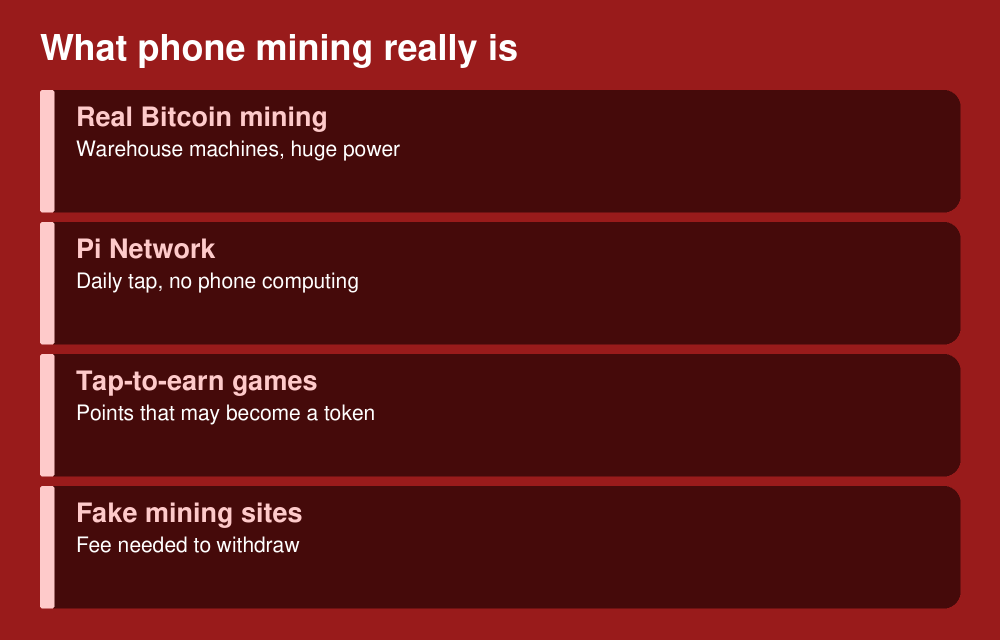
Bitcoin mining means running specialised computers that race to solve a puzzle, which secures the network and earns new coins. It needs powerful machines and a lot of electricity. A phone cannot do it in any useful way. One Nigerian crypto explainer published in April 2026 says it directly: payouts from phone apps are small, and a phone cannot compete with a mining rig.
So when an app says you are “mining” with your phone, one of three things is happening. It is a daily check-in game, it is a points system run by a company that may or may not turn the points into a token, or it is a trick to collect your money or data. Keep those three in mind as you read.
How Pi Network works
Pi Network is the best-known case in Nigeria. You open the app once a day, press a button, and your balance goes up. Explainers on the project say your phone is not solving any puzzle when you tap. The tap tells the network you are a real, active person, and the “security circle” of people you vouch for feeds a trust map the network uses. The heavy work of validating transactions runs on computers called nodes, not on phones.
Pi does not ask users to pay to join, but there are catches. Your mined balance stays locked inside the app until you complete identity verification (KYC) and then migrate to the main network. KYC means submitting a government ID and facial checks, so you are handing over sensitive data. Pi’s own team and community posts in November 2026 report more than 18 million verified users, over 300 apps, and a first ecosystem summit from 17 to 19 November. Those numbers come from the project, so read them as claims.
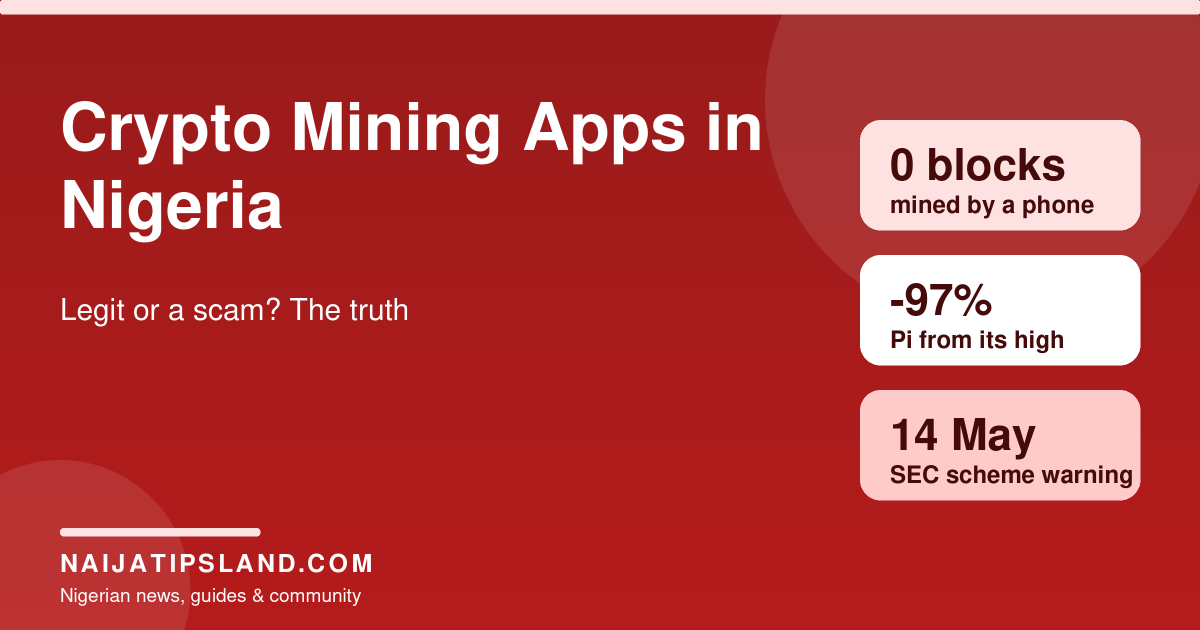
The price picture is less cheerful. A market summary dated 28 October 2026 says PI traded near $0.076, about 97 per cent below its peak of $2.99, with roughly 11.3 billion of a 100 billion maximum supply in circulation and a risk of dilution as more tokens are released. It also says several of the largest global exchanges do not offer PI spot trading. A rumour of a “full mainnet launch on 20 November” has been denied by the community accounts themselves, which say the open network has been live since February 2025.
My reading: Pi is a real project that has not asked for your money, but the balance you see in the app is only worth what a market will pay for it, and you give up personal data to unlock it. Some sources disagree on whether phone mining has ended, so check the Pi Core Team’s own announcements before you assume anything.
Tap-to-earn games and what happened to their tokens
Notcoin, Hamster Kombat, TapSwap, Catizen and Blum are Telegram games where you tap a screen to collect points that can later become a token. Many Nigerians joined in 2024. BBC News Pidgin reported in June 2024 that Nigerians were flocking to these platforms, and quoted a crypto professional who warned that some of the platforms might never launch a token at all.
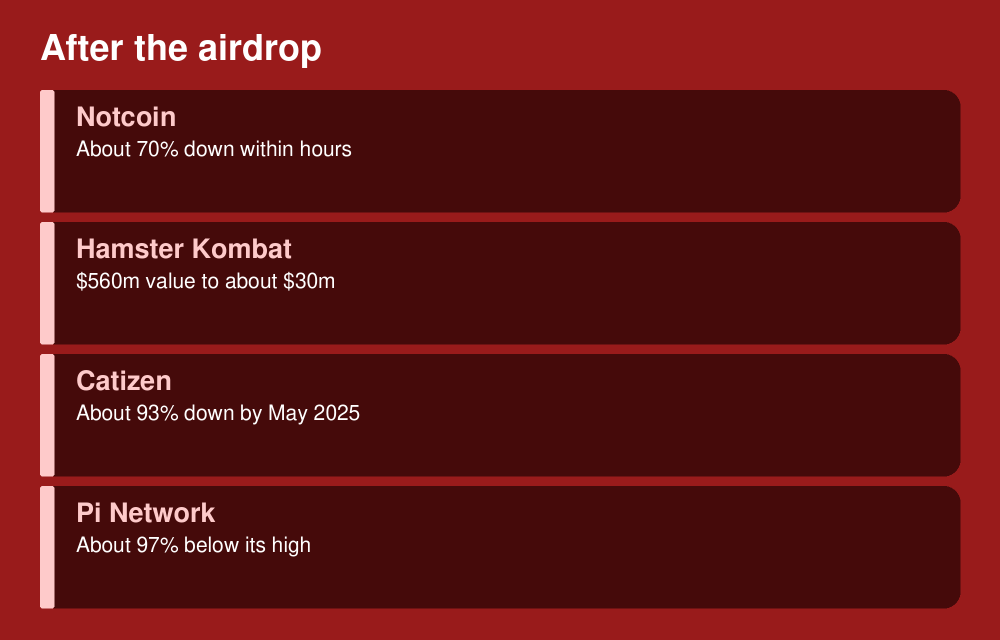
Then the tokens launched, and the numbers were rough. Reports say Notcoin fell about 70 per cent within hours of its launch in May 2024. A BanklessTimes report from October 2025 says Hamster Kombat went from a market value of about $560 million at launch to around $30 million, and that TapSwap was valued at only a few hundred thousand dollars. An earlier May 2025 report says Catizen fell about 93 per cent and Notcoin about 80 per cent. The common reasons given are that most players sold their free tokens immediately, that the token supply was huge, and that the projects struggled to find a use for the token beyond selling it.
I should be fair. Some players did cash out something, and some projects are still running. But the pattern is clear enough to treat any tap-to-earn balance as a lottery ticket, not as income.
What the regulators have said
The Securities and Exchange Commission (SEC) published a public notice on 14 May 2026 about unregistered online investment schemes promoted on WhatsApp, Instagram, Telegram, Facebook, TikTok and other platforms. It says many of them show the traits of Ponzi or prohibited schemes and advises people not to join any platform promising unrealistic or guaranteed returns. It also reminds the public that, under the Investments and Securities Act 2025, only entities registered by the Commission may promote investment services or ask the public for funds, and it points to the SEC’s own registers where you can check a firm.
On crypto itself, a Nigerian explainer says the 2025 Act brought digital assets under the SEC and requires platforms to register as virtual asset service providers. On 9 November 2026 The Africa Report said the SEC was close to finalising new digital-asset rules and warned that illegal operators could face jail. A report on 18 November adds that the SEC proposed higher minimum capital for digital-asset businesses in August and that its director-general said in October that no operator had yet secured final registration under its incubation programme.
What this means for you: in Nigeria, buying and holding crypto is not the same thing as handing money to an unregistered platform. If a mining app is not on an SEC register and asks you to deposit money, you have no regulator to turn to when it fails. Our guides to crypto exchanges and who is approved and how cryptocurrency works in Nigeria go deeper on the rules.
Warning signs of a fake mining app
Free apps that hand out points are one thing. These signs point to a scam:
- You are asked to pay or “activate” before you can mine or withdraw.
- You must pay a fee, tax or “gas” to release your balance. Real exchanges deduct fees from what you withdraw.
- The app promises a fixed daily or weekly return, such as 10 per cent a week.
- Your earnings rise mainly when you recruit friends.
- You cannot find a company name, address or contact on the website.
- The app wants your BVN, bank login or a copy of your ID with no clear regulated purpose.
- You can only get the app from a link in a group chat, not from the official app stores.
The BBC Pidgin report also flagged other risks. Click-bot software and cheap VPNs, which some players use to cheat the system, can carry malware that steals data. A tap-to-earn task might also ask you to repost things you have not read, which can land you in trouble. Our guide to Ponzi schemes in Nigeria lists more warning signs, and the guide on protecting your phone and bank apps from hackers shows how to lock down your accounts.
A six-step check before you join anything
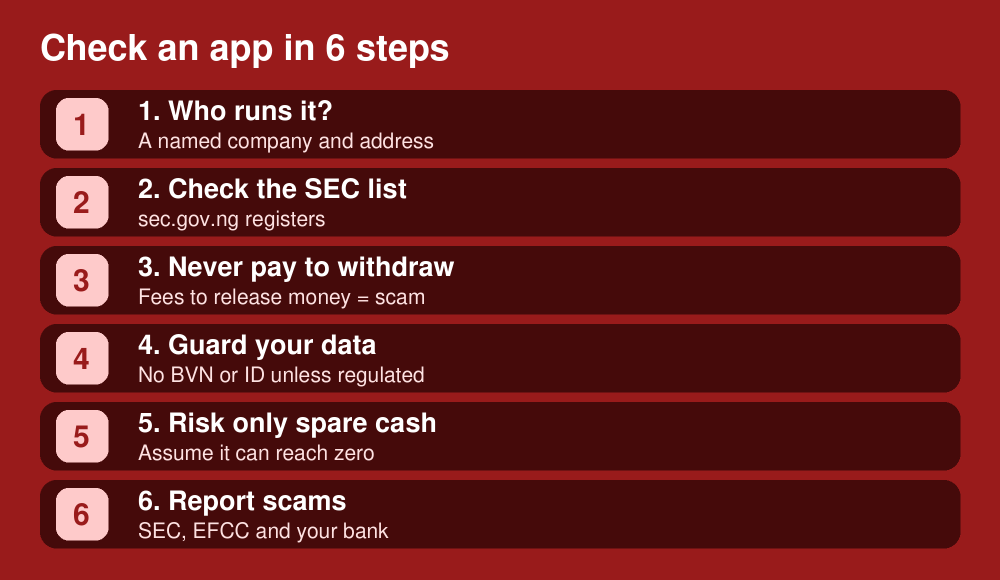
First, find out who runs it. A real company will have a name, a registered office and a way to contact it. Second, check the SEC website’s registered operators pages. Third, if any step asks for money before you can withdraw, stop. Fourth, think carefully before you share your ID or face scan. Fifth, only put in time and money you can afford to lose entirely. Sixth, if you have been caught out, tell your bank straight away and report the scheme to the SEC and the EFCC through their official sites.
Better ways to earn or invest
If you want exposure to crypto, buy through a platform that is licensed or is going through the SEC’s registration process, and only with money you can afford to lose. If you simply want income, a skill is worth more than any points app. Our make money online hub and the guide to side hustles for Nigerians list options that pay in naira. For longer-term saving, see the personal finance hub.
FAQ
Can a phone really mine Bitcoin?
Not in any useful way. Bitcoin mining needs specialised machines and large amounts of electricity. Apps that say otherwise are usually games, points systems or scams.
Is Pi Network a scam?
Pi has not asked users to pay to join, and it reports millions of verified users. But the in-app balance is locked until you complete KYC and migration, the price is far below its peak, and you must share ID data. Treat it as a risky project and make your own decision.
Did anyone make money from Notcoin or Hamster Kombat?
Some early sellers took small profits, but reports say the tokens fell sharply after launch. Do not count on points turning into income.
Are crypto mining apps legal in Nigeria?
Holding crypto is not illegal. But platforms that take money from the public must be registered with the SEC, and the SEC has warned against unregistered online schemes. Check the SEC registers before you deposit anything.
What should I do if an app asks me to pay to withdraw?
Stop and do not pay. A fee demanded before withdrawal is a classic scam sign. Report it to your bank, the SEC and the EFCC.
How do I check if a platform is registered?
Use the registers on the SEC Nigeria website named in its 14 May 2026 notice, under the fintech registered operators and capital market operators pages.
This article gives general information and is not financial or legal advice. Crypto is high risk and you can lose everything you put in. Rules and prices change, so check official sources before you act.
Sources
- SEC Nigeria: Public notice on unregistered online investment schemes (14 May 2026)
- The Africa Report: Nigeria inches closer to new digital asset rules (9 November 2026)
- The Will News: Nigeria’s crypto rules expand, but regulatory overlap clouds investment (18 November 2026)
- NairaCompare: Crypto news in Nigeria, what shaped the market in Q1 2026
- CoinDCX: Pi Network update, Protocol 28 and KYC status (28 October 2026)
- NBTC Finance: How does Pi mining work? The Stellar Consensus Protocol explained
- Bybit Learn: What is Pi Network, complete guide
- BanklessTimes: Why Hamster Kombat collapsed (15 October 2025)
- BanklessTimes: Why Hamster Kombat, Notcoin and Catizen plunged (8 May 2025)
- Coinlive: Notcoin falls 70% after launch
- BBC News Pidgin: The dangers of tap-to-earn crypto platforms (4 June 2024)
Join the discussion
Have you tried this, or do you have a question we did not answer? 1 reader has already shared their view. Naijatipsland members help each other with real, first-hand experience.






Editor note: have you used Pi Network, Hamster Kombat, Notcoin or another mining or tap-to-earn app? Tell us in the comments what you earned, whether you managed to withdraw, and whether anyone ever asked you for a fee. Please leave out phone numbers, wallet addresses and ID details. We read every comment. – Ade