
Are Task-and-Earn Apps Legit in Nigeria? What Happens When You Like Videos for Money (2026)

Last updated: 9 November 2026 · By Naijatipsland Editorial Team · Editorial policy
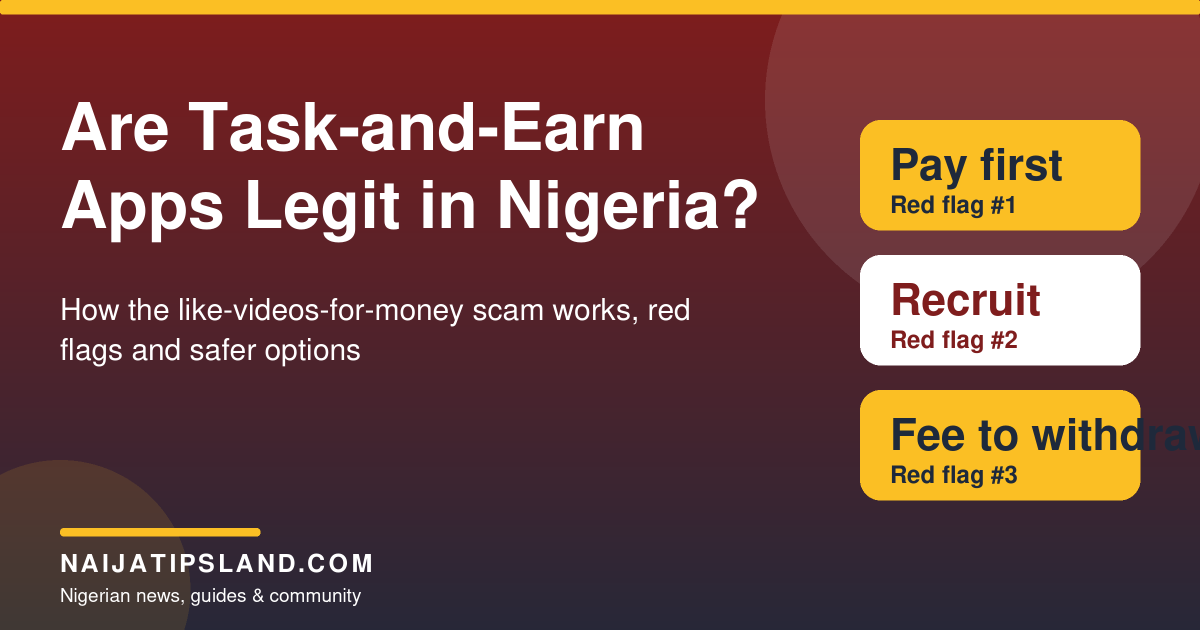
Short answer: apps that promise to pay you for liking videos, following pages or tapping through simple tasks are not a real job. In almost every version we have seen, the earnings shown on screen are numbers in a database, and the real money moves in only one direction: from you to the operator. This guide explains how the scheme works, the warning signs, what the Securities and Exchange Commission (SEC) has said, and safer ways to earn online from Nigeria.
Editor’s note: this article describes patterns, not any single named app. We do not accuse any specific company of wrongdoing beyond what regulators have published. If you have lost money, see the steps near the end.
What is a task-and-earn app?
A task-and-earn app (also sold as ‘like videos for money’, ‘rate products’, ‘boost orders’ or ‘daily tasks’) says you can earn by doing small jobs on your phone: liking a TikTok or YouTube video, following an Instagram page, rating a hotel or product, or ‘optimising’ an order. You usually find it through a WhatsApp or Telegram message, a TikTok comment, or a friend who shows a screenshot of ‘withdrawals’.
The pitch sounds harmless: no experience, no qualifications, work from home, get paid daily. That is exactly why it spreads quickly among students, graduates and people between jobs.
How the scam usually works
Reports from consumer-protection bodies and from guides such as this overview of money-making apps in Nigeria describe the same sequence:
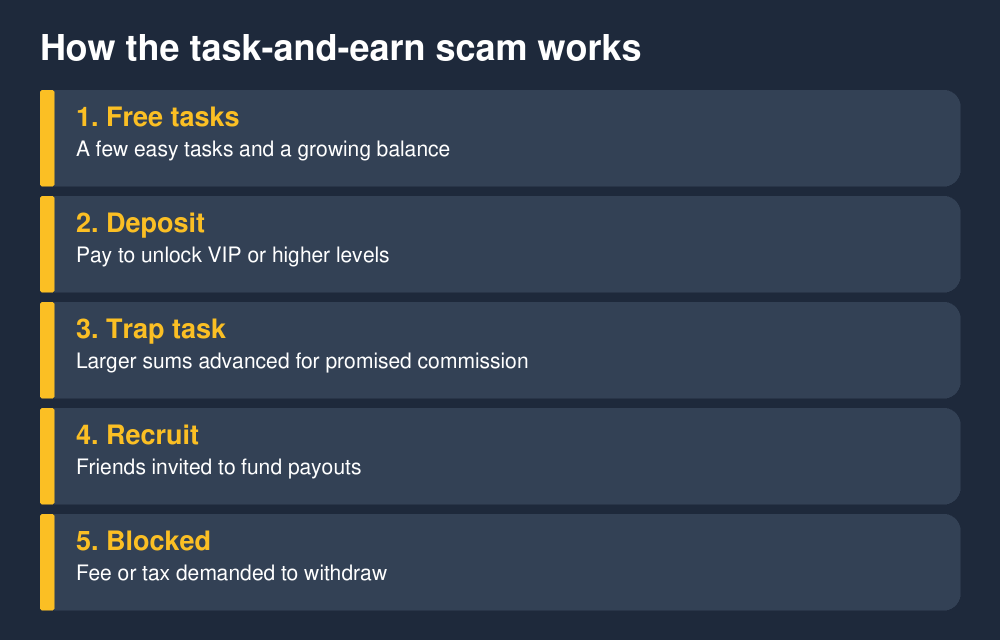
- A small, real-looking win. You complete a few free tasks and see a balance grow, sometimes with a tiny payout to prove it ‘works’.
- The upgrade. To unlock ‘higher-paying’ tasks you must deposit money or buy a VIP, activation or ‘merchant’ level.
- The trap task. A task suddenly requires you to ‘advance’ a larger sum, with a promise that it will be returned with a commission. Each new task asks for more.
- The recruiting loop. You are encouraged to bring in friends for a bonus, which funds the next payouts and makes you responsible for their losses too.
- The blocked withdrawal. When you try to cash out you are told to pay a tax, a ‘verification’ fee or to clear a negative balance. Paying never releases the money. The group chat goes quiet or the app disappears.
Why this is not a real job
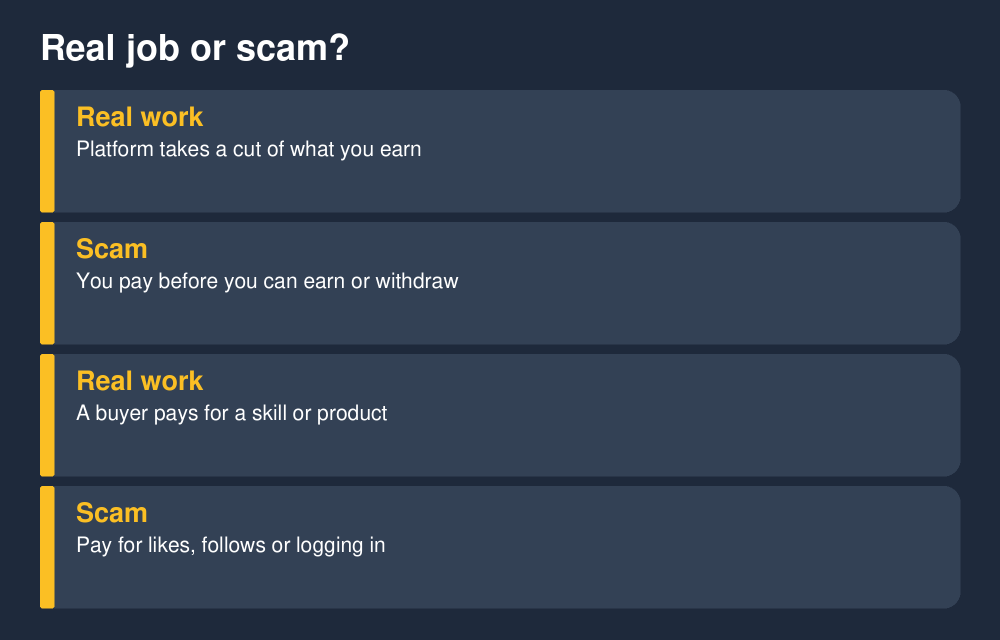
A real employer or client pays you because your work creates value for them. Liking a video or following a page does not. The only way an operator can show ‘income’ is from people paying in. That is the structure of a Ponzi or pyramid scheme, however modern the app looks.
Compare this with legitimate online work, where the platform takes a cut from what you earn, never an entry fee before you can earn. Our guide to making money online in Nigeria covers routes that do pay, such as freelancing and content work, and what to expect from each.
What the SEC has said
On 8 May 2026 the Securities and Exchange Commission, Nigeria’s capital-market regulator, warned Nigerians about unregistered online investment schemes promoted on WhatsApp, Instagram, Telegram, Facebook, TikTok and other platforms. According to Legit.ng’s report, the SEC said many of these show features of Ponzi or prohibited schemes, urged people not to rely on advice from unregistered persons, and noted that under the Investments and Securities Act, 2025 only SEC-registered entities may promote investment services or solicit funds from the public. It also pointed people to its register of approved operators. Task apps that ask you to deposit money in return for ‘commissions’ fall squarely into the area this warning covers, because they are, in effect, collecting funds from the public with a promise of returns.
You can check an operator on the SEC’s pages for registered fintech operators and capital market operators. Being absent from the list is a strong reason to stay away. Being present does not prove a particular message you received is genuine, as scammers have also faked certificates, so always type the website address yourself.
Ten warning signs
- You must pay or ‘deposit’ before you can earn or withdraw.
- Pay is offered for liking, following, logging in or tapping, with no real buyer of that work.
- Returns are guaranteed or unusually high (‘earn N50,000 daily’).
- You are paid for recruiting friends.
- Someone you do not know sends the app link, or you are added to a group full of ‘payment proof’ screenshots.
- Withdrawal needs a tax, release fee or ‘credit score’ top-up.
- The brand copies a famous company’s name or logo.
- The app is not in the official store, or has a new developer account with few reviews.
- You are told to keep it secret or to hurry.
- You cannot find a registered company, address or regulator number you can verify yourself.
If you have already paid in
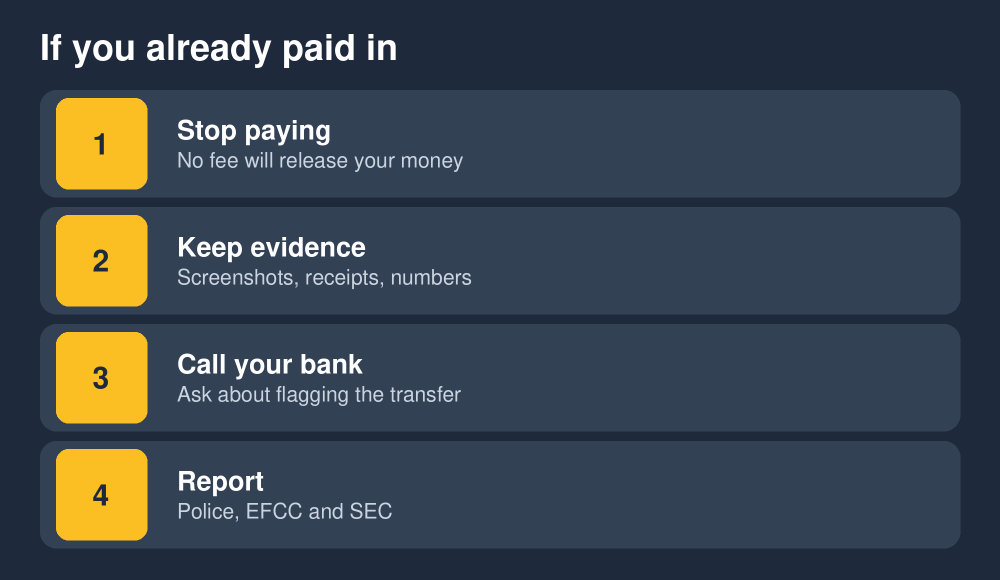
- Stop. Do not send any further ‘fee’ to unlock a withdrawal. It will not work.
- Screenshot chats, the app, wallet addresses, account numbers and receipts.
- Tell your bank or payment app straight away and ask whether a transfer can be flagged.
- Report to the police, to the EFCC through its public reporting channels, and to the SEC if the scheme involved investments or deposits.
- Warn friends. Do not recruit anyone to ‘recover’ your loss.
- Beware recovery scams: people who promise to get your money back for an upfront fee are usually the same criminals.
Safer ways to earn from your phone
None of these is a quick fix, but they are real, and you never pay to start:
- Freelancing (writing, design, virtual assistance, customer support) on established marketplaces.
- Tutoring in school subjects or English through reputable platforms.
- Transcription and data-entry work from known companies, which pay on accuracy.
- Selling products you can see, store and deliver. See our guide to snacks you can make and sell from home.
- TikTok and content income built over months. Read how to make money on TikTok in Nigeria for what really pays.
Survey and feedback panels exist, but treat the pay as pocket change, not a salary.
For more on spotting fraud, see how to earn money from Facebook in Nigeria and what is a scam and our personal finance hub.
Frequently asked questions
Are task-and-earn apps legit in Nigeria?
The ones that pay for liking videos and ask you to deposit money to continue are not legitimate jobs. Treat any app that requires payment before you can earn or withdraw as high risk.
Can you really get paid for liking videos?
Not as a job. Platforms pay creators and advertisers, not people who tap like. Any ‘income’ you see is typically a number the app displays.
Why did I get a small withdrawal at first?
Scheme operators often pay a small first withdrawal to build trust so you will deposit more. It is paid from other members’ deposits.
Is it a crime to take part?
Operating a scheme is unlawful. Ordinary participants are usually victims, but recruiting others can create legal risk for you. Do not recruit.
How do I check if a company is registered?
Use the SEC registers linked above and the Corporate Affairs Commission (CAC) search for company registration. Always type the web address yourself.
I lost money. Can I get it back?
Sometimes a bank can freeze funds if you report quickly, but recovery is not guaranteed. Report early and avoid anyone charging a fee to recover your money.
Disclaimer: this article is general information and not legal or financial advice. Laws, SEC lists and warnings change, so check the regulator’s website for the latest.
Join the discussion
Have you tried this, or do you have a question we did not answer? 1 reader has already shared their view. Naijatipsland members help each other with real, first-hand experience.





If a task app asks you to pay before you can earn or withdraw, treat it as a red flag and stop. Tell me in the comments if you have seen one that worked differently and I will look into it. – Ade Adeniyi