


Last updated: 14 October 2026. Scammers change tactics constantly, so this is a guide to patterns, not a complete list. We replaced unsourced statistics in an earlier version.
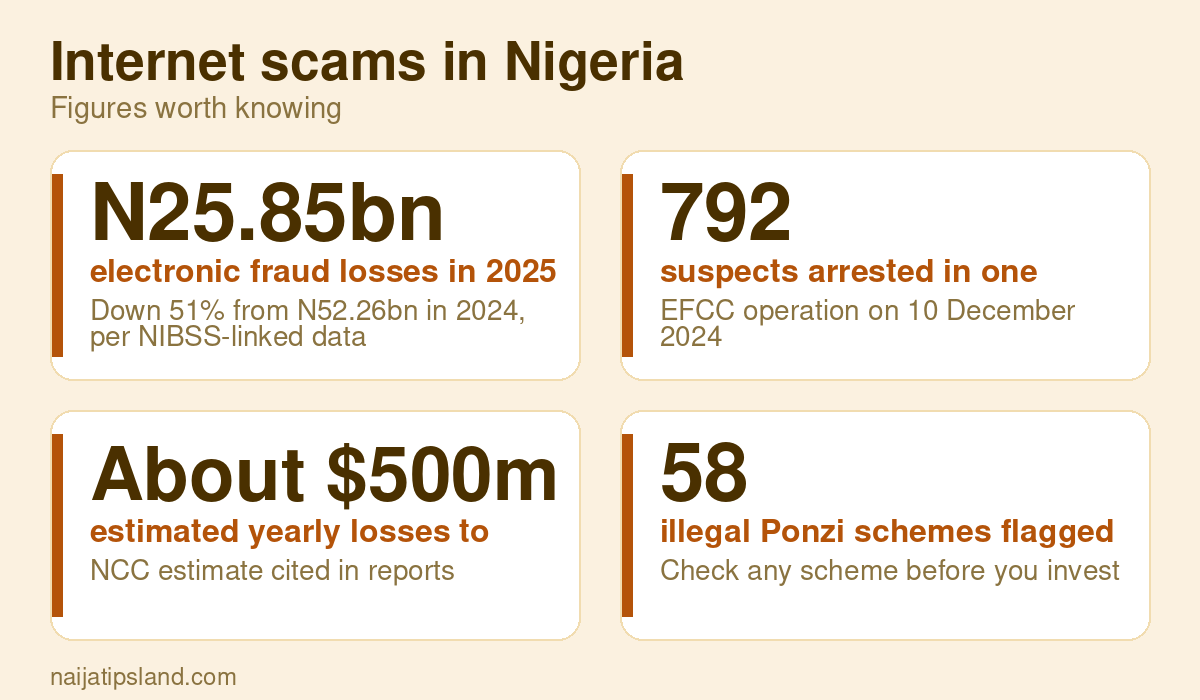
Scams cost Nigerians billions of naira every year, and the victims are not only the careless. Fraudsters target the hopeful, the busy and the worried. Electronic fraud losses fell to about ₦25.85 billion in 2025 from ₦52.26 billion in 2024, according to figures linked to NIBSS reporting, but that is still a lot of stolen money. Here is how to spot and avoid the common ones.
1. Fake investments and Ponzi schemes
“Double your money in 30 days” is the oldest trick. Schemes pay early investors with new investors’ money until they collapse, as CBEX did in 2025, and the EFCC has flagged dozens of illegal Ponzi schemes. Under the Investments and Securities Act 2025, running an unregistered scheme can bring penalties of ₦20 million or more and imprisonment. Check: is the firm registered with the SEC? Is it promising guaranteed returns? Can you withdraw easily? See our guides on passive income and cryptocurrency.
2. Romance and sextortion scams
A “person” you meet online builds trust, then needs money for an emergency or an investment. In sextortion, a fraudster threatens to expose private images unless you pay. The EFCC arrested 792 suspects in one Lagos raid in December 2024 over crypto-investment and romance scams, including 193 foreigners, and says foreign syndicates exploit Nigerians. Never send money to someone you have not met, and report blackmail instead of paying.
3. Fake jobs and visas
Real employers do not charge you for applications, interviews or training, and government recruitment is free. Agencies have repeatedly warned about fake letters, including AI-generated ones. See our guides on CV writing and interview tips, and our guide on visa types.
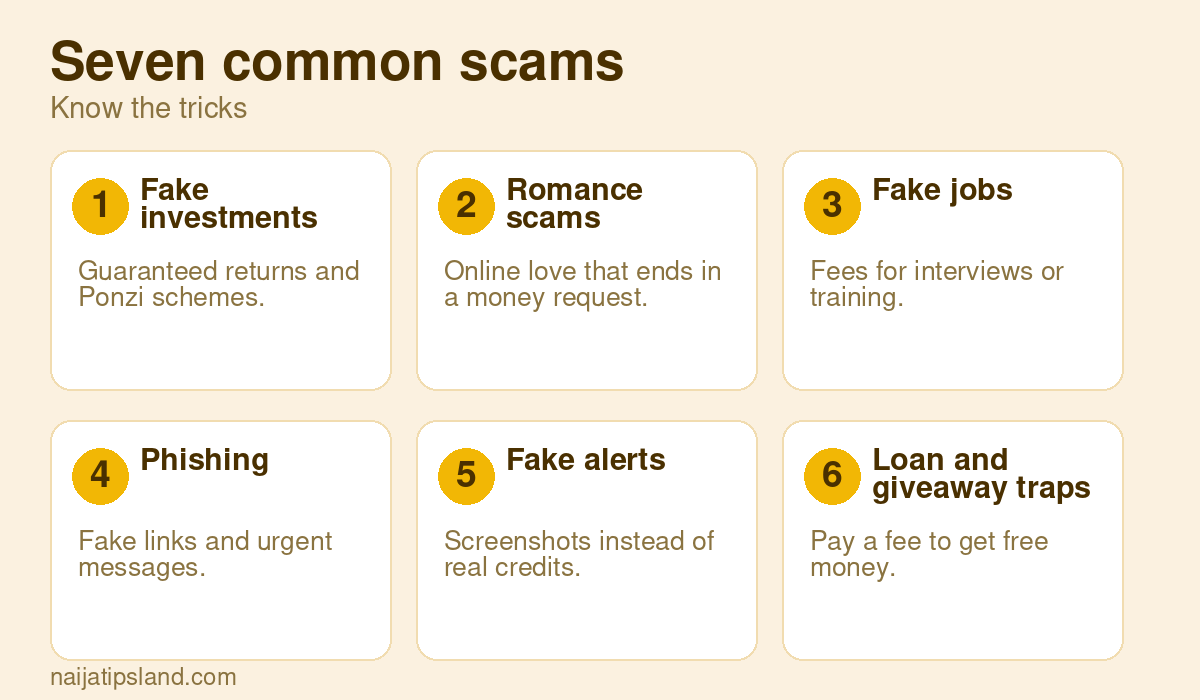
4. Phishing, smishing and fake apps
Messages that look like they come from your bank, network or a government body ask you to click a link and “verify”. The link leads to a fake page that steals your login, card details or OTP. Rule: your bank will never ask for your PIN or OTP. Type the website address yourself or use the official app. See our guide on online safety tips.
5. Fake alerts, POS and WhatsApp tricks
Criminals send fake transfer screenshots, ask sellers to release goods before the money lands, or pose as a friend on WhatsApp asking for emergency money. Always confirm credit in your own app. Read our guides on POS agent fraud and WhatsApp scams.
6. Loan, grant and giveaway scams
Messages promise “government grants”, free data or easy loans if you pay a processing fee or share your BVN. Genuine lenders and agencies do not do this, and digital lenders are regulated by the FCCPC. See our guide to microfinance banks.
7. Identity and account takeover
Fraudsters who get your NIN, BVN, SIM or passwords can drain accounts or take loans in your name. See our guide on digital identity.
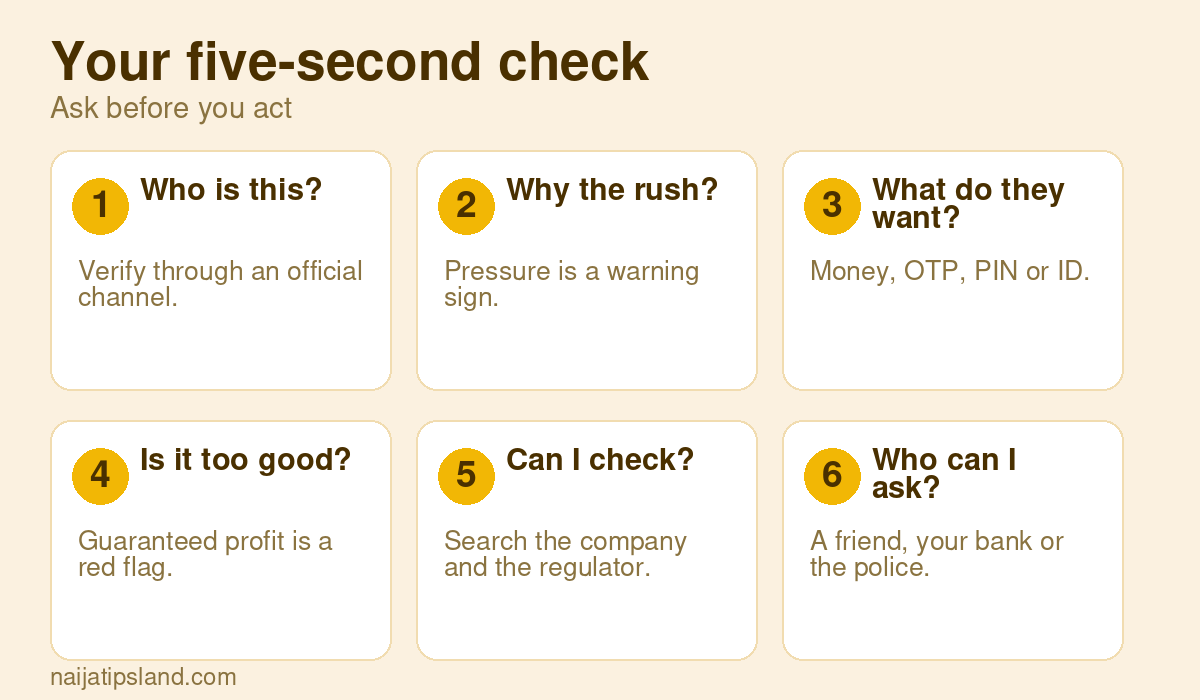
Red flags at a glance
- Pressure to act now, or secrecy.
- Guaranteed or unusually high returns.
- Requests for OTPs, PINs, passwords or BVN.
- Payment by gift card, crypto or transfer to a personal account.
- Poor spelling, copied logos and look-alike web addresses.
- Contact on social media from a stranger who quickly moves you to WhatsApp or a private chat.
If you have been scammed
- Call your bank at once and ask them to block or trace the transfer.
- Save evidence: screenshots, numbers, links and receipts.
- Change passwords and secure your accounts and SIM.
- Report to the EFCC, the police cybercrime unit and the platform concerned. See cybercrime laws.
- Warn others, and do not respond to “recovery agents” who ask for fees. They are often scammers too.
What the Authorities Say
The EFCC has warned that the get-rich-quick mindset fuels scams, listing advance-fee fraud, fake job and scholarship offers, online loan and grant scams and fraudulent forex and cryptocurrency platforms among the common types, and it says it works with the CBN, the SEC, banks and Interpol to trace scam money. Reports in 2026 included the EFCC flagging dozens of illegal Ponzi schemes and the police cybercrime centre arresting a suspect over a $597,000 romance fraud in September. The EFCC also says it does not demand payments by phone or messaging apps, so treat any such request as a scam.
Loan App Scams
Illegal loan apps charge hidden fees, take huge permissions and harass borrowers. The FCCPC keeps a register of approved and blacklisted digital lenders on its website, and one guide counted 457 approved digital lenders in early 2026. Check the lender on the FCCPC register before downloading, refuse apps that ask for contacts or photos, and report threats to the police.
Romance and Investment Scams
- They start on social media or dating apps, build trust quickly, then ask for money, gifts or a “profitable investment”.
- Real investments do not guarantee returns or require you to recruit others. See our guides on passive income and money mistakes.
- Verify any investment firm with the SEC before you pay.
If You Have Been Scammed
- Stop all contact and do not send more money, including “fees to recover your money”.
- Contact your bank straight away and ask it to flag or block the transaction.
- Save evidence: messages, account numbers, screenshots and receipts.
- Report to the police, the EFCC or the relevant regulator (the SEC for investment schemes, the NCC for telecom fraud, the CBN consumer protection department for banking complaints).
- Change passwords, enable two-step login and warn friends.
See also our guides on SIM registration and swap fraud, online safety tips and cybercrime laws.
Frequently Asked Questions
What is the most common internet scam in Nigeria?
Phishing, fake investments and romance scams are among the most reported, along with fake alerts and fake jobs.
Can I get my money back?
Sometimes, if you report quickly and the funds can be traced, but recovery is not guaranteed.
How do I check an investment company?
Check its registration with the SEC and the CAC, search for complaints and be wary of guaranteed returns.
Sources
- Al Jazeera: Nigeria deports 60 Chinese and 39 Filipinos convicted in crypto romance scams
- BusinessDay: EFCC arrests 792 suspects over crypto and romance scams
- Global Voices: Cybercrime schools in Nigeria
- Technology Times: EFCC cybercrime stories, including illegal Ponzi schemes
- MSME Africa: FAAN warns job seekers against fake employment letters
- BusinessDay: EFCC warns Nigerians against Ponzi schemes
- Nairacompare: List of fake loan apps in Nigeria, 2026
Related: How to spot fake job ads in Nigeria: red flags and where to find verified vacancies
Related: Recruitment scams in Nigeria: red flags and how to report
Related: Is forex trading legal and safe in Nigeria?
Related: How to report cybercrime in Nigeria: police, EFCC and your bank
Related: Fake credit alerts and phishing SMS: how to check a transfer is real
Related: Ponzi schemes in Nigeria: warning signs before you invest
Related: How to check that a bank, fintech or loan app is licensed in Nigeria