Best Investment Opportunities in Nigeria for Beginners (2026): Low-Risk Options, Real Rates and Scams to Avoid


Last updated: 24 October 2026 · By Naijatipsland Editorial Team · Editorial policy
If you are new to investing in Nigeria, the hardest part is not finding opportunities. It is choosing between them while inflation, interest rates and online scams all compete for your attention. This guide ranks the main options for beginners from lower to higher risk, shows the latest official numbers behind them, explains how each one works in plain language, and lists the red flags the Securities and Exchange Commission (SEC) wants you to watch for.
This article is general information, not personal financial advice. Rates change often, every investment can lose value, and your own goals and finances matter. Check current rates and rules with the provider, the regulator or a licensed adviser before you commit money.
The numbers behind your decision (October 2026)
Three numbers frame almost every beginner’s choice: inflation, the central bank’s policy rate and what safe assets currently pay.
- Inflation: the National Bureau of Statistics reported headline inflation of 14.63% for September 2026, down from 15.39% in August. Food inflation was 19.59% year on year.
- Policy rate: the CBN’s Monetary Policy Committee reset the Monetary Policy Rate to 23% at its 21 to 22 September 2026 meeting, down from 26.5% in July, and recalibrated the standing facilities corridor to +50/-300 basis points.
- Treasury bills: at the 14 October 2026 auction, stop rates were 15.50% (91-day), 15.80% (182-day) and 15.90% (364-day).
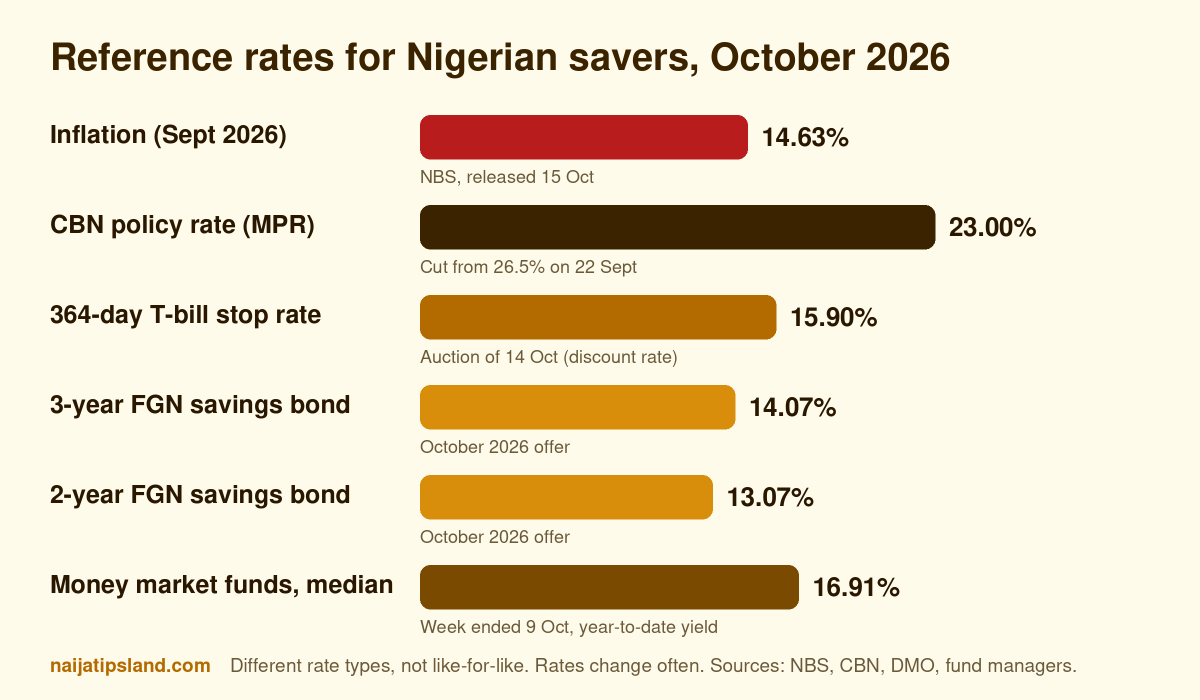
The point to take from this is simple. Inflation is easing but still high, so money left idle loses buying power, and the safest assets currently pay somewhat more than inflation. The gap is not wide, and with the policy rate now lower, some yields have eased. The 3-year FGN savings bond rate, for example, fell from 15.12% in September to 14.07% in October, according to Nairametrics. The bar chart above mixes different kinds of rates, so treat it as a snapshot rather than a like-for-like league table.
Before you invest a single naira
- Build an emergency cushion first. Money you may need for rent, school fees or medical bills should sit somewhere easy to access, not in a lock-up you cannot break.
- Deal with expensive debt. Paying off a loan charging far more than any safe investment pays is often a better first move.
- Match the investment to the time frame. Money needed within a year belongs in low-risk, accessible places. Money for retirement or a child’s university can accept more ups and downs.
- Only invest what you can afford to lose in higher-risk assets like shares, crypto and foreign exchange.
Not sure where your savings should sit while you build that cushion? Our guide to savings apps in Nigeria covers safety, interest and withdrawal rules.

1. Savings and money market funds
What it is: A money market fund pools many investors’ money and a licensed fund manager invests it in short-term, mostly government and bank instruments. Some savings apps use these funds behind the scenes.
What it has been paying: For the week ended 9 October 2026, the tracker Afriradar listed 49 funds holding about ₦6.72 trillion for 927,990 unitholders, with year-to-date yields ranging from 10.50% to 21.31% and a median of 16.91%. The site notes that figures are reported by fund managers and can contain errors, so check the fund’s own factsheet.
Watch for: yields are not guaranteed and change with the market. Confirm that the fund manager and the platform are registered with the SEC, and compare fees, withdrawal timing and the fund’s own track record rather than a headline rate.
2. Treasury bills
What it is: A short-term government IOU of 91, 182 or 364 days. You buy it at a discount and receive the full face value at maturity. Our guide to treasury bills vs fixed deposits vs savings bonds explains the differences in detail.
How the rate works: The stop rate is a discount rate, so the effective yield is higher than the headline number. Kobo Terminal gives the example that at a 15.85% stop rate, ₦100,000 of face value costs about ₦84,200 today, a true yield of about 19%. By the same arithmetic, the 15.90% rate at the 14 October auction works out to an effective yield of roughly 19%. Treat that as an approximation.
How to buy: Through banks, stockbrokers or licensed dealers who bid on your behalf, or indirectly through money market funds. Kobo Terminal says direct purchases through most banks typically start from about ₦100,000, while money market funds accept a few thousand naira.
Watch for: rates reset at every auction, so you face reinvestment risk, and selling early on the secondary market can return less than expected. At the 14 October auction, the 364-day bill drew bids of ₦982.21 billion against ₦350 billion offered, but only ₦220 billion was allotted, which shows strong demand and that the authorities decide how much to accept. Confirm the current tax treatment before relying on any figure.
3. FGN savings bonds
What it is: A retail government bond with a fixed tenor that pays interest every quarter, with the principal returned at maturity. The October 2026 offer carried 13.071% for the 2-year bond (maturing 14 October 2028) and 14.071% for the 3-year bond (maturing 14 October 2029). The unit price was ₦1,000 with a minimum subscription of ₦5,000 and a maximum of ₦50 million. Interest is paid on 14 January, April, July and October.
How to buy: Through stockbroking firms appointed by the Debt Management Office (DMO) as distribution agents, during the short subscription window of each offer. The October window ran from 5 to 9 October, so check the DMO’s site for the next one.
Watch for: the rate is fixed at the offer, so you lock in today’s rate. That helps if rates fall and hurts if inflation rises. Selling before maturity depends on the secondary market.
4. Pension contributions
If you have a Retirement Savings Account, you may be able to add voluntary contributions through your pension fund administrator. The money is invested in funds with different risk levels and is designed for the long term, which makes it a sound base for retirement, though it is less accessible than a savings account. Our guide to five investment options for your pension in Nigeria walks through the choices.
5. Mutual funds
Beyond money market funds, SEC-regulated mutual funds include bond, equity and mixed funds. A professional manager picks the investments, and you hold units whose value rises and falls. They suit people who want market exposure without choosing individual shares. Compare the fund’s objective, fees and track record over several years, and remember that past performance does not predict the future.
6. Shares on the Nigerian Exchange (NGX)
The opportunity and the risk: The NGX All-Share Index closed at 247,222.27 points on 23 October 2026, with market capitalisation of ₦160.52 trillion, according to Nairametrics. Earlier in the year, Proshare reported that the index was up 51.06% year to date on 24 June, yet it fell 2.35% that same day, erasing ₦3.64 trillion in value. Strong years and sharp drops can sit side by side.
How to start: nairaCompare’s beginner guide describes the process: use an SEC-registered broker or app that is an NGX member, open a trading account and a CSCS account for holding the shares, submit ID, NIN, BVN and a bank account, fund the account, place a market or limit order, and keep the contract note. It reports minimums of about ₦10,000 at some brokers and as little as ₦1,000 on some apps, settlement of T+1 since 1 June 2026, and total costs of roughly 1.5% to 2.5% per transaction.
Tax: the same guide says capital gains tax rules changed under the Nigeria Tax Act 2025 from 1 January 2026, with individuals taxed at progressive rates and an exemption for share-sale proceeds up to ₦150 million where gains stay under ₦10 million in twelve months. Tax rules are technical, so confirm them with the revenue authority or a tax adviser.
Watch for: frequent trading eats returns through fees, putting everything in one company concentrates risk, and selling in a panic can lock in losses.
7. Land and property
Real estate can protect value over time, but it is illiquid, expensive to enter and a classic scam target. Document checks, survey plans and legal searches matter far more than a persuasive sales pitch. Start with our guide on how to buy land in Nigeria without being scammed and our cost of building a house in Nigeria breakdown.
8. Crypto and foreign exchange (very high risk)
Cryptocurrency and currency trading can move sharply in either direction and attract more fraud than almost any other category. If you decide to learn, use small amounts you can afford to lose. Our guides on buying Bitcoin and USDT in Nigeria and the dollar to naira exchange rate cover the practical basics and risks.
9. Investing in skills and a small business
For many beginners, the best early return comes from increasing income rather than chasing yields. A course, a tool or a small side business can pay more than a few percentage points on savings. See our guides to side hustle ideas for Nigerians, small businesses that succeed in Nigeria and realistic passive income options.
A simple starter plan
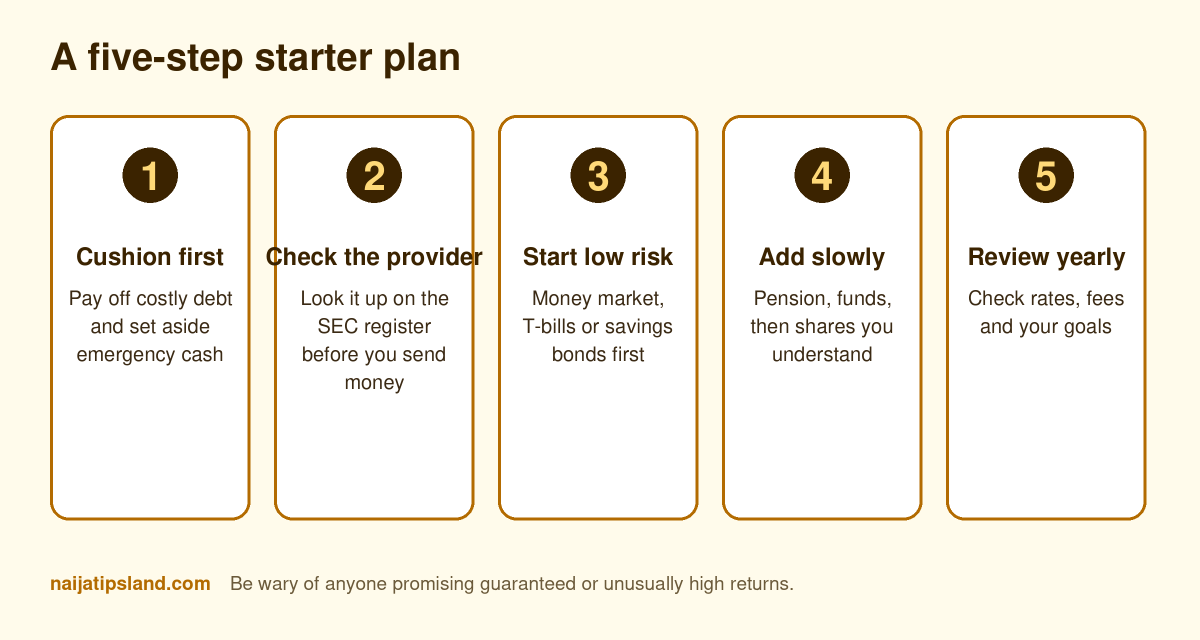
- Cushion first. Clear costly debt and set aside emergency cash.
- Check the provider. Look up the platform or fund manager on the SEC register before sending money.
- Start low risk. Money market funds, treasury bills or savings bonds are common first steps.
- Add slowly. Consider pension contributions, then funds, then shares you understand, in amounts you can live with if prices fall.
- Review yearly. Rates, fees and your own goals change.
Investment scams: the red flags
On 8 May 2026 the SEC cautioned Nigerians against unregistered online investment schemes promoted on social media, many of which resemble Ponzi or prohibited schemes. The red flags it listed include:
- Promises of unrealistic or guaranteed returns
- Platforms that are not registered or authorised to operate in the capital market
- Promotion on WhatsApp, Instagram, Telegram, Facebook, TikTok and similar platforms
- Promoters who claim to be registered but run investment advisories illegally
The SEC advises checking the registration status before depositing money, using its registered fintech operators page and its capital market operators portal at sec.gov.ng. Our guide to Ponzi schemes in Nigeria shows how these schemes pay early investors with new deposits, and why they collapse.
Common beginner mistakes
- Chasing the highest advertised yield without checking who holds the money.
- Putting emergency money into assets you cannot get out of quickly.
- Investing on a tip from a social media page or a group chat.
- Ignoring fees, which compound as surely as returns do.
- Putting everything into one asset, one company or one scheme.
- Panic selling after a bad week and buying again at a higher price.
Frequently asked questions
What is the safest way to start investing in Nigeria?
Government-backed instruments like treasury bills and FGN savings bonds, and money market funds from SEC-registered managers, are common starting points because they carry lower risk than shares or crypto. No investment is risk-free, and the right choice depends on your needs.
How much money do I need to start?
It depends on the product. Money market funds can start with a few thousand naira, FGN savings bonds from ₦5,000, and some brokers and apps allow share purchases from around ₦1,000 to ₦10,000, though minimums vary by provider.
Can I beat inflation?
Safe assets have recently paid slightly more than the 14.63% September inflation rate, but returns and inflation both change. Some rates, such as the FGN savings bond, have eased since the CBN cut its policy rate, while treasury bill rates ticked up at the 14 October auction.
How do I know an investment platform is genuine?
Check it on the SEC’s registers before you deposit money, be suspicious of guaranteed returns, and never rely on a certificate or a logo shown on social media.
Last checked on 24 October 2026. Rates and rules cited here come from the sources below and will change; confirm current figures with the provider or regulator before you invest.
Sources
- Nairametrics: Nigeria’s inflation drops to 14.63% in September 2026
- Central Bank of Nigeria: Monetary Policy Committee decisions
- Arise News: CBN cuts MPR to 23% from 26.5%
- Nairametrics: Treasury bill auction of 14 October 2026
- Kobo Terminal: Nigerian treasury bills guide
- Nairametrics: FGN savings bond rates, October 2026
- Afriradar: Nigerian money market fund yields
- Nairametrics: NGX market close, 23 October 2026
- Proshare: NGX largest single-day loss of 2026
- nairaCompare: How to buy shares on the NGX
- Legit.ng: SEC warns Nigerians over online investment schemes