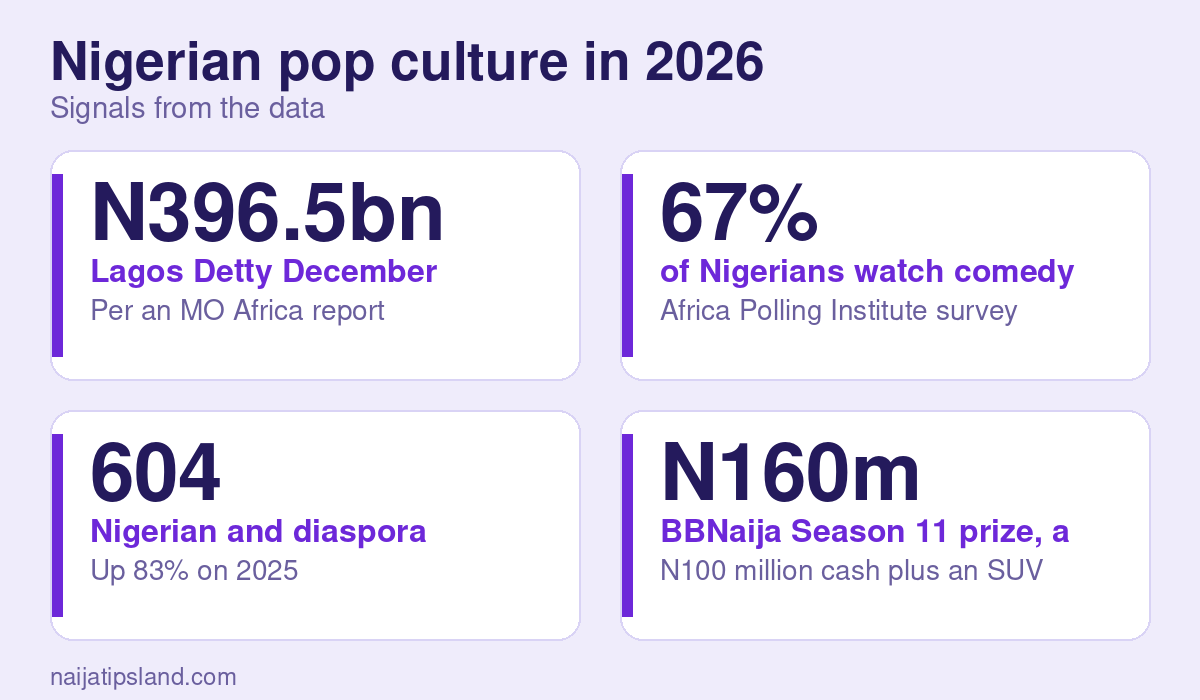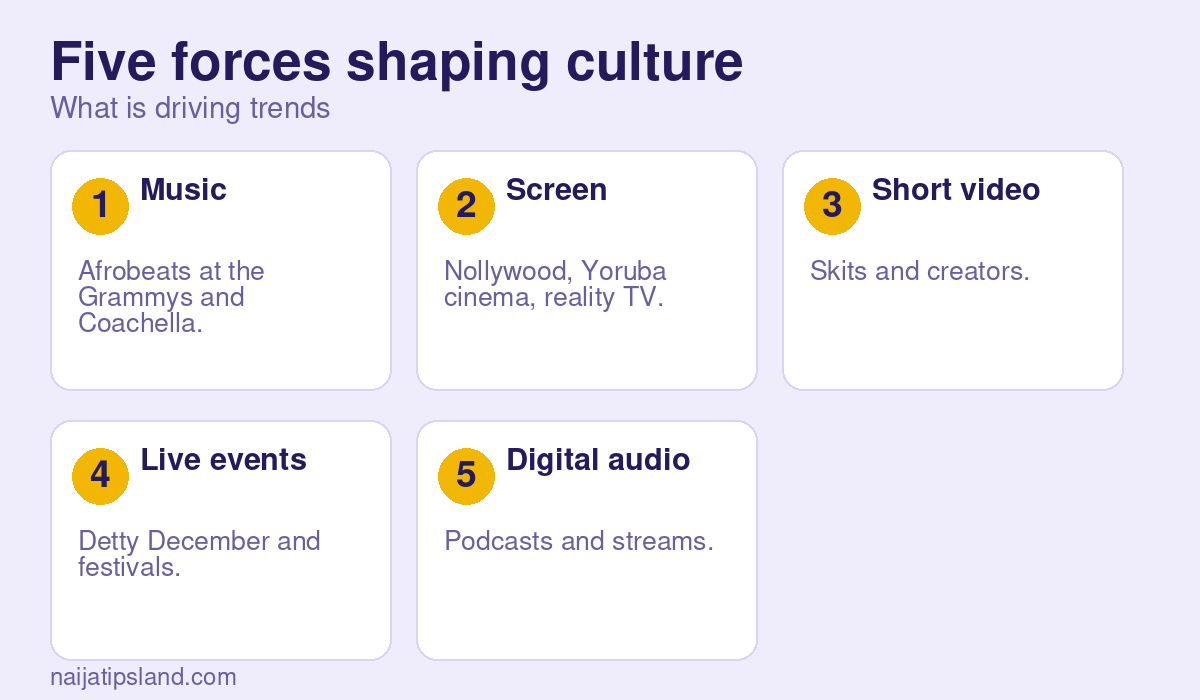
Nigerian pop culture in 2026 is being driven by nine forces you can already track: underground and alté sounds pulling mainstream Afrobeats in new directions; a Naijapiano wave spreading beyond the South; a hip hop and R&B revival; Aso-oke reworked into streetwear; Ankara fused with denim and chiffon; sustainable fashion gaining ground; short-form video collapsing the line between musician and comedian; Hausapiano and South-East drill feeding national playlists; and youth-driven cultural expression showing up in fashion and lyrics alike. Nigeria’s population sits at roughly 230 million, and its apparel market is worth an estimated $6 billion heading into 2026, which tells you these are not niche shifts. They are consumer behavior at national scale.
Here is the one-line rundown before we break each trend down:
- Underground to mainstream: Alté and street sounds are setting the direction Afrobeats moves in next.
- Naijapiano expansion: Amapiano’s Nigerian cousin keeps finding new regional flavors.
- Hip hop and R&B revival: Rap bars and R&B melodies are back in rotation after years of Afrobeats dominance.
- Aso-oke reinvention: Ceremonial cloth is turning up on bomber jackets and bucket hats.
- Ankara fusion: Traditional print meets denim, chiffon, and Western tailoring.
- Sustainable fashion: Ethical production is becoming a selling point, not an afterthought.
- Creator-category collapse: Comedians write songs, musicians go viral doing skits.
- Regional sound expansion: Hausapiano and South-East drill are pushing past their home markets.
- Youth identity and voice: Fashion and lyrics are carrying more open commentary on gender and politics.
Key Takeaways
Nigerian pop culture in 2026 runs on underground-to-mainstream speed, heritage-fabric revival, and creator-category collapse, all measurable through streaming data and market spending figures.
| Point | Details |
|---|---|
| Underground sets the pace | Alté and street sounds are shaping mainstream Afrobeats faster than label playlists can catch up. |
| Streaming proves reach fast | Blaqbonez’s “Chanel” hit over 10.2 million Spotify streams in under two weeks |
| Heritage fabric is now streetwear | Aso-oke is showing up in bomber jackets and bucket hats, backed by a $6 billion apparel market. |
| Creator lines are gone | Comedians and musicians increasingly share the same viral moment, with skits regularly birthing hit songs. |
| Naijatipsland tracks it in real time | The forum’s community threads surface regional breakouts and fashion moments before wider coverage catches on. |
Table of Contents
- Nigerian Music Trends 2026: Sonic Shifts, Metrics, and Breakout Artists
- Nigerian Fashion Styles 2026: Aso-Oke, Ankara Fusion, and Sustainable Design
- Creator Economy and Platform Shifts Driving Nigerian Entertainment Industry Updates
- Regional Sounds and the 2026 Nigerian Events Calendar
- Data Snapshot: The Evidence Behind These 2026 Predictions
- How to Follow Nigerian Pop Culture Trends and Support Creators
- How Nigerian Pop Culture Trends Are Shaping Africa and the Diaspora
- Sources
Nigerian Music Trends 2026: Sonic Shifts, Metrics, and Breakout Artists
The single biggest force in Nigerian music heading into 2026 is that underground and alté producers, not major-label playlists, are now setting the direction mainstream Afrobeats follows. Industry coverage of the trends set to dominate 2026 points to genre hybrids, a hip hop resurgence, and an R&B comeback all pulling from sounds that started in smaller scenes and worked their way up.
The production side backs this up. Studios are moving away from the pristine, overly digital polish that defined mid-2020s Afrobeats and leaning into what engineers call “grit-logic,” a set of analog processing techniques that make tracks sound better on cheap phone speakers and in crowded Lagos danfo rides than on studio monitors. Producers are routing raw vocals through tube preamps and hardware optical compressors, then feeding them through granular delay units before the track ever touches a DAW plugin. The goal is analog warmth and deliberate imperfection, sometimes called “ghost hits,” downsampled drum textures with a rough edge that a fully digital chain would smooth away.

You can see the payoff in the numbers. Blaqbonez’s “Chanel” pulled in more than 10.2 million Spotify streams in under two weeks and charted in dozens of countries, landing at No. 3 on both the US and UK Afrobeats charts. That kind of speed used to take months.
| Artist | Metric | Source |
|---|---|---|
| Blaqbonez | 10.2 million Spotify streams in under two weeks | The Cabal |
| REAL Vol. 1 releases | Fastest African song to reach 10 million Spotify streams | The Cabal |
| Tuff King | Approximately 3 million streams cited in regional breakout coverage | Guardian Nigeria |

Pro Tip: If you want to hear the difference production makes, listen to a 2026 single on your phone speaker first, then on headphones. The grit and warmth engineers add for phone listening often disappears on studio-grade audio, which is the whole point.
Three artists worth following right now: Asake, whose street-hymn style keeps bridging Afrobeats and Fuji influences into new territory; Sarz, the producer whose fingerprints show up on nearly every hybrid record breaking out this year; and BNXN, whose R&B leanings are part of the reason that genre’s comeback has real staying power rather than being a passing moodboard trend. Watch also for Tiwa Savage, still shaping how R&B melody fits into Afrobeats structure a decade into her career, proof that the revival is not only a youth movement.
Nigerian Fashion Styles 2026: Aso-Oke, Ankara Fusion, and Sustainable Design
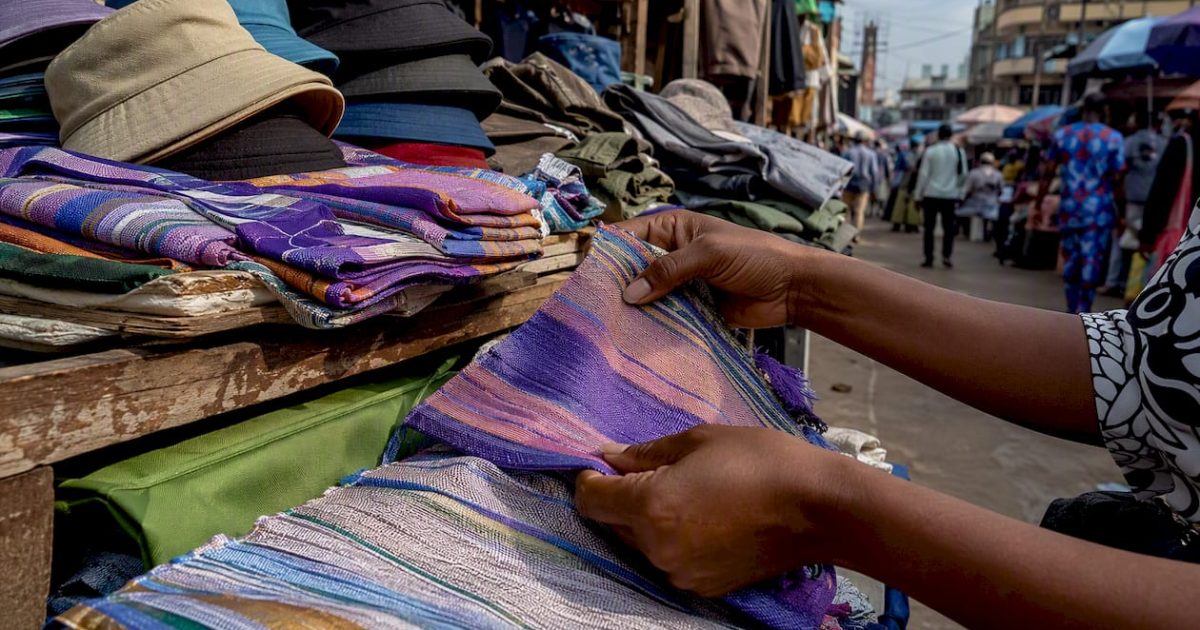
Heritage fabric is going mainstream. Lagos designers are pulling Aso-oke out of weddings and owambe events and putting it into everyday wardrobes, turning a cloth once reserved for ceremony into bomber jackets, mini dresses, cargo pants, and bucket hats. That is not a small shift. It signals designers betting that identity-led fashion has real commercial pull, not just cultural cachet.

Ankara is following a similar path, but sideways rather than up. Instead of standalone Ankara outfits, you are seeing the print mixed into denim jackets, chiffon blouses, and structured Western silhouettes, which makes it wearable outside festive occasions and into daily rotation. Sustainability is the third leg of this shift: smaller Nigerian labels are increasingly marketing ethical sourcing and local production as a feature rather than burying it in a press release nobody reads.
The scale behind these movements is worth pausing on.
Nigeria’s population is estimated at 230 million, with annual apparel spending near $6 billion in early 2026. This is a domestic fashion economy large enough to make a heritage-fabric revival a genuine commercial story, not just a runway moment.
Four things to watch on the ground:
- Aso-oke streetwear drops from independent Lagos labels reworking ceremonial weave into casualwear.
- Ankara-denim hybrids showing up on Instagram street-style pages before they hit retail.
- Sustainable capsule collections from smaller labels marketing traceable, local production.
- Bucket hats and bomber jackets in traditional weave becoming the easiest entry point for people testing the trend without committing to a full outfit.
Creator Economy and Platform Shifts Driving Nigerian Entertainment Industry Updates
The creators shaping 2026 culture are not staying in one lane. Comedians write hooks that chart, musicians build entire releases around a 15-second skit, and the line between “influencer,” “musician,” and “comedian” has essentially disappeared. Editorial coverage of the state of Nigerian music in 2026 points directly to this collapse in categories as one of the defining features of the year, with viral skits regularly turning into charting singles.
Shallipopi’s rise is the clearest case study here. Coverage of what’s been called the “plutomania effect” describes an artist building persona and branding as deliberately as he builds beats, engineering moments specifically for how they will perform once clipped into a 15-second TikTok loop.
That platform mechanic matters more than most people give it credit for. A song’s first ten seconds now function almost like a movie trailer: if the hook does not land immediately, the clip gets scrolled past and the song never gets its shot at a sync placement or a dance-challenge moment. TikTok and YouTube Shorts have effectively become A&R departments, deciding which songs get amplified before radio or Spotify editorial ever weighs in. Naijatipsland’s own coverage of how influencers shape trends and culture in Nigeria traces this same shift from a slightly different angle.
Pro Tip: Watch skit-comedy accounts as closely as you watch music pages this year. If a comedian’s caption song gets reused across dozens of unrelated clips within 48 hours, that track is probably headed for an official release within weeks.
Regional Sounds and the 2026 Nigerian Events Calendar
Lagos does not own Nigerian pop culture anymore, and 2026 is making that obvious. Regional scenes keep feeding the national conversation, with Hausapiano growing out of the North’s amapiano appetite, South-East drill carving its own lane distinct from Lagos street rap, and a fresh cohort of regional breakout artists pushing sounds that would have stayed local five years ago.
- Hausapiano blends Northern melodic sensibilities with amapiano’s log-drum backbone, and artists like Azanti and Kunmie are carrying that sound past its regional base.
- South-East drill keeps building on the region’s rap tradition, with acts like Straffitti and Kidd Carder representing a harder-edged lane distinct from Lagos street pop.
- Rising national names worth tracking include Mavo, Zaylevelten (also known as Tenski), 6uff, Tuff King, OG Abbah, Wave$tar, AR4, and CupidSZN, all part of a wider maverick wave reshaping what counts as an Afrobeats sound.
Festival season and live-show patterns will tell you a lot about which of these names have real staying power versus fleeting streaming spikes. Watch lineup announcements through the first half of the year, since booking patterns tend to lag streaming success by a few months. Naijatipsland’s coverage of current affairs topics impacting Nigeria is a useful companion read here, since festival economics and ticketing often intersect with broader political and consumer stories.
Data Snapshot: The Evidence Behind These 2026 Predictions
These are not guesses stitched together from vibes. They rest on measurable signals: population and consumer spending figures, streaming numbers, chart placements, and reported festival and touring activity.
| Metric | Figure | Source |
|---|---|---|
| Nigeria’s population | Approximately 230 million | The Economist |
| Annual apparel spending | Approximately $6 billion (early 2026) | The Economist |
| Blaqbonez “Chanel” streams | 10.2 million Spotify streams in under two weeks | The Cabal |
A streaming spike tells you a song is having a moment. It does not automatically tell you an artist has staying power, that is closer to what chart placements across multiple weeks and festival booking patterns show. The 10.2 million streams for “Chanel” is a genuine signal of reach, but the more reliable proof of mainstreaming is a follow-up single performing nearly as well or a festival slot booked off the back of it.
Most of what feeds these predictions comes from press reporting on streaming platforms, chart data from services like Spotify and Apple Music, and industry analysis from outlets like The Cabal, Tooxclusive, and Culture Custodian. The thing to watch next is whether regional acts named earlier convert single-song virality into second and third releases that chart just as well, since that is usually the tell for a genuine career rather than a one-off moment.
How to Follow Nigerian Pop Culture Trends and Support Creators
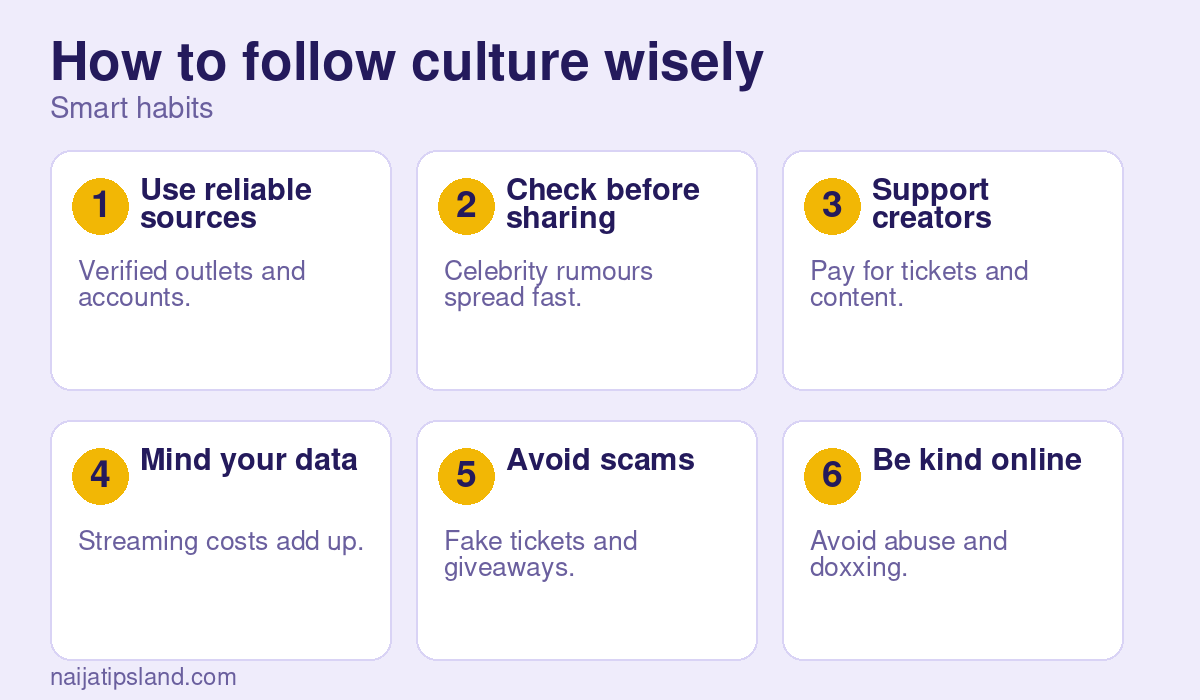
The top three things to do this month: rebuild your playlists around regional and underground names, follow a mix of music and comedy accounts rather than just musicians, and put money or attention directly toward at least one rising act instead of only the already-famous ones.
- Rebuild your streaming playlists to include at least two regional or underground names alongside the artists you already follow, so the algorithm starts surfacing similar acts.
- Follow a mix of account types, not just musicians, since comedians and lifestyle creators are increasingly the first place a breakout song surfaces.
- Check local entertainment reporting weekly rather than relying on international coverage, since Nigerian outlets catch regional breakouts months before global press does.
- Attend a live show when one comes to your city, since touring behavior is one of the clearest signs an artist has moved past a streaming spike.
- Buy directly from designers and artists when you can, whether that’s a physical release, merchandise, or a ticket, since that revenue reaches creators faster than streaming royalties.
For diaspora readers, the same principles apply with a twist: lean on platform features like YouTube’s release notifications and Spotify’s artist-follow alerts, since you will not catch a regional breakout from casual scrolling the way someone in Lagos might. Naijatipsland’s guide to curating trending news in Nigeria and its rundown of Afrobeats artists to watch are both built for exactly this kind of remote tracking.
How Nigerian Pop Culture Trends Are Shaping Africa and the Diaspora
Nigerian pop culture does not stay inside Nigeria’s borders anymore, and it hasn’t for years. What’s different in 2026 is the speed. A Lagos-produced Naijapiano record or an Aso-oke streetwear drop can influence fashion choices in Accra, Nairobi, or London within weeks rather than months, largely because the same platforms driving domestic virality, TikTok and YouTube in particular, distribute globally by default.
Diaspora audiences in the UK, US, and Canada have become an amplification engine rather than a passive audience. Nigerian creators increasingly design content knowing a UK-based Nigerian teenager might be the one who pushes a sound into a wider Black British audience, and that a US-based diaspora account might be the bridge into American R&B and hip hop circles. That two-way traffic is part of why the hip hop and R&B revival inside Nigeria is happening in near lockstep with renewed American interest in Afrobeats collaborations.
Fashion follows the same pattern. Aso-oke’s move into streetwear is not just a Lagos story, it is showing up at diaspora cultural events and weddings abroad as younger Nigerians overseas look for ways to wear heritage fabric outside of strictly ceremonial contexts. The commercial upside is real for Nigerian designers with any kind of export or online retail presence, since diaspora buying power often outpaces domestic per-capita spending even when the cultural cues are identical.
What This Means for Nigerian Culture Right Now
My honest read on 2026 is that the biggest story isn’t any single artist or trend, it’s how fast the gap between “underground” and “mainstream” has collapsed. A song can go from a niche alté crowd to a national chart placement in the time it used to take a single radio cycle, and that speed is rewriting who gets to be a tastemaker. It used to be gatekeepers, labels, radio programmers, festival bookers. Now it’s often a comedian with a good caption or a teenager with a well-timed TikTok clip, and I think that shift toward community-driven discovery is the healthiest thing to happen to Nigerian entertainment in years. Naijatipsland exists to track exactly this kind of shift as it happens, and our community’s discussions around the role of entertainment in Nigerian culture consistently surface these regional and underground names weeks before they hit wider coverage.
Stay Ahead of Every Nigerian Pop Culture Shift
There’s no shortage of ways to follow Nigerian entertainment, from individual artist pages to international outlets that cover Afrobeats as a side beat. What Naijatipsland offers that a single artist feed or an international entertainment site can’t is a running, community-driven conversation, where Nigerian readers and diaspora members flag breakout tracks, regional scenes, and fashion moments in real time, often before they hit mainstream coverage.

If you want the fastest way to catch the next Aso-oke drop or the next Hausapiano breakout before it’s everywhere, see why reading entertainment updates keeps you ahead of the curve and join the discussion threads tracking these trends as they develop.
Sources
- Aso-Oke Is Back — And Lagos Designers Are Reinventing It — News247 Nigeria
- Why the Lagos Sound is Eating the World: Afrobeats and Alté Production Trends in 2026