TL;DR:
- Over 50% of Nigerian children have experienced online bullying, highlighting a growing digital safety crisis.
- Cyberbullying involves digital harassment, spreading rapidly with many harmful forms like flaming and denigration.
- Prevention requires digital literacy, peer support, community involvement, and understanding legal protections.
Over 50% of Nigerian children have experienced online bullying, yet many young people still dismiss cruel comments and public shaming as harmless banter. That gap between perception and reality is exactly where cyberbullying causes the most damage. If you have ever been mocked in a WhatsApp group, had your photo shared without permission, or watched someone get dragged on Twitter, you have already seen cyberbullying up close. This guide breaks down what cyberbullying actually is, how widespread it is in Nigeria, what it does to its victims, and most importantly, what you can do to stop it.
Table of Contents
- What is cyberbullying?
- Current trends of cyberbullying in Nigeria
- The effects of cyberbullying: Understanding the real impact
- Preventing cyberbullying: What works in Nigerian communities
- Legal and personal responses to cyberbullying
- Why most advice on cyberbullying misses the mark
- Taking action: Join a safer online community
- Frequently asked questions
Key Takeaways
| Point | Details |
|---|---|
| Cyberbullying is widespread | More than half of Nigerian adolescents report experiencing online bullying. |
| Impacts are serious | Cyberbullying can cause long-lasting mental health and academic problems. |
| Prevention starts locally | Community-led programs and digital literacy can significantly reduce cyberbullying risk. |
| Legal protections exist | Nigerian law now provides harsher penalties for online abuse but awareness remains key. |
| Peer action matters most | Empathy, intervention, and positive peer leadership are essential for change. |
What is cyberbullying?
With a clear sense of the challenge, let’s define what cyberbullying actually involves.
Cyberbullying is bullying conducted through digital platforms, and it carries unique features that make it more dangerous than traditional bullying: anonymity, the ability to spread rapidly, and the fact that it follows victims everywhere, even into their own homes. Three core traits define it: an imbalance of power between bully and victim, repeated harmful behavior, and a clear intent to hurt.
Understanding the types helps you recognize them when they happen. Here are the most common forms:
- Flaming: Sending angry, offensive messages, often in public comment sections or group chats
- Harassment: Repeatedly sending threatening or hurtful messages to a specific person
- Denigration: Posting false or damaging information about someone to ruin their reputation
- Impersonation: Creating a fake account to pretend to be someone else and cause them harm
- Outing: Sharing someone’s private information or secrets without their consent
- Cyberstalking: Persistently monitoring, following, or threatening someone online
- Boycotting: Organizing others to exclude or ignore a specific person online
In Nigeria, these behaviors play out in very familiar spaces. Someone gets mocked relentlessly in a secondary school WhatsApp group. A girl’s photo gets shared on Facebook with cruel captions. A young man’s old tweets get dug up and used to publicly shame him. These are not just arguments or misunderstandings. They are cyberbullying.
Here is how cyberbullying compares to traditional bullying:
| Feature | Traditional bullying | Cyberbullying |
|---|---|---|
| Location | Physical spaces only | Everywhere, 24/7 |
| Audience | Limited | Potentially thousands |
| Anonymity | Rare | Very common |
| Evidence | Hard to capture | Easily documented |
| Escape | Possible at home | No escape at home |
One key difference is that cyberbullying can go viral news definition within minutes, turning a private conflict into a public spectacle. That speed and scale is what makes it uniquely harmful.
Current trends of cyberbullying in Nigeria
Now that we know what cyberbullying is, how common is it among Nigerian youth, and where does it happen most?
The numbers are striking. Research shows that 39.8% were victimized and 23.9% participated as perpetrators among Nigerian children surveyed, with over half reporting some form of online bullying experience. These are not small figures. They represent millions of young Nigerians.
Key stat: Over 50% of Nigerian children surveyed have experienced cyberbullying in some form, making it one of the most pressing digital safety issues facing youth today.
Here is a breakdown of where cyberbullying most commonly occurs among Nigerian youth:
| Platform | Common bullying behavior |
|---|---|
| Group exclusion, harassment, rumor spreading | |
| Public shaming, fake accounts, denigration | |
| Body shaming, hateful comments, impersonation | |
| Twitter/X | Public call-outs, pile-ons, doxxing |
| TikTok | Mocking videos, duet harassment |
Research also confirms that frequent social media use directly predicts higher involvement in cyberbullying, both as a victim and as a perpetrator. The more time young people spend online without digital safety awareness, the greater the risk.
Key patterns worth noting:
- Adolescents aged 13 to 17 are the most affected group
- Girls are more frequently targeted for body shaming and sexual harassment
- Boys are more likely to engage in flaming and online threats
- Urban youth with consistent smartphone access face higher exposure
Understanding these patterns matters because it helps communities target prevention where it is needed most. Nigeria’s cybercrime laws in Nigeria exist to address these harms, but legal action alone is not enough. The impact of viral news means a single bullying incident can escalate into a nationwide public shaming in hours. That is why online forums for youth need to actively promote safer engagement norms.
The effects of cyberbullying: Understanding the real impact
Understanding the trends, let’s look at why cyberbullying can have such serious consequences.
Cyberbullying is not just hurtful in the moment. It leaves lasting damage. Victims often experience depression, anxiety, poor self-image, and in severe cases, suicidal thoughts. These are clinical outcomes, not exaggerations.
Here are the main effects you need to know:
- Mental health decline: Persistent anxiety and depression are common among victims
- Damaged self-image: 66.8% of victims in studies reported negative changes in how they see themselves
- Social withdrawal: Many victims stop participating in online spaces and real-world social activities
- Academic decline: Difficulty concentrating, skipping school, and falling grades are well-documented outcomes
- Physical symptoms: Sleep problems, headaches, and loss of appetite often accompany emotional distress
One particularly sneaky form of harm is body shaming disguised as jokes. When someone says “I’m just being honest” about your weight or skin tone in a group chat, and everyone laughs along, it still qualifies as cyberbullying if it is repeated and intended to hurt. The humor does not cancel the harm.

Cyberbullying is also more persistent than traditional bullying. A physical bully cannot follow you home. An online bully can send messages at 2 a.m., post content that stays up for weeks, and recruit others to join in. That constant exposure is what makes the psychological toll so heavy.
Supporting your mental health benefits starts with recognizing when you or someone you know is struggling.
“The psychological harm from cyberbullying is real, measurable, and in many cases, long-lasting. It requires the same level of attention as physical harm.”
Pro Tip: If you feel targeted online, talking to a trusted adult or counselor immediately can help prevent escalation. Do not wait for it to get worse before reaching out.
Preventing cyberbullying: What works in Nigerian communities
Knowing what’s at stake, what can you and your community actually do about it?
Prevention works best when it combines digital literacy, community involvement, and peer accountability. Prevention methods that have proven effective globally include digital literacy programs, parental guidance, school-based interventions, and policy enforcement. Nigeria has examples of all of these.
Organizations like TechHer NG run youth-led digital safety clinics that teach young Nigerians how to recognize, report, and respond to online harassment. These peer-led sessions work because young people trust their peers. When a fellow student explains why body shaming is harmful, it lands differently than a lecture from a teacher.
Here is a step-by-step prevention approach you can apply:
- Raise awareness: Share accurate information about what cyberbullying is and why it matters within your school or community group
- Build digital literacy: Learn how to use privacy settings, block and report users, and identify harmful content
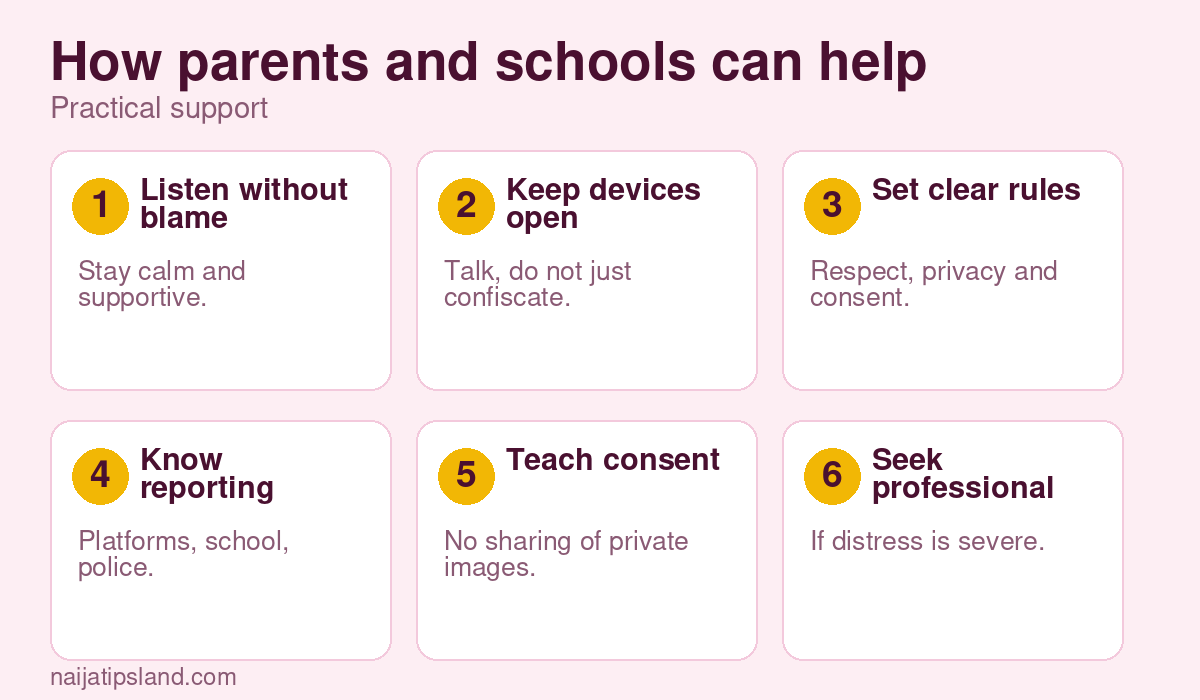
- Involve parents and schools: Encourage open conversations about online behavior at home and in classrooms
- Create peer support networks: Form or join groups where members agree to speak up when they see bullying happen
- Engage local leaders: Community leaders and religious figures can reinforce positive online norms in their messaging
- Support national policy: Nigeria’s National Plan on Violence Against Children includes provisions for online safety that communities can advocate for
Pro Tip: Being a positive bystander, speaking up and supporting victims when you see bullying happen, makes a real difference. Silence often signals approval to the bully.
Local community technology initiatives and content moderation tips can also help communities build safer digital environments from the ground up.
Legal and personal responses to cyberbullying
Effective prevention is only part of the story. What are your rights and options if you encounter cyberbullying?
Nigeria has legal tools in place. The Cybercrime Act criminalizes cyberstalking and cyberbullying, with penalties reaching up to N7 million in fines or 3 years in prison. The 2024 amendment strengthened these provisions, making it easier to prosecute online offenders.
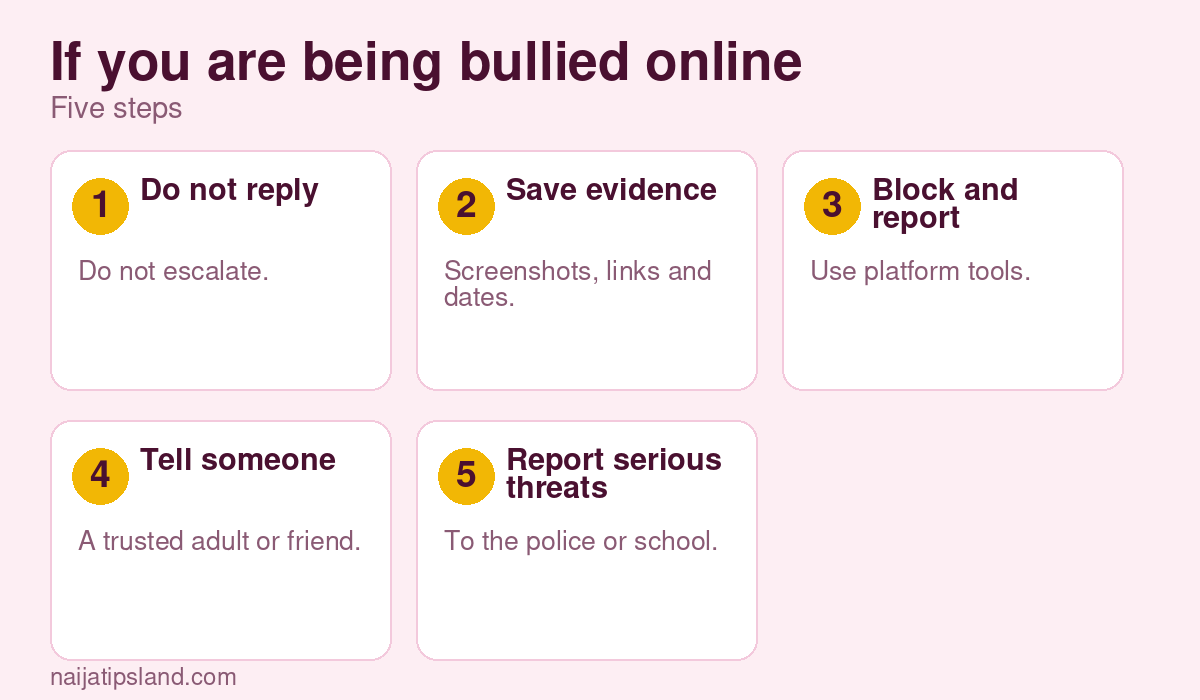
Here is what you can do if you or someone you know is being cyberbullied:
- Document everything: Take screenshots of messages, posts, and profiles before reporting or blocking
- Block and report: Use platform tools to block the bully and report the content to the platform
- Tell a trusted adult: A parent, teacher, or school counselor can help you decide on next steps
- Contact authorities: For serious threats or persistent harassment, you can report to the Nigerian Police Force or the National Information Technology Development Agency (NITDA)
- Seek legal advice: A lawyer can advise you on whether to pursue charges under the Cybercrime Act
Research also shows that personality traits and class level influence the risk of cyberbullying perpetration. Students who score high on openness and honesty tend to be less likely to bully others. This suggests that character education, not just digital rules, plays a role in prevention.
For the most current legal protections, review the latest cyber laws applicable in Nigeria. Knowing your rights is the first step toward using them.

Why most advice on cyberbullying misses the mark
Here is an uncomfortable truth: most cyberbullying awareness campaigns focus on victims and rules, but they rarely address the culture that makes bullying acceptable in the first place.
Top-down campaigns, school assemblies, and government policies matter. But they do not reach the WhatsApp group where someone is being mocked right now. Real change happens when peers decide that cruelty is not entertainment. When a friend speaks up instead of laughing along. When a group admin deletes harmful content without being asked.
Body shaming is a perfect example. In many Nigerian online spaces, commenting on someone’s weight or appearance is treated as casual conversation. Calling it out feels awkward. But that discomfort is exactly where culture shifts begin. The need for genuine discussion among young people, not just top-down messaging, is what drives lasting change.
Empathy and peer accountability are not soft skills. They are the most effective tools we have against cyberbullying. You do not need a law degree or a government program to make your online spaces safer. You just need the willingness to set a different standard.
Taking action: Join a safer online community
If you are ready to be part of the solution, these resources can help you take meaningful steps.
Naijatipsland.com is built for exactly this kind of engagement. It is a space where Nigerian youth can share ideas, discuss real issues, and build the kind of respectful online culture that pushes back against cyberbullying.

Start by learning the basics of online forum etiquette so you know how to engage respectfully from day one. If you want to spark meaningful conversations in your community, find out how to start online discussions that actually go somewhere. And if you want to understand how community participation supports your wellbeing, explore the community engagement benefits of joining an active, supportive forum. Your voice matters. Use it to build something better.
Frequently asked questions
What are the main signs that someone is a victim of cyberbullying?
Common signs include sudden withdrawal from online activities, mood swings, secrecy about digital life, and unexplained academic decline. Victims often experience anxiety, depression, and a negative shift in self-image that may not have an obvious cause.
How can Nigerian youth protect themselves from cyberbullying?
Practice digital literacy, use privacy settings, report harmful behavior, and seek support from trusted adults or counselors. Digital literacy and awareness campaigns are among the most effective prevention tools available.
What legal actions can be taken against cyberbullies in Nigeria?
The Cybercrime Act provides for substantial fines or imprisonment for cyberbullying offenses, and reports can be made to authorities or through school channels. Penalties can reach N7 million or 3 years in prison for serious offenses.
Is all teasing or online criticism considered cyberbullying?
No, cyberbullying involves repeated, intentional harm with a power imbalance, so not all online criticism qualifies. True cyberbullying is characterized by intent, repetition, and an imbalance of power between the bully and the victim.