

Start with So Nigerian, I Said What I Said, WHOT Podcast, The Volume Pod, and Loose Talk. Each one owns a different lane of Nigerian culture, and each one functions as a community hub, not just a feed you press play on. Below is a shortlist to get you listening today, followed by the reasoning behind every pick.
- So Nigerian — best for sharp, unfiltered pop-culture and “Japa” commentary. Over 173 episodes since 2020, on Apple Podcasts and Spotify.
- I Said What I Said — best for candid relationship and social-life gist, built into a full media brand.
- WHOT Podcast — best for weekly pop-culture banter with heavy social engagement, via Spotify.
- The Volume Pod — best for long-form political interviews ahead of the 2027 election cycle.
- Loose Talk — best for loose, comedic conversational gist with a loyal listener base.
- Two or three rotating charters — check the Nigeria charts weekly, since ranking movement often signals a fresh must-listen.
Pro Tip: If you only have data for one show this week, pick whichever one matches your mood, not your feed’s popularity. Gist shows reward binge-listening; civic shows reward one episode at a time.
Key Takeaways
Nigerian podcasts succeed by combining strong genre focus with active community channels, and chart position matters far less than release consistency and listener engagement.
| Point | Details |
|---|---|
| Start with the five essentials | So Nigerian, I Said What I Said, WHOT Podcast, The Volume Pod, and Loose Talk each anchor a different genre lane. |
| Sample before committing | Listen to three to five episodes of a show before judging fit, since pilot episodes rarely represent the format at its best. |
| Watch for community signals | Active WhatsApp channels and social clips indicate a show built for longevity, not just a one-off viral episode. |
| Use clips to save data | Follow a show’s Instagram or YouTube first to judge tone before downloading full audio episodes. |
| Language shapes tone | English dominates, but Pidgin code-switching and indigenous-language shows add authenticity and regional reach. |
Table of Contents
- Top 10 Nigerian Podcasts: Curated Picks and What Makes Each Stand Out
- How to Choose Nigerian Podcasts That Fit Your Taste
- Where and How Nigerians Actually Listen to Podcasts
- Why These Podcasts Matter in Nigerian Culture
- History and Evolution of Nigerian Podcasts
- Challenges Faced by Nigerian Podcasters
- Language Diversity in Nigerian Podcasts
- Growing Your Own Listening Habit and Joining the Conversation
- Editorial Take: Community Beats Chart Position
- Sources
Top 10 Nigerian Podcasts: Curated Picks and What Makes Each Stand Out
Nigeria’s podcast scene has grown wide enough that Feedspot now tracks more than 100 active shows across politics, music, comedy, and niche interest. That range means there’s no single “best” Nigerian podcast, only the best one for what you’re chasing this week. Here are ten worth your attention, ranked by relevance rather than a rigid chart position.
- So Nigerian covers pop culture, relationships, and the “Japa” wave with a bold, opinionated tone. Its standout run has been the multi-part series on diaspora life, and it fits listeners who want fast, quotable takes. Weekly-ish cadence, available on Apple Podcasts and Spotify, with active social clips.
- I Said What I Said built a full brand around candid, no-filter conversation about relationships and modern Nigerian social life. Best for listeners who enjoy long-form gist that occasionally gets uncomfortable on purpose. Distributed across audio and YouTube with social clips to widen reach.
- WHOT Podcast brands itself as Nigeria’s leading pop-culture show, releasing weekly episodes with heavy listener callouts and social buzz on Spotify. Best for people who want their gist served fast and current.
- The Volume Pod runs interview and documentary-style series aimed at Nigeria’s civic conversations, including coverage tied to the 2027 election cycle. Best for listeners who want politics without shouting matches. Multi-channel, with content built for both audio and video formats.
- Loose Talk keeps things comedic and conversational, less structured than news podcasts, more like eavesdropping on a smart group chat. Best for commute-length episodes when you want to laugh, not think too hard.
- Political and civic series backed by advocacy partners increasingly pair with organizations like BudgIT and CODE to move beyond debate into accountability journalism, a shift documented on The Volume Pod’s own site. Best for listeners who want podcasts that push toward real outcomes.
- Music-focused shows covering Afrobeats, Amapiano crossovers, and industry gossip round out the ecosystem Feedspot maps across genres. Best for fans who want release breakdowns alongside gist.
- True-crime and mystery series rooted in Nigerian cases have grown steadily, filling a genre gap that used to be dominated by American shows. Best for late-night listening when you want tension over comedy.
- Lifestyle and relationship advice shows sit adjacent to I Said What I Said but lean softer, more advice-column than confrontation. Best for listeners newer to the genre who want a gentler entry point.
- Business and tech commentary podcasts have emerged to cover Nigeria’s startup and fintech scene, often run by founders themselves. Best for listeners tracking the economy beyond headlines.
How to Choose Nigerian Podcasts That Fit Your Taste
Picking a show isn’t about finding the most popular one. It’s about matching a show’s rhythm to your actual listening habits.
Run through this checklist before you commit to a subscription:
- Genre fit: pop culture, politics, comedy, true crime, or business — pick the lane, not the hype.
- Episode length: 20 minute episodes suit a commute; 90 minute interviews suit a weekend chore.
- Release cadence: weekly shows build habit loops faster than monthly or irregular ones.
- Host background: check whether the host has relevant experience (journalism, comedy, civic work) for the topic they cover.
- Community presence: a WhatsApp channel or active Instagram comments section signals a show that treats listeners as participants, not just numbers.
Sample three to five episodes before deciding a show “works” for you, not just one. The pilot episode is rarely a show’s best representation, and a second or third listen often reveals whether the chemistry between hosts holds up over time. Watch for red flags too: long inactive gaps between episodes, a community-focused show with a dead social presence, or a release schedule that swings wildly between weekly and once-a-quarter. Those are signs the show may be winding down even if old episodes still sound great.
Pro Tip: If your data plan is tight, follow the show’s Instagram or YouTube first. Most Nigerian podcast hosts post short clips before the full episode drops, so you can judge the vibe without spending a single megabyte on the full audio file.
Where and How Nigerians Actually Listen to Podcasts
Platform choice in Nigeria isn’t just about preference, it’s about access. Apple Podcasts hosts Nigeria-specific Grep, useful if you have unlimited data and an iPhone. Spotify offers similar discovery tools with a lower data footprint per episode, which matters when you’re budgeting megabytes. YouTube, meanwhile, has become the default for many shows because it doubles as both a listening platform and a clip factory for social media.
That’s not an accident. Creators lean on multi-platform distribution precisely because audio-only reach is limited when internet reliability varies from listener to listener. A show posts full episodes on Spotify and Apple, then cuts three-minute highlights for TikTok, Instagram, and X, then drops the same links into a WhatsApp channel where fans discuss the episode in real time.
A few practical habits help stretch your data further:
- Download episodes over Wi-Fi in bulk rather than streaming one at a time on mobile data.
- Toggle low-data or “data saver” settings inside Spotify and YouTube before you start listening.
- Follow a show’s WhatsApp or Telegram channel for direct download links instead of relying on app search.
- Bookmark where to listen to Nigerian radio online style guides if you’re new to streaming audio content generally.
Why These Podcasts Matter in Nigerian Culture
Nigerian podcasts don’t just report culture, they build it in real time through comment sections, WhatsApp threads, and live Q&As that keep listeners returning between episodes. Naijatipsland tracks these same conversations daily across entertainment, politics, and lifestyle discussions, which is exactly why we treat podcast gist as part of the wider public discourse Nigerians engage in online.
- Live shows and listener call-ins turn passive audio into ongoing dialogue.
- Comment-driven episodes let hosts respond directly to audience reactions from the previous week.
- WhatsApp channels function as an extension of the show, not just a notification tool.
Community engagement through WhatsApp channels and live Q&As is a real longevity driver. Shows that keep these channels active tend to hold onto listeners far longer than shows that treat episodes as one-way broadcasts, a pattern industry observers on Podchaser have noted repeatedly among the biggest names in the space.
Got a topic you think deserves its own episode? Bring it to a Naijatipsland discussion thread and see where the conversation goes.
History and Evolution of Nigerian Podcasts
Nigerian podcasting started small, largely as a side project for radio personalities and bloggers experimenting with a new format in the early 2010s. Equipment was basic, distribution was clunky, and most shows lived and died within a handful of episodes because there was no clear path to an audience or income.
That changed as smartphone penetration climbed and platforms like Spotify made international distribution simple for local creators. Shows that once existed as scrappy audio experiments have grown into full media businesses, producing audio, YouTube video, and social clips from a single recording session. So Nigerian’s run past 173 episodes since 2020 is a good marker of this shift: a show that started as commentary became a sustained brand with a recognizable voice and format.
The next stage of that evolution has been monetization. Sponsorships, live events, and merchandise now support shows that once ran purely on host enthusiasm. Political podcasts followed a parallel path, moving from casual debate shows into structured series that sometimes partner with civic organizations to push accountability work rather than just talk about it. The result is an ecosystem that looks less like hobbyist audio and more like a genuine media industry, built specifically around Nigerian voices and Nigerian concerns.
Challenges Faced by Nigerian Podcasters
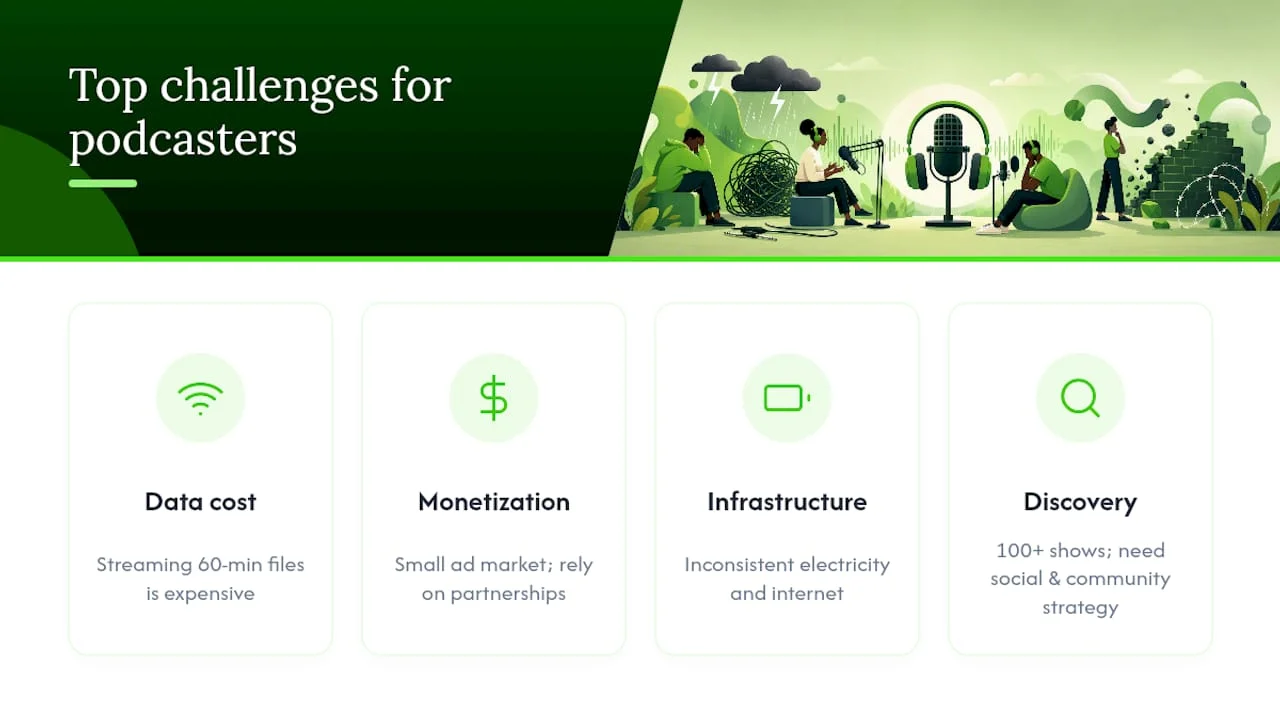
Data cost remains the biggest barrier between a great episode and an actual listener. Streaming a 60-minute audio file is expensive for anyone paying by the megabyte, which is why so many creators now treat short-form video clips as the real front door to their show rather than the full episode itself.
Monetization is the second major hurdle. Nigeria’s advertising market for podcasts is still young compared to markets like the US or UK, so many hosts rely on brand partnerships, live event tickets, or side businesses to keep a show running between sponsorship deals. Inconsistent electricity and internet infrastructure add production friction that creators in more stable markets rarely deal with, turning a simple recording session into a logistical challenge some weeks.
There’s also a discovery problem. With well over 100 active Nigerian shows now competing for attention, standing out requires more than good content, it requires an active social strategy, consistent release scheduling, and a community presence that keeps listeners talking about an episode after it drops. Shows that skip the community layer tend to plateau even when the content itself is strong, which is part of why WhatsApp channels and comment-heavy formats have become close to standard practice among the shows that last.
Language Diversity in Nigerian Podcasts
English dominates Nigerian podcasting simply because it reaches the widest cross-section of listeners across regions and diaspora audiences. Most of the biggest shows, including the ones covered above, record primarily in English with regional inflection rather than switching languages entirely.
Pidgin shows up constantly, though, often mid-sentence rather than as a separate show format. Hosts slide into Pidgin for emphasis, comedy, or emotional weight, then back into English for structure, a code-switching style that mirrors how many Nigerians actually talk in daily life. It’s part of what makes gist-style shows feel authentic rather than scripted.
Indigenous-language podcasts exist too, in Yoruba, Igbo, Hausa, and other languages, though they occupy a smaller share of the mainstream charts. These shows tend to serve specific regional or cultural audiences directly, covering topics like local politics, folklore, or community news that a general English-language show wouldn’t prioritize. As Nigerian podcasting keeps growing, that linguistic range is likely to expand rather than narrow, since creators are increasingly betting that a tightly targeted audience in one language beats a diluted reach across several.
Growing Your Own Listening Habit and Joining the Conversation
Naijatipsland exists for the same reason these podcasts do: Nigerians want a space to talk about what’s actually happening, not just consume it passively. If a podcast episode gets you fired up about a political story, an entertainment scandal, or a cultural shift, that energy belongs somewhere beyond your own headphones.
Bring it to the forum. Submit a topic, start a thread, or join an existing discussion about the same stories your favorite hosts are already covering. Podcasts start the conversation; the comment section is where it actually plays out.
Editorial Take: Community Beats Chart Position
The conventional advice on picking Nigerian podcasts leans too hard on chart rankings, as if a number one spot on Apple Podcasts guarantees a show is worth your time. It doesn’t. A show sitting lower on the charts with an active WhatsApp channel and consistent weekly episodes will often serve you better than a chart-topper that’s gone quiet for two months.
What’s genuinely underrated is how much these shows function as social infrastructure rather than entertainment products. The gist format works precisely because it mimics a friend group’s group chat, not a broadcast. That’s the real differentiator between shows that last years and shows that flame out after a viral episode or two.
Prioritize activity over prestige. A podcast that replies to comments, drops clips consistently, and keeps its community channel alive is telling you something a chart position never will: that the people behind it are still showing up.
— Naijatipsland
Sources
- So Nigerian – Podcast (Apple Podcasts)
- Volume with FemiDlive | The Volume Pod
- Grep
- So Nigerian | Podcast on Spotify
- So Nigerian — Podchaser