“How far? Abeg no vex, sapa dey hold me but e go be.” If you understood that sentence, you already speak some Nigerian Pidgin. If you didn’t, this guide is for you. Nigerian Pidgin is spoken by an estimated tens of millions of people across Nigeria and the diaspora, and Nigerian slang moves fast. New words spread through Twitter (X), TikTok, skits and Afrobeats songs every year, and some, such as japa, suya, yarn dust and 419, have even entered the Oxford English Dictionary.
Below is our Nigerian Pidgin and slang dictionary: the everyday Pidgin words you need, popular slang and their meanings, the newest words of 2025 and 2026, money and campus slang, and words from Yoruba, Igbo and Hausa that everyone uses. Each entry has a short meaning and an example.
Last updated: 21 October 2026. Slang changes quickly and meanings can vary by region and age group. We have left out vulgar and sexual slang.
Everyday Nigerian Pidgin words
| Word or phrase | Meaning | Example |
|---|---|---|
| How far? | Hello / how are you? / what’s up? | “How far, my guy?” |
| Abeg | Please | “Abeg, help me carry this bag.” |
| Wetin | What | “Wetin happen?” |
| Dey | Is / am / are (continuous); to be somewhere | “I dey come.” (I’m coming.) |
| Una | You (plural) | “Una well done.” |
| Wahala | Trouble, problem, stress | “No wahala, I go do am.” |
| Chop | Eat; also to spend or enjoy money | “Make we go chop.” |
| Sabi | To know or be good at | “She sabi cook well well.” |
| Comot / komot | Leave, get out, remove | “Comot for road!” |
| Oya | Come on, let’s go, okay then | “Oya, make we start.” |
| Abi? | Isn’t it? / right? | “You go come, abi?” |
| Sef | Even / too (for emphasis) | “Me sef no know.” |
| Shey? | Is it? / are you? (question marker) | “Shey you don chop?” |
| Pikin | Child | “Na im pikin be that.” |
| Wan | Want to | “I wan sleep.” |
| Fit | Can, able to | “I no fit come today.” |
| Don | Has / have (completed action) | “Light don come!” |
| Na | It is / is | “Na so e be.” |
| Wey | That / which / who | “The man wey call you.” |
| Gist | Gossip or story; to chat | “Come gist me wetin happen.” |
| No vex | Sorry, don’t be angry | “No vex, I late small.” |
| Shine your eye | Be alert, be careful | “Shine your eye for Lagos.” |
| Sharp sharp | Quickly | “Do am sharp sharp.” |
| Small small | Gradually, little by little | “We go reach there small small.” |
| Wahala dey | There’s trouble | “If NEPA take light, wahala dey.” |
| Nawa (o) | Expression of surprise or disbelief | “Nawa o, this traffic!” |
| Chai! | Exclamation of shock or regret | “Chai, I forget my phone.” |
| Ehen | Okay, I see, and then? | “Ehen, wetin happen after?” |
| Kpatakpata | At all, completely | “I no get money kpatakpata.” |
| I no fit shout | I can’t be bothered / not my problem | “Dem dey fight? I no fit shout.” |

Popular Nigerian slang and their meanings
| Slang | Meaning | Example |
|---|---|---|
| Japa | To relocate abroad, usually for a better life | “Half of my class don japa.” |
| Sapa | Being broke, extreme lack of money | “Sapa dey hold me this month.” |
| Jand | The UK or abroad; “janded” describes someone with a foreign accent | “She just come back from Jand.” |
| IJGB | “I Just Got Back”, a diaspora visitor home for December | “The IJGBs don land for Detty December.” |
| Yawa | Trouble, disgrace, a bad situation | “Yawa don gas!” |
| Shakara | Showing off, playing hard to get | “Stop dey do shakara.” |
| Packaging | Presenting yourself to look richer or better than you are | “Na packaging, e no get money.” |
| Ginger | Motivate, hype up; energy | “The song ginger me.” |
| Gbam! | Exactly! Spot on | “Gbam! Na wetin I talk be that.” |
| K-leg | A problem or flaw in a plan | “The deal get k-leg.” |
| Mugu | A fool, someone easily cheated | “Dem take am as mugu.” |
| Oversabi | A know-it-all | “No dey do oversabi.” |
| Amebo | A gossip; gossip itself | “That woman na amebo.” |
| Bolo | Slow, naive | “Don’t be bolo, read the contract.” |
| Ajebo | Someone from a wealthy, sheltered background | “He’s an ajebo, he can’t cook.” |
| Ajepako | Someone tough, from a humble background (opposite of ajebo) | “Ajepako no dey fear hard life.” |
| Gbege | Trouble | “No bring gbege come my house.” |
| Wahala be like bicycle | Trouble comes easily and quickly | “Just one word, wahala be like bicycle.” |
| Dey play | You’re not serious / keep deceiving yourself | “You think say e easy? Dey play.” |
| Soft life | A comfortable, stress-free life | “This year, na soft life I want.” |
| Trenches | Tough, poor neighbourhoods; hard times | “He grew up in the trenches.” |
| Owambe | A big party, especially a Yoruba celebration | “We get owambe on Saturday.” |
| Aso ebi | Matching fabric worn by guests at a party | “Have you bought the aso ebi?” |
| Gbedu | Music, a party, a vibe | “The gbedu loud for there.” |
| Detty December | The December festive party season | “Detty December don start!” |
| Area boy / agbero | Street touts, often collecting money at bus stops | “The agbero collect money from the driver.” |
| 419 / Yahoo boy | Fraud / internet fraudster | “Na 419 that offer.” |
| Yarn | To talk or tell a story | “Wetin you dey yarn?” |
| Yarn dust | To talk nonsense | “Stop dey yarn dust.” |
| NEPA take light | Power cut (NEPA is the old power authority) | “NEPA don take light again.” |
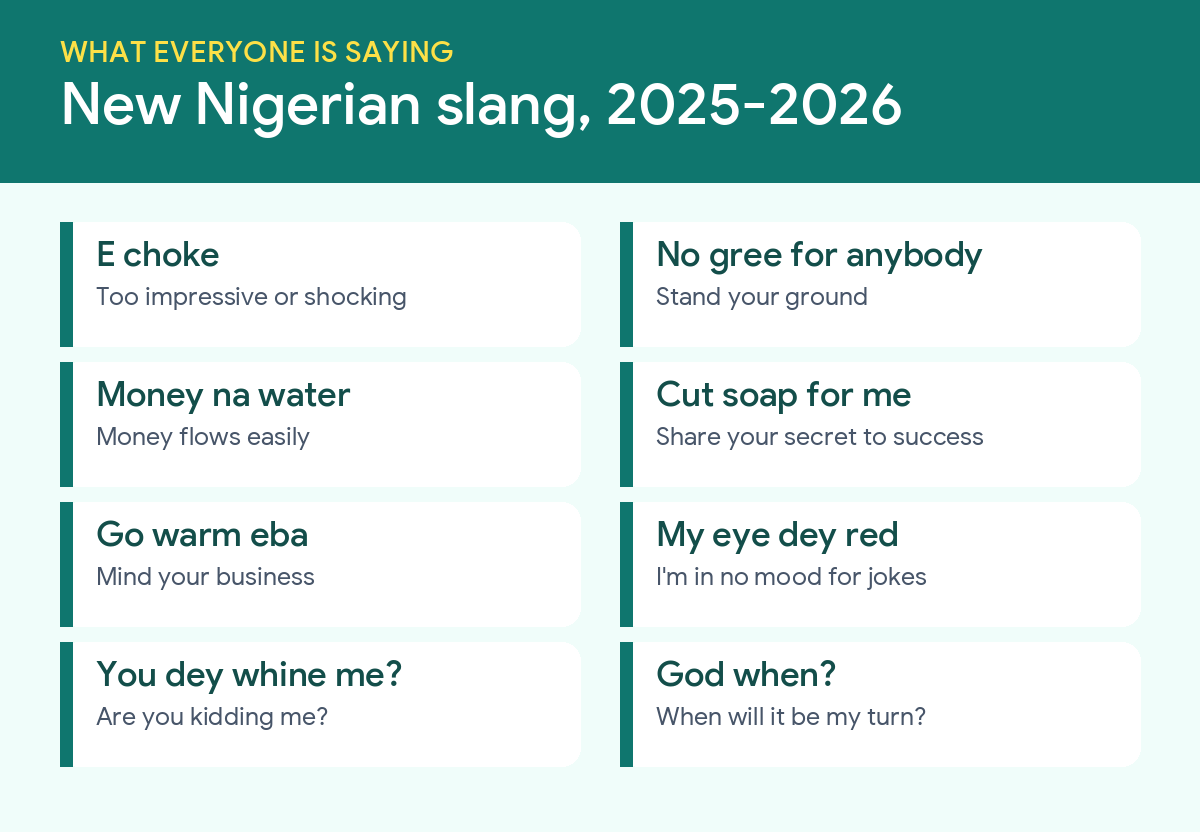
New Nigerian slang in 2025 and 2026
| Slang | Meaning | Example |
|---|---|---|
| E choke | Too impressive or shocking | “The wedding? E choke!” |
| No gree for anybody | Stand your ground, don’t let anyone cheat or disrespect you; popular from 2024 | “For this Lagos, no gree for anybody.” |
| Money na water | Money flows easily / I have plenty of money | “Na so he dey spray, money na water.” |
| Cut soap for me | A joke request for the “secret” of someone’s sudden success | “You don buy car? Cut soap for me!” |
| You go explain tire | No matter how much you explain, the evidence is against you | “You go explain tire, no evidence.” |
| How’s it doing you? | A playful “what’s wrong with you?” | “You dey shout for road. How’s it doing you?” |
| My eye dey red | I’m angry or in no mood for jokes | “Leave me, my eye dey red today.” |
| You dey whine me? | Are you kidding me? | “N50,000 for this shoe? You dey whine me?” |
| As how? | How come? (in disbelief) | “He don marry? As how?” |
| E go be | It will be well | “No worry, e go be.” |
| Hammer | A big break; to finally make it | “This year I go hammer.” |
| Ejeh | Close friend, “my blood” | “That na my ejeh.” |
| Liver | Courage, daring | “You get liver to talk to oga like that?” |
| Steeze | Effortless cool | “His steeze is unmatched.” |
| Go warm eba | Mind your business, stay in your lane | “Nobody ask you, go warm eba.” |
| Vibes and Inshallah | Hoping things work out with no clear plan | “The plan? Na vibes and Inshallah.” |
| We move / we meuve | Life goes on | “We lost the match. We meuve.” |
| God when? | “When will it be my turn?” (said about someone else’s success) | “He bought a Benz? God when?” |
Money slang
| Slang | Meaning |
|---|---|
| Aza | Bank account number (“send your aza”) |
| Kudi / owo / ego | Money (Hausa / Yoruba / Igbo) |
| Wazo / figo | ₦50 |
| Muri | ₦20 |
| Spray | Throwing money on someone dancing at a party |
| Egunje | A bribe or “something small” for a favour |
| Hustle | Work, business, side job |
If japa is your plan and you need to send money abroad, see our guide to the cheapest ways to send money abroad from Nigeria.
Campus and NYSC slang
| Slang | Meaning |
|---|---|
| Jacking | Studying hard for long hours |
| Fresher / JJC | New student / “Johnny Just Come”, a newcomer |
| Carryover | A failed course you must retake |
| Expo / origo | Exam malpractice materials |
| Spagewa | Spaghetti and beans mixed together |
| Indospag | Noodles and spaghetti cooked together |
| Otondo | A newly arrived NYSC corps member |
| Corper | A National Youth Service Corps member |
| Allawee | The NYSC monthly allowance |
Yoruba, Igbo and Hausa words everyone uses
From Yoruba
- Omo: literally “child”, used as an exclamation (“Omo, this thing hard!”) or for “guy”.
- E ku ise: well done (greeting someone at work).
- Oya: come on, let’s go.
- Mafo: don’t panic.
- O por: it’s plenty / impressive.
- Idan: a streetwise hustler.
- Olodo: a dullard (an insult).
- Oti lo: it’s gone.
- Tokunbo: second-hand imported goods, especially cars.
From Igbo
- Biko: please.
- Nna: father, used like “my guy” or as an exclamation.
- Jisie ike: well done, keep it up.
- Ngwa: come on, quickly.
- Odeshi: someone tough who never shows pain.
- Ote: original, top quality.
- Tuu: nonsense.
From Hausa
- Shikena: that’s it, that’s all.
- Kudi: money.
- Mai guard (maigad): security guard.
- Sannu: hello / sorry / well done.
- Wallahi: I swear (from Arabic).
- Jaara: something extra added, like a bonus.
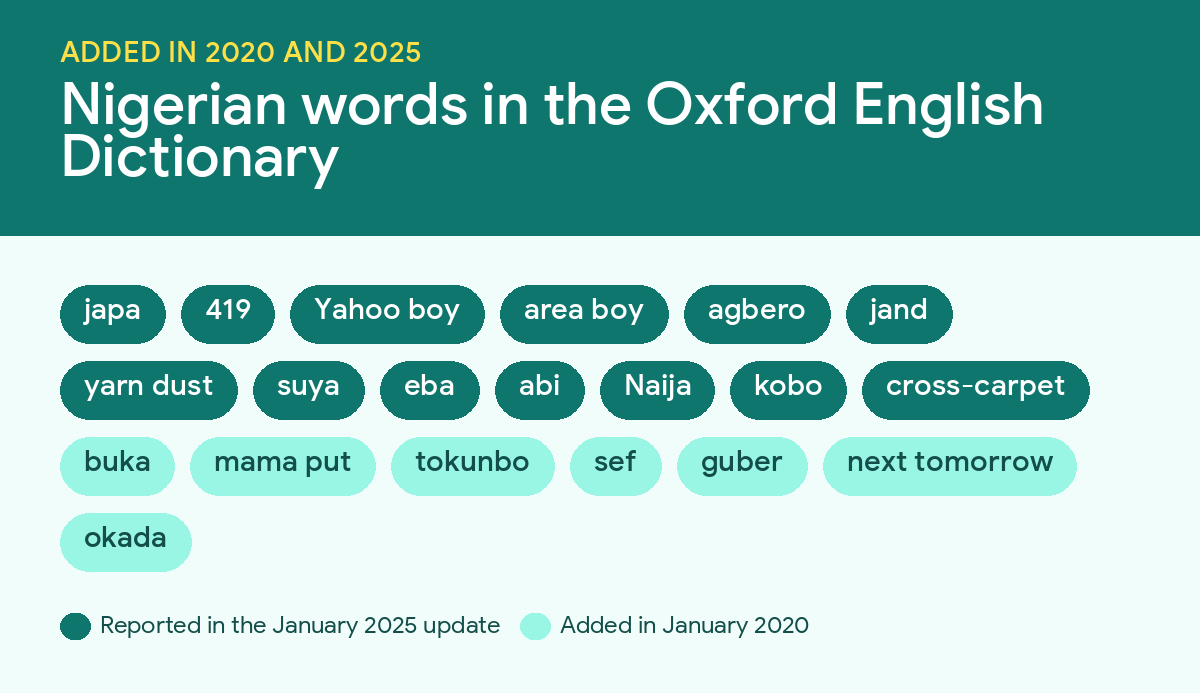
Nigerian words in the Oxford English Dictionary
Nigerian English is now officially recognised by the Oxford English Dictionary (OED). In January 2020, the OED added a batch of Nigerian English words, including buka (a roadside restaurant), mama put (a street food vendor), tokunbo (second-hand imported goods), sef and guber (short for gubernatorial), along with words such as next tomorrow and okada. A further update reported in January 2025 added japa, 419, Yahoo boy, area boy, agbero, jand, yarn, yarn dust, suya, eba, abi, Naija, kobo and cross-carpet (when a politician switches parties).
Tips for using Nigerian Pidgin
- Pidgin is a language, not “broken English”. It has its own grammar. For example, “I dey go” means “I am going”, and “I don go” means “I have gone”.
- Know your audience. Pidgin and slang are great with friends and on social media, but in a job interview or formal letter, use standard English.
- Some slang is offensive. Words like mumu, olodo or ode can be playful between friends but insulting to others.
- Listen to Nigerian music, skits and Nollywood to pick up slang naturally. BBC News Pidgin also publishes news in Nigerian Pidgin. For what to watch, see our guide to the best Nigerian movies to stream, and for more on music and trends, our guide to Nigerian pop culture in 2026.
Frequently asked questions
What does “japa” mean?
To leave Nigeria and relocate abroad, usually for better opportunities. The word comes from Yoruba and was added to the Oxford English Dictionary.
What does “sapa” mean?
Being broke or having no money, often after overspending.
What does “e choke” mean?
Something so impressive or shocking that it “chokes” you. “The party e choke!”
What does “no gree for anybody” mean?
Stand your ground and don’t let anyone cheat or disrespect you. It became a popular slogan in 2024.
Is Nigerian Pidgin the same as Ghanaian Pidgin?
They are related and partly understandable to each other, but they have different vocabulary and pronunciation.
Sources
- Pulse Nigeria: updated Nigerian slang you need to know (October 2025)
- Zikoko: Nigerian slangs and their meanings, the 2025 guide
- Peoples Gazette: Yahoo boy, japa, 419, eba, suya added to the Oxford English Dictionary
- The Native: the OED adds Nigerian English words (January 2020)
- Wikipedia: Sapa (slang)
- Wikipedia: No gree for anybody