Last updated: 14 October 2026. These steps reduce your risk of being fooled, but they do not guarantee certainty. When in doubt, wait for confirmation from several reliable sources.
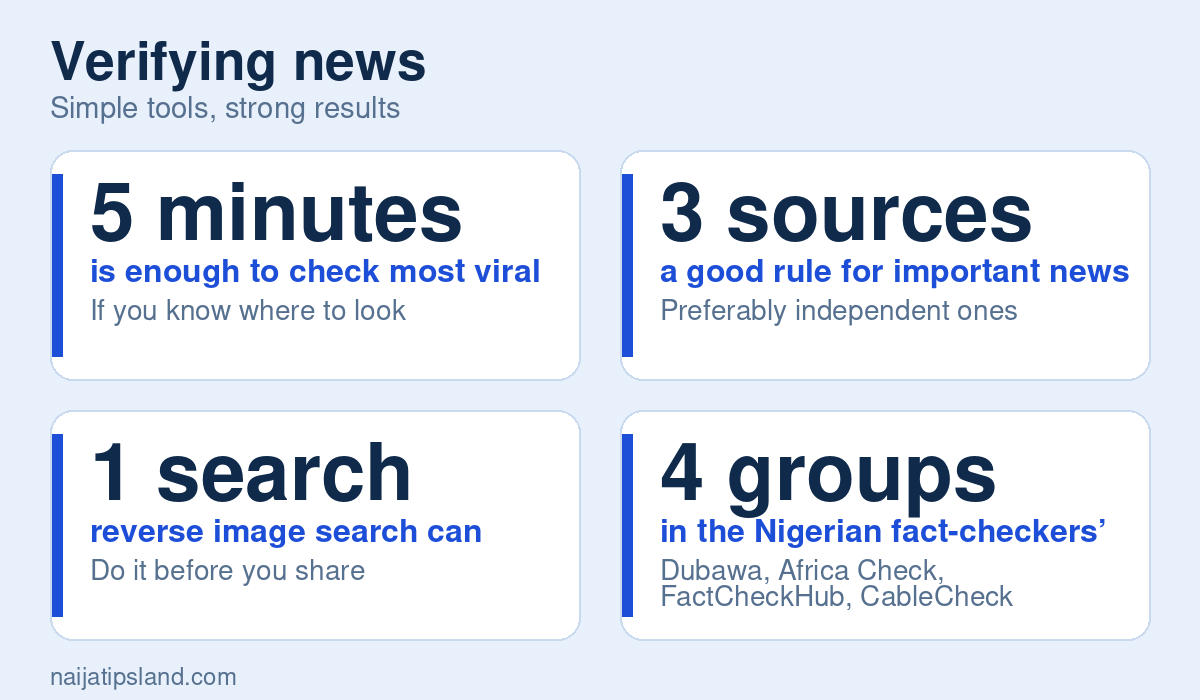
You do not need to be a journalist to check a claim. Most false stories fall apart within five minutes if you follow a routine. This guide gives you one, with Nigerian examples and sources. For the types of fake content to watch for, see our guide to fake news and AI deepfakes.
Step 1: Read past the headline
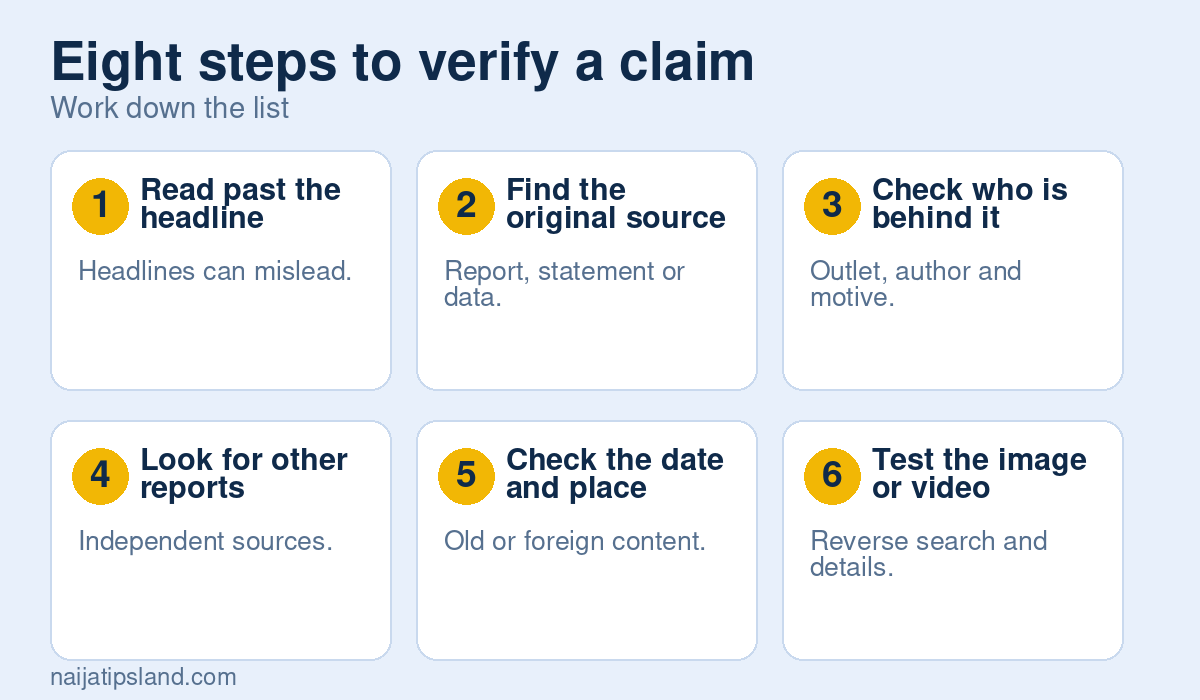
Headlines are written to get clicks. Read the whole article, and see whether the facts support the headline. Be careful with posts that screenshot only a part of a story.
Step 2: Find the original source
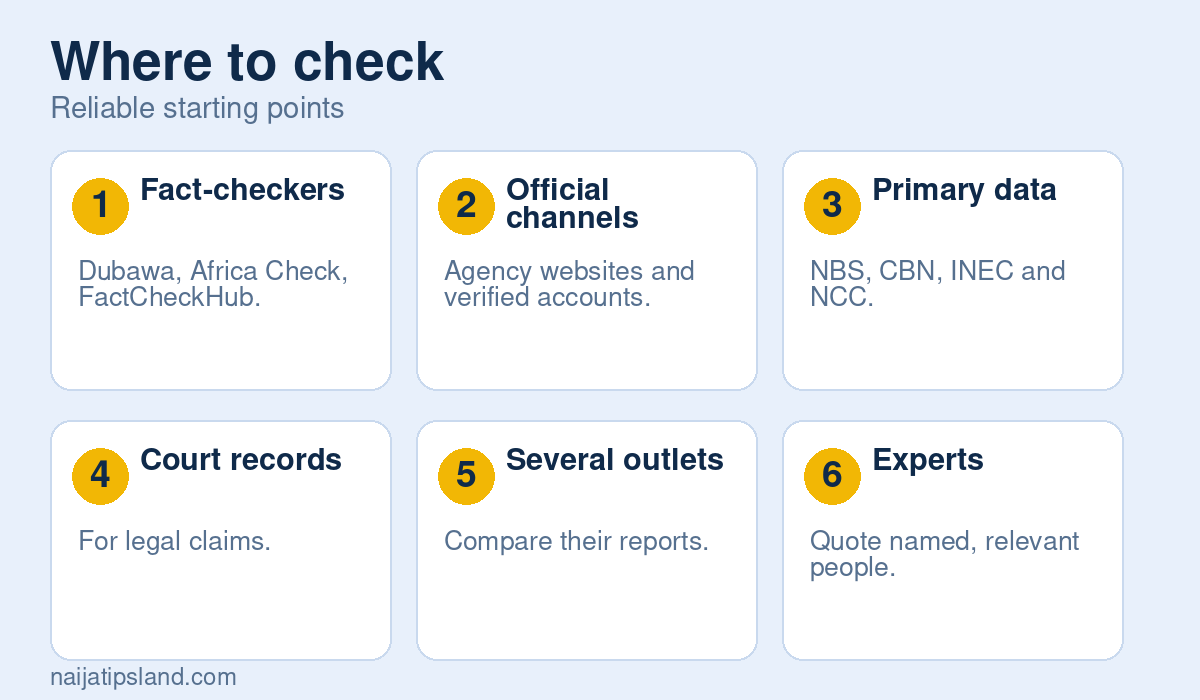
Where does the claim come from: a statement, a court document, a report, a data release or just “sources say”? Search for the original. If a story says the NBS reported inflation of a certain rate, check the NBS release. If it says INEC announced something, check INEC’s official channels. If a claim cannot be traced to any original, treat it as unverified.
Step 3: Check who is behind it
Look at the outlet or account. Does it have a track record, a named editor and a contact page? Is the web address a look-alike of a real site? Who gains if you believe this? Many propaganda pages copy the logos of real media houses.
Step 4: Look for independent confirmation
Real news usually appears in more than one place. Search for the story on several reliable outlets. If only one obscure page or a viral chat message carries it, be sceptical. Remember that copy-pasted reports on many sites can still trace back to one weak source.
Step 5: Check the date and the place
Old stories are often recycled during crises. Check the publication date, and look at the clues in a picture, such as signs, language, number plates and weather, to see whether it matches the claimed place and time.
Step 6: Test images and videos
- Reverse image search: upload the picture or take a screenshot of a video frame to see where else it appeared.
- Look for AI signs: distorted hands, unreadable text, odd shadows, mismatched lip movement and unnatural blinking or voice.
- Do not rely on detection tools alone. Nigerian fact-checkers say tools exist but struggle with local languages and the sheer volume of content.
Step 7: Test the numbers and quotes
Check whether statistics come from a credible source, whether the percentages make sense and whether the numbers are being compared properly (for example, one month versus the same month last year). Search for a quote in full to see where and when it was said. Many fake quotes are attributed to well-known people.
Step 8: Ask the fact-checkers
Nigeria has a coalition of fact-checkers that includes Africa Check, CableCheck, FactCheckHub and Dubawa. They publish verifications and sometimes accept requests. During elections they set up situation rooms to monitor false claims. Check their websites and social channels before you share anything dramatic.
A 60-second routine
- Stop and breathe.
- Search the main claim plus “fact check”.
- Look for the original source or an official statement.
- Check at least two other reliable outlets.
- Share only if you are sure, and say where it came from.
Verifying specific kinds of news
- Government notices: check the agency’s official website and verified accounts, and be wary of fake recruitment notices. See interview tips for avoiding job scams.
- Money and investment claims: check the SEC, CBN or CAC. See internet scams.
- Health claims: check the NCDC, WHO or a qualified doctor.
- Election news: check INEC and our 2027 election hub.
For long-term habits, read our guides on following the news, political commentary and digital literacy.
A Worked Example (Hypothetical)
A photo shows flooded streets with the caption “Lagos today”. You run a reverse image search and find the same photo in an article from another country two years ago. You check the caption against local weather reports and find no match. The verdict: old photo, wrong place, false claim.
Checks by Type of Content
- Images: reverse image search, look for shadows and signs, and check metadata where available.
- Video: split into key frames, search for earlier versions and check audio for cuts.
- Screenshots: find the original post or page, since screenshots are easy to edit.
- Documents and letters: check the letterhead, signature, reference numbers and official website.
- Statistics: find the primary source, the date and the definition used.
Red-Flag Phrases
Be careful with “share before they delete this”, “forward to 10 people”, “breaking: confirmed” with no source, and anything that makes you very angry or afraid very quickly. See our guides on a 48-hour verification routine and fake news and deepfakes.
Frequently Asked Questions
How do I know if a website is real?
Check the address carefully, the About and Contact pages, named authors and whether other trusted outlets cite it.
Can I trust screenshots?
Not on their own. Screenshots are easy to fake. Find the original post or page.
Should I trust an AI chatbot to fact-check?
Use it as a starting point at most. Confirm with human fact-checkers and primary sources.