Submit Post
Date: May 15, 2026 10:15 am. Number of posts: 3,545. Number of users: 3,373.

Why online trends matter for Nigerian youth today


TL;DR:

  • Most Nigerian youth are deeply impacted by online trends, which influence culture, economy, and social identity. Studying these trends critically enables them to shape narratives, seize economic opportunities, and participate meaningfully in civic actions. However, understanding and navigating trend cycles requires intentional analysis to avoid misinformation, echo chambers, and digital inequalities.

Nigeria has over 60% of its population under the age of 25, and more than 65% of young people report daily social media exposure that directly shapes their attitudes, spending habits, and worldviews. That is not just a demographic fact—it is a signal that online trends are one of the most powerful forces in Nigerian society right now. Yet most conversations treat trend-following as something trivial or even reckless. The reality is far more layered. Understanding why and how online trends move through digital spaces can unlock real economic opportunities, sharpen your cultural awareness, and position you to lead conversations rather than just react to them.


Table of Contents

Key Takeaways

PointDetails
Trends shape youth livesOnline trends influence values, career options, and civic engagement for most Nigerian youth.
Opportunities and risksStudying trends brings economic and social benefits, but also requires caution against misinformation and echo chambers.
Intentional learning mattersThose who study trends strategically gain more than those who simply chase viral content.
Practical tools availableFree and paid platforms make it easy to start tracking relevant online trends.

Studying online trends is not the same as doom-scrolling through your Twitter or TikTok feed. It means actively researching, monitoring, and analyzing which topics, behaviors, and content formats are rising or falling in popularity across digital platforms. You are looking for patterns, not just moments.

Infographic shows steps for studying online trends

Think of it like reading the room—but the room is the entire Nigerian internet, and the signals are hashtags, search volumes, comment sentiment, and viral content cycles. When a meme about fuel scarcity takes over your WhatsApp groups, that is a trend. When a specific dance challenge racks up millions of views across Lagos and Abuja creator accounts in 72 hours, that is a trend. Knowing how to read these moments critically is a skill, not a hobby.

The key methods for studying trends include:

  • Social listening tools: Platforms like Hootsuite allow you to monitor brand mentions, keywords, and sentiment across multiple channels simultaneously. Sprout Social offers similar functionality for deeper analytics.
  • Google Trends: This free tool shows you the relative search volume for any keyword over time. You can filter by Nigeria specifically to track local spikes in interest.
  • Platform analytics: TikTok’s Creator Marketplace, Instagram Insights, and YouTube Studio all provide data on what content is performing and why.
  • Natural Language Processing (NLP) and sentiment analysis: More advanced teams use these to process thousands of comments or posts and determine whether public opinion on a topic is positive, negative, or mixed.
  • Surveys, interviews, and focus group discussions (FGDs): Qualitative methods that add human context to raw numbers.

Local examples of trends worth studying include the viral news cycles that spread across Nigerian forums, the rapid growth of Afrobeats-driven challenges on TikTok, and hashtag movements like #BuyNaijaToGrowNaija that blended commerce with national pride.

Pro Tip: Start with Google Trends and one social listening tool before adding more layers. Free tools give you 80% of the insight you need when you first begin. Add paid analytics only when you have a specific business or research goal in mind.


Now that you know what it means to study trends, let us explore why it is particularly powerful for Nigerian youth.

Cultural influence is the first reason. Online trends carry values. When foreign beauty standards or relationship norms go viral in Nigeria, they can quietly erode traditional values—family structures, language use, or community expectations. But the reverse is also true. Afrobeats, Nollywood memes, and Pidgin-language content have used viral trends to put Nigerian culture on a global stage. Social media’s impact on culture is a two-way street: it can dilute identity or amplify it, depending on who is driving the narrative.

Economic opportunity is the second reason—and it is growing fast. The numbers are significant. Gen Z Nigerians spend an average of ₦462,500 per year on online courses, signaling that young people are already investing in digital skills. Trend-aware creators are turning that knowledge into brand deals, sponsored content, and full-time income. Understanding which content formats are trending, which platforms are growing, and what audiences want to see gives you a real competitive edge.

Opportunity areaWhat trend knowledge enables
Content creationIdentifies viral formats before they peak
Brand partnershipsConnects creators to brands seeking relevant audiences
Online upskillingShows which skills are in demand right now
E-commercePredicts product demand from rising search interest
Civic advocacyAmplifies campaigns by aligning with active conversations

The role of influencers in shaping trends is central to this economic ecosystem. Brands in Nigeria are moving budgets from traditional media toward digital creators, and the creators who understand trend cycles earn more consistently than those who post randomly.

Social identity is the third reason. Online trends help you form a sense of who you are, who your community is, and what you stand for. They connect diaspora Nigerians to the homeland, they give youth a language for political frustration, and they create shared cultural reference points. Following trending topics in Nigeria keeps you plugged into that collective consciousness.

“The internet does not just reflect culture—it actively creates it. Nigerian youth are not passive consumers; they are co-authoring the digital identity of a nation in real time.”

For creators looking to monetize this energy, understanding the top platforms for creators in 2026 is a practical starting point.


The influence of trends does not stop at personal life—it moves entire societies, especially in civic and political realms.

Nigeria has produced some of the most powerful examples of social media-driven civic action on the African continent. The #EndSARS movement in October 2020 began as a trending hashtag and escalated into nationwide protests that forced an official police unit to disband. More recently, #EndBadGovernance demonstrated how a viral grievance can translate into organized physical and political action within days. These were not accidents—they were the result of sustained trend momentum, shared storytelling, and coordinated online pressure. Social media’s role in political engagement among Nigerian youth is now well-documented and continues to grow in scale.

Here is how a trending topic typically drives mass civic action:

  1. A grievance surfaces. A video, story, or post captures a real injustice and begins circulating in small networks.
  2. Amplification begins. Influencers, news outlets, and regular users share and comment, boosting the content’s reach algorithmically.
  3. A hashtag forms. The conversation consolidates around a single phrase, making it searchable and trackable.
  4. Cross-platform spread. The hashtag moves from Twitter/X to Instagram, WhatsApp, TikTok, and Facebook, reaching different demographic layers.
  5. Offline action follows. Meetups, protests, petitions, or boycotts emerge as the online energy demands a real-world outlet.

The comparison between different types of trend-driven movements tells a deeper story:

Movement typeExamplePrimary outcome
Civic/political#EndSARSPolicy change, police reform debate
CulturalAfrobeats challengesGlobal visibility for Nigerian music
Economic#BuyNaijaToGrowNaijaBoosted local brand awareness
Social polarizationElectoral misinformation campaignsDivision, reduced trust

Understanding how digital communities shape social change gives you a framework for participating in these movements thoughtfully rather than reactively.

“Online activism is one of the most democratic tools Nigerian youth have ever had access to. But without critical thinking, the same tool that sparks justice can just as easily spread chaos.”

The social media impact on Nigerian civic life is one of the defining stories of this generation, and your ability to read trend cycles determines whether you contribute productively or get swept up in the noise.


Young Nigerians discussing trends on tablet at café

The double-edged effects: Opportunities, challenges, and pitfalls

Understanding both sides allows you to harness the benefits while staying alert to risks.

The positive outcomes of engaging with online trends are real:

  • Global exposure: Nigerian youth can now access ideas, movements, and markets that were completely out of reach before social media.
  • Skill-building: Following trends in tech, design, and content creation pushes young people to learn new tools and stay competitive.
  • Community formation: Online communities built around shared interests create genuine support networks, especially for minorities or youth outside major cities.
  • Entrepreneurship: Trend-aware youth identify gaps in the market faster and move quickly to fill them with products or services.
  • Empowerment: Access to information means that young Nigerians can advocate for themselves and others more effectively.

The negative consequences are equally real, and more dangerous when ignored:

  • The digital divide: Access to these opportunities is still heavily skewed toward urban centers. Rural youth with limited data access or older devices are consistently excluded from the conversations shaping their own futures. Research confirms that urban-rural gaps in digital tool usage create unequal participation in digital culture.
  • Misinformation and echo chambers: When you only consume content from people who think exactly like you, your worldview narrows. Algorithms are designed to keep you engaged, not to keep you informed.
  • The pressure to go viral: The pursuit of clout at any cost has pushed some creators toward harmful, misleading, or illegal content. This is not a small issue—it is a pattern.
  • Get-rich-quick mentality: High daily social media exposure is directly linked to unrealistic financial expectations, particularly among Gen Z Nigerians. 68% of posts analyzed in certain digital environments were found to carry polarizing content, amplifying division rather than dialogue.

Understanding how online communities shape your identity is key to protecting yourself from these pitfalls while still participating actively in digital spaces.

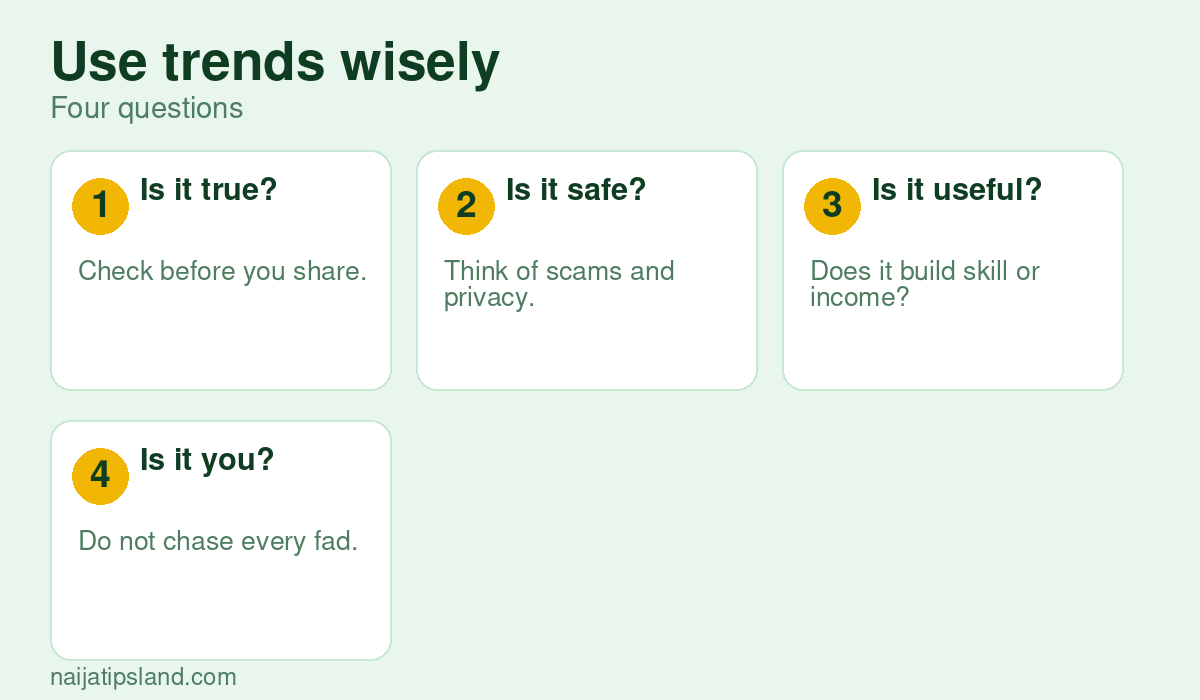
Pro Tip: Before jumping on any trend, ask three questions. Who started this, and why? What am I actually promoting if I share it? Does this align with what I genuinely stand for? This 10-second check separates intentional participation from blind reaction.

For creators looking to grow on short-form video without falling into clickbait traps, studying proven viral TikTok strategies gives you a content playbook built on authentic engagement rather than shock value.


Most guides about online trends stop at a simple list of do’s and don’ts. They tell you to stay informed, avoid misinformation, and use trends to grow your brand. That is useful, but it misses the deeper point.

The real divide in Nigeria’s digital space is not between those who are online and those who are not. It is between those who consume trends and those who understand them well enough to shape them. Jumping on a trend because everyone else is doing it—chasing clout or FOMO—is a reactive strategy. It makes you a passenger. Studying trends intentionally, understanding why they start, how they spread, and what they actually reveal about public sentiment, is what makes you a driver.

The young Nigerians who are building genuine influence right now are not the ones who post the most. They are the ones who post with purpose. They identified where conversations were heading and positioned themselves there early. They used trend data to make decisions about products, content formats, and platforms before the majority caught on. That gap between reactive and intentional is where real opportunity lives.

There is also a hidden layer that most people ignore: the power of online forums for Nigerian youth as spaces for deeper network-building. Trends on mainstream platforms are loud and fast. But the sustained conversations happening in smaller forums and communities are where real alliances form, businesses get built, and social movements get organized before they ever go viral.

Echo chambers are the other thing worth naming directly. Many Nigerian digital natives believe they are getting diverse information because they follow many accounts. But if all those accounts share the same political leaning, the same class background, or the same type of content, the algorithm is still showing you a filtered version of reality. Critical trend analysis means stepping outside your usual feed deliberately, seeking out dissenting voices, and questioning why certain stories are trending while others are being suppressed.

The digital environment in Nigeria is changing faster than most institutions can keep up with. Those who adapt by learning consistently, thinking critically, and using trends as data rather than entertainment will be the ones who create lasting value.


Connect with the digital wave: Next steps for staying ahead

You now have a clear picture of why online trends are not shallow entertainment—they are a lens through which culture, economics, and civic life in Nigeria get filtered and shaped. The next step is turning that understanding into consistent action.

https://naijatipsland.com

At Naijatipsland, we have built a space where Nigerian digital natives can do exactly that. Whether you want to follow the latest conversations, submit your own perspectives, or dig deeper into how digital communities shape identity and trends, our platform brings you the tools and the community to stay informed and engaged. You can also explore how community engagement supports mental health in an increasingly noisy online world. The conversation is already happening—come be part of it with intention.


Frequently asked questions

Start with free tools like Google Trends and social listening platforms such as Hootsuite, then focus on local hashtags and trending topics on TikTok or Instagram to build your awareness before moving to advanced analytics.

Youth are digital natives who were exposed to social media earlier and more frequently, meaning trends directly shape their values, career choices, and worldviews in ways that older generations—who formed their identities offline—do not experience the same way. With over 60% of Nigeria’s population under 25, this effect is especially concentrated and powerful.

Tracking trends helps youth identify content creation opportunities, secure brand partnerships, and discover which digital skills are currently in demand, with Gen Z already investing heavily in online upskilling to stay competitive.

Misinformation, digital inequality between urban and rural youth, and echo chambers that amplify polarization are the most significant risks, all of which require active critical thinking rather than passive consumption to manage effectively.

NTL
We will be happy to hear your thoughts

      Leave a reply

      Nigeria's Fast-Growing Online Forum for News & Discussions
      Logo
      1