
How to Become a Data Analyst in Nigeria With No Experience (2026): Skills, Roadmap, Salary and Portfolio

Last updated: 9 November 2026 · By Naijatipsland Editorial Team · Editorial policy
Data analysis is one of the more realistic tech-adjacent careers for a Nigerian with no experience, because it does not require a computer science degree and the core tools (Excel, SQL and a dashboard tool) can be learned in months. Banks, fintechs, telecoms, NGOs and oil and gas firms all need people who can turn messy numbers into decisions. This guide gives a practical, step-by-step route from zero, what the job pays, what employers test, how to build a portfolio, and the traps to avoid.
About this guide: we drew on Legit.ng’s 2026 data analyst salary guide (published 15 September 2026) and a Zikoko interview with two Nigerian data professionals, read on 9 November 2026. Pay figures vary widely between sources and employers, so treat them as indicative and check current job adverts before you negotiate. This is general career information, not a job guarantee.
Quick answer: how do you become a data analyst in Nigeria with no experience?
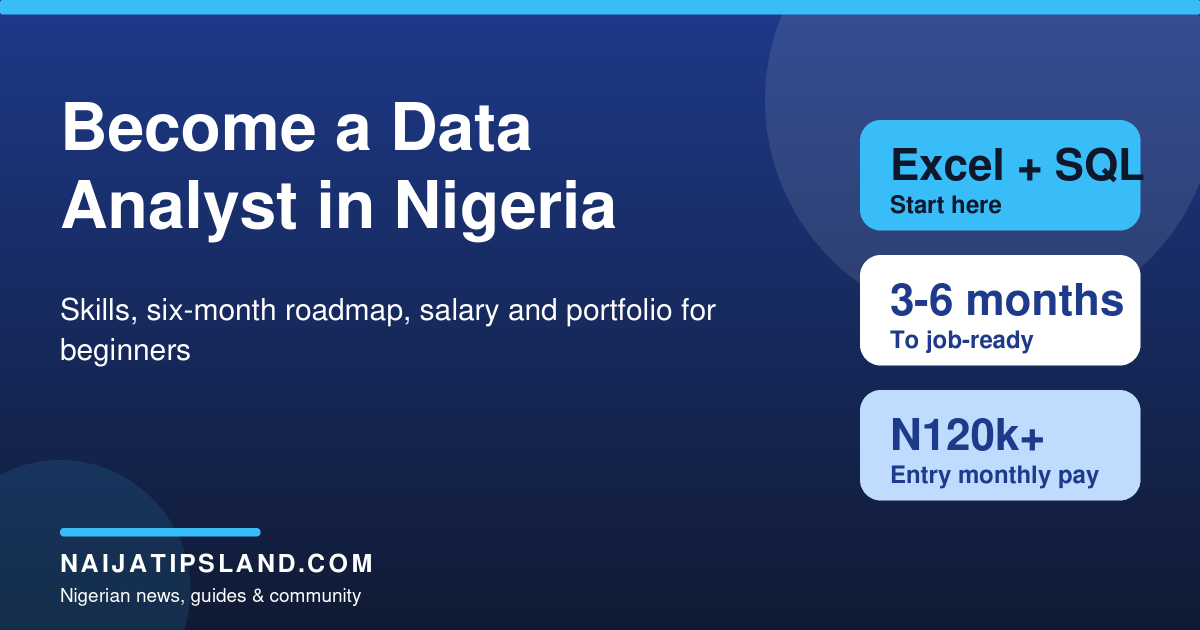
Learn Excel first, then SQL, then a visualisation tool such as Power BI or Tableau, and add Python later if you want to go further. Build three to five real projects with datasets you can explain, publish them where employers can see them, then apply for entry-level analyst, reporting or business-intelligence roles once you meet roughly 70% of a job’s requirements. Legit.ng puts job-readiness at about three to six months of consistent study and projects; focused learners can do it in three.
What does a data analyst actually do?
A data analyst collects data, cleans it, answers business questions with it, and presents the answer in a way that non-technical people can act on. In practice that means writing SQL queries to pull sales or customer data, tidying spreadsheets, building dashboards, and explaining what changed and why. Analysts are needed in banking, fintech, telecoms, consulting, healthcare, NGOs and the public sector.
The skills employers test
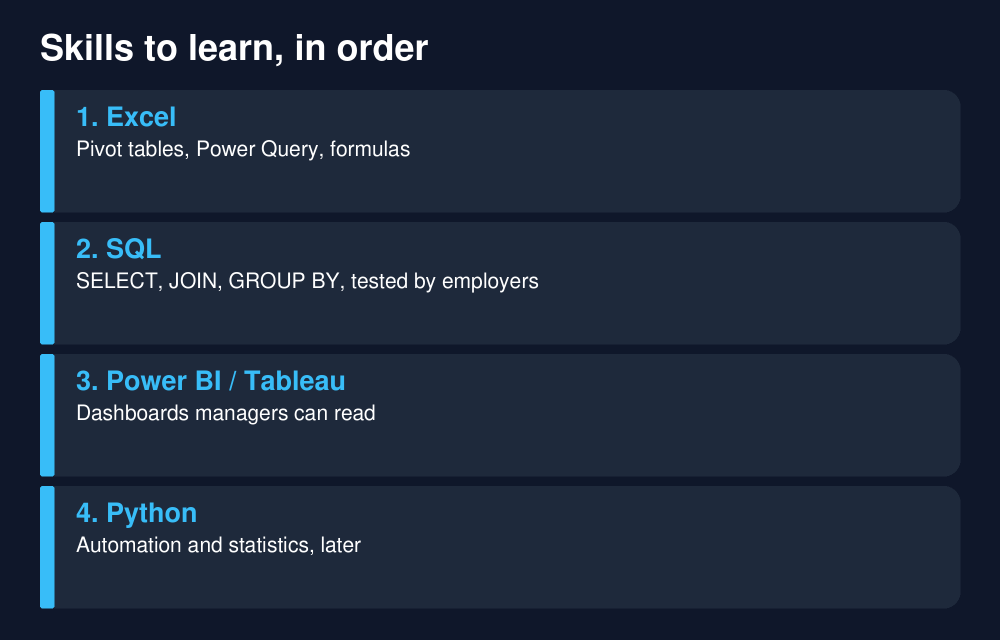
| Skill | Why it matters |
|---|---|
| Excel | Pivot tables, Power Query and advanced formulas; the usual starting point and still used daily |
| SQL | Described by Legit.ng as the most universally tested skill; failing the SQL assessment can end an application |
| Power BI or Tableau | Dashboards and reports that managers actually read |
| Python | Automation and statistical work, mostly expected at mid to senior level |
| Communication | Explaining findings simply; Legit.ng says storytelling can raise pay faster than technical skills alone |
The Zikoko experts give the same order of learning: Excel, then SQL, then a visualisation tool, then programming or cloud knowledge, with soft skills such as asking good questions and understanding the business throughout.
A six-month roadmap
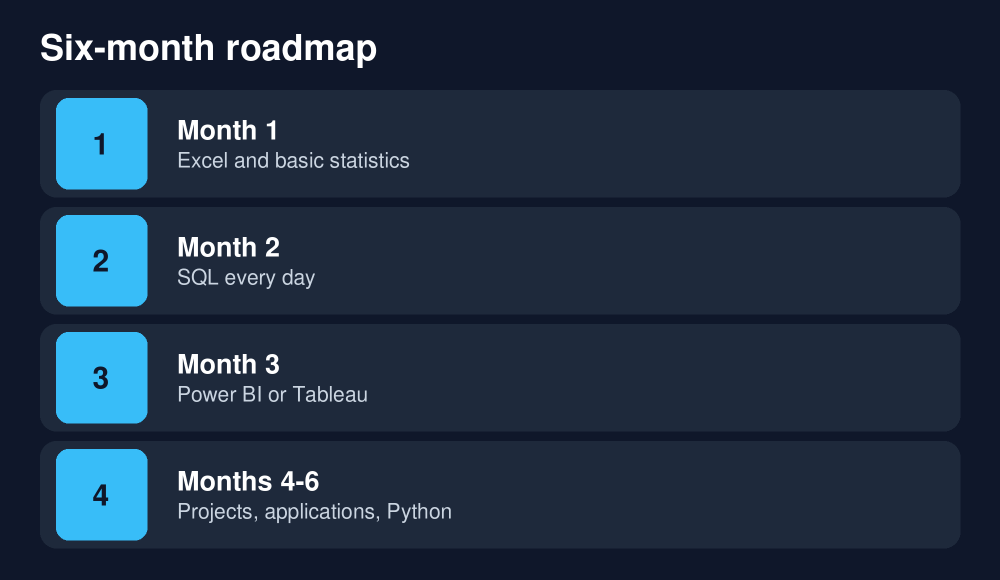
Month 1: Excel and basic statistics. Learn formulas, lookups, pivot tables, charts and data cleaning. Understand averages, medians, percentages and what a trend is.
Month 2: SQL. Practise SELECT, WHERE, GROUP BY, JOINs and subqueries on a free practice database every day. Aim to be able to answer a business question with a query from scratch.
Month 3: Power BI or Tableau. Connect to data, build a dashboard with filters, and learn to present it. Pick one tool and finish a project before switching.
Months 4 and 5: portfolio projects. Build three to five projects (see below) and write a short summary of the question, method and finding for each.
Month 6: applications and Python. Start applying, practise timed SQL and Excel tests, and begin basic Python (pandas) if you want to move toward data science later.
How to build a portfolio with no job experience
- Ask friends, a church or mosque group, a small shop or a local business for a real dataset (with permission and with personal details removed) and answer a real question for them.
- Base projects on topics Nigerians care about, such as fuel prices, exchange rates, school results or transport costs, using public data sources you can name.
- Publish your work on GitHub, a simple website or LinkedIn, and explain your reasoning in plain English.
- Share progress publicly. One of the Zikoko experts said a project that went viral on Twitter led to job offers.
How much do data analysts earn in Nigeria?
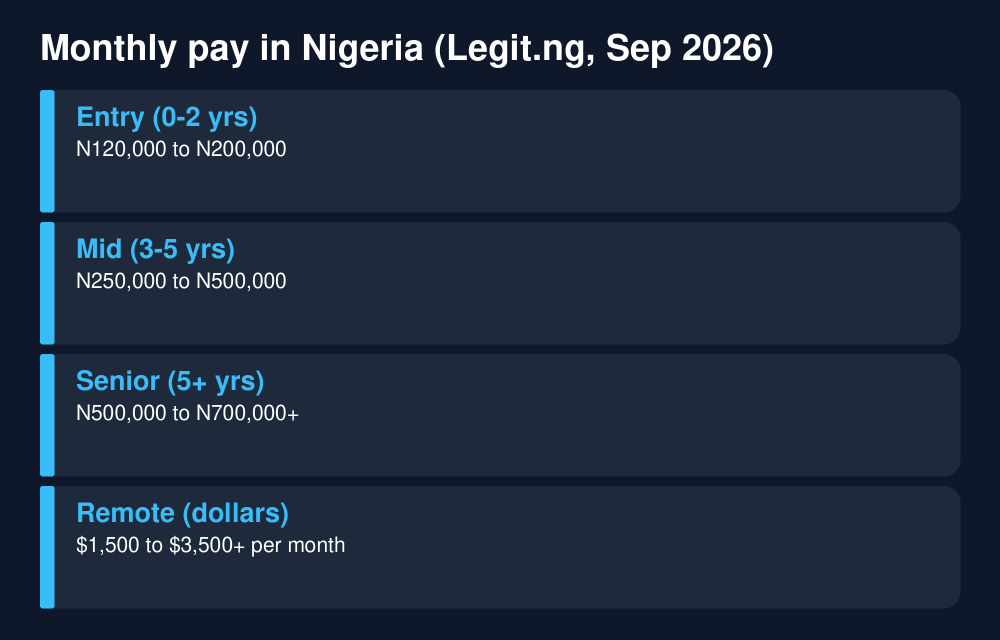
Legit.ng gives these monthly ranges for local jobs, with Lagos paying roughly 20% to 35% more than Abuja, Port Harcourt or Kano:
| Level | Experience | Monthly pay (naira) |
|---|---|---|
| Entry | 0 to 2 years | N120,000 to N200,000 |
| Mid | 3 to 5 years | N250,000 to N500,000 |
| Senior | 5+ years | N500,000 to N700,000+ |
By sector, the same guide lists oil and gas upstream at N450,000 to N700,000+, fintech and technology at N300,000 to N650,000, banking and consulting at N250,000 to N500,000, telecoms at N200,000 to N450,000 and NGOs or the public sector at N120,000 to N250,000. Remote, dollar-paid roles are quoted at $1,500 to $3,500+ a month. Legit.ng’s article is internally inconsistent in places (for example on the entry-level ceiling and the national average), which is why we advise checking live adverts and salary-survey sources before negotiating.
Courses, certificates and costs
Free resources named by Nigerian practitioners include Coursera, Udemy, YouTube, DataCamp and Microsoft Learning. Legit.ng lists these certificates as helpful but not required: Google Data Analytics Certificate (beginner-friendly), Microsoft Certified Data Analyst Associate (Power BI), Tableau Desktop Specialist and the IBM Data Analyst Professional Certificate. Paid courses in Nigeria range from about N50,000 to N120,000 for beginner programmes, N120,000 to N250,000 for fuller programmes and N20,000 to N60,000 for Udemy-style courses, per the same source. The Zikoko experts warn against collecting certificates: employers hire mainly on what you can show you can do. See our guide to the best online courses for digital skills in Nigeria.
Where to apply and how to stand out
Target Lagos-based banks, fintechs and telecoms for the best entry-level pay, but also look at consulting firms, NGOs and graduate programmes (see graduate trainee programmes in Nigeria). Most employers want at least a bachelor’s degree and many prefer a 2:1 or better, although a strong portfolio can offset a weak grade for some roles. Many vacancies are filled by referral, so join data communities and attend meetups. Compare the pay with other careers in best paying jobs in Nigeria.
Scams and mistakes to avoid
Never pay a recruiter or “employer” to get a data job. Be careful with training schools that promise guaranteed jobs or huge salaries, and check reviews and graduates’ real work. Do not lie about experience; build projects instead. Avoid learning five tools at once.
Frequently asked questions
Can I become a data analyst without a degree?
It is possible but harder, because many employers ask for a bachelor’s degree. A strong portfolio, certificates and referrals help.
How long does it take to become a data analyst in Nigeria?
About three to six months of consistent study and projects to become job-ready, according to Legit.ng. Landing a job can take longer.
Which skill should I learn first?
Excel, then SQL, then Power BI or Tableau. Python can follow.
Do I need Python?
Not for most entry-level analyst roles, but it helps at mid and senior levels.
How much does an entry-level data analyst earn?
Legit.ng quotes N120,000 to N200,000 a month for 0 to 2 years of experience, though some roles pay more, especially in Lagos fintech.
Can I work remotely as a data analyst from Nigeria?
Yes, remote roles exist and are quoted at $1,500 to $3,500+ a month, but they are competitive and usually require experience.
Are data analyst certificates worth it?
They add credibility, but employers mostly hire based on demonstrated skills. Choose one or two and build projects.
What is the difference between a data analyst and a data scientist?
Analysts answer business questions with existing data, mainly using Excel, SQL and dashboards. Data scientists build predictive models and usually need stronger programming and statistics.
Sources and notes: Legit.ng, Data Analyst Salary in Nigeria (2026), 15 September 2026; Zikoko, 2 data experts on becoming a data professional in Nigeria (read 9 November 2026). Salaries and course prices change; verify with current job adverts and providers. This article is general information, not a guarantee of employment.
Join the discussion
Have you tried this, or do you have a question we did not answer? 1 reader has already shared their view. Naijatipsland members help each other with real, first-hand experience.







Editor’s note: salary figures in this guide come from published surveys and differ between sources, so please check live job adverts before negotiating. If you are a working analyst in Nigeria and want to share what entry-level pay and interviews really look like, tell us in the comments. Ade Adeniyi