Last updated: 16 October 2026 · By Naijatipsland Editorial Team · Editorial policy
A graduate trainee programme is how many large Nigerian employers hire new graduates. Instead of posting one job at a time, a bank, an oil company, a consumer-goods firm or an accounting firm opens a yearly intake, selects a cohort through tests and interviews, trains it for months and then posts each trainee to a unit. The route is competitive and the windows are short, which is why it also attracts scammers who charge for slots. This guide explains how the programmes work, which sectors run them and when they tend to open, the usual requirements, the selection stages, how to prepare for the tests, how to apply safely, and what to do if you do not fit the standard profile.
Programme details change every intake. The sector patterns below come from career sites and guides dated 2026, some of them independent and not run by the employers, so treat them as typical windows rather than promises. Always confirm the dates, age limits and requirements on the employer’s own careers page before you apply. This is general guidance, not a guarantee of selection.
The short answer
- Most programmes ask for a 2:1, a completed NYSC and an age under about 26 to 28. A few banks accept a 2:2 or an HND upper credit, and some tracks have different rules. The rules are set per intake.
- The process has stages: an online application, an aptitude or psychometric test, a group exercise or assessment centre, one or more interviews, then a training school and a posting.
- Intakes follow patterns. Banks often open in the first half of the year, oil companies and consulting firms later in the year, and some FMCG and tech employers recruit on a rolling basis.
- Apply only through the employer’s official portal. Genuine programmes do not charge for forms, materials, uniforms or processing, and a listing with no named employer is a red flag.
- Prepare early. Practise timed aptitude tests, tidy your documents and tailor your CV and cover letter to the role.
What a graduate trainee programme is
A graduate trainee programme (GTP) is a structured entry route for recent graduates. Uni2Study’s 2026 explainer on bank programmes describes how banks fill most entry-level roles this way: you apply when an intake opens, pass a multi-stage selection, spend weeks or months in a training school and are then posted to a branch, unit or department. Access Bank’s Entry Level Training Programme, as described in that guide, runs four months at its School of Banking Excellence with three tracks: a graduate track that asks for at least a second class upper, and retail and technology tracks that ask for at least a second class lower.
A GTP is not an internship or a one-off vacancy. It is a paid employment route in most cases, but we found no reliable published pay data, so treat any salary figure you see online with caution and ask in the interview stage.
Who runs graduate trainee programmes, and when
Profolio.ng’s 2026 list of companies hiring graduate trainees, last updated in March 2026, gives typical patterns. It is an independent guide, it says its timings are general patterns, and it names about 30 companies despite a title promising 50 or more, so use it as a map and check each employer.
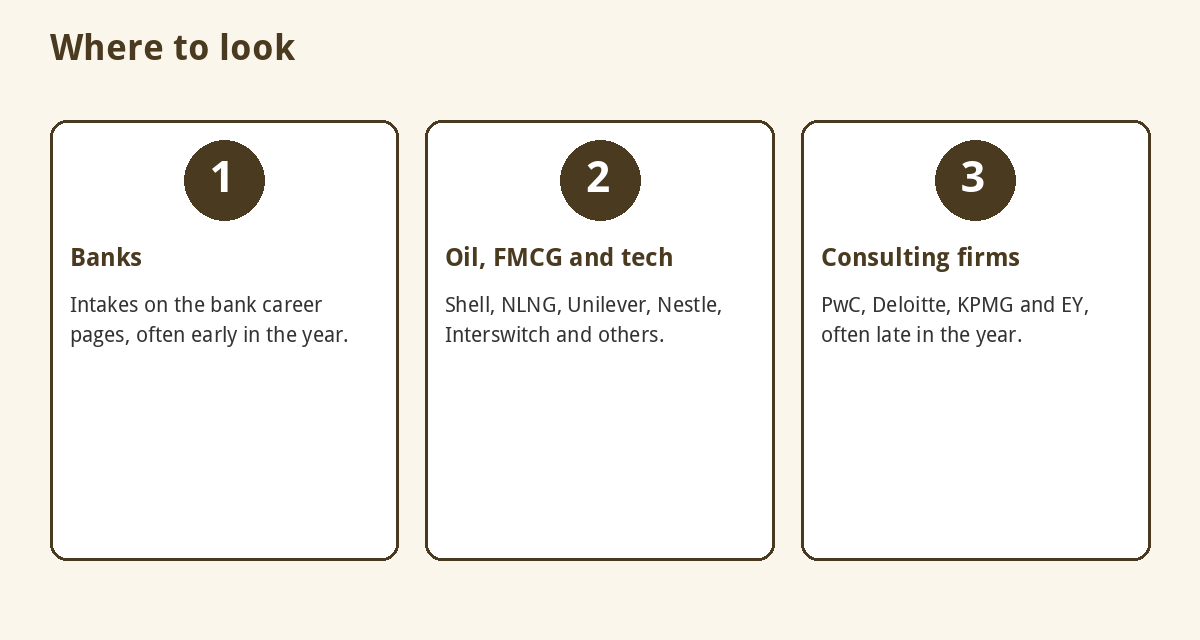
- Banks: Access Bank, GTBank, First Bank, Zenith Bank, UBA, FCMB, Sterling Bank, Stanbic IBTC and Fidelity Bank. The guide lists typical windows from January to May, with a 2:1 common and a 2:2 accepted at some, and age caps of 26 to 28 at several.
- Oil and gas: Shell, Chevron, TotalEnergies, ExxonMobil and NLNG, with typical windows from September to February, a strong preference for engineering and geoscience, and, for NLNG, a need to be willing to relocate to Bonny Island.
- Consumer goods: Unilever, Nestlé Nigeria, Procter & Gamble, Coca-Cola Nigeria and Nigerian Breweries, mostly rolling or with a main intake in the second half of the year, and often a limit on post-graduation work experience of about two years.
- Consulting and audit: PwC, Deloitte, KPMG and EY, typically from August to December, with a preference for accounting, finance or economics at some.
- Technology and fintech: Interswitch, Flutterwave, Paystack, Andela and Moniepoint, many on rolling or twice-yearly cycles.
Reports from October 2026 also list newer opportunities, such as the Afrinvest analyst programme for 2027. A third-party blog says it asks for a first or second class upper degree, NYSC completed no earlier than July 2026, ages 20 to 27 at 31 December 2026 and no post-NYSC experience, with an application deadline of 25 October 2026. That blog is not an Afrinvest publication, so confirm it, and the link, on Afrinvest’s own website.
Requirements: what employers usually ask for

- Degree: a bachelor’s degree from an accredited institution, most often a second class upper. Some employers accept second class lower or HND upper credit for certain tracks.
- O’level results: five credits including English and Mathematics, as many banks require.
- NYSC: a completed service certificate, or in some cases a discharge certificate that will be ready before training begins. See our NYSC guide.
- Age: an upper limit that varies, commonly 24 to 28.
- Experience: little or none for most, with some allowing up to two years.
- Field of study: engineering for oil and gas, accounting or finance for audit, STEM or economics for technology tracks, but many banks and FMCG programmes accept any discipline.
- Extras: computer skills, a professional certificate for some roles, and languages such as French at a few international employers.
Check your own documents before the window opens: degree certificate or statement of result, WAEC or NECO results, NYSC certificate, a valid ID and a current passport photograph, and a short CV that matches your LinkedIn profile.
How selection works
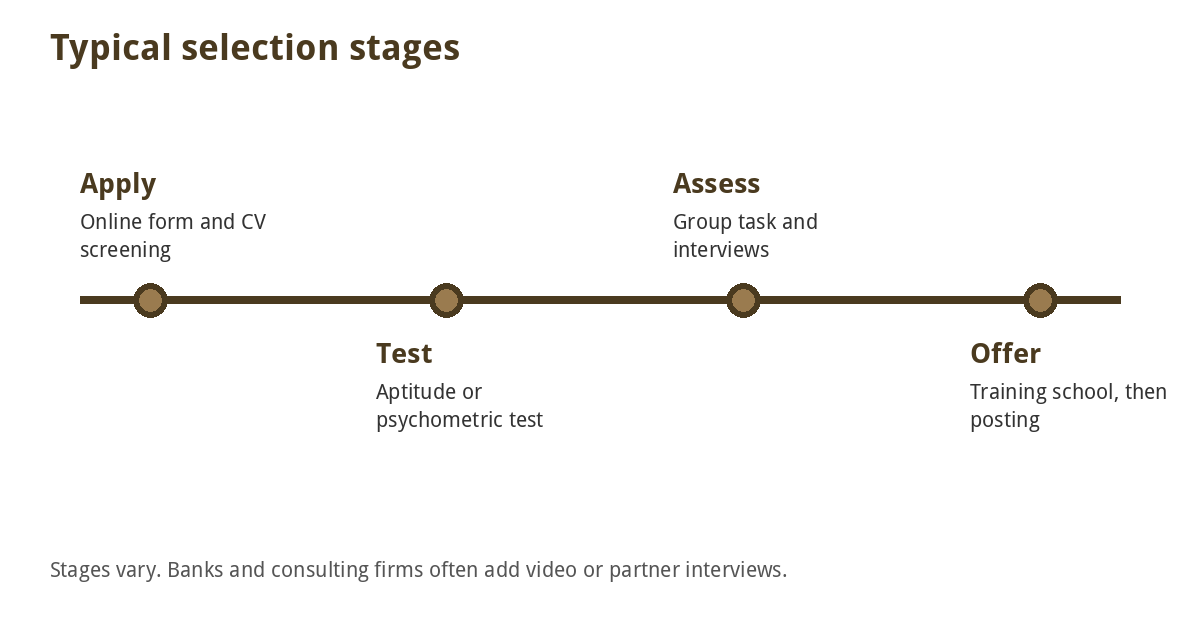
1. Online application and CV screening
You complete a form on the employer’s portal and upload your documents. Mistakes in age, class of degree or NYSC details lead to automatic rejection, so read the notice twice. Your CV and, where asked, your cover letter matter here: see how to write a CV for Nigerian jobs and how to write a cover letter.
2. Aptitude or psychometric test
Expect timed tests on numerical reasoning, verbal reasoning and logical or abstract reasoning, sometimes with a personality or situational judgement test. A 2026 guide to PwC Nigeria’s process describes an online assessment of situational judgement and personality followed by a cognitive test with numerical, verbal (true, false, cannot say) and inductive reasoning sections. That guide gives no official source for its details, so use it as an example, not as a rule.
3. Group exercise or assessment centre
Some employers run group tasks, case studies or presentations. Speak clearly, listen, build on others’ points and keep to time. One guide notes that GTBank weights presentation skills heavily, but it is an independent site, so check what your target employer says.
4. Interviews
You may have a panel or one-to-one interview, and at consulting firms a partner interview. Expect questions on your CV, motivation, commercial awareness and Nigerian business and economic news. Prepare with job interview tips for young Nigerian adults, common interview questions and the interview checklist.
5. Training school and posting
Successful candidates go through induction and training, then are posted. Be ready to relocate, since postings may be outside Lagos or Abuja.
How to prepare for the tests
- Practise under time. Use free or paid practice tests that mimic SHL-style numerical, verbal and logical questions, and time yourself.
- Brush up basic maths. Percentages, ratios, averages and reading tables and charts come up often.
- Use the rules of the test. In verbal tests, answer only from the passage, not from outside knowledge.
- Take it properly. Use a quiet room, a stable connection, a charged laptop and a calculator if allowed. Close other tabs.
- Follow the news. Know the naira exchange rate trend, inflation, fuel and big policy changes, which are common interview topics. Our guides on Nigeria’s economy, the dollar to naira rate and personal income tax help.
- Prepare stories. Use the STAR method (situation, task, action, result) for behavioural questions.
A calendar to plan around
- Months before the window: collect documents, update your CV and LinkedIn (see the LinkedIn profile guide) and start practice tests.
- When a window opens: apply in the first days, because some intakes close early or fill quickly. Confirm the closing date on the employer’s page.
- After you apply: check the email you used, including spam, and keep your phone on. Tests often arrive with short deadlines.
- If you are rejected: feedback is not guaranteed, so learn from the stage you reached and apply to the next intake.
Scams and red flags
- Fees. Genuine schemes do not ask for payment for forms, study materials, uniforms or processing. Anyone who asks for money is a fraud.
- No named employer. In September 2026 a Nigerian blog posted a Top Talent Graduate Trainee Programme asking for a 2:1, NYSC and age 27 or under, with a generic online form and no named employer, no official website and no deadline. That is exactly the kind of listing to avoid until you can find the programme on a real company’s careers page.
- Personal email addresses and WhatsApp-only contact. Real employers use company domains and portals.
- Middlemen. Anyone claiming to guarantee a slot or influence shortlisting is a scammer.
- Links in forwarded messages. Open the company website yourself.
Read how to spot fake job ads in Nigeria and how to avoid internet scams before sharing your documents or BVN with anyone.
If you do not fit the standard profile
- You have a 2:2 or an HND. Look for programmes that accept it, such as some bank tracks, and build your case with certifications, internships and strong test scores.
- You are over the age cap. Apply for experienced-hire roles instead and show results.
- You have not finished NYSC. Some programmes accept a discharge certificate due before training, but many want the full certificate. Read the notice.
- You want something other than banking. Look at tech, logistics, FMCG distribution, NGOs and remote work. See remote jobs for Nigerians paid in dollars and essential career tips for young professionals.
- You want to start a business instead. See how to register a business name.
Frequently asked questions
Can I apply with a 2:2?
Sometimes. Some banks accept a 2:2 or an HND upper credit, but many programmes ask for a 2:1. Read each notice.
Do I need NYSC before applying?
Most programmes want a completed NYSC or a discharge certificate that will be ready before training. Some employers have rules on timing, such as completion after a certain month, so read the notice.
Is there an age limit?
Often yes, commonly between 24 and 28, depending on the employer.
When do programmes open?
Banks often open early in the year, oil and consulting firms later in the year, and some FMCG and tech employers recruit throughout the year. Check each employer’s careers page.
Do I have to pay to apply?
No. Genuine programmes do not charge fees.
How long is the training?
It varies from weeks to many months. Access Bank’s programme is described as four months at its training school.
How many programmes can I apply to?
As many as fit your profile. Tailor each application, and keep a tracker of dates, tests and deadlines.
Bottom line
Treat the graduate trainee route as a project: check the requirements, gather your documents before the window opens, practise timed tests, tailor your CV and letter, apply early through the employer’s own portal and never pay a fee. If you do not fit the standard profile, there are other doors, and the same skills of preparation and clear writing will carry you through them.
Sources
- Profolio.ng (independent site): Companies hiring graduate trainees in Nigeria, 2026
- Uni2Study: Graduate trainee programmes at Nigerian banks and how to apply (September 2026)
- Pathlins (independent site): How to pass the PwC graduate trainee test and interview, 2026
- Careers Nigeria (third-party blog): Afrinvest graduate trainee programme 2026/2027
- Haskenews (aggregator): Top Talent Graduate Trainee Programme 2026
Related: Salary negotiation in Nigeria