
LinkedIn Profile Guide for Nigerian Job Seekers (2026): Headline, About and Scam Checks

Last updated: 7 November 2026 · By Naijatipsland Editorial Team · Editorial policy
For a Nigerian job seeker, LinkedIn is no longer optional. Recruiters search it, employers check it after you apply, and many remote and international roles are posted nowhere else. A profile that is half filled in, or one that reads like a list of duties, wastes that exposure. A strong one can get you found for jobs you did not apply to. This guide goes section by section through a profile that works, shows example headlines and an About paragraph, explains Open to Work, how to network without being annoying, how to search for jobs, and how to protect yourself from fake recruiters and account hijacking, which are real risks for Nigerian users.
Profile limits and screen sizes are the commonly cited figures from career guides. LinkedIn can change them, so check the edit screen. Statistics about Nigeria come from third-party estimates, and the advice comes from career sites and LinkedIn’s own announcements as reported in the press. This is general guidance, not a promise of job offers.
The short answer
- Fill in the sections that recruiters search: a clear photo, a headline with your target role and key skills, an About section with results, an experience list with numbers, a skills list and your location.
- Write the headline for search, not for sympathy. Put your role, skills and value in the first 60 or so characters. Skip lines like Looking for opportunities.
- Use Open to Work deliberately. Choose job titles, locations and who can see it. Be aware that scammers also target people who show it.
- Never pay to get a job and never hand over your LinkedIn login. A Rest of World investigation in December 2025 described a Nigeria-based scam in which people offered crypto-promotion work were asked for their login details, leading to hijacked accounts and fake referrals sent to their network.
- Do a little each day. Connect with colleagues and alumni, follow target employers, comment thoughtfully and keep your profile consistent with your CV.
Why LinkedIn matters in Nigeria
NapoleonCat’s estimate for September 2026 puts LinkedIn’s addressable audience in Nigeria at about 14 million people, or 5.8% of the population. About 55% are aged 25 to 34, and another 28.5% are aged 18 to 24. These are marketing estimates from the platform’s advertising data, not official membership figures, but they show where the audience is: young adults early in their careers, which is also where competition for jobs is toughest.
A profile does three jobs. It is a searchable page recruiters use to find candidates, a reference check that employers open after they receive your CV, and a place to prove your skills with posts and projects. Make sure it matches your CV. See how to write a CV for Nigerian jobs and how to write a cover letter for the paperwork side.
Build the profile, section by section
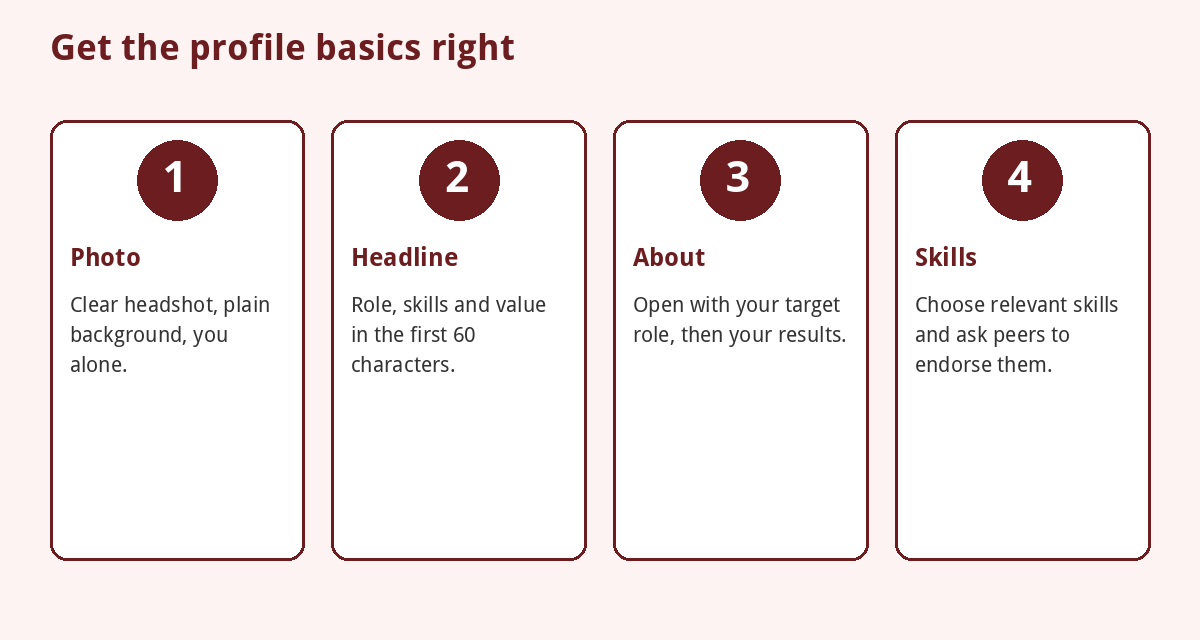
Photo and banner
Use a clear, well-lit headshot in which you are the focus. A plain background and professional but natural clothing are enough. Resume.io’s guide suggests a 400 by 400 pixel image under 8 MB. For the banner, a 1586 by 396 pixel image works, and it is best to avoid text that might be cropped on a phone. Do not use group photos, filters or a photo from a party.
Headline
The headline appears beside your name in search results, comments and messages, so it does more work than any other line. It can be up to 220 characters, but the first 60 to 65 characters are the most visible. Use your target job title, two or three skills that appear in job adverts and, if you have it, one proof point. Examples (fictional):
- Economics graduate | Data analysis (Excel, SQL) | NYSC 2025 | Seeking analyst roles in Lagos
- Operations Manager | Logistics and cost control | Led a 24-person team | Cut delivery delays
- Customer Support Specialist | Zendesk and Intercom | Clear written English | Open to remote roles
Avoid vague phrases such as Passionate dreamer or Unemployed and available. Read 10 to 15 adverts for the role you want, note the repeating keywords and use the true ones.
About section
The About section can run to 2,000 characters. Start with who you are professionally, what you do and the sectors you serve. Add two or three achievements, then say what you want next and how to contact you. A fictional example:
I am a logistics operations professional with five years in road freight in Lagos and Abuja. I help distribution teams cut late deliveries and control fuel costs. At Pioneer Haulage I rebuilt the dispatch handover process, which lifted on-time delivery from 78% to 91% in a year. I manage a team of 24 and report weekly to leadership. I am looking for an operations manager role in a growing logistics or FMCG business. You can reach me on LinkedIn or at the email in my contact info.
Write in the first person, keep paragraphs short and use only numbers you can defend. The tone should match the cover letter you would send, described in our cover letter guide.
Experience and education
List each role with the employer, your title, dates and two to four bullets that show results, not duties. Say what you did and what changed. If you are a graduate, include internships, student leadership, projects, volunteering and NYSC service. Use the same job titles and dates that appear on your CV, because employers compare them.
Skills, endorsements and recommendations
Add the skills that appear in the adverts you want and pin the top ones. Ask people who have worked with you to endorse the skills you actually use. Recommendations from managers, lecturers, clients or colleagues who can describe your work carry more weight than a long skills list. Do not trade recommendations with strangers.
Featured section
Use it to show proof: a portfolio, a GitHub project, a presentation, a published article, a case study. For remote work, a short video introduction or a writing sample can help a recruiter in another country judge your communication. See remote jobs for Nigerians paid in dollars for the skills that sell.
Custom URL and location
Personalise your profile address so it reads as your name, not a string of numbers. Set your location to the city where you want to work, because recruiters filter by it. If you are open to relocation, say so in your Open to Work note rather than changing your location to a city you do not live in.
Open to Work: how to use it
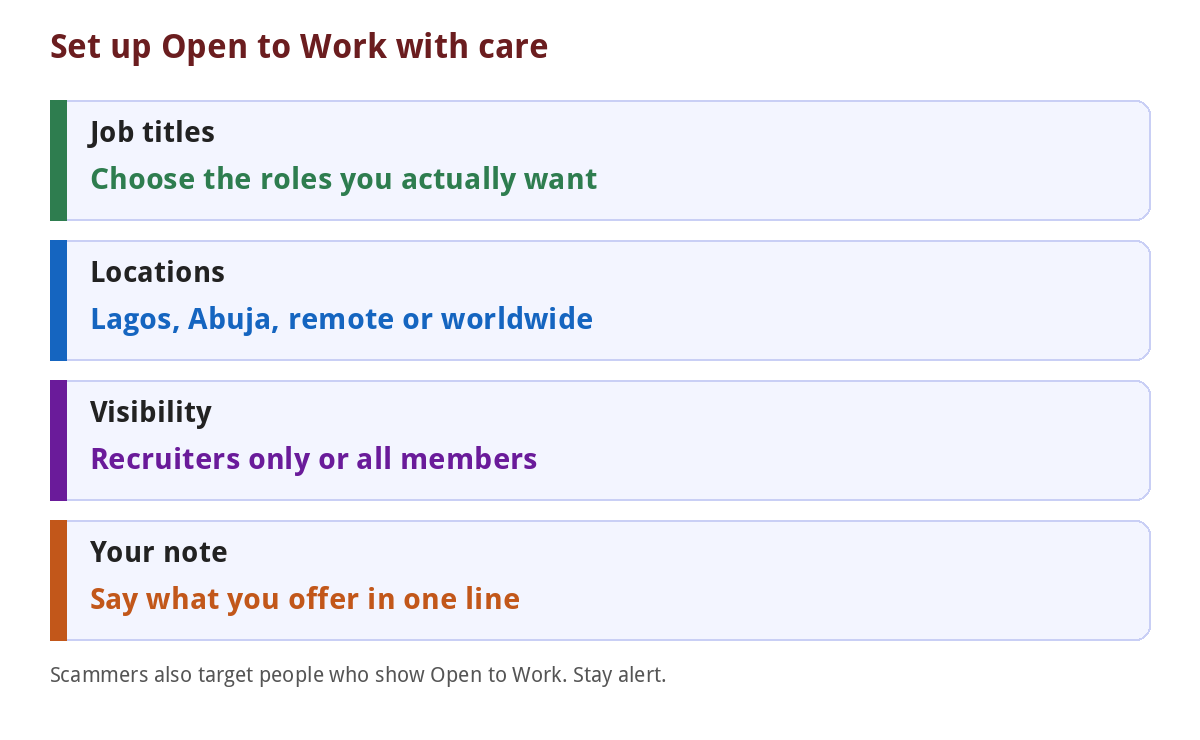
Open to Work lets you tell LinkedIn and recruiters what you are looking for. You can choose job titles, locations, job types and start date, and you can choose whether only recruiters or all LinkedIn members can see it. The green photo frame is visible to everyone, which some job seekers like and some avoid.
- Be specific. A list of three to five related job titles works better than twenty.
- Add locations and remote options that you would really accept.
- Add a note. One line on what you offer, not a plea for help.
- Know the risk. Rest of World reported scammers sending fake offers to people marked Open to Work in several countries. That does not mean you should avoid it. It means you should treat every cold offer with caution.
Network without being annoying
- Start with people you know: classmates, lecturers, former colleagues, NYSC platoon mates, church or community contacts. Many jobs are filled through referrals.
- Follow the companies you want and turn on notifications for their jobs.
- Add a short note to connection requests. One sentence on why you are connecting is better than a blank request.
- Join alumni and professional groups for your industry and ask specific questions.
- Comment before you post. A few useful comments each week keep you visible without needing to write long posts.
- Do not message strangers asking for a job. Ask for advice or a short chat, and make it easy to say no.
A message to someone who works at a company you want to join could say: Hello Mrs Eze, I am a logistics graduate preparing to apply for the operations trainee role at Northgate. Would you be open to a 10-minute chat about what the team looks for? Thank you either way.
Search and apply for jobs on LinkedIn
- Set job alerts for your target titles and locations, and for remote roles if you want them.
- Use filters for date posted, experience level, company and remote options. LinkedIn also reports adding verification badges to job posts and recruiter profiles.
- Read the company page and see who works there and how long they stay.
- Look for the employer’s own careers page and apply there too, since some LinkedIn postings are reposts.
- Tailor your application. Use the keywords in the advert in your CV and message, and send a cover letter if one is requested.
Prepare for the interview that follows with job interview tips for young Nigerian adults, common interview questions and an interview checklist.
Privacy and safety
Your profile is public by default, so decide what you show. Keep your home address, phone number, BVN, NIN and date of birth off it. Check who can see your email address, and use a dedicated email for job hunting. Turn on two-step verification, use a strong password you do not use elsewhere, and check where your account is signed in. Our guides to online safety and data privacy rights under the NDPA explain why this matters, and how your digital image shapes career opportunities covers what employers can see.
LinkedIn scams to watch for
The risk is real. In February 2026 a LinkedIn executive described new steps against scam listings, including identity and workplace verification, moving messages from questionable accounts outside your network to the spam folder, and removing more fake company pages. LinkedIn said scammers are five times more likely to come from outside your network than genuine contacts and twice as likely to ask to move the conversation off the platform. Rest of World reported that LinkedIn removed 80.6 million fake accounts at registration in the second half of 2024. Even so, the common scams still reach Nigerian users:
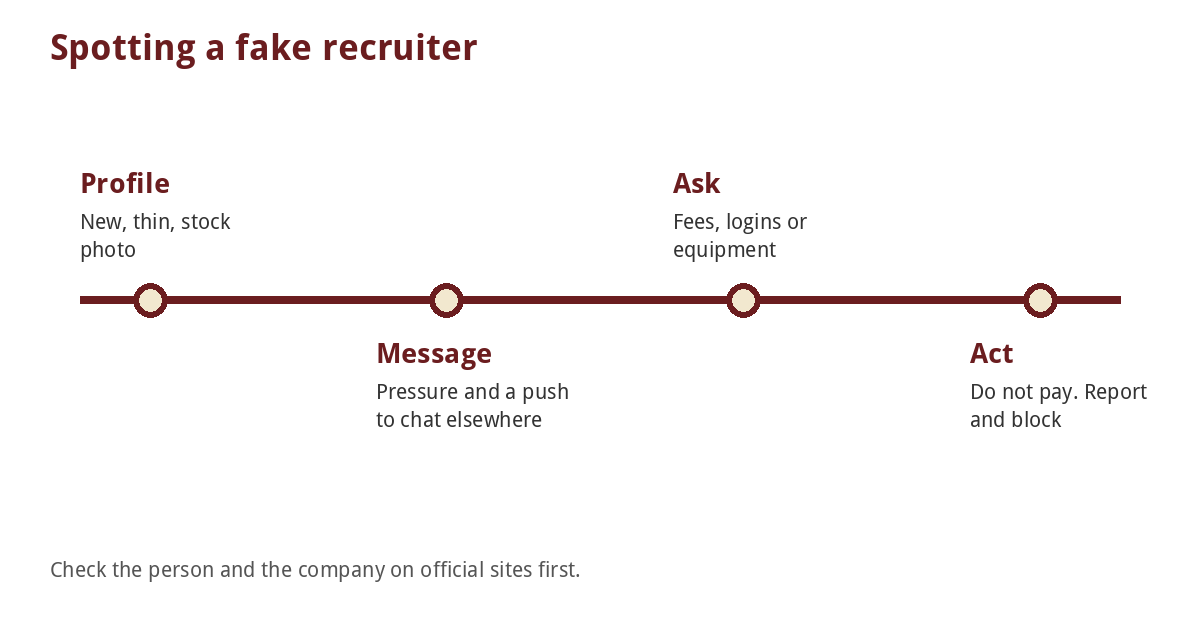
- Fake recruiters: a thin or brand-new profile, a stock photo, few connections, scripted messages, pressure to decide quickly, and a request to move to WhatsApp or Telegram.
- Pay-to-work: fees for training, placement, a laptop or insurance. Never pay to get a job.
- Credential theft: a gig that needs your LinkedIn or email login, or a link to a fake login page. Never share your password.
- CV-writing upsells: LinkedIn said more than a third of job scams now involve low-quality CV-writing services. Be careful with anyone who offers a free review and then sells placement.
- Malicious attachments and links: a job description sent as a file or an unfamiliar link. Do not open them.
If you doubt a message, check the person and the company on official websites, call a number from the company site, and read how to spot fake job ads in Nigeria. Report the message and profile to LinkedIn, block the account and stop replying. If you shared your login, change your password, switch on two-step verification and sign out of unfamiliar sessions. For money lost, see how to recover money sent to the wrong account.
Mistakes that hurt your profile
- A headline that says only Student or Unemployed.
- A photo that is dark, cropped from a group or full of filters.
- An About section that copies your CV or is left empty.
- Duties instead of results, and claims that do not match your CV.
- Dozens of skills with none that match the adverts.
- Connecting with everyone, including strangers who send odd offers.
- Spelling and grammar errors in the headline and About.
- Posting angry political rants or complaints about employers.
A 30-day plan
- Week 1: new photo, headline, About and location. Match your experience to your CV.
- Week 2: add skills, request two or three recommendations and add one Featured item.
- Week 3: connect with 20 people you actually know, follow 15 target companies and set job alerts.
- Week 4: comment on five posts, message three people for advice and apply for roles that fit. Review the safety settings.
Frequently asked questions
Do I need a premium LinkedIn account?
No. A free account is enough to build a profile, connect, search and apply. Paid plans add extras but do not replace a good profile.
Should I turn on the Open to Work frame?
It is a choice. The frame is visible to everyone; the recruiter-only setting is more private. Either way, be careful with unsolicited offers.
Can a fresh graduate have a good profile?
Yes. Use projects, internships, leadership, volunteering and NYSC service as evidence, and add a clear headline about the role you want.
How often should I post?
You do not have to post. Useful comments a few times a week help, and a post now and then about something you built or learned adds proof.
Is it safe to share my CV with a LinkedIn recruiter?
Only after you have checked the person and company. A CV with phone numbers and addresses should not go to an unverified account.
What should I do if my account is hacked?
Reset your password through the official site, turn on two-step verification, sign out other sessions and warn your contacts that messages from your account may be fake.
Bottom line
A good LinkedIn profile is simple: a clear photo, a headline that names the job you want, an About section with real results, experience with numbers, skills that match adverts and a few people who can vouch for you. Use Open to Work deliberately, network with people you actually know, and treat every cold offer as a possible scam until you have checked it. Keep your login private and never pay for a job.
Sources
- Resume.io: 20 LinkedIn profile tips (commonly cited limits and sizes)
- NapoleonCat: LinkedIn users in Nigeria (marketing-audience estimate)
- Rest of World: LinkedIn job scams (December 2025)
- HR Dive: LinkedIn outlines measures to combat scam job listings (February 2026)
- CyberGhost VPN (commercial site): LinkedIn scams and how to avoid them (2026)
Join the discussion
Have you tried this, or do you have a question we did not answer? 4 readers have already shared their views. Naijatipsland members help each other with real, first-hand experience.





A quick tip from the guide: read 10 to 15 adverts for the role you want and use the keywords that keep repeating, as long as they’re true for you. That one step sharpens most headlines. What’s in your headline right now, and has it brought recruiters to you?
Write the headline for search, not sympathy: put your target role and key skills in the first 60 or so characters, and skip lines like “Looking for opportunities”. If you’ve rewritten your headline, did you notice more recruiters finding you?
Open to Work is useful, but scammers target people who use it, so treat every unexpected offer with care. Do you keep the green frame visible to everyone, or to recruiters only, and why?
Open to Work helps recruiters find you, but the guide warns that scammers also target people who show it, and you should never hand over your LinkedIn login. Have you had a suspicious message from a “recruiter” on LinkedIn, and what gave it away?