


TL;DR:
- Nigeria’s economy was historically diverse but shifted to oil dependence after the 1970s oil boom. Repeated reforms have not achieved significant diversification, leaving the country vulnerable to oil price volatility, jobless growth, and sector neglect. Successful models like the UAE and Azerbaijan demonstrate the importance of infrastructure, coherent policy, and governance in transforming from resource reliance to sustainable, diversified economies.
Nigeria’s agriculture and mining sectors once contributed over 65% of GDP before the 1970s oil boom reshuffled economic priorities almost overnight. Decades of reform programs have followed, yet the country’s fiscal health still swings with global crude prices. This guide cuts through the noise, showing you exactly what oil dependence costs Nigeria, why diversification works, where previous policies fell short, and what a credible, actionable blueprint for change looks like, drawing on global evidence and Nigeria-specific data.
Table of Contents
- The cost of over-reliance: Nigeria’s oil dependence in context
- Why diversify? Core benefits for Nigeria’s growth and stability
- Behind Nigeria’s diversification gap: Policy efforts and persistent roadblocks
- What works: Global success stories and lessons for Nigeria
- A policy blueprint: Practical strategies for economic diversification in Nigeria
- Why conventional diversification advice falls short—and what Nigeria really needs
- Connecting insight with action: Resources for economic transformation
- Frequently asked questions
Key Takeaways
| Point | Details |
|---|---|
| Oil reliance is risky | Nigeria’s economy remains vulnerable to oil price changes and external shocks due to heavy dependence on the energy sector. |
| Diversification fosters stability | Expanding into non-oil sectors like agriculture, manufacturing, and tech leads to more jobs and balanced long-term growth. |
| Policy and governance matter | Effective diversification requires improved public goods, strong institutions, and realistic policy implementation. |
| Learn from global leaders | Benchmarks like the UAE and Azerbaijan show the power of strategic reforms and investment in economic complexity. |
| Build on local strengths | Nigeria should leverage regional comparative advantages and labor-intensive sectors to drive sustainable change. |
The cost of over-reliance: Nigeria’s oil dependence in context
Understanding where Nigeria stands today requires an honest look at how its economy got here. The oil boom of the 1970s did not just grow Nigeria’s revenue. It actively crowded out other productive sectors. Agriculture, which had sustained export earnings through cocoa, groundnuts, and palm oil, was sidelined. Mining dwindled. The structural logic of “Dutch disease” set in, where petrodollars inflated the naira and made non-oil exports uncompetitive.
“Nigeria’s economy became heavily reliant on oil after the 1970s oil boom, leading to the neglect of agriculture and mining sectors which previously contributed over 65% of GDP.”
The consequences are visible in the data. A 1980 to 2023 analysis using Concentration Index and Diversification Quotient metrics confirms that Nigeria remains susceptible to oil price variations, and that non-oil revenue improvements under democratic governance have not translated into genuine structural diversification. Understanding the role of oil in Nigeria is essential before designing any credible reform path.
The socioeconomic costs are equally stark:
- Revenue volatility: When oil prices crashed in 2014 to 2016, Nigeria’s federal budget suffered a sharp shortfall, triggering a recession and currency crisis.
- Job losses and inequality: Oil contributes roughly 90% of foreign exchange earnings yet employs less than 3% of the workforce, concentrating wealth narrowly.
- Missed industrialization: Decades of rent-seeking have delayed the manufacturing and value-added processing that could absorb Nigeria’s growing labor force.
- Exchange rate fragility: Dependence on oil dollars means every price swing destabilizes the naira and undermines business planning.
These are not abstract risks. They are recurring crises that erode household incomes, public services, and investor confidence. Nigeria’s path forward depends on confronting them directly.
Why diversify? Core benefits for Nigeria’s growth and stability
Now we understand the risks of over-dependence, let’s explore the tangible upside of a more balanced economy. Diversification reduces vulnerability to oil price shocks, enhances economic stability, creates jobs, boosts non-oil revenue, and promotes sustainable growth. Each of those outcomes addresses a specific gap in Nigeria’s current structure.
Consider this comparison of outcomes across key dimensions:
| Benefit | Impact on Nigeria | Priority sector |
|---|---|---|
| Reduced shock exposure | Stabilizes government revenue | Agriculture, manufacturing |
| Job creation | Absorbs 3 million new entrants annually | Agro-processing, construction |
| Broader tax base | Reduces deficit financing | SMEs, retail, tech |
| Inclusive regional growth | Reduces North-South economic gap | Mining, food processing |
| Sustainable development | Builds long-term export capacity | Renewable energy, logistics |
The benefits cascade across Nigeria’s economic challenges in a reinforcing way. A wider tax base funds better infrastructure. Better infrastructure attracts private investment. Private investment creates jobs. Jobs reduce poverty and political instability. The whole system becomes self-reinforcing rather than hostage to crude prices.
Here are four core reasons why diversification is the right priority for Nigeria right now:
- Resilience: A multi-sector economy does not collapse when one commodity falls.
- Employment: Labor-intensive sectors like agro-processing can absorb millions of workers oil never will.
- Fiscal sustainability: Broader income sources reduce reliance on deficit financing and volatile oil rents.
- Social stability: Inclusive growth across regions reduces grievance-driven conflict and strengthens governance.
Pro Tip: Frame diversification not just as an economic goal but as a national security strategy. Economies with broader productive bases are statistically more stable politically, which matters deeply for investor confidence in Nigeria.
Behind Nigeria’s diversification gap: Policy efforts and persistent roadblocks
Armed with the benefits, Nigerian policymakers have tried but often failed to diversify with lasting impact. The record of reform is long but uneven. Despite initiatives like the National Development Plans, the Structural Adjustment Program (SAP), Vision 2010, and the National Economic Empowerment and Development Strategy (NEEDS) since 1980, Nigeria’s economy remains undiversified, with oil dominating revenue and GDP contributions remaining uneven across sectors.
Why have these initiatives stalled? The barriers are structural and interconnected:
- Infrastructure deficit: Unreliable power supply alone adds roughly 40% to manufacturing costs. Without competitive energy, factories cannot scale.
- Weak governance and corruption: Regulatory capture and contract enforcement failures make private investment risky and unpredictable.
- Security challenges: Insecurity in the North East and in agricultural belts directly disrupts farming and mining operations.
- Protectionism without capability-building: Nigeria has shielded domestic industries with tariffs, but without accompanying investments in skills and technology, protected sectors rarely become competitive.
- Policy implementation failures: Many well-designed programs have collapsed at execution, due to weak monitoring, poor inter-agency coordination, and inconsistent political will.
A look at sector outcomes illustrates the contrast. Nigeria’s cement industry is a genuine success story. Government policy, including local content mandates and consistent demand, helped Dangote Cement and others grow into globally competitive producers. Contrast this with textiles, where protective tariffs were applied without investment in modern machinery or skills training, leading to shuttered mills and rampant smuggling that undermined the sector.
| Policy approach | Cement sector | Textile sector |
|---|---|---|
| Government support type | Local content + demand stimulus | Tariff protection only |
| Capability investment | Yes, technology transfer occurred | Minimal |
| Outcome | Regional export leader | Near collapse |
| Key lesson | Build capacity alongside protection | Protection alone fails |
The lesson is clear. Policies that bundle market protection with genuine capability development work. Those that rely on protection alone do not. Nigeria’s trade facilitation reforms offer one avenue to improve the enabling environment, but structural investments must accompany them.
Pro Tip: Always attach clear, measurable performance benchmarks to sectoral support programs. Without built-in review mechanisms, subsidies and protections tend to become permanent entitlements rather than temporary scaffolding for growth.
What works: Global success stories and lessons for Nigeria
To get clarity on what’s achievable, we turn to nations that successfully broke commodity dependency. The UAE and Azerbaijan offer two instructive models, both starting from heavy oil dependence and achieving structural transformation through deliberate, sustained policy.

The UAE’s story is remarkable. Non-oil sectors now account for approximately 75 to 77% of GDP, a reversal from a position of 90%+ oil dependence in earlier decades. The UAE achieved this through free economic zones that attracted foreign direct investment, world-class logistics and aviation infrastructure, deliberate tourism development, and a financial services cluster that became regionally dominant. The strategy was coherent, funded, and executed consistently across administrations.
Azerbaijan pursued a parallel path. Its non-oil sector now exceeds 70% of GDP and serves as the primary growth engine, with non-oil exports growing at 7 to 10% annually. Agriculture and food processing are key drivers. Azerbaijan’s Strategic Road Maps, introduced in 2016, created sector-specific roadmaps with defined targets, timelines, and accountability structures.
| Country | Starting point | Core strategies | Key outcome |
|---|---|---|---|
| UAE | 90%+ oil-dependent | Free zones, FDI, logistics, tourism | Non-oil sectors ~75-77% of GDP |
| Azerbaijan | Heavily oil-dependent | Strategic Road Maps, agri-food, non-oil exports | Non-oil sector >70% of GDP |
| Nigeria (target) | Oil dominates revenue | TBD: AfCFTA, agro-processing, mining | Target: 50%+ non-oil GDP by 2035 |
What does Nigeria take from this? Three lessons stand out:
- Coherence matters more than ambition. Both the UAE and Azerbaijan aligned fiscal policy, infrastructure investment, and regulatory reform toward the same goals simultaneously.
- Infrastructure is non-negotiable. World-class ports, roads, and energy supply made non-oil sectors competitive. Nigeria must treat these as preconditions, not aspirations.
- Governance determines credibility. Investors moved into these economies because rules were enforced predictably. Nigeria needs equivalent institutional reform to attract similar capital flows.
A policy blueprint: Practical strategies for economic diversification in Nigeria
Bringing it all together, here’s how Nigeria can translate lessons and data into lasting policy impact. The Federal Ministry of Industry, Mines, and Investment has identified a framework that includes stakeholder seminars, zonal advocacy workshops, monitoring of state-level projects, and a focus on regional comparative advantages in agriculture, mining, and manufacturing. This participatory approach is essential for political buy-in and local ownership.
Layered on this base, here is a practical policy sequence:
- Invest in public goods first. Electricity, road connectivity, and port efficiency are the foundations on which every other sector depends. Nigeria’s chronic power deficit costs manufacturers billions annually. Fixing power before expecting manufacturing to boom is not optional.
- Target labor-absorbing sectors. Agro-processing, construction materials, and light manufacturing can each absorb large numbers of low-to-medium-skilled workers. These are the sectors that will move the poverty needle.
- Apply regional comparative advantage thinking. The North West has mining potential. The Niger Delta has petrochemical feedstocks. The South West has services and tech. National policy should create tailored, region-specific packages rather than one-size-fits-all programs.
- Build value chains, not just export volumes. Raw commodity exports generate little domestic value. Nigeria should focus on processing and packaging to capture more revenue per ton of output.
- Leverage AfCFTA aggressively. Infrastructure and logistics upgrades combined with public-private partnerships (PPPs) and improved governance position Nigeria to become Africa’s dominant manufacturing and agri-food exporter under the African Continental Free Trade Area framework.
Pro Tip: Use the AfCFTA as a forcing function for reform. Sector-specific market access commitments create deadlines and external accountability that domestic political processes often cannot generate alone.
Why conventional diversification advice falls short—and what Nigeria really needs
Here is the uncomfortable truth. Most diversification recommendations list sectors to invest in, but they miss the deeper question: how does an economy build genuine productive capability, not just sector variety?
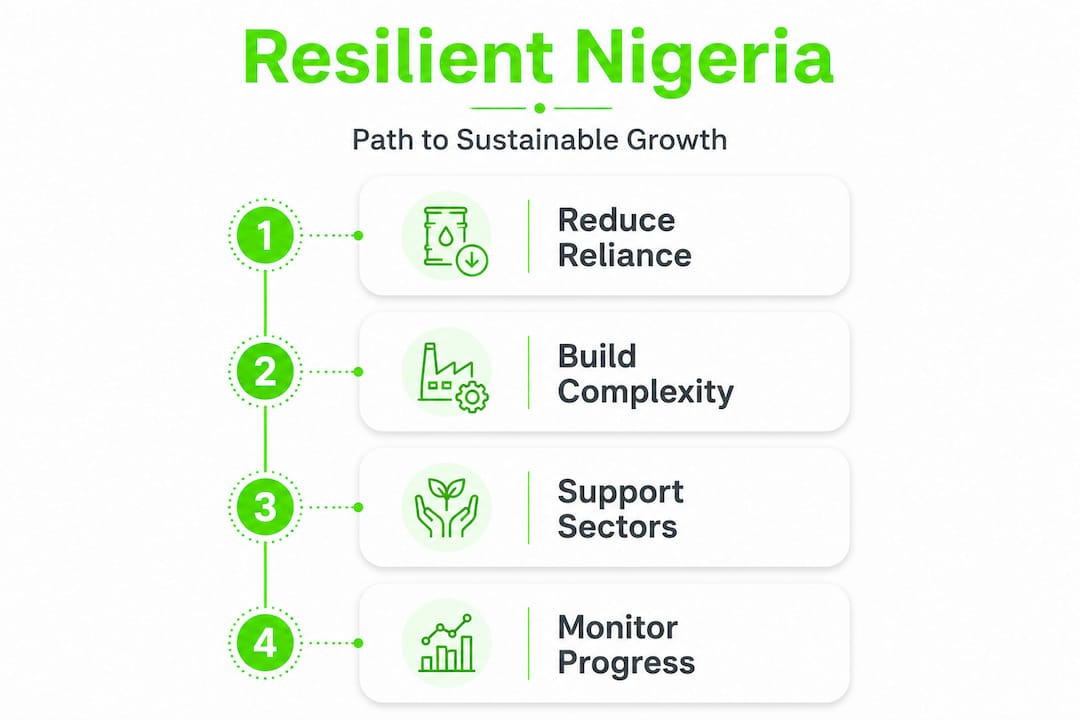
Economic complexity research from UNCTAD is clear on this point. You should build economic complexity rather than simply export variety. Target products that leverage existing capacities and knowledge, because this approach creates genuine resilience against external shocks. Nigeria does not need 20 new sectors. It needs 5 to 7 deeply connected, increasingly sophisticated value chains where capabilities built in one area enable growth in adjacent areas.
The second uncomfortable truth is about protectionism. We at Naijatipsland recognize that the political appeal of “protecting Nigerian jobs” through tariffs is real and understandable. But protection without parallel investment in machinery, skills, and technology consistently fails, as the textile sector shows. Policymakers must resist the temptation to call protectionism a diversification strategy.
The third truth is about time horizons. Nigeria’s political cycle favors quick wins. But structural transformation takes 10 to 20 years of sustained, consistent effort. The UAE did not shift its economy in one administration. Azerbaijan’s Strategic Road Maps span decades. Nigerian policymakers need to institutionalize diversification commitments in ways that survive election cycles, through independent statutory bodies, long-term fiscal rules, and sector compacts with the private sector.
Understanding the full deep dive on oil policy helps ground this perspective. The goal is not to abandon oil. It is to build enough non-oil productive capacity that Nigeria is never again held hostage by a single commodity price set in London or New York.
Connecting insight with action: Resources for economic transformation
You now have a clearer, evidence-backed picture of what economic diversification requires in Nigeria and why it matters more urgently than ever. The challenge is moving from analysis to action, and staying informed along the way.
Naijatipsland.com gives you a direct connection to Nigeria’s evolving economic conversation. Explore ground-level reporting on how urban challenges projects are reshaping communities across Lagos and beyond. Discover how digital advertising is transforming brand growth in Nigeria and what that means for non-oil sector competitiveness. Naijatipsland brings together policymakers, analysts, entrepreneurs, and engaged citizens in one accessible forum where ideas about Nigeria’s economic future are debated, challenged, and refined every day.
Frequently asked questions
What is economic diversification and why do governments pursue it?
Economic diversification means expanding an economy’s sectors and income sources to reduce risk, stabilize growth, and create more jobs. Governments pursue it because diversification reduces vulnerability to commodity price shocks and builds a more resilient fiscal base.
What are the main barriers Nigeria faces in achieving diversification?
Key barriers include poor infrastructure, weak governance, corruption, insecurity, and consistent policy implementation failures that undermine even well-designed reform programs.
Which countries offer useful models for Nigeria to emulate?
The UAE and Azerbaijan are the most instructive models, with non-oil sectors at 75-77% and over 70% of GDP respectively, achieved through sustained infrastructure investment, governance reforms, and sector-specific strategic plans.
How does building economic complexity benefit Nigeria?
Economic complexity increases resilience by creating diverse, interconnected industries that target related products for resilience against global shocks, rather than simply adding new raw commodity exports.
What practical first steps can Nigerian policymakers take?
Start with public goods: reliable power, logistics, and road infrastructure. Then leverage AfCFTA via infrastructure upgrades and PPPs to open competitive markets for agriculture, agro-processing, and manufacturing sectors with existing regional strengths.