The live rate box below updates automatically every day, and the dated figures after it were reported on 9 and 10 October 2026. Exchange rates change every day, so always check the date and confirm the rate with your bank or provider before you transact. This page is general information, not financial advice.
Dollar to naira at a glance (9 to 10 October 2026)
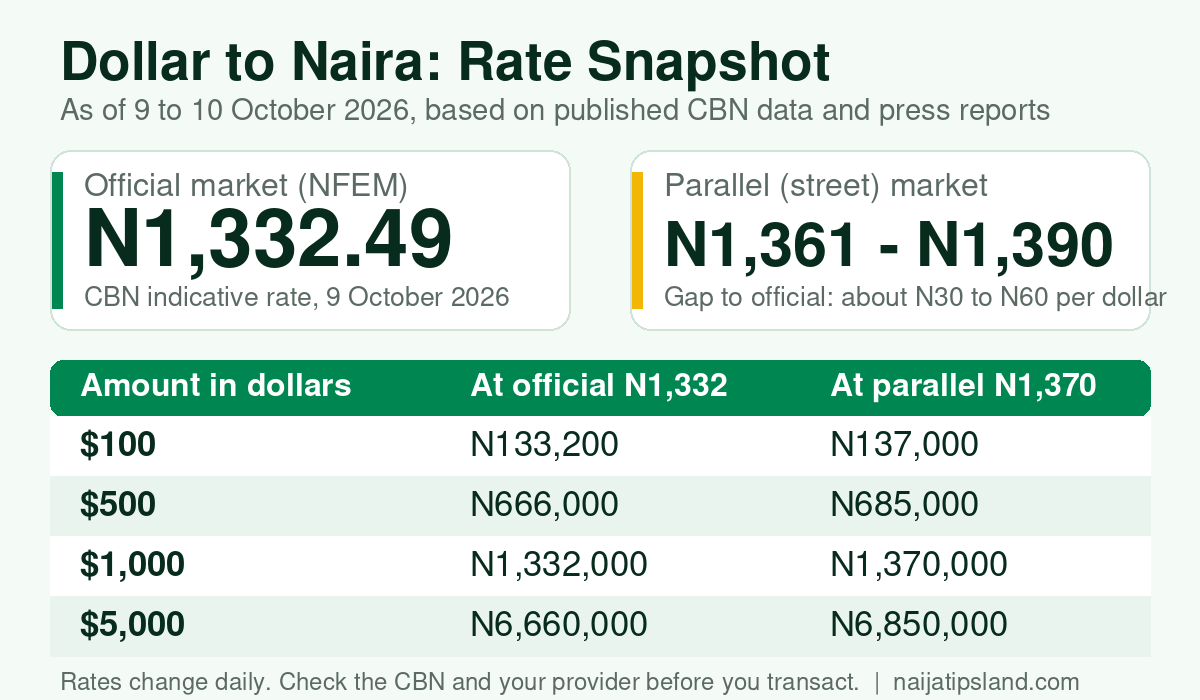
- Official rate (NFEM): about ₦1,332 per dollar. The CBN’s indicative rate eased to ₦1,332.49 at the end of the week.
- Parallel (black) market: about ₦1,361 to ₦1,390 per dollar, depending on the dealer and whether you are buying or selling.
- Gap between the two: roughly ₦30 to ₦60 per dollar.
- Trend: the naira has traded in a narrow band around ₦1,330 since the end of September, after strengthening earlier in the year.
- Foreign reserves: above US$54 billion, the highest in about 18 years.
Dollar to Naira Exchange Rate Today
Live rate (updates automatically)
| Amount | In naira |
|---|---|
| US$100 | ₦133,144 |
| US$500 | ₦665,720 |
| US$1,000 | ₦1,331,440 |
| US$5,000 | ₦6,657,200 |
| Date | Rate (₦ per US$1) |
|---|---|
| 13 Oct 2026 | 1,331.44 |
| 12 Oct 2026 | 1,330.17 |
| 11 Oct 2026 | 1,331.00 |
Indicative market rate from Rates By Exchange Rate API, refreshed automatically. It tracks the official market closely but can differ slightly from the CBN NFEM closing rate and from bank and street rates. Confirm the rate with your bank or provider before you transact.
Reported official and parallel rates for 9 to 10 October 2026
At the official Nigerian Foreign Exchange Market (NFEM), the naira has barely moved this month. It closed at ₦1,332 per dollar on 2 October after trading between ₦1,329 and ₦1,333, then at ₦1,332.90 on 5 October and ₦1,331.50 on 6 October. The CBN’s indicative rate for 9 to 10 October was ₦1,332.49. The CBN says its NFEM rate is calculated as a volume-weighted average and serves as the official rate for the day.
In the parallel market the picture is wider. Reports put the dollar at about ₦1,357 on 6 October, ₦1,362 on 7 October, between ₦1,375 (buying) and ₦1,390 (selling) on 8 October, and around ₦1,363 on 10 October. The gap to the official rate was about ₦24 per dollar on 6 October and about ₦30.50 on 7 October.
Why different websites show different parallel rates
There is no single parallel market rate. Dealers in different cities quote different prices, and some reports give the buying price while others give the selling price. That is why this page shows a range. Treat any single figure for the street market as an estimate.
Dollar to naira conversion table
| Amount in dollars | At official rate (₦1,332) | At parallel rate (₦1,370) |
|---|---|---|
| $100 | ₦133,200 | ₦137,000 |
| $500 | ₦666,000 | ₦685,000 |
| $1,000 | ₦1,332,000 | ₦1,370,000 |
| $5,000 | ₦6,660,000 | ₦6,850,000 |
To convert any amount yourself, multiply the dollar amount by the rate. Banks and dealers also add fees or spreads, so your final figure may differ.
Official vs Parallel Market: What Is the Difference?
The official market is where banks, authorised dealers and other participants trade foreign exchange under CBN oversight. Its rate is published by the CBN and is generally the steadier of the two. The parallel market, also called the black market or street market, is where Bureau De Change operators and informal dealers sell cash dollars at their own prices. It usually trades above the official rate because of demand for physical cash for travel, school fees and imports.
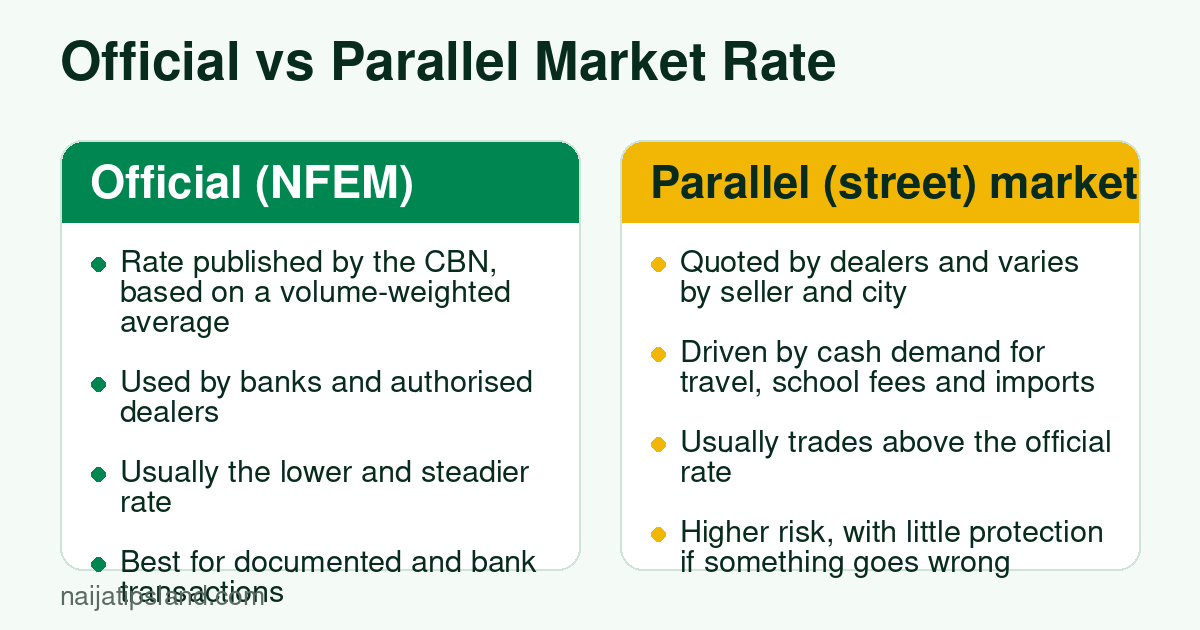
The narrower the gap between the two, the more confidence the market tends to have in the official window. The gap has been much smaller in 2026 than in earlier years, but it has not closed. Market reports say corporate demand for trade obligations and school fees keeps up routine pressure on unofficial channels.
How Active Is the Official Market?
Trading volumes swing from week to week. On 2 October there were 249 NFEM deals worth $569.80 million in turnover. For the whole week ended 2 October, total spot and derivatives turnover was about $1.70 billion, down 35.41% from $2.63 billion the week before. Lower turnover does not by itself mean the naira is weaker, but it can make daily moves less informative.
How the Naira Has Moved in 2026
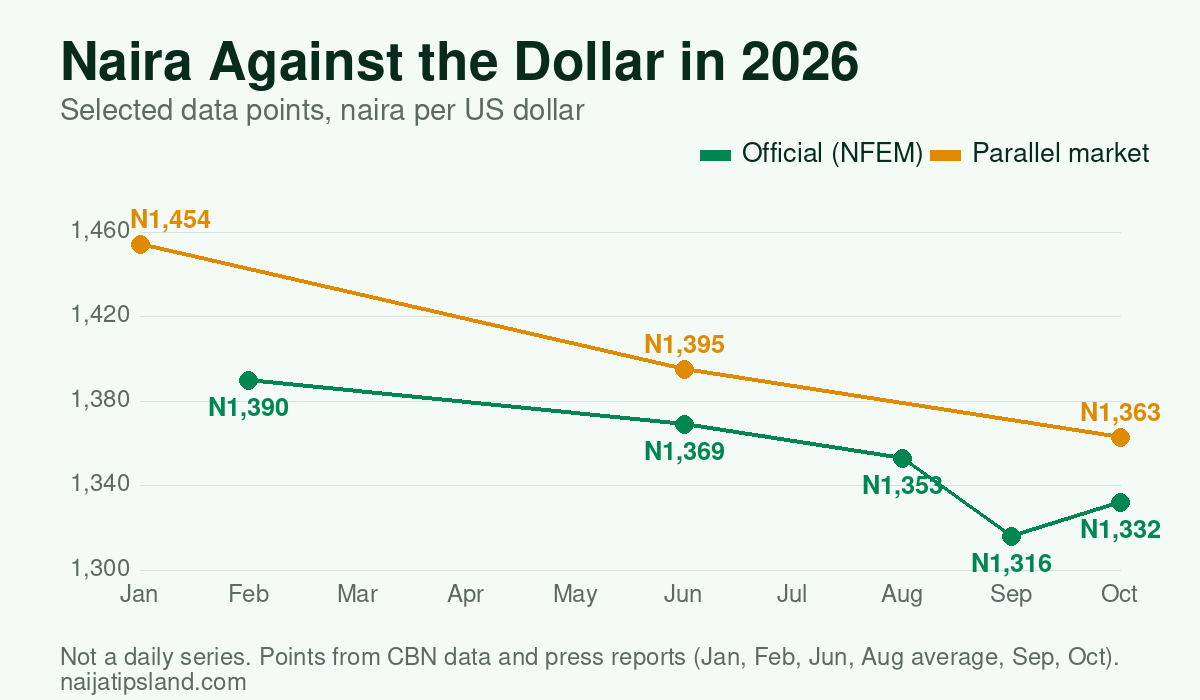
The naira has generally strengthened this year, although not in a straight line. In late January the parallel market was around ₦1,454 per dollar, and at the start of February the official rate was in the ₦1,390 range. By 22 June the official rate was ₦1,369.11 and the parallel rate ₦1,395. The naira averaged ₦1,353 in August, and on 3 September it traded at ₦1,315.67 at the NFEM, its strongest level in these data points. It has since eased slightly to about ₦1,332.
What Moves the Naira?
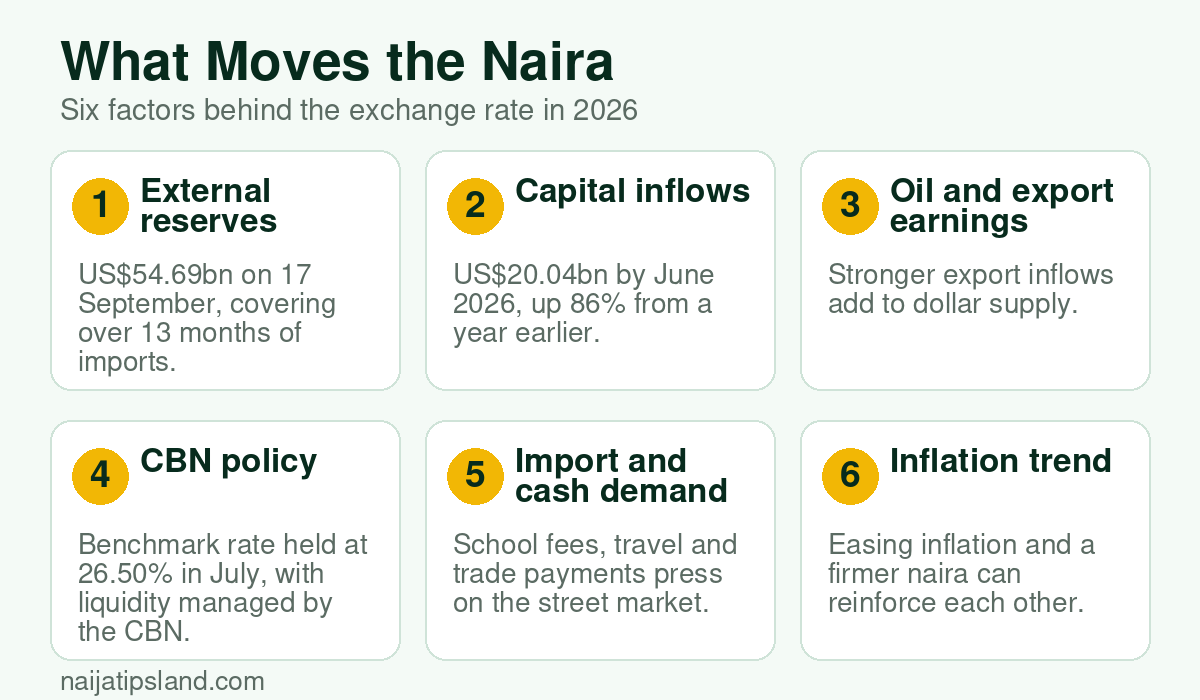
Several forces explain why the naira has been more stable in 2026:
- External reserves. Gross reserves reached $54.08 billion on 3 September, an 18-year high, and $54.69 billion on 17 September, covering over 13 months of imports. They gained about $6.4 billion in the first seven months of 2026 and passed the CBN’s year-end target of $51.04 billion. Larger reserves give the CBN more ability to meet dollar demand and support confidence in the naira.
- Capital inflows. Inflows reached about $20.04 billion by June 2026, up 86% from a year earlier, according to analysis from United Capital.
- Oil and export earnings. Analysts expect stronger export inflows, helped by higher global oil prices, to keep adding to reserves.
- CBN policy. The CBN held its benchmark rate at 26.50% at its July meeting. High rates help keep investors interested in naira assets. Check the CBN for its latest Monetary Policy Committee decision.
- Demand for cash dollars. School fees, travel and trade payments keep pressure on the street market, especially around peak periods.
- Inflation. A firmer naira lowers the cost of imports, which helps ease inflation, and easing inflation in turn supports confidence in the currency. The CBN noted that headline, food and core inflation have moderated.
Will the Naira Get Stronger or Weaker?
Nobody can say for certain. Rising reserves are a supportive sign, and the CBN has described the case for easing monetary policy as stronger. At the same time, analysts at Cowry Asset Management said the naira could stay under some pressure in the coming week even though rising reserves might offer support. Rates can move quickly on oil prices, investor flows, policy decisions and demand from importers, so treat any forecast, including this one, with caution.
Practical Tips for Dollar to Naira Transactions
- Compare the total cost, not just the rate. Fees, spreads and delays can matter as much as the headline rate.
- Know which rate applies. Banks and transfer services convert at their own rates, which are usually tied to the official market, while street dealers set their own prices.
- If you are receiving money from abroad, note that licensed remittance operators have had to settle diaspora remittances in naira since 1 May 2026. If you want dollars, ask the sender to pay into an account that can receive them instead.
- Understand the cash limits. The CBN’s 2026 Foreign Exchange Manual, effective 1 June 2026, caps cash collection on inbound transfers at the naira equivalent of $200. Ask your bank how the rules apply to your transaction.
- Be careful on the street. There is little protection if a dealer short-changes you or you receive counterfeit notes. Count and check cash, avoid carrying large sums, and keep records.
- Consider timing. If you have a large payment such as school fees, avoid waiting until the last minute, when demand and prices tend to rise.
Some Nigerians also look at stablecoin prices such as USDT as another reference point for the dollar. If you are curious about that route, read our guide on how to buy Bitcoin and USDT in Nigeria, including the risks and tax rules.
Key Terms Explained
- NFEM: the Nigerian Foreign Exchange Market, the CBN’s official trading window. Some earlier coverage called it NAFEM.
- Parallel market: the informal market where cash dollars trade outside the official window, also called the black market.
- BDC: Bureau De Change, a business that buys and sells foreign cash.
- Spread: the difference between two rates, such as official and parallel, or between a dealer’s buying and selling price.
- External reserves: the foreign currency and other assets the central bank holds to support the currency and pay external obligations.
- Monetary policy rate: the CBN’s benchmark interest rate, which influences borrowing costs and investor demand.
Frequently Asked Questions
What is the dollar to naira rate today?
As of 9 and 10 October 2026, the official NFEM rate was about ₦1,332 per dollar and the parallel market was about ₦1,361 to ₦1,390. Rates change daily, so confirm before you transact.
Why is the black market rate higher than the official rate?
The parallel market trades physical cash, where demand from travellers, students and importers is high and supply is limited. Dealers also price in their own risk and costs.
Who sets the official exchange rate?
The official rate emerges from trading on the NFEM. The CBN publishes it, calculated as a volume-weighted average of the day’s deals.
Which rate should I use to convert dollars to naira?
For banks, transfers and documented transactions, the rate your bank or provider quotes, which is linked to the official market, is what applies. The street rate only matters if you trade cash with dealers, and that carries extra risk.
Is the naira getting stronger in 2026?
Overall it has strengthened from about ₦1,390 at the official window in early February to about ₦1,332 now, with a high point near ₦1,316 in early September. Movements since late September have been small.
How much is $1,000 in naira?
At the official rate of about ₦1,332, $1,000 is roughly ₦1,332,000. At a parallel rate of about ₦1,370, it is about ₦1,370,000.
How often is this page updated?
The live rate box refreshes automatically, with a check twice a day, and shows the date of the rate it uses. The dated official and parallel market figures are updated by our editors, so check the date every time you use them.
Related Reading
- Nigeria’s cost of living in 2026: what you’ll actually spend
- Subsidy removal exposed Nigeria’s crude shortfall
- FTSE Russell restores Nigeria to frontier market status
Browse more in the Business section.
Disclaimer: Rates shown are compiled from published CBN data and press reports and are for information only. They are not a quote or an offer. Nothing here is financial advice, so check live rates with your bank or provider.
More Naijatipsland Guides
Sources
- Nairametrics: Naira slips to N1,332.90/$ as FX trading activity swings
- Vanguard: Dollar to naira exchange rate today, 6 October 2026
- Vanguard: Dollar to naira exchange rate today, 8 October 2026
- WithinNigeria: Dollar to naira today, 10 October 2026
- BusinessDay: CBN pre-MPC review note, September 2026
- BusinessDay: Naira firms as external reserves hit an 18-year high
- United Capital: Monetary Policy Watch, September 2026
- Rio Times: Naira outlook as CBN holds benchmark rate at 26.50 percent
- Daya: Nigeria’s money rules in 2026 (summary of the FX Manual and remittance changes)