Last updated: 13 October 2026. The sample answers below are examples. Use them as a shape, not a script, and fill them with your own facts. Interview styles differ by employer.
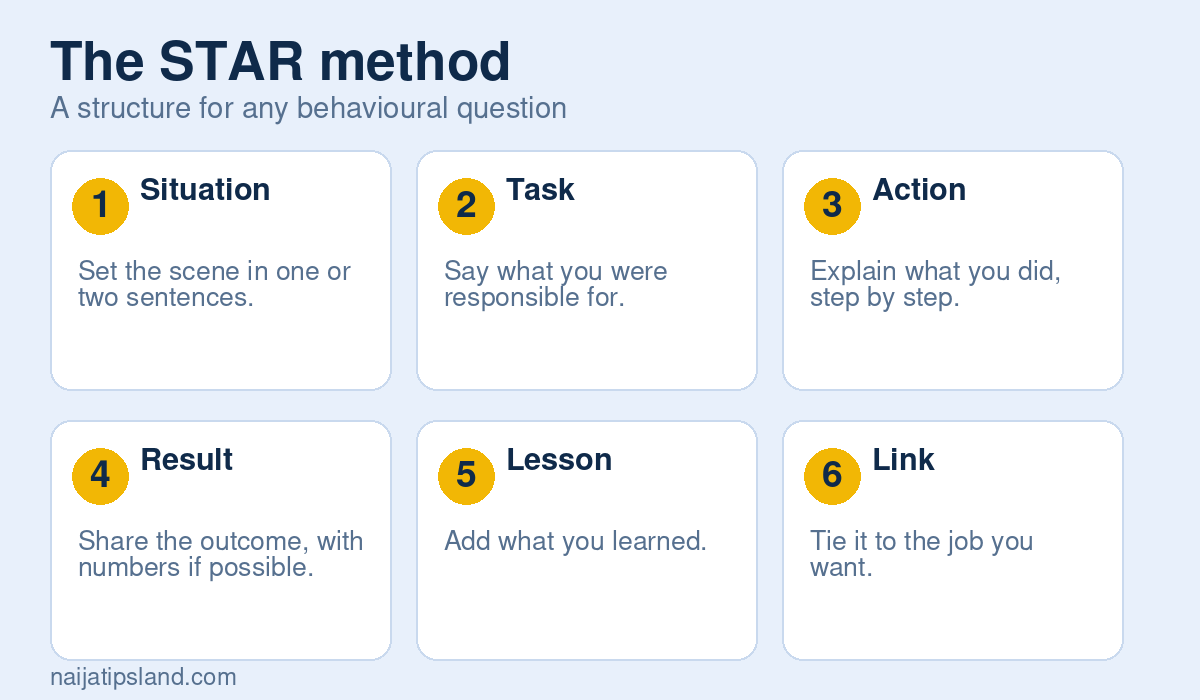
Interviewers do not have a hundred different questions. They have a handful of themes: who you are, why you want this job, what you can do, how you handle problems and whether you will fit in. If you prepare for the ten questions below, you will be ready for most of what comes your way. Read our guides to interview tips and the interview checklist alongside this one.
The STAR method for behavioural questions
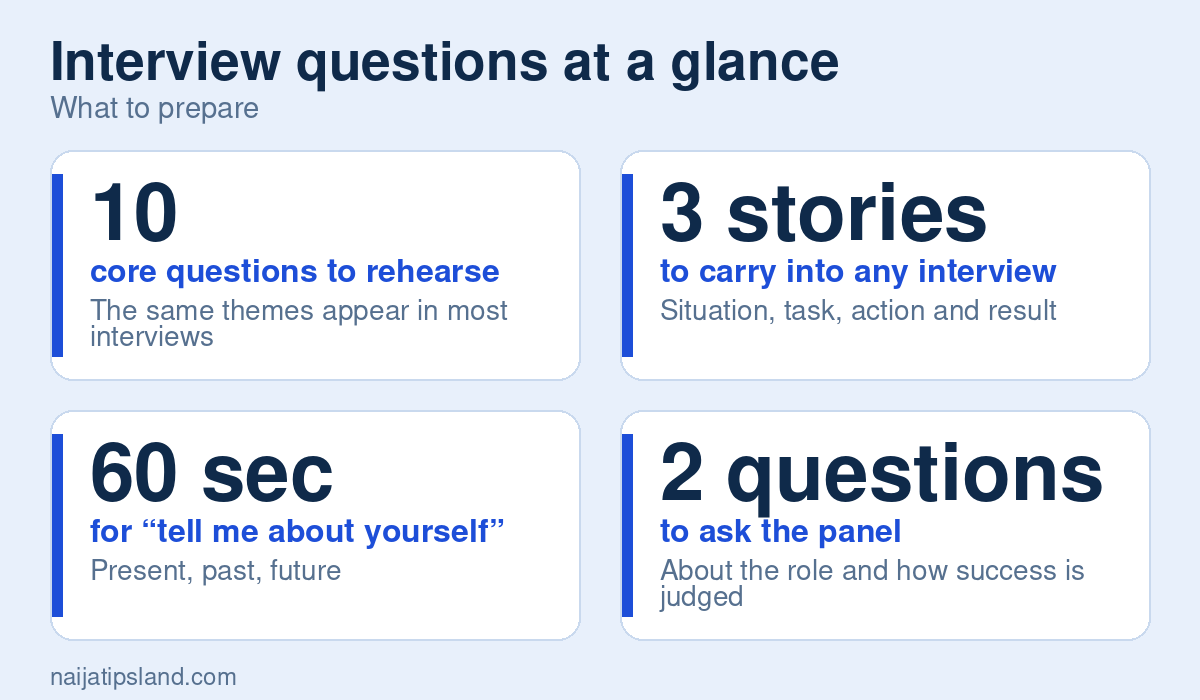
When an interviewer asks, “Tell me about a time when…”, they want a real example. Use STAR: describe the Situation, the Task you had, the Action you took and the Result. Practise three stories from work, school, projects or volunteering that you can adapt to different questions.
1. “Tell me about yourself”
What they want: a short, relevant summary, not your life story. Sample: “I am a business administration graduate who spent a year as a sales assistant at a retail chain, where I helped raise weekly sales by about ten per cent by improving how we displayed stock. I enjoy working with customers and with numbers, and I am looking for a role where I can grow into sales management, which is why this position interests me.”
2. “Why do you want to work here?”
What they want: proof that you did your research. Sample: “I have followed your expansion into the northern states, and I like that you train junior staff. My skills in customer service and reporting match what you need, and I want to contribute to a team that is growing.” Mention something specific and true.
3. “What are your strengths?”
Pick two or three strengths that match the job and back each with a short example. Instead of saying “I am hardworking”, say “I once volunteered to cover a colleague’s tasks during year-end stock-taking, and we finished two days early.”
4. “What is your biggest weakness?”
Choose a real, manageable weakness and show how you are working on it. Sample: “I used to take on too much without asking for help. Now I list my tasks every Monday and flag early when I need support.” Do not pretend you have no weaknesses, and do not name a deal-breaker for the role.
5. “Why did you leave your last job?” or “Why is there a gap?”
Be honest and positive. Talk about what you are moving towards, not what you are running from. For a gap, say what you did: studying, caring for family, freelancing, volunteering, learning a skill or searching for the right role.
6. “Tell me about a time you faced a conflict or a problem”
Use STAR and show calm problem solving. Describe how you listened, found common ground and fixed the issue. Avoid blaming people.
7. “Tell me about a failure”
Choose a genuine but modest failure, explain what you learned and show what you changed. Interviewers respect honesty and growth.
8. “Where do you see yourself in five years?”
They want to know you are ambitious and realistic. Sample: “I hope to have mastered this role, taken on more responsibility and perhaps be mentoring newer team members.”
9. “What are your salary expectations?”
Research pay for similar roles, and give a range based on your skills and the market, such as “I am looking at between X and Y, and I am open to discussing the whole package.” Also ask about allowances, pension and health cover. See our guide to the minimum wage for context on pay floors.
10. “Do you have any questions for us?”
Always have two or three. Ask: “What would success look like in the first six months?” “What are the biggest challenges for the team?” “What are the next steps and timeline?” Do not ask only about pay and leave.
Personal questions
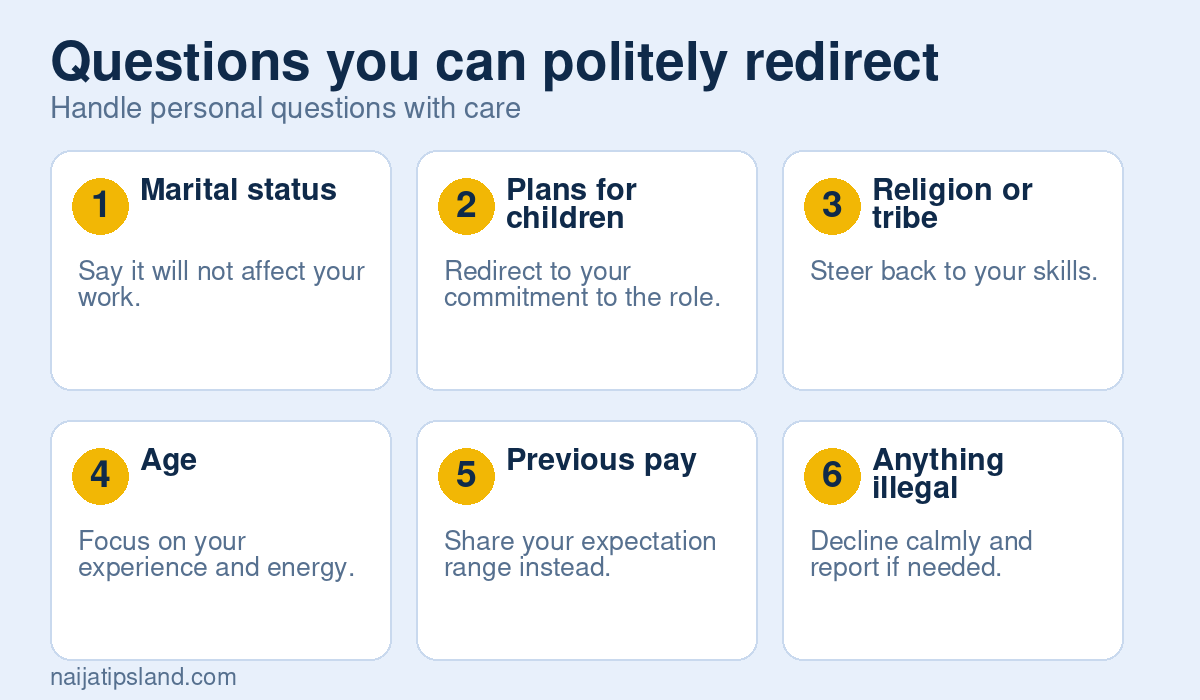
Some Nigerian interviewers still ask about marital status, plans for children, religion, tribe or age. These do not predict job performance, and you can answer politely and steer back: “My personal circumstances will not affect my commitment to this role, and I would be happy to talk about my experience.” You decide how much to share. If anything feels inappropriate or unsafe, you may decline to continue and report it.
Special situations
- Fresh graduates: use projects, internships, student leadership and NYSC experience as examples. Mention your NYSC status clearly.
- Online interviews: test your camera, sound and internet beforehand, and look at the camera, not the screen.
- Panels: address your answer to the person who asked, but make eye contact with everyone.
- Tests and group exercises: read instructions twice, manage your time and show teamwork.
Practice plan
- Write answers to all ten questions in your own words.
- Say them aloud to a friend or in front of a mirror, and record one if you can.
- Trim anything longer than two minutes.
- Do one full mock interview before the real one.
Frequently Asked Questions
How long should my answers be?
Aim for one to two minutes per answer. Short enough to hold attention, long enough to include an example.
Can I bring notes?
A small notebook with your questions for the interviewer is fine. Do not read your answers aloud.
What if I do not know the answer?
Say so, then explain how you would find out or approach the problem.
Should I ask about salary in the first interview?
Let the interviewer raise it, unless the advert says otherwise. Be ready to answer when asked.