


Last updated: 1 November 2026 · By Naijatipsland Editorial Team · Editorial policy
Checked 1 November 2026. Ask almost any Nigerian civil servant and they will tell you the same thing: the salary alone isn’t enough. Even after the national minimum wage rose to ₦70,000 a month, rent, school fees, transport and food prices have stretched public-sector pay to breaking point. So it’s no surprise that many workers in ministries, agencies, local governments, schools and hospitals look for a side hustle.
But civil servants are not like other workers. The Constitution and the Public Service Rules limit what a full-time public officer can do outside the office, and getting it wrong can mean a query, disciplinary action or a case at the Code of Conduct Tribunal. This guide explains what the rules actually say, then lists the best side hustles in Nigeria for civil servants that fit within them, from farming and investing to approved part-time work, plus how to start safely.
What the law says about civil servants and side businesses
The key rule is in the Code of Conduct for Public Officers, the Fifth Schedule to the 1999 Constitution. Paragraph 2(b) says a public officer shall not, except where he is not employed on a full-time basis, engage or participate in the management or running of any private business, profession or trade. It then adds an important exception: nothing in that paragraph prevents a public officer from engaging in farming or participating in the management or running of a farm.
In practice this means:
- Farming is clearly allowed for full-time public officers, as long as it doesn’t interfere with your official duties.
- Running or managing a private business, trade or profession is not, if you are a full-time officer. In 2013 the Office of the Head of the Civil Service of the Federation issued a circular reminding all federal workers that private practice, apart from farming, is unconstitutional and counts as misconduct under the Public Service Rules.
- Owning shares is generally allowed. Lawyers point out that the rule targets management, not ownership, and the Supreme Court has drawn the same distinction. A public officer can hold shares as an investor, but shouldn’t be a director or run the company, and must declare the shares in their asset declaration.
- Using a spouse, relative or friend as a front doesn’t help. The chairman of the Code of Conduct Bureau, Dr Abubakar Bello, has said public servants remain responsible when they are the real beneficiaries of activities carried out through nominees. He also said being a company director, or operating or signing on a business account, is a breach.
- Part-time officers are outside the restriction. The rule applies to full-time public officers.
The Code of Conduct covers federal, state and local government employees, including teachers, health workers in public hospitals, and staff of government agencies and parastatals. Your scheme of service or state civil service rules may add their own conditions, so check with your Human Resources (Admin) department if you are unsure.
The government isn’t against civil servants earning more. In 2023 the federal government launched the Federal Public Service Entrepreneurship Programme to help workers build extra income and prepare for retirement, with an agripreneurship scheme built around the constitutional farming exception. The point is to choose the right kind of hustle and do it properly.
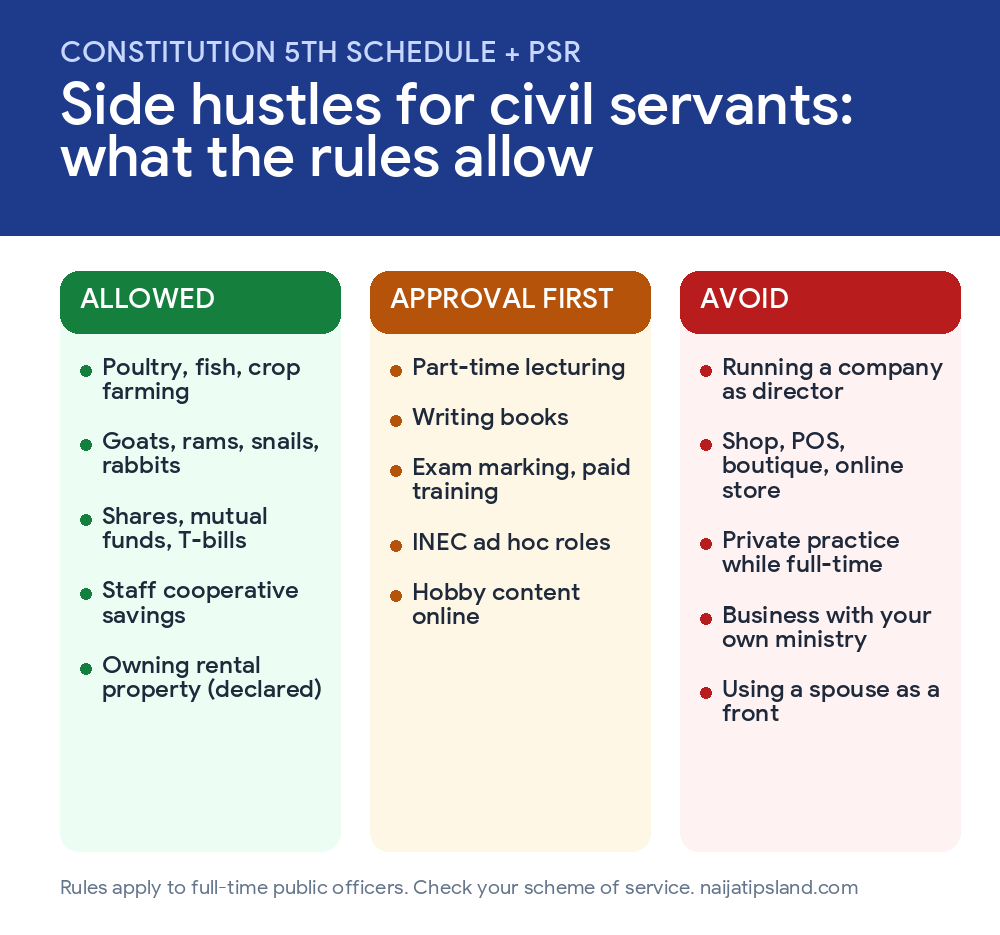
The best side hustles for civil servants (allowed)
1. Poultry farming
Broilers for festive seasons, layers for eggs, or turkeys for December can all run from a backyard or a small plot near home. Broilers turn around in about six to eight weeks, which suits a salary earner who wants regular returns. Feed is the biggest cost, so start small, perhaps 50 to 100 birds, and learn before you expand. Our full guide to poultry farming in Nigeria covers start-up costs, feed and profit.
2. Fish farming (catfish or tilapia)
Catfish in tarpaulin or concrete ponds is one of the most popular hustles among civil servants because daily care takes under an hour: feeding morning and evening and checking the water. A batch takes about four to six months to reach table size. Buy fingerlings from a reputable hatchery, never overstock, and line up buyers (fish sellers, restaurants, pepper soup joints) before harvest.
3. Crop and vegetable farming
Peppers, tomatoes, ugu, waterleaf, okra, plantain and maize do well on small plots. If you have land in your village or on the edge of town, cassava, yam or maize farming with hired labour can run while you are at work. Many civil servants farm with family members and visit on weekends. Agricultural cooperatives and the Bank of Agriculture can help with inputs and loans.
4. Livestock: goats, rams, snails and rabbits
Fattening rams and goats for Sallah and Christmas is a seasonal hustle with strong demand. Snail farming (heliciculture) needs little space and sells well in the south. Rabbits breed quickly and are increasingly popular as a lean meat. All count as farming.
5. Investing in shares, mutual funds and treasury bills
Investing is passive, so it doesn’t involve running a business. A monthly habit of putting part of your salary into treasury bills, money market funds or Nigerian stocks builds wealth over time. Start with our guides to treasury bills vs fixed deposits, the best Nigerian stocks for long-term investing and investment options for beginners. Remember to declare your investments when you make your asset declaration, and avoid “investment” schemes promising fixed high monthly returns; read our Ponzi warning signs first.
6. Staff cooperative societies
Almost every ministry, agency and school has a staff cooperative. Regular contributions earn dividends and give you access to low-interest loans for land, a car or farm equipment. It’s one of the safest ways to grow money as a civil servant, and it’s fully within the rules.
7. Owning rental property
Buying land, building gradually and renting out rooms, shops or flats is a long-standing civil-servant strategy. Owning property and collecting rent is generally treated as an investment rather than running a trade, but declare the property, use a lawyer for agreements, and let an estate agent or caretaker handle day-to-day management. See our guide to the cost of building a house in Nigeria.
Side hustles that need written approval first
Some activities sit in a grey area. They aren’t running a business in the usual sense, but they use your time and skills for pay. The safe approach is to write to your Permanent Secretary, Head of Department or HR and get approval in writing before you start:
- Part-time lecturing or teaching at a university, polytechnic or professional institute.
- Writing and publishing books, especially on subjects related to your work. Royalties from a book are usually fine, but anything touching official information needs clearance.
- Paid training, consultancy or exam marking for professional bodies such as WAEC, NECO or JAMB.
- Election ad hoc work, such as INEC roles for which public servants are often specifically recruited. See our guide to INEC ad hoc staff recruitment.
- Content creation on YouTube or TikTok about hobbies unrelated to your job. Never post official documents, internal matters or anything that could embarrass your ministry.
Side hustles to avoid as a full-time civil servant
- Registering and running a company as director or manager, or operating a business account in your name.
- Trading: running a shop, provision store, POS stand, boutique or online store, even from home. Selling what you produce on your own farm is part of farming; buying and reselling goods is trade.
- Private professional practice, such as a private clinic, law firm or consulting business, while on full-time service (some professions have specific approved arrangements; check your scheme of service).
- Doing business with your own ministry or agency, directly or through someone else. This is a serious conflict of interest.
- Using office time, phones, vehicles or computers for any side activity.
- Selling through a “front”: putting the business in your spouse’s or sibling’s name while you run it.
If you are close to retirement and want to start a business, the Federal Public Service Entrepreneurship Programme and pre-retirement trainings are a good way to plan it so you can launch the day you leave. Our guides to starting a provision store and small businesses that succeed in Nigeria are useful for that stage.

How to choose the right hustle for you
Ask yourself four questions:
- How much time do I really have? If you leave home at 6am and return at 7pm, choose something with low daily attention such as investing, a cooperative or fish farming with a reliable helper.
- How much capital can I risk? Start small. A first batch of birds or fish is a lesson; don’t put your entire savings or a loan into it.
- Who will help me? Family members or a paid farm hand make farming practical alongside a full-time job.
- Who will buy? Find your buyers before you produce. Colleagues, churches, mosques, restaurants and market traders are natural customers.
How to start safely: step by step
- Read your scheme of service and check with HR whether your cadre has any extra rules.
- Pick a hustle on the allowed list, or get written approval for a grey-area one.
- Keep it out of office hours. Feed fish before work, sell eggs at weekends, and never use official resources.
- Open a separate personal account for your farm or investment money so you can track profit. Don’t open a business account as a director.
- Keep simple records of costs, sales and profit in a notebook or spreadsheet.
- Declare your assets, including farmland, property and shares, in your Code of Conduct Bureau asset declaration.
- Understand tax. Under the new tax law that took effect in 2026, the first ₦800,000 of annual income is tax-free, and farm income and investment income have their own rules. Read our guide to personal income tax in Nigeria 2026.

Common mistakes civil servants make
- Starting too big: 1,000 birds on the first attempt, with no experience, often ends in heavy losses.
- Trusting a caretaker blindly: visit your farm often and keep your own records.
- Falling for “agro-investment” schemes that promise fixed monthly returns from farms you never see. Several have collapsed with civil servants’ savings.
- Letting the hustle affect the job: lateness, absence or poor work invites queries and puts your pension at risk.
- Not saving the profit: reinvest part of every harvest and save part, so the hustle actually changes your finances. Our financial literacy checklist can help.
Frequently asked questions
Can a civil servant run a POS business in Nigeria?
A POS stand is a trade, so a full-time civil servant shouldn’t run or manage one. Putting it in a relative’s name while you control it doesn’t change that.
Can my wife or husband run a business?
Yes, your spouse can run their own genuine business. The problem arises only when the business is really yours and your spouse is just the name on the papers.
Can civil servants do freelancing online?
Paid freelance work for clients is a form of private professional practice. Get written approval before taking it on, and never do it during office hours or with official equipment.
Can a teacher in a public school give private lessons?
Many teachers do, but strictly it is a private service. Check your state’s teaching service rules and get approval from your school management or board, and never charge your own pupils for extra lessons in ways your school forbids.
Is buying shares on the stock exchange allowed?
Yes. Owning shares is an investment, not management. Just don’t serve as a director of a private company, and declare your shareholdings.
What happens if I break the rule?
It can be treated as misconduct under the Public Service Rules, leading to queries, suspension or worse, and breaches of the Code of Conduct can be tried at the Code of Conduct Tribunal.
For more ways to grow your income, see our main guide to side hustle ideas for Nigerians in 2026 and what the ₦70,000 minimum wage actually pays for.
Disclaimer: this guide is general information based on the 1999 Constitution (Fifth Schedule), Office of the Head of the Civil Service of the Federation circulars and Code of Conduct Bureau statements available on 1 November 2026. It is not legal advice. Rules differ between federal, state and local services and between cadres, so confirm with your HR department or a lawyer before starting any paid activity.









Editor’s note: many civil servants don’t realise farming is the one hustle the Constitution clearly protects. If you’re unsure about anything else, write to your HR and get approval in writing first. It costs nothing and protects your job and pension.