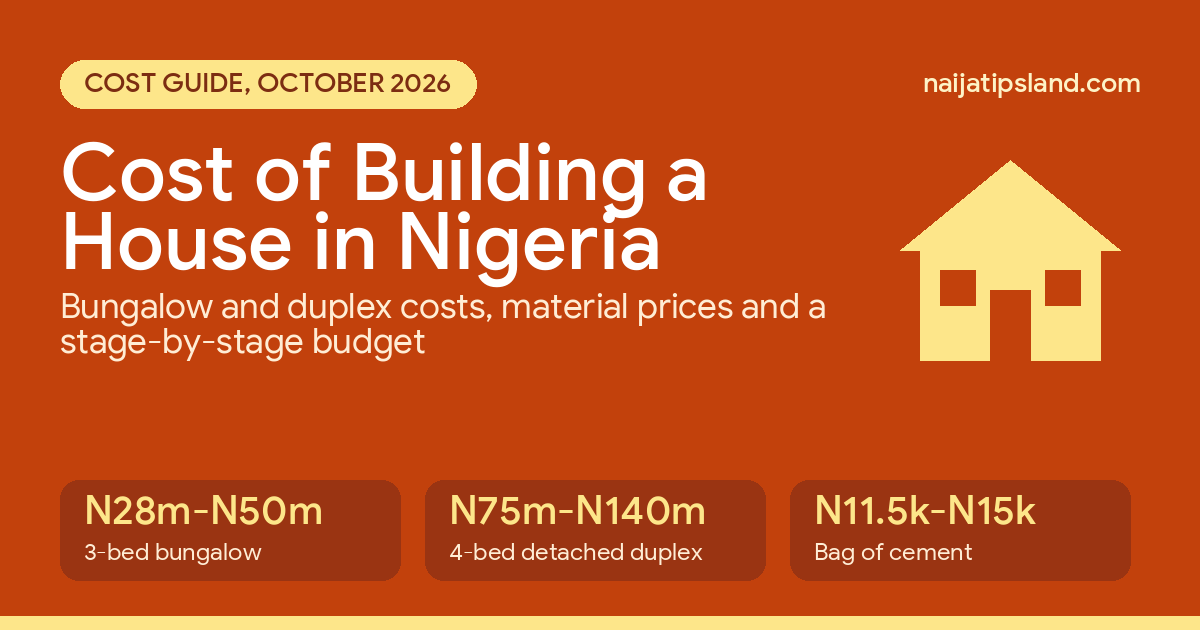
How much does it cost to build a house in Nigeria in 2026? A 3-bedroom bungalow now typically costs about ₦28 million to ₦50 million to build to a basic or mid-range finish, excluding land, and a 4-bedroom detached duplex about ₦75 million to ₦140 million. Costs have risen sharply since 2023 as cement, iron rods and roofing materials have climbed with inflation and the naira’s fall. A bag of cement that cost about ₦4,000 in early 2023 now costs ₦11,500 to ₦15,000.
This guide breaks down the current cost of building different house types, the prices of key building materials, how the budget splits across each stage of construction, and practical ways to build for less, whether you live in Nigeria or are building from abroad.
Last updated: 21 October 2026. Figures are indicative 2026 estimates from Nigerian construction-cost trackers, property guides and price surveys (see Sources). Costs vary widely by location, design, soil conditions and finish, so always get a bill of quantities from a quantity surveyor before you start.
Cost of building a house in Nigeria at a glance
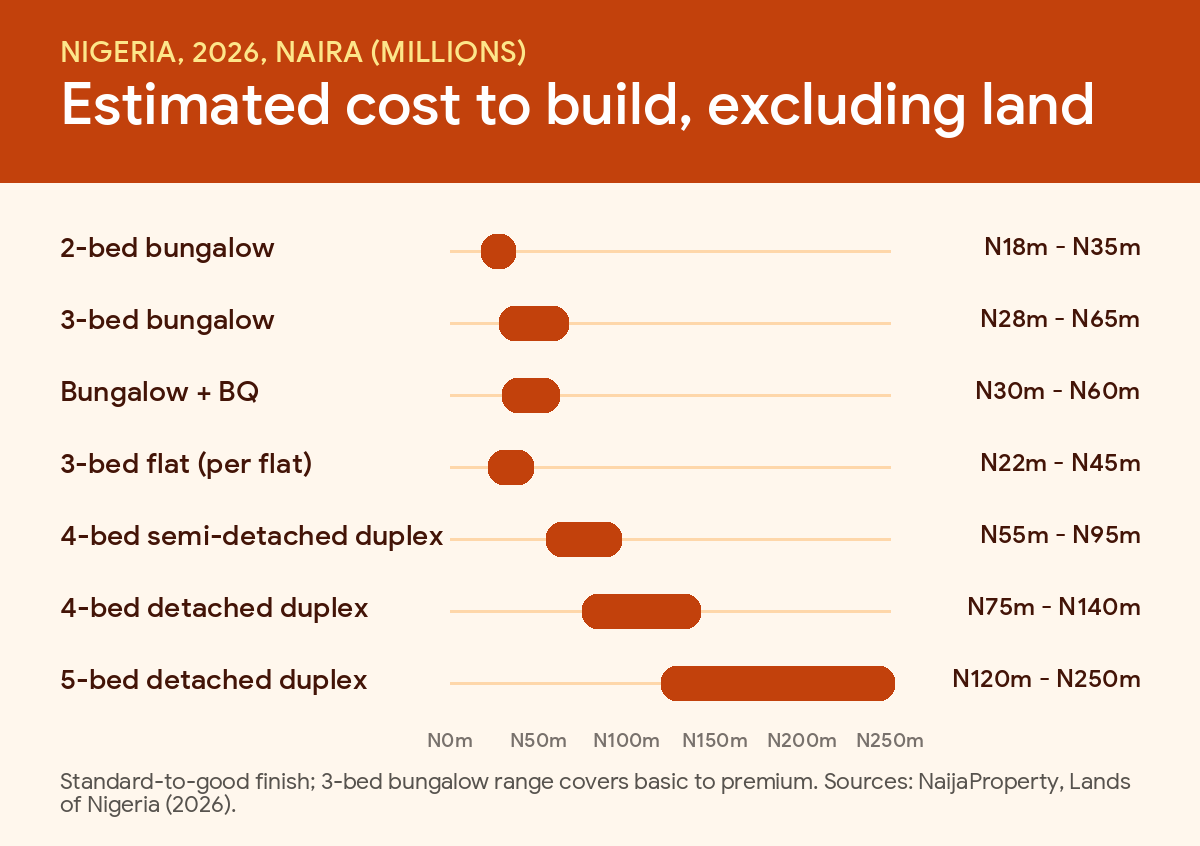
| House type | Estimated cost to build (excluding land) |
|---|---|
| 2-bedroom bungalow | ₦18 million to ₦35 million |
| 3-bedroom bungalow (basic finish) | ₦28 million to ₦38 million |
| 3-bedroom bungalow (mid-range finish) | ₦38 million to ₦50 million |
| 3-bedroom bungalow (premium finish) | ₦50 million to ₦65 million+ |
| Bungalow with boys’ quarters (BQ) | ₦30 million to ₦60 million |
| 3-bedroom flat in a block of flats (per flat) | ₦22 million to ₦45 million |
| 4-bedroom semi-detached duplex | ₦55 million to ₦95 million |
| 4-bedroom detached duplex | ₦75 million to ₦140 million |
| 5-bedroom detached duplex | ₦120 million to ₦250 million+ |
These are typical ranges for a standard-to-good finish. The same floor plan can cost half as much or twice as much depending on the finishes you choose, and building in Lagos, Abuja or Port Harcourt usually costs more than in Ibadan, Abeokuta, Ilorin, Enugu or smaller towns because of higher labour and haulage costs.
Prices of building materials in Nigeria (October 2026)
| Material | Unit | Typical price |
|---|---|---|
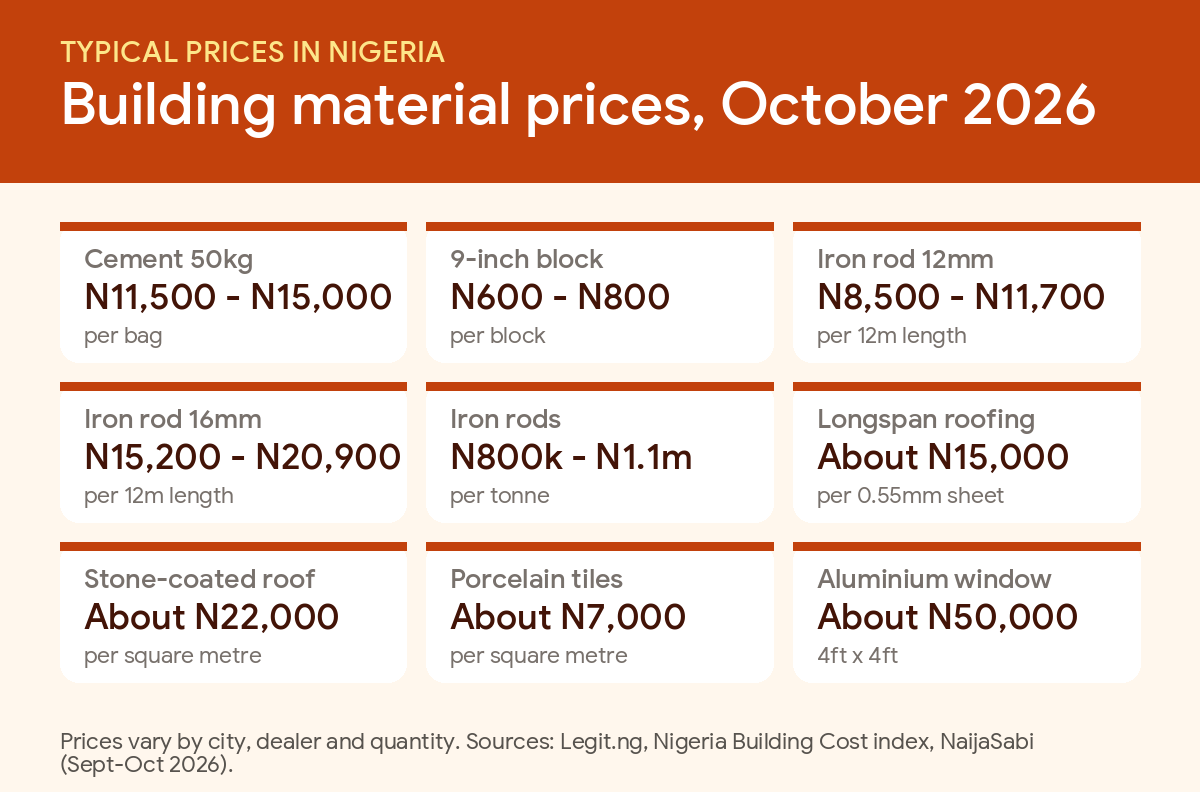
| Cement (Dangote, BUA, Lafarge), 50kg | Per bag | ₦11,500 to ₦15,000 |
| 9-inch hollow block | Per block | About ₦600 to ₦800 |
| 6-inch hollow block | Per block | About ₦450 to ₦600 |
| Iron rod 12mm | Per 12m length | ₦8,500 to ₦11,700 |
| Iron rod 16mm | Per 12m length | ₦15,200 to ₦20,900 |
| Iron rods (all sizes) | Per tonne | ₦800,000 to ₦1,100,000 |
| Aluminium longspan roofing, 0.55mm | Per sheet | About ₦15,000 |
| Stone-coated roofing tile | Per m² | About ₦22,000 |
| Ceramic floor tiles (supply) | Per m² | About ₦3,500 |
| Porcelain floor tiles | Per m² | About ₦7,000 |
| External door with frame | Per unit | About ₦80,000 |
| Aluminium window, 4ft x 4ft | Per unit | About ₦50,000 |
| Skilled carpenter | Per day | About ₦15,000 |
| Blockwork laying | Per m² | About ₦3,500 |
Cement prices vary by city. In September 2026, a 50kg bag cost about ₦11,500 to ₦13,550 in Lagos, ₦11,800 to ₦15,000 in Abuja, ₦12,800 to ₦14,000 at retail in Kano and ₦13,000 to ₦15,000 in Ibadan. The Federal Competition and Consumer Protection Commission (FCCPC) has been investigating pricing in the cement industry. Block, sand and granite prices also vary a lot between locations, mainly because of transport costs.
How the budget splits across each stage
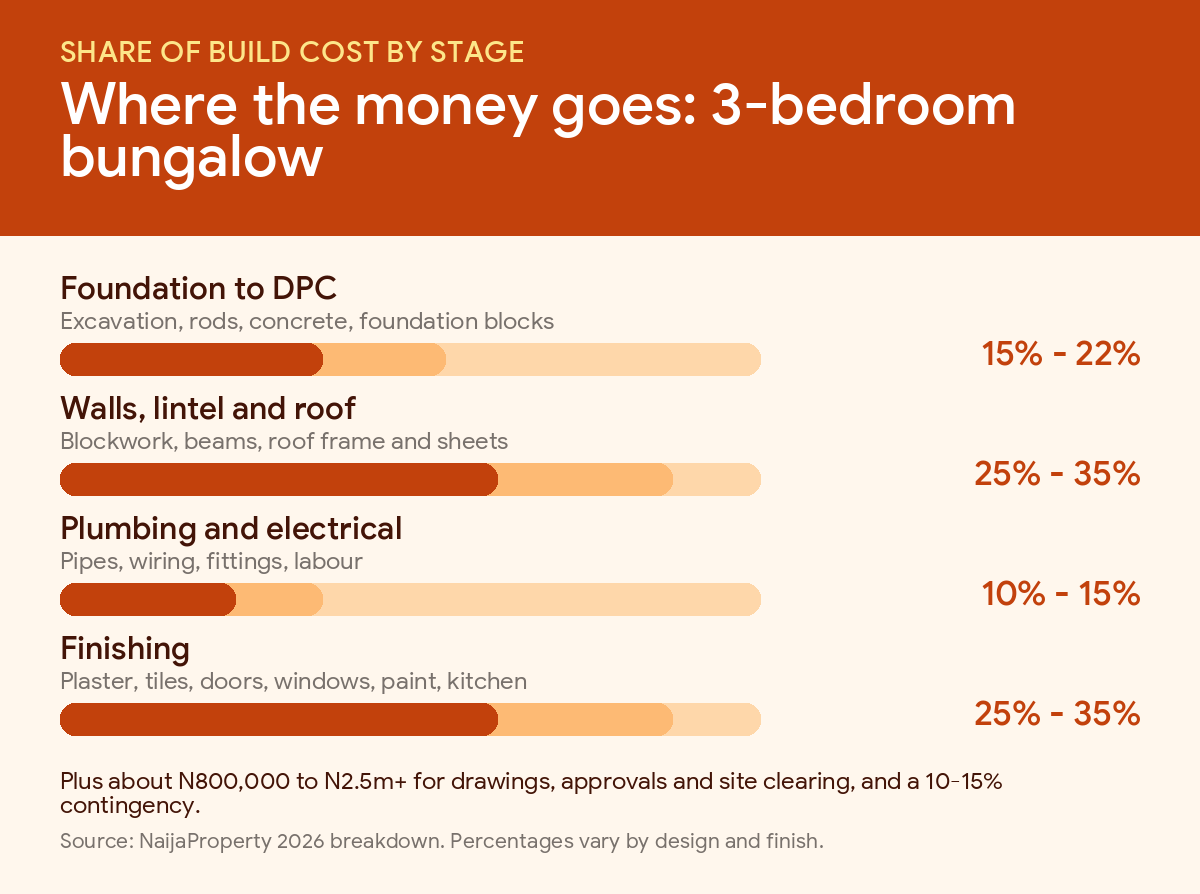
For a typical 3-bedroom bungalow (about 110 to 140 square metres), the cost divides roughly as follows:
| Stage | Share of build cost | On a ₦45m mid-range bungalow | What it includes |
|---|---|---|---|
| Pre-construction and approvals | ₦800,000 to ₦2.5m+ | About ₦1.5m | Architectural and structural drawings, survey, soil test, building approval, site clearing |
| Foundation to damp-proof course (DPC) | 15% to 22% | About ₦7m to ₦10m | Excavation, reinforcement, concrete, foundation blocks, backfilling, hardcore |
| Walls, lintel and roofing | 25% to 35% | About ₦11m to ₦16m | Blockwork, lintel and beams, roof timber or steel, roofing sheets |
| Plumbing and electrical | 10% to 15% | About ₦4.5m to ₦7m | Pipes, wiring, distribution board, sockets, switches, labour |
| Finishing | 25% to 35% | About ₦11m to ₦16m | Plastering, screeding, ceilings, tiles, doors, windows, painting, kitchen and bathroom fittings |
Finishing is where costs most often run over budget. Imported tiles, a fitted kitchen, aluminium windows, POP ceilings and quality sanitary ware can quickly add millions. Many Nigerians build in stages, finishing the shell first and then completing the interior as money becomes available.
Cost of building a 3-bedroom bungalow: an example
A 3-bedroom bungalow is the most popular first house in Nigeria. As a rough guide, a typical 3-bedroom bungalow needs:
- Cement: roughly 300 to 400 bags in total for foundation, blockwork, plastering and screeding (about ₦3.5 million to ₦6 million at current prices).
- Blocks: typically 2,500 to 3,500 blocks, mostly 9-inch for the foundation and external walls (about ₦1.8 million to ₦2.8 million).
- Iron rods: a few tonnes for the foundation, columns, lintel and beams, depending on the structural design (about ₦2 million to ₦4 million).
- Roofing: roof timber or steel plus longspan aluminium or stone-coated sheets (about ₦3 million to ₦8 million, depending on roof type and size).
These quantities are only illustrative. The real figures depend on the plan, ceiling height, soil and structural design. That is why a bill of quantities from a quantity surveyor is the most important document you can have before you start building. It lets you buy materials in the right amounts and spot an inflated quote from a contractor.
Bungalow or duplex?
- A bungalow is cheaper per square metre, simpler to build, needs a lighter foundation and suits larger plots. It is ideal for a first home and for older occupants.
- A duplex uses less land for the same floor space, which matters on small or expensive plots in Lagos and Abuja. But it needs a stronger foundation, columns, beams, a staircase and suspended floor slab, so it typically costs much more.
- A block of flats or a bungalow with a BQ can earn rental income. If you plan to rent out, see our guide to the mistakes first-time landlords make in Nigeria and our guide to rents in affordable Lagos areas.
Other costs to budget for
- Land: often the biggest cost of all. A plot can cost from a few million naira on the outskirts of smaller cities to hundreds of millions in prime Lagos and Abuja areas.
- Land documents: survey plan, deed of assignment, Governor’s consent or Certificate of Occupancy, and the related fees. Always verify the title at the land registry before buying.
- Building approval: most states require approved drawings and a building permit before construction. In Lagos, approvals are handled by the Lagos State Physical Planning Permit Authority (LASPPPA).
- Professional fees: architect, structural engineer, quantity surveyor and, ideally, a site supervisor or project manager.
- Fencing, gate, borehole and septic tank: these can add several million naira.
- Power: connection to the grid (and meter), plus a solar system or generator.
- Contingency: set aside at least 10% to 15% extra for price rises and surprises.
How to reduce the cost of building a house
- Keep the design simple. A rectangular plan with a simple gable or hip roof costs far less than complex shapes, many corners and fancy roofs.
- Get a bill of quantities and buy materials yourself in bulk where possible, rather than relying entirely on a contractor’s estimates.
- Mould blocks on site if you have space and supervision. It can be cheaper than buying ready-made blocks, but quality control matters.
- Buy materials when prices dip and store them safely. Cement prices often rise in the dry season, when building activity peaks.
- Consider local materials, such as compressed earth bricks or interlocking blocks, which can reduce cement and labour costs in suitable areas.
- Build in phases. Complete the structure and roof first, then finish rooms one by one.
- Supervise the site. Material theft and poor workmanship are among the biggest causes of cost overruns. If you are abroad, hire an independent supervisor and ask for regular photos and videos.
- Don’t cut corners on the structure. Save money on finishes, not on the foundation, columns, reinforcement or cement mix. Building collapses in Nigeria are often linked to substandard materials and poor supervision.
Building from abroad
Many Nigerians in the diaspora build at home. The biggest risks are relatives or contractors misusing funds and poor-quality work. To protect yourself, release money in stages linked to completed work, insist on receipts and dated photos or videos, hire an independent quantity surveyor or project manager, and open a dedicated account for the project. When sending money home, compare transfer costs. See our guide to the cheapest ways to send money between Nigeria and abroad.
Before you buy a plot: see how to buy land in Nigeria without getting scammed.
Frequently asked questions
How much does it cost to build a 3-bedroom bungalow in Nigeria in 2026?
About ₦28 million to ₦38 million for a basic finish, ₦38 million to ₦50 million for a mid-range finish and ₦50 million to ₦65 million or more for a premium finish, excluding land.
How much does it cost to build a duplex in Nigeria?
A 4-bedroom semi-detached duplex costs about ₦55 million to ₦95 million, and a 4-bedroom detached duplex about ₦75 million to ₦140 million, excluding land.
How much is a bag of cement in Nigeria now?
About ₦11,500 to ₦15,000 for a 50kg bag of Dangote, BUA or Lafarge cement, depending on the city and dealer.
How many bags of cement does a 3-bedroom bungalow need?
Roughly 300 to 400 bags in total, depending on the design and finishes. A quantity surveyor can give an exact figure for your plan.
Is it cheaper to build or buy a house in Nigeria?
Building is usually cheaper than buying a finished house in the same area, often by 20% or more, but it takes longer, needs close supervision and carries more risk.
Sources
- NaijaProperty: cost of building a 3-bedroom bungalow in Nigeria, 2026 breakdown (June 2026)
- Lands of Nigeria: 10 popular house designs and what they cost (September 2026)
- Nigeria Building Cost: building materials price index (October 2026)
- Legit.ng: cement prices in Lagos, Abuja, Kano and Ibadan (September 2026)
- NaijaSabi: iron rod prices in Nigeria 2026 (October 2026)
- Lagos.cool: cost of building in Lagos 2026