
Last updated: 13 October 2026. Wage figures change as states review pay, so confirm what applies to you with your employer or union.
Nigeria’s national minimum wage is ₦70,000 per month under the National Minimum Wage (Amendment) Act 2024. That floor covers federal, state, and private-sector employees with specific exemptions, and the law now requires a review every three years instead of five. If you’re an employee checking your payslip or an employer updating payroll, that’s the number and the rule to work from right now.
TL;DR:
- The ₦70,000 minimum wage applies to federal, state, and private-sector employees, but has coverage exemptions that have been reported to include part-time and seasonal work and some small employers, so check the Act for your situation.
- The law requires wage reviews every three years, making adjustments more frequent and reducing the chance of real income erosion.
- Employers paying below ₦70,000 face legal penalties, with increased scrutiny on misclassification and exemptions to avoid compliance.
- Inflation has offset some wage gains, with the real purchasing power of ₦70,000 being much lower than the nominal figure, especially for food and housing costs.
- Union pressure is mounting for higher wages, as inflation outpaces the current increase, and the three-year review cycle paves the way for future negotiations.
Table of Contents
- Minimum Wage Nigeria: Quick Facts You Need Right Now
- What the National Minimum Wage (Amendment) Act 2024 Actually Says
- Enforcement and Penalties: What Happens if You Underpay
- How Far Does ₦70,000 Actually Stretch?
- Employer Compliance Checklist for Payroll Teams
- Will Nigeria’s Minimum Wage Rise Again Soon?
- From ₦70,000 Gross to Take-Home Pay: A Worked Example
- How Nigeria’s Minimum Wage Got to ₦70,000
- Nigeria’s Minimum Wage Next to Its African Peers
- Does a Higher Minimum Wage Cost Jobs or Cut Poverty?
- Why Compliance Looks Different From Lagos to Rural Kebbi
- Is ₦70,000 Actually Enough? The Debate That Won’t Go Away
- What This Means for Nigerian Households and Small Businesses
- Sources
Minimum Wage Nigeria: Quick Facts You Need Right Now
Before you dig into the legal fine print, here’s the snapshot every worker and payroll officer should have handy.
- Current floor: ₦70,000 per month, effective from mid-2024 under the amended national minimum wage law.
- Who’s covered: federal government workers, most state government workers, local government staff, and private-sector employees, typically tied to an 8-hour day, 5-day workweek structure.
- Who’s exempt: part-time staff, small employers with fewer than 25 employees, seasonal workers, and crew on vessels or aircraft.
- Historical trend: Nigeria’s minimum wage averaged roughly ₦46,182 a month between 2018 and 2026, according to Trading Economics data. This puts the current ₦70,000 figure well above the multi-year mean.
Quick stat: The jump from the previous ₦30,000 wage to ₦70,000 represents more than a doubling in nominal terms, yet as later sections show, inflation has quietly clawed back a chunk of that gain.
Update, October 2026: What Has Changed
- The federal floor is still ₦70,000. The next statutory review is due in 2027 under the three-year cycle in the 2024 Act. The Federal Government signalled in June 2026 that a review is coming, but no new rate had been announced by early October.
- Labour is pressing now. On 7 October 2026 the Nigeria Labour Congress’s NEC and CWC gave the federal government a two-week ultimatum from 9 October to reduce petrol prices to the level at the time the 2024 minimum wage was signed, and demanded fresh wage talks. The ultimatum runs for two weeks from 9 October, so it expires around 23 October, and the union wants negotiations to start before the end of the month.
- Many states pay more. Reported figures include ₦104,000 in Imo, ₦90,000 in Ebonyi, ₦85,000 in Lagos and Rivers, and ₦80,000 in Niger, Enugu, Akwa Ibom, Bayelsa and Oyo, while several states remain at ₦70,000 and some have been slow to implement.
- Implementation gaps persist. In May 2026 the local government workers’ union said about 20 states had yet to fully implement the wage for local government staff and primary school teachers.
- In dollars, ₦70,000 is about USD 53 at the indicative rate of ₦1,331 per US dollar on 13 October 2026.
- Tax: reports say workers earning the minimum wage or less are exempt from personal income tax under the Nigeria Tax Act 2025.

What the National Minimum Wage (Amendment) Act 2024 Actually Says
The 2024 Act didn’t just raise the number. It restructured who qualifies and how often the figure gets revisited.
Coverage is broad by design: the law applies to federal, state, and private employers across Nigeria, regardless of sector. But the Act carves out specific exemptions that legal analysts flag as easy to misunderstand:
- Establishments with fewer than 25 employees are exempt from the statutory floor.
- Part-time and seasonal workers fall outside mandatory coverage.
- Workers on vessels or aircraft are excluded under maritime and aviation labor provisions.
- The Minister of Labour retains power to grant additional exemptions through gazette orders.
Perhaps the most consequential change is procedural rather than numerical. The Act shortened the mandatory wage-review cycle from five years to three, according to analysis from M.J Numa & Partners LLP. That shift matters because it forces both government and employers to budget for adjustments more frequently, rather than treating a wage hike as a once-a-decade shock. Readers who want the full statutory text should consult the official gazette or a labor law firm rather than relying on summaries alone, since exemption eligibility often hinges on specific documentation.
Enforcement and Penalties: What Happens if You Underpay
Paying below ₦70,000 isn’t a gray area. It’s a compliance failure with real legal exposure, and Nigerian labor authorities and courts have mechanisms to act on it.
Legal commentary on the amended Act outlines the practical risks employers face:
- Employers who pay below the statutory floor can face legal sanctions, including claims filed through labor courts.
- Misclassifying full-time staff as “part-time” or “seasonal” purely to dodge the wage floor is a common but legally risky shortcut, since enforcement analysis notes regulators and unions increasingly scrutinize these classifications.
- Disputes often escalate through union representation before reaching formal litigation, meaning early pushback from staff or the Nigeria Labour Congress can precede any court filing.
If you’re an employer unsure whether your workforce structure qualifies for an exemption, don’t guess. Verify with a labor lawyer or an HR consultant before you finalize payroll, since an incorrect assumption about the fewer-than-25-employee exemption can turn into a costly retroactive liability.
How Far Does ₦70,000 Actually Stretch?
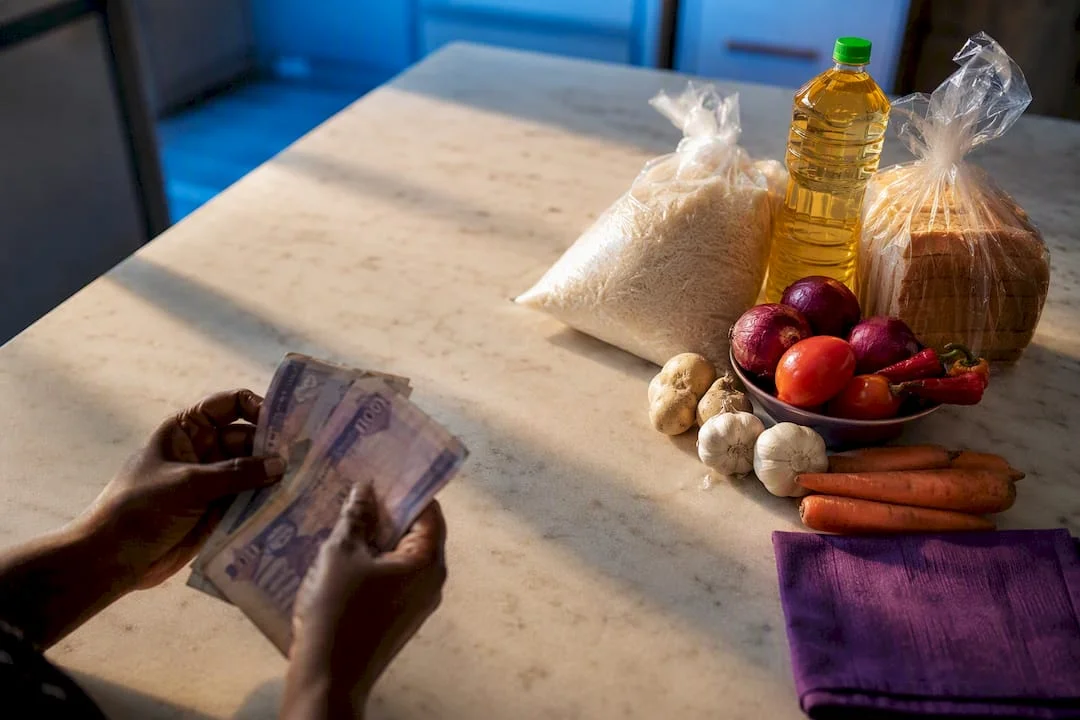
Here’s the uncomfortable part of the story. A ₦70,000 wage looks generous next to the old ₦30,000 floor, but inflation has been eating into that gain almost as fast as it arrived.
Nigeria’s consumer prices have climbed sharply in recent years, with World Bank inflation data showing sustained double-digit annual increases that hit food prices especially hard. Food inflation tends to outpace headline inflation in Nigeria, and since food eats up the largest share of a low-income household’s budget, that gap matters more than the topline number suggests.
Consider a typical urban household budget stretched across ₦70,000 a month:
- Rent (shared or single-room accommodation in a mid-tier area): often ₦15,000 to ₦25,000
- Transport to and from work: ₦8,000 to ₦15,000
- Food for a small family: frequently ₦30,000 or more, given persistent food price pressure
- Utilities, airtime, and miscellaneous costs: the remainder, often leaving little to nothing for savings
Stat callout: In dollar terms, ₦70,000 translates to roughly $51 a month at recent exchange rates, a figure Business Insider Africa cites as trailing well behind minimum wages in Kenya, South Africa, and Mauritius. Exchange rates move constantly, so treat that dollar figure as illustrative rather than fixed. For a fuller breakdown of what everyday costs look like across Nigeria, see Naijatipsland’s cost-of-living analysis.
Employer Compliance Checklist for Payroll Teams
If you run payroll or HR for a Nigerian business, don’t wait for a labor complaint to force your hand. Work through this sequence now.
- Update payroll software to reflect ₦70,000 as the statutory floor for every eligible employee.
- Recalculate gross pay for anyone currently below the threshold, including staff on graduated or step-based salary scales.
- Confirm exemption status in writing if you’re claiming the fewer-than-25-employee exception, part-time status, or seasonal classification.
- Post compliance notices where staff can see them, since transparency reduces disputes before they start.
- Keep dated records of every wage adjustment, contract update, and exemption determination for at least the current review cycle.
Pro Tip: Don’t rely on verbal confirmation for exemption status. Get a written determination from a labor consultant or legal counsel, because an unclear exemption claim discovered during an audit is far more expensive to fix retroactively than to verify upfront.
When in doubt, loop in HR consultants or a labor lawyer before a dispute reaches the Nigeria Labour Congress or a labor court. Reviewing your VAT and broader tax compliance obligations at the same time often catches overlapping payroll issues.
Will Nigeria’s Minimum Wage Rise Again Soon?
Union pressure hasn’t cooled since the ₦70,000 figure took effect. If anything, it’s building toward the next round of negotiations.
Nigeria Labour Congress leadership has publicly called the current wage a “poverty wage” and told workers to prepare for a fresh minimum wage battle, according to Pulse Nigeria’s reporting. The Trade Union Congress has echoed similar concerns about wages failing to keep pace with living costs. Notably, union framing has shifted from simply restoring purchasing power to demanding a genuine living wage, a higher bar than past negotiations.
A few things point toward negotiations reopening sooner rather than later:
- The three-year review cycle built into the 2024 Act creates a natural checkpoint for renegotiation.
- Persistent food and transport inflation keep public pressure on the government to act before the cycle technically requires it.
- Ongoing wage arrears disputes at state levels, like the ultimatums labor unions have issued over unpaid wages, keep the issue politically active between formal review periods.
Workers should follow union statements and state government announcements closely. Employers should model payroll budgets against multiple wage scenarios now, rather than waiting for a final number.
From ₦70,000 Gross to Take-Home Pay: A Worked Example
Exact deductions vary by employer, state, and pension arrangement, so treat this as an illustrative estimate rather than a payroll guarantee.
A worker earning the ₦70,000 floor, after typical pension contributions and minor statutory deductions, often takes home somewhere in the ₦60,000 to ₦65,000 range monthly, depending on the employer’s specific deduction structure. At a market exchange rate hovering around ₦1,331 per US dollar in mid-October 2026, that gross figure works out to roughly $53 monthly, consistent with the dollar comparisons cited earlier. Always check your specific payslip breakdown rather than assuming a flat deduction rate applies universally.
How Nigeria’s Minimum Wage Got to ₦70,000
Nigeria’s minimum wage has moved in long, slow steps rather than steady annual increases, which is part of why each adjustment feels like such a political event.
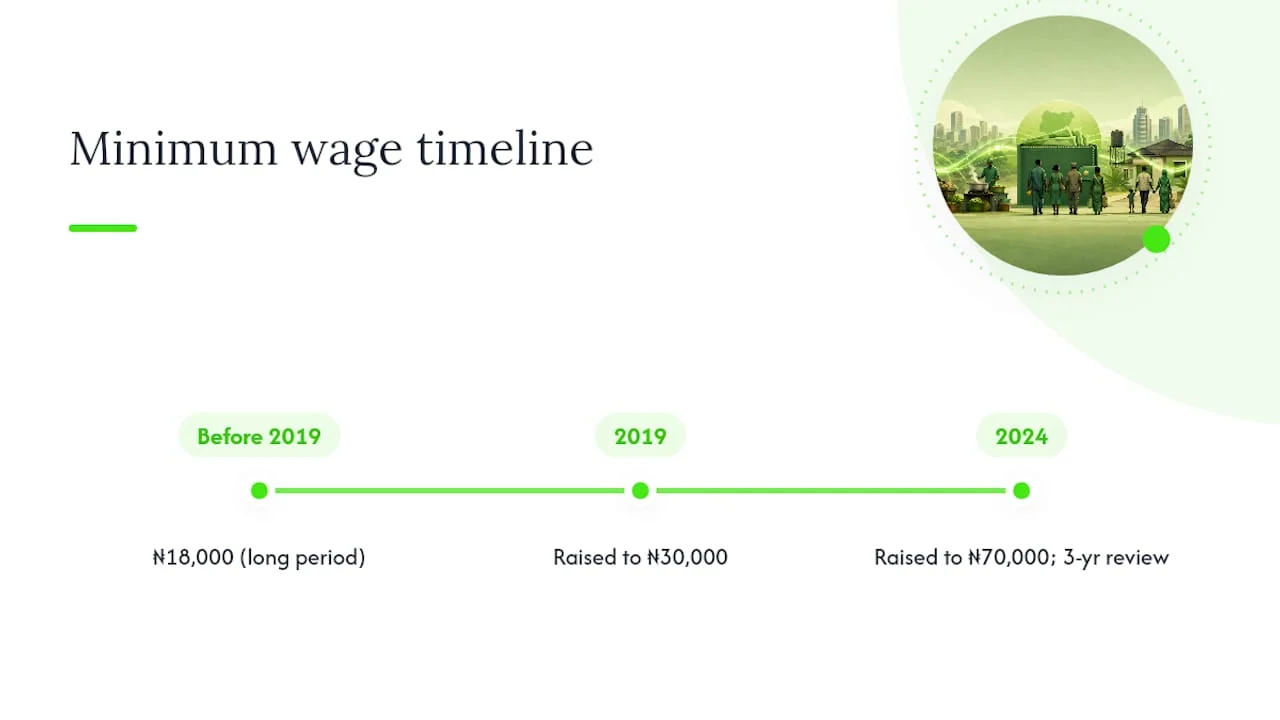
The wage sat at ₦18,000 for years before rising to ₦30,000 in 2019, a jump that itself followed years of union agitation and delayed implementation across several states. That ₦30,000 figure held through a period of sharp naira devaluation and rising fuel costs, which meant its real value eroded significantly by the time the 2024 amendment arrived. When the National Minimum Wage (Amendment) Act 2024 pushed the floor to ₦70,000, it represented more than a 130% nominal increase, the largest single jump in the wage’s history.
What makes this history relevant to 2026 is the pattern: Nigeria typically raises its minimum wage in large, infrequent jumps rather than small annual adjustments tied to inflation. That approach means workers often experience years of eroding real income between increases, followed by a headline-grabbing jump that partially, but rarely fully, restores lost purchasing power. The shift to a three-year review cycle is a direct response to that historical lag, an attempt to prevent the wage from falling as far behind inflation as it did between 2019 and 2024.
Nigeria’s Minimum Wage Next to Its African Peers
Measured in naira, ₦70,000 sounds substantial. Measured in dollars against comparable African economies, it tells a different story.
At roughly $51 a month, Nigeria’s minimum wage trails several regional peers by a wide margin, based on comparisons reported by Business Insider Africa. South Africa’s minimum wage, calculated hourly and converted to monthly equivalents for full-time work, generally lands well above that figure. Kenya’s statutory minimum wage, which varies by sector and location, also tends to exceed Nigeria’s dollar equivalent. Mauritius, one of the continent’s higher-wage economies, sets its floor even further ahead.
The gap isn’t purely about generosity or policy failure. Currency volatility plays an outsized role. Nigeria’s naira has depreciated sharply against the dollar in recent years, meaning even a large naira-denominated wage increase can look stagnant or worse when converted to dollars. That’s precisely why union voices now frame their demands partly in dollar terms, pointing to a target near $365 a month as a benchmark for what a genuine living wage would look like regionally. Whether that number becomes a formal negotiating position remains to be seen, but it signals how far apart current pay and union aspirations sit.
Does a Higher Minimum Wage Cost Jobs or Cut Poverty?
Economists disagree on how much a minimum wage hike helps versus hurts, and Nigeria’s 2024 increase gives both sides fresh evidence to argue with.
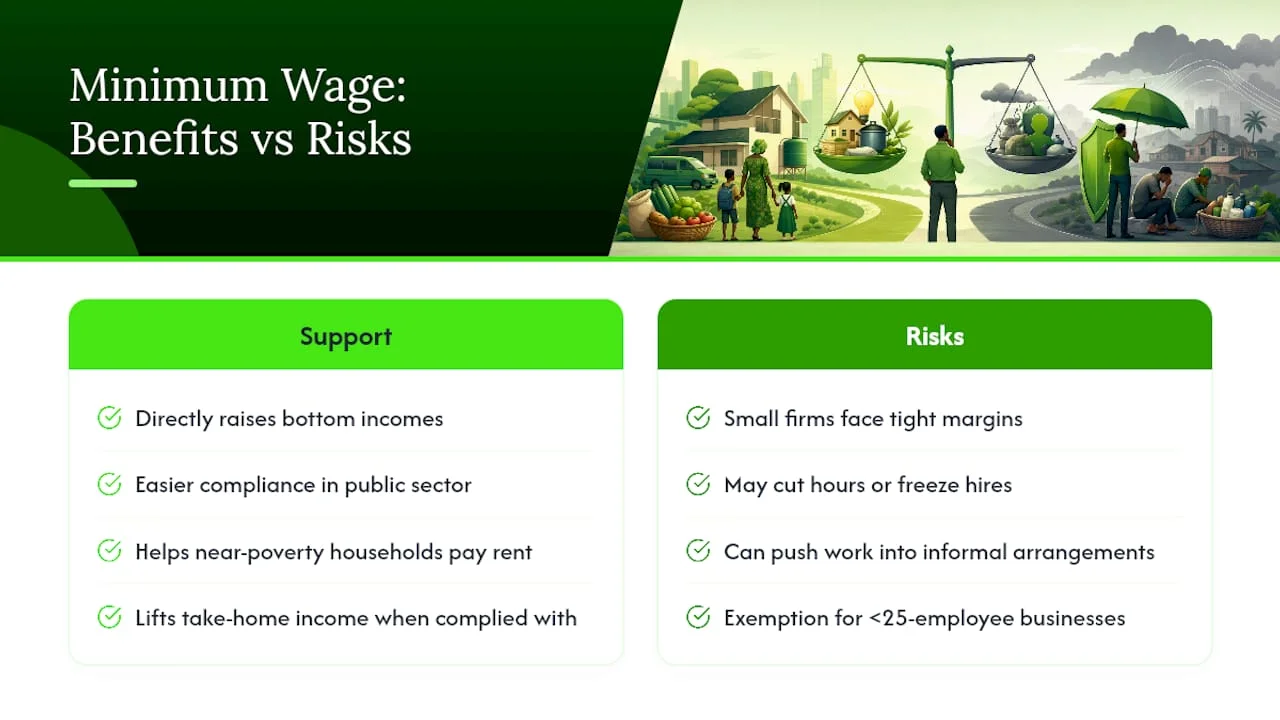
The case for the wage hike centers on poverty reduction. Lifting the floor from ₦30,000 to ₦70,000 directly raises income for workers at the bottom of the pay scale, particularly in public-sector roles where compliance is easier to enforce. For households living close to the poverty line, that additional income can mean the difference between covering rent or falling behind.
The case for caution centers on employment effects, especially in the informal and small-business sector. Employers with tight margins, particularly small retailers, artisans, and service businesses, may respond to a higher mandatory wage by cutting staff hours, freezing new hires, or shifting workers into informal arrangements that sit outside the law’s reach entirely. The Act’s own exemption for businesses under 25 employees acknowledges this risk, effectively shielding much of Nigeria’s small-business sector from the full mandate.
The honest picture sits somewhere in between. Public-sector and larger private employers can generally absorb the increase, and evidence suggests it does lift take-home income for compliant workers. But enforcement gaps mean the poorest workers, often in informal jobs, may see little direct benefit while still facing the inflationary pressure that a higher wage was partly designed to offset.
Why Compliance Looks Different From Lagos to Rural Kebbi
A national minimum wage law reads the same everywhere on paper. Enforcement on the ground is a different story entirely.
Urban commercial hubs like Lagos, Abuja, and Port Harcourt tend to see faster, more visible compliance, partly because larger employers there face more union presence, media scrutiny, and formal labor inspections. State governments in wealthier states have also generally moved faster to implement the wage for their own civil servants, since larger tax bases make the fiscal adjustment easier to absorb.
Rural states and those with weaker state revenue face a tougher path. Several state governments have historically lagged in implementing federal minimum wage increases for their own workers, citing budget constraints, which is part of why wage arrears disputes keep surfacing in labor news. Informal-sector enforcement is thinner almost everywhere, since labor inspectors have limited reach into small shops, family businesses, and agricultural employment that make up a large share of actual Nigerian jobs. The practical result: a worker’s real protection under the ₦70,000 floor depends heavily on which state they’re in, what sector they work in, and how large their employer is.
Is ₦70,000 Actually Enough? The Debate That Won’t Go Away
Ask a government official and a union leader the same question, “Is the current minimum wage adequate?”, and you’ll get two very different answers, both grounded in real data.
Government officials point to the sheer size of the 2024 increase, more than doubling the previous floor, as evidence of serious commitment to worker welfare. From that vantage point, the three-year review cycle itself is proof the system is built to adapt faster than before, rather than leaving workers stuck with a stale number for a decade.
Labor unions counter that the increase was effectively priced in before it even applied, since inflation over the preceding years had already eroded the value of the old ₦30,000 wage far below its real 2019 purchasing power. The Nigeria Labour Congress’s “poverty wage” framing isn’t rhetorical flourish. It reflects union leadership’s shift toward demanding a dignity or living wage benchmark, not just a number that keeps pace with the old baseline. Independent economic analysts tend to land closer to the union’s position, noting that food inflation specifically has outpaced headline inflation in several recent periods, hitting low-income households hardest regardless of the nominal wage figure. Expect this debate to intensify as the three-year review point approaches.
What This Means for Nigerian Households and Small Businesses
For the average Nigerian family, ₦70,000 is welcome relief on paper but thin protection against the cost of food, transport, and rent that keeps climbing regardless of legislation. For small business owners, the exemption threshold offers breathing room, but only if you understand exactly where your business sits under the law.
The article covers the cost-of-living squeeze alongside wage policy because the two are inseparable for many Nigerian readers. If you’re tracking how far your pay stretches month to month, our ongoing coverage of food and living costs gives useful context beyond the headline wage figure. Share your own experience in the comments, whether you’re a worker navigating a tight budget or an employer figuring out compliance. Real accounts from readers often surface details official reports miss. For readers who want to stay close to how these policy shifts ripple into everyday reporting, keep following Naijatipsland’s ongoing coverage projects tracking urban economic issues.
— Naijatipsland
Sources
- Tinubu signs N70,000 new minimum wage bill into law – Businessday NG
- Nigeria National Minimum Wage – TradingEconomics
- Inflation, consumer prices (annual %) – Nigeria | World Bank
This article is general information, not a substitute for advice from a qualified financial advisor. Consult a qualified financial professional about your own circumstances before acting on anything here.
Recommended
- Nigeria’s Cost Of Living In 2026: What You’ll Actually Spend
- Poverty In Nigeria 2026: What The Data Really Shows
- How To Earn Online Nigeria: Step-by-Step Guide For 2026
Sources for the October 2026 Update
- Nairametrics: NLC gives FG two-week ultimatum to reduce petrol prices, renegotiate minimum wage
- ThisDay: Fuel price, FG offers 30-day discount at NNPC stations
- Tribune: NLC pushes fresh wage review as N70,000 implementation crisis worsens
- WithinNigeria: Which Nigerian states pay above N70,000 minimum wage in 2026
- Betternship: Minimum wage in Nigeria 2026