
How to Start Fish Farming in Nigeria With Low Capital (2026): Costs, Feed Prices, Tanks and a 500-Fish Example

Last updated: 5 November 2026 · By Naijatipsland Editorial Team · Editorial policy
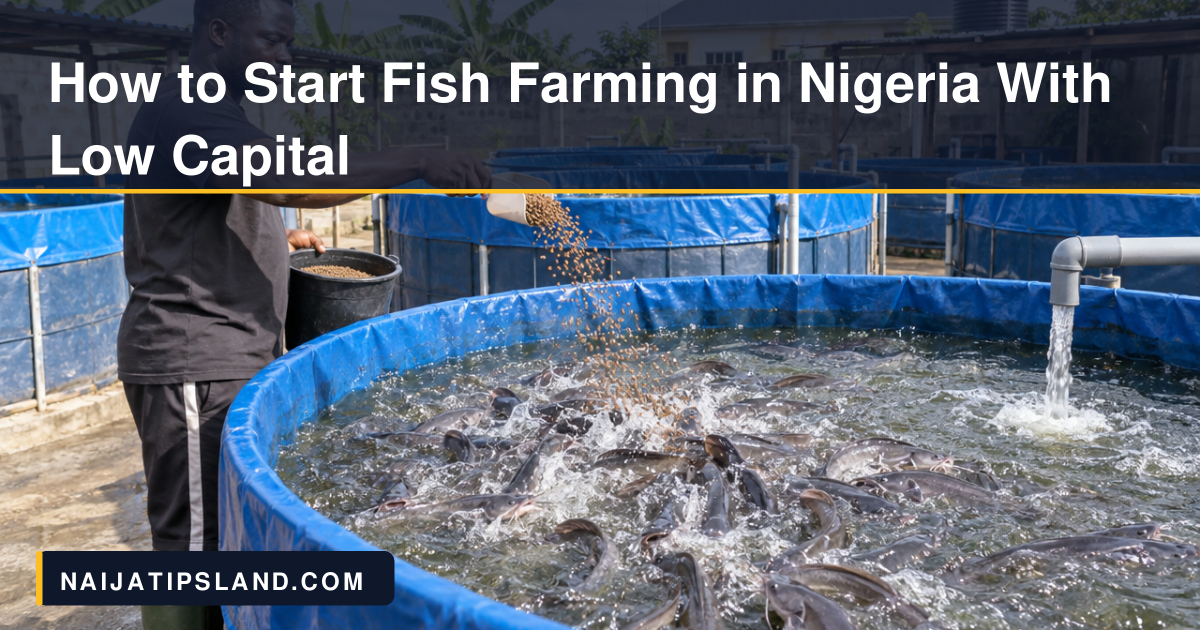
Fish farming, and catfish farming in particular, is one of the few agribusinesses a Nigerian can begin on a small plot, in a backyard or even in a compound with a few tarpaulin tanks. Demand is steady, because Nigeria produces roughly 1.2 million tonnes of fish a year but needs about 3.6 million, according to figures cited in a 2026 industry review. But “low capital” does not mean “no risk”. Feed is the cost that kills most small farms, and a bad batch of fingerlings or poor water can wipe out a cycle. This guide walks you through starting fish farming in Nigeria with low capital in 2026, with current prices, a worked 500-fish example and the mistakes to avoid.
How to read the numbers: prices below come from dated 2026 price pages and farm guides (May to August 2026). They are indicative, vary by state and supplier, and sources sometimes disagree, which I point out where it matters. The worked example is my own arithmetic from those inputs, not a guaranteed result. Get live quotes from at least three suppliers before you spend.
How much do you really need to start?
The honest answer is a range. Farm guides published in 2026 put the first-cycle cost of a small 500-fish catfish setup anywhere from about N500,000 to N900,000 on lean assumptions, while a BusinessDay report cited around N1.2 million in operating cost for a 500-fish cycle. The gap comes mostly from feed choice and whether you already have land and water. If you already have space and a borehole or clean water, you can stay at the lower end. If you must rent land, dig a borehole and buy premium imported feed, expect the higher figure.
Step 1: Choose your fish and your system
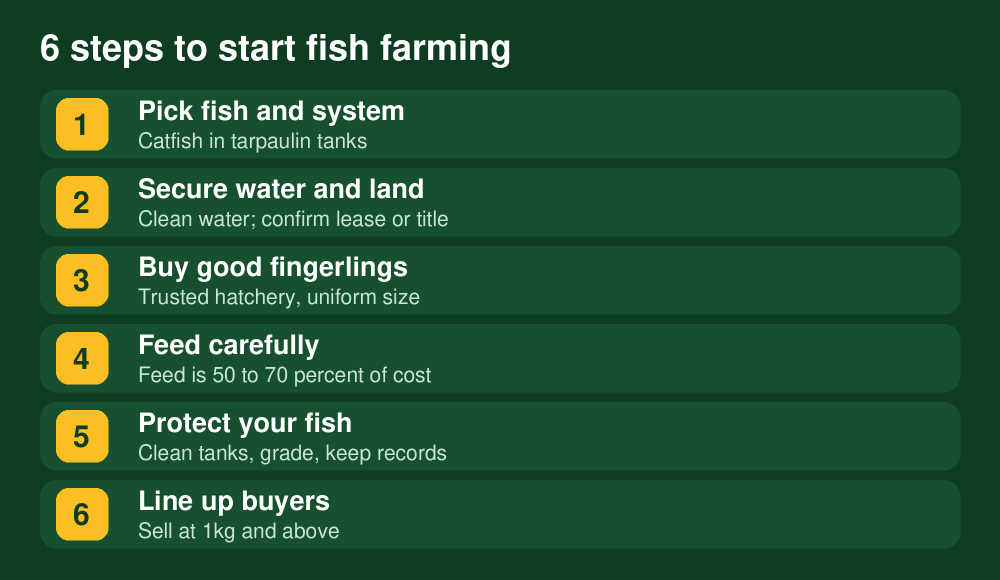
Most beginners choose African catfish (Clarias) because it tolerates crowded, low-oxygen conditions, grows to market size in roughly 4 to 6 months, and sells well in Lagos, Abuja and across the south. Tilapia is the main alternative: it is cheaper per kilogram (retail about N1,770 to N2,656/kg versus N2,647 to N4,412/kg for catfish in Lagos and Abuja), but it has a lower price and usually needs a bit more care with breeding and temperature. For a first farm, catfish in tanks is the simplest route.
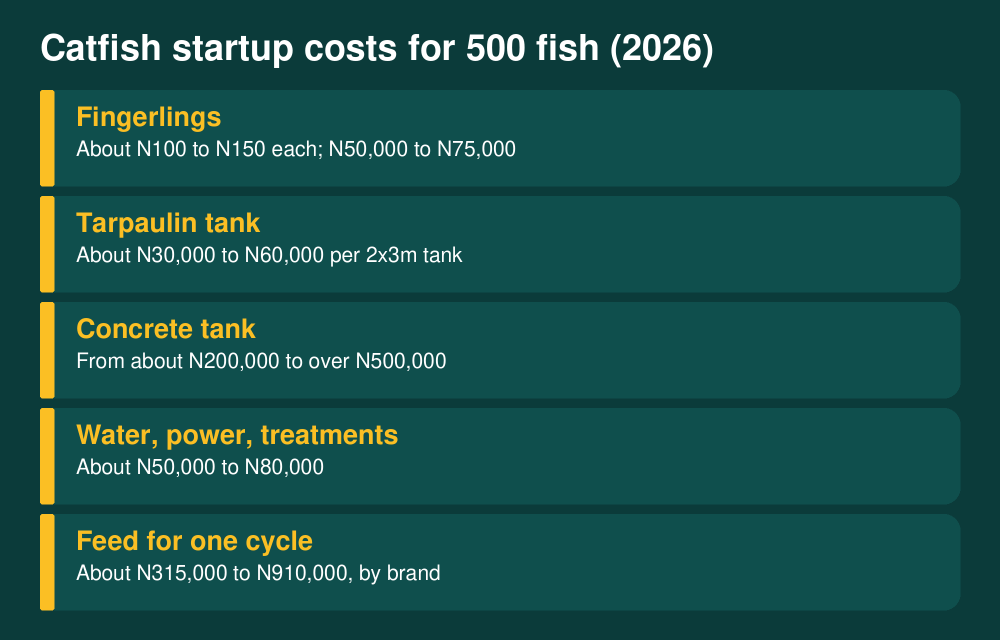
For your system you have three realistic options. Tarpaulin or plastic tanks are the cheapest and easiest to set up; a 2 by 3 metre or 1,000-litre tarpaulin pond was priced at roughly N30,000 to N60,000 in a May 2026 guide. Concrete tanks last longer but cost from about N200,000 to over N500,000 depending on size and number. Earthen ponds need land, digging and good soil but can be cheaper at scale. For low capital, start with two or three tarpaulin tanks and expand from profits.
Step 2: Get water, location and basic permissions right
Fish need clean water with a pH of about 6.5 to 8.5, temperature of roughly 25 to 30 degrees Celsius and dissolved oxygen of at least 4 to 5 mg/L. A borehole is ideal; river or stream water needs testing. Plan to change about 20 to 30 percent of the water every three to five days in an intensive tank system, and test at least weekly.
On land and permits: I could not find a single national licence that applies to every small fish farm, and requirements vary by state and local government. Before you invest, confirm ownership or a written lease of the plot (our guide to verifying land ownership in Lagos State shows the checks to make), and ask your state ministry of agriculture or fisheries office whether registration is needed. Joining a local fish farmers’ association also helps with buyers and training.
Step 3: Buy quality fingerlings
Poor fingerlings are the number one cause of failed first cycles. Buy from a reputable hatchery that can show healthy, uniform juveniles and ask for a trial batch. A May 2026 guide put fingerlings at about N100 to N150 each in a 500-fish example, so N50,000 to N75,000 for the batch; another August 2026 guide gave N50,000 to N120,000. Avoid the cheapest unknown seller: stunted, mixed-size fish waste feed and sell badly.
Stocking density: a common guide is 50 to 70 fingerlings per cubic metre under standard management, and 100 or more only with strong aeration and water exchange. Overstocking is a classic mistake that triggers disease and mass deaths.
Step 4: Feed smartly, because feed is the business
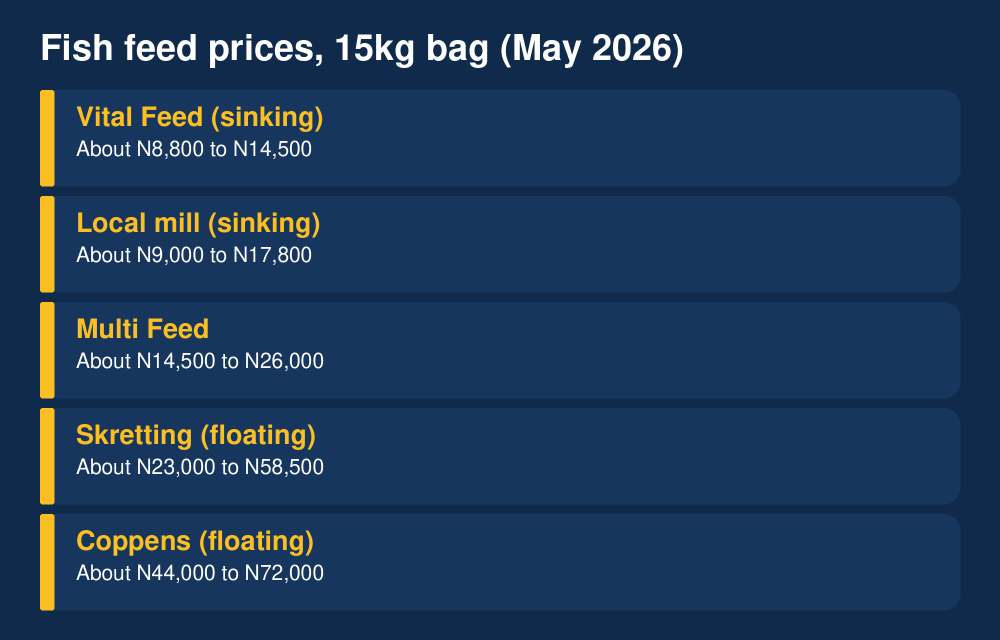
Feed typically accounts for 50 to 70 percent of operating cost. The price range is wide. A 3 May 2026 price survey of 15kg bags listed local mill sinking feed at roughly N9,000 to N17,800, Vital Feed sinking at about N8,800 to N14,500, Multi Feed at N14,500 to N26,000, Skretting floating from about N23,000 for 2mm pellets up to N58,500 for larger sizes, and Coppens from N44,000 to N72,000. Imported floating feed usually gives a better feed conversion ratio (about 1.1 to 1.3, against 1.4 to 1.6 for some local sinking feeds), so the cheapest bag is not always the cheapest per kilogram of fish. Buying in bulk from depots can cut premium prices by about 5 to 10 percent.
Feed two to three times a day, only what the fish finish in 10 to 15 minutes, and stop feeding 24 hours before harvest. Use higher-protein starter feed (about 45 to 50 percent) for small fish, then 32 to 45 percent grower feed.
A worked example: 500 catfish in tanks
Here is a simple illustration, using the figures above. Assume you stock 500 fingerlings, 80 percent survive (400 fish), they average 1kg at harvest after about 5 months, and you sell at about N3,000/kg, a working farm-gate average cited for early 2026. Revenue is about 400kg × N3,000 = N1.2 million.
- Fingerlings: N50,000 to N75,000
- Tanks: N60,000 to N180,000 (two to three tarpaulin tanks)
- Feed: with a feed conversion ratio of 1.3, producing 400kg of fish needs about 520kg of feed, roughly 35 bags of 15kg. At N9,000 per bag that is about N315,000; at N14,500 about N507,000; at N26,000 about N910,000. (My calculation.)
- Water, power and treatments: about N50,000 to N80,000
Total cost therefore runs from roughly N475,000 on cheap local feed to well over N1 million on premium feed. Profit could be anywhere from a loss to around N700,000 per cycle, which is in line with published estimates of N400,000 to N700,000 for a 500-fish cycle and a 2024 Ogun State study that reported net farm income of about N718,754 on a N3 million investment. If survival falls to 60 percent or feed costs jump, profit shrinks fast.
Step 5: Protect your fish and manage disease
A 2025 study cited in a 2026 guide found that more than half of Nigerian catfish farmers reported a disease outbreak in their last cycle. Keep tanks clean, remove dead fish daily, sort (grade) fish by size every few weeks to limit cannibalism, and keep a record of feed, deaths and treatments. Call a fisheries extension officer or vet early instead of guessing with drugs.
Step 6: Plan your market before you stock
Do not stock fish without buyers. Table-size catfish of 1kg and above sells best; pepper-soup buyers want 0.8 to 1.5kg. Line up restaurants, hotels, fish sellers, event caterers and neighbours. Selling live, delivered fish can earn a premium of roughly 15 to 25 percent. Smoked and packaged catfish is another route, especially for diaspora demand. Stagger two or three batches a few weeks apart so you have regular income instead of one big harvest.
Common mistakes to avoid
- Buying cheap fingerlings from unknown sources.
- Overstocking tanks beyond what your water and aeration can support.
- Ignoring water quality until fish start dying.
- Underfeeding or using poor feed and then wondering why growth is slow.
- Treating the farm as a casual side activity with no daily care or records.
- Not having buyers lined up before harvest day.
- Relying on one income source. Start small and keep your job or other income while you learn.
Fish farming is one of several routes into agribusiness. See our guide to poultry farming in Nigeria, our list of profitable businesses you can start from home, and the Start a Business in Nigeria hub for registration, tax and growth tips.
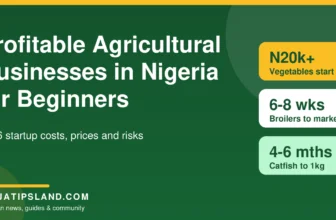
Related guide (updated 5 November 2026): Profitable Agricultural Businesses in Nigeria for Beginners (2026) — startup costs, current prices and risks for poultry, fish, crops and processing.
Frequently asked questions
How much does it cost to start catfish farming in Nigeria?
For 500 fish in tanks, 2026 guides suggest roughly N500,000 to N900,000 on lean assumptions, with some sources citing about N1.2 million. Costs depend mainly on feed, tank type and whether you already have land and water.
Can I start fish farming with N100,000?
Not at a commercial scale for catfish. With around N100,000 you could do a very small trial of perhaps 50 to 100 fish in one tarpaulin tank to learn, but expect small returns. Smoking and selling fish, or starting a snail or vegetable plot, may be safer first steps.
How long before catfish are ready to sell?
Clarias catfish typically reach about 1kg in 4 to 6 months with good feed and water; some systems take 7 to 8 months.
Is fish farming profitable in Nigeria?
It can be, but margins are tight because feed costs are high. Published examples show profits of several hundred thousand naira per cycle for 500 to 1,000 fish when survival is good and prices hold, and losses when feed or mortality get out of control.
Which fish is best for beginners: catfish or tilapia?
Catfish is more forgiving of crowded conditions and sells at a higher price per kilogram. Tilapia is cheaper to sell and usually grows more slowly in basic systems unless you use improved strains.
Do I need a licence to start a fish farm?
Rules vary by state and by size of operation, and I could not confirm a single national licence for small farms. Check with your state ministry of agriculture or fisheries, and confirm land ownership or lease terms before you invest.
Disclaimer: prices and returns are indicative, based on dated third-party guides and price lists (May to August 2026), and are not guarantees. Get local quotes and professional advice before investing.
Join the discussion
Have you tried this, or do you have a question we did not answer? 1 reader has already shared their view. Naijatipsland members help each other with real, first-hand experience.








Ade here. Fish farming looks simple from the outside, but feed cost and water quality decide whether you make money or lose it. My advice is to start with two or three tanks, keep records from day one, and line up buyers before you stock. If you already farm fish, tell us in the comments what your feed cost and survival rate looked like so other beginners can learn from it. Prices here were checked in May to August 2026 and will move, so get live quotes. – Ade Adeniyi