Last updated: 16 October 2026 · By Naijatipsland Editorial Team · Editorial policy
Poultry is one of the first businesses many Nigerians think of when they want to start farming: chickens grow fast, eggs and meat sell every day, and you can begin on a small scale. But the last two years have been hard on poultry farmers. Feed prices rose sharply, day-old chicks became expensive and hard to book, and disease outbreaks hit flocks in several states. The farmers who survive treat poultry as a business with a budget, a vaccination plan and a cash reserve, not as a quick way to get rich. This guide explains the main types of poultry farming, what it costs to start, where feed and chick prices stand, the disease risks, and how to plan before you spend.
Poultry costs in Nigeria change quickly and vary by state, supplier and season. The cost guides we found are estimates with no sources, and some come from companies selling other products, so we flag them and show the ranges with their dates. News reports and trade-association statements give firmer anchors. Always get current quotes from local suppliers and talk to a veterinarian before you build or buy birds. This is general information, not financial or veterinary advice.
The short answer
- Feed is the biggest cost. The Poultry Association of Nigeria said in February 2026 that feed makes up 65 to 70 percent of farmers’ input costs.
- Broilers are meat birds with a short cycle of about six to eight weeks, but their margins have been squeezed by feed costs. Layers are egg birds that cost money for months before they produce, then earn daily.
- Budget estimates differ widely. One 2026 guide puts a 500-bird broiler setup at roughly N1.3 million to N2.5 million, and a 1,000-bird setup at about N2.5 million to N4.3 million, while a micro flock of 50 to 100 birds is estimated at N350,000 to N750,000. These are unsourced.
- Disease can wipe out a flock. Newcastle disease can cause very high mortality in unvaccinated birds, and bird flu outbreaks were recorded in several northern states in 2026.
- Start small, learn, then scale. Keep a cash reserve for feed, vaccines and slow sales.
Broilers or layers?

Broilers
Broilers are raised for meat and are usually ready in about six to eight weeks, so you can run several cycles a year. That fast turnover is attractive, but it also means you buy chicks and feed again each cycle, and you depend on a good selling price at the end of it. A July 2026 Pluboard report says many farmers are shifting from broilers to layers because feed costs rose while consumers struggled to afford whole chickens. Reported live broiler prices in a Lagos price guide in August 2026 were N15,000 to N27,000 per bird, a wide range that depends on size and market.
Layers
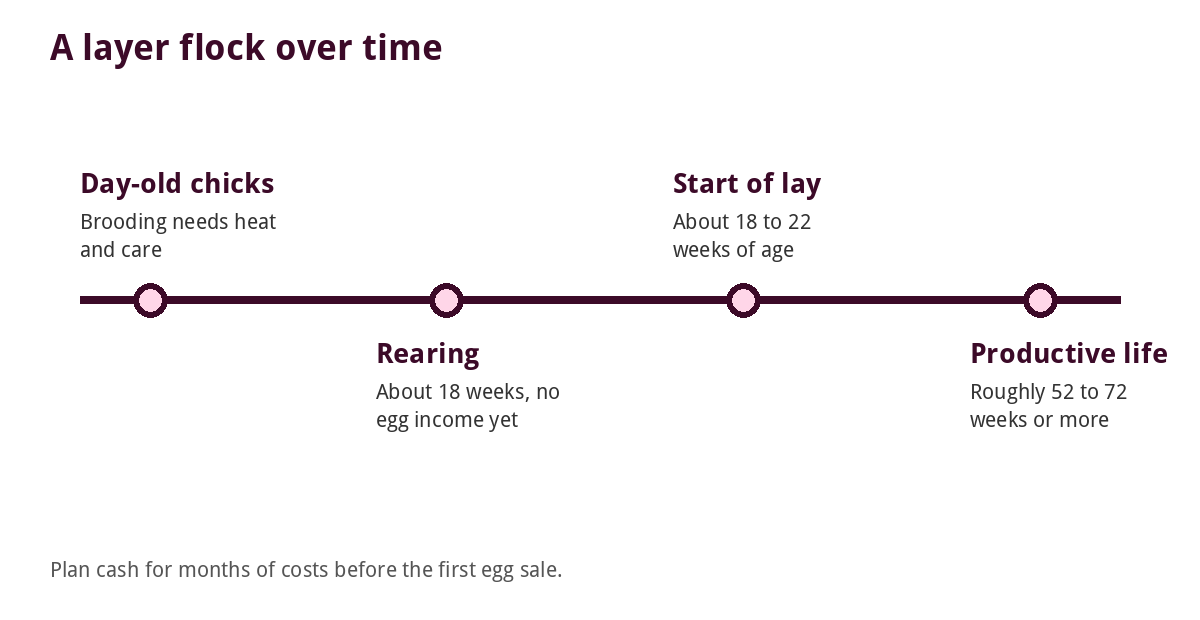
Layers are raised for eggs. The same Pluboard report describes about 18 weeks of rearing before they begin to lay, with 250 to 300 eggs per bird per year and a productive life of roughly 52 to 72 weeks or more. That means several months of costs with no egg income, so you need more starting capital or a bigger cash reserve. When they stop laying, the spent layers are sold for meat, and a Lagos guide in August 2026 listed cleaned old layers at N10,000 to N15,000.
Other options
Some guides also describe cockerels, noilers and kuroilers (dual-purpose or hardy birds). These are cheaper as chicks but have different growth and selling patterns, so ask experienced local farmers before choosing them.
How much does it cost to start?
There is no single number. One March 2026 guide from a software company gives planning ranges for broilers, and says they are benchmarks and not final budgets:
| Broiler flock | Estimated first-cycle budget |
|---|---|
| 500 birds | about N1.3 million to N2.5 million |
| 1,000 birds | about N2.5 million to N4.3 million |
| 2,000 birds | about N4.7 million to N8.1 million |
Those totals include housing, equipment, chicks, first-cycle feed, medication, labour, utilities, insurance and a 10 percent working-capital buffer. The same guide mentions N700,000 to N1.2 million for a 500-layer setup, but it does not break that figure down and it appears to leave out the months of feed before the first egg. A May 2026 Legit.ng guide, with figures attributed partly to other sites, estimates N350,000 to N750,000 for a micro flock of 50 to 100 birds and N3.5 million to N9 million for 500 to 1,000 birds.
The numbers disagree because they assume different housing, equipment, bird prices and feed prices. Use them only to see the shape of the costs, then build your own budget from local quotes:
- Land and housing. Buy or lease land away from crowded residential areas. A wood-and-mesh house for 500 birds is estimated at about N1.5 million in one guide, with automated cage systems costing much more.
- Equipment. Feeders, drinkers, brooders or heat sources, lighting, water storage and, for layers, nest boxes or cages.
- Birds. Day-old chicks or point-of-lay pullets. See prices below.
- Feed. The largest running cost.
- Vaccines and medication. Budget for a vaccination programme set by a vet.
- Labour, power and water. Including backup power for brooding.
- Biosecurity fittings. Foot baths, fencing, mesh and gates.
- Working capital. Cash for the first months, including slow sales and price swings.
Feed and chick prices: what has been reported
Prices have moved a lot, so check what suppliers quote today. Reported figures from 2026:
- February 2026 (Poultry Association of Nigeria, via The Guardian): layer feed at N15,000 to N17,000 per 25 kg bag and broiler feed at N20,000 to N22,000. Broiler day-old chicks had risen from N500 in December 2023 to N1,700, and pullet chicks cost N2,000 to N2,200. Maize and soya prices had fallen, but finished feed prices had not.
- Early 2026 (software-company guide): broiler chicks at N550 to N900 and broiler feed at N9,000 to N14,000 per bag. These are lower than the association’s figures, and the guide gives no source.
- January to March 2026 (BusinessDay, via Pluboard): day-old pullets rising from about N1,800 to about N3,000. Chick orders placed in late 2025 were reportedly still waiting in 2026, and an association leader estimated about a year to rebuild parent stock.
The wide gaps show why you should not copy a single price from the internet. Get quotes from at least three hatcheries and feed suppliers, ask for the date and the brand, and check whether you must book chicks weeks ahead. Feed and input prices are also affected by the exchange rate and the wider economy. See our guides on the dollar to naira rate and the Nigerian economy.
Disease: the risk that can end the business
Two diseases dominate the news:
- Newcastle disease. In August 2026 the federal livestock ministry inaugurated a national technical working group to develop a first national strategic plan, describing the disease as one of the most devastating poultry diseases in Nigeria. Reports say mortality can reach 100 percent within days in unvaccinated flocks, and experts recommend routine vaccination. It does not infect humans.
- Highly pathogenic avian influenza (bird flu). In June 2026 the government and the FAO launched a nine-month, $350,000 preparedness project in seven pilot states. Reports say outbreaks were recorded in 2026 in Kebbi, Kano, Katsina, Plateau and Bauchi, that the disease has recurred every year since 2021, and that layer farms are the worst affected.
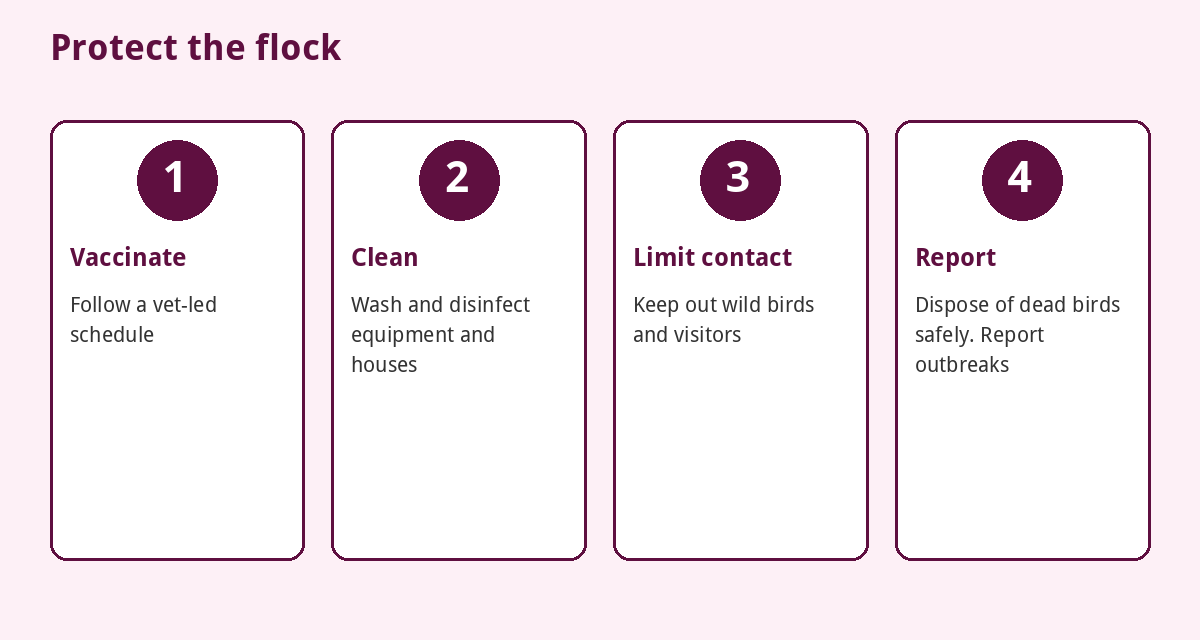
Practical steps, drawn from the ministry’s recommended measures and standard farm practice:
- Get a vet to set a vaccination schedule for your birds and area, and follow it.
- Buy chicks from a reliable hatchery, not from roadside sellers.
- Control access. Limit visitors, use foot baths, and keep wild birds and other poultry away.
- Clean and disinfect houses and equipment between batches.
- Dispose of dead birds safely by burial or burning, not by dumping or selling.
- Report suspected outbreaks promptly to your state veterinary services. If you suspect bird flu, avoid moving birds or sharing equipment.
- Avoid live bird markets for restocking where possible, since they are named as major transmission points for Newcastle disease.
Plan the money before you buy birds
- Choose a scale you can feed for the whole cycle. Buying many birds and running out of feed costs more than starting smaller.
- Calculate your cost per bird and per egg or kilogram. Add chicks, feed, medication, labour, power, water and housing costs, then divide by what the flock will produce. Compare it to local selling prices.
- Test the market first. Find buyers such as shops, hotels, schools, restaurants and traders before the birds arrive. A farm that cannot sell on time pays for feed it cannot recover.
- Keep a reserve. The software-company guide suggests a 10 percent buffer in its tables, while others advise at least one full cycle of variable costs. Aim higher if you can.
- Record everything. Feed used, deaths, eggs collected or birds sold, vaccines given and money in and out.
- Consider insurance and funding carefully. Ask lenders and insurers for written terms, and do not take a loan you cannot repay if a disease outbreak hits.
Registration and permits
Sources we found say little about permits. Ask your local government, state ministry of agriculture or livestock office about land use, environmental requirements and any licences, and see our guide to registering a business name if you will sell to shops or businesses. If you process eggs or meat into packaged products, you may need other approvals, so see our guides to NAFDAC and SON for packaged goods. For other business ideas, see small businesses that succeed in Nigeria.
Common mistakes
- Starting with too many birds and too little feed money.
- Copying a profit figure from an advert instead of working out your own costs.
- Buying chicks from an unverified seller.
- Skipping vaccines to save money.
- Building near a crowded residential area or a live bird market.
- Having no buyers lined up.
- Ignoring deaths and feed use records until the money runs out.
- Selling dead or sick birds, which spreads disease and harms customers.
Frequently asked questions
How much money do I need to start poultry farming in Nigeria?
It depends on scale and type. Guides estimate hundreds of thousands of naira for a micro flock and millions for hundreds of birds, but they disagree. Get local quotes and keep a cash reserve.
Are layers more profitable than broilers?
Layers earn daily after a long wait, and some reports say farmers are moving toward them. Neither is automatically more profitable. It depends on your costs, disease control and market.
How long before layers start laying?
Reports describe about 18 to 22 weeks of age, with costs and no egg income until then.
What is the biggest cost?
Feed, reported by the Poultry Association of Nigeria at 65 to 70 percent of input costs.
Can I farm poultry in a residential area?
Check local rules. Guides advise keeping farms away from residential areas for environmental and health reasons, and neighbours often complain about smell and noise.
Are vaccines necessary?
Yes. Experts recommend routine vaccination against Newcastle disease, and a vet should set the schedule.
Where do I sell eggs and birds?
Markets, shops, restaurants, hotels, schools and direct customers. Line up buyers before you start.
Bottom line
Poultry can be a real business, but it rewards planning more than optimism. Start with a number of birds you can feed for the full cycle, get local quotes for feed, chicks and housing, work with a vet from the start, keep records, and sell through buyers you have already spoken to. Treat any published profit figure as a rough guide at best and calculate your own costs before you commit.
Sources
- The Guardian Nigeria: Poultry farmers seek FG’s intervention for lower OpEx, feed costs (4 Feb 2026)
- Pluboard: Why Nigerian poultry farmers are abandoning broilers for eggs (15 Jul 2026) (some figures cite other outlets)
- Smart SMS Solutions: Poultry farm setup cost in Nigeria 2026 (company blog; figures unsourced)
- Legit.ng: How much does it cost to start a chicken farm in Nigeria (May 2026) (figures partly unsourced)
- Naijasabi: Chicken price in Nigeria (updated 14 Oct 2026) (compiles dated Lagos prices)
- Daily Trust: Newcastle disease, poultry farmers count losses as FG sets up committee (6 Aug 2026)
- allAfrica: Govt, FAO combat bird flu in Nigeria with $350,000 project (June 2026)