Last updated: 13 October 2026. Success depends on location, skill, timing and luck, and nothing here is a guarantee. We replaced unsourced income claims from an earlier version with official data and practical guidance.
Small businesses are the backbone of Nigeria’s economy. The NBS and SMEDAN’s 2020 survey counted about 39.65 million micro, small and medium enterprises employing 62.5 million people, 80.2% of the labour force, and contributing roughly 46.3% of GDP. They are also fragile: the sector shrank from about 41.5 million in 2017, and SMEDAN says more than two million businesses closed between 2017 and 2021. So which ones last?

What the survivors have in common
- They meet a daily need such as food, transport, phone repair or hair care, so demand does not depend on trends.
- They start small and grow from cash flow instead of big loans.
- They keep customers coming back through trust, fair prices and convenience.
- They know their numbers: stock, costs, profit and cash.
Ten businesses that keep going
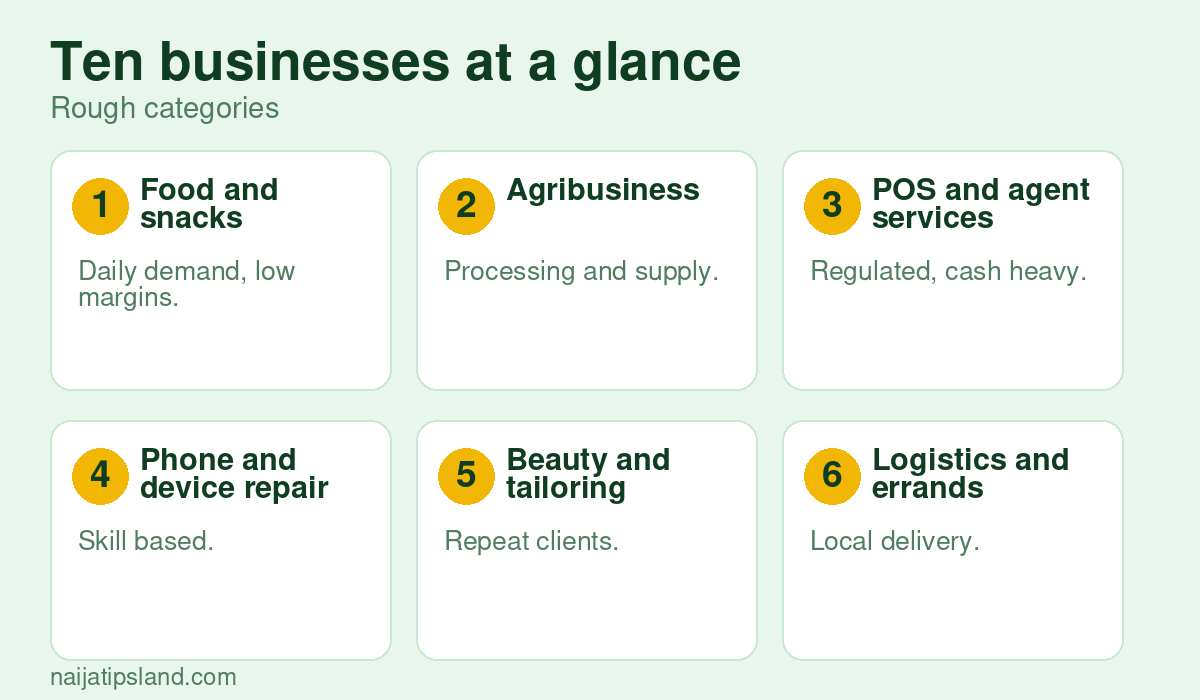
- Food and snacks: catering, baked goods, street food and packaged meals. Demand is constant, but margins are thin and rising ingredient costs, with food inflation at 19.57% in August 2026, mean you must reprice often.
- Agribusiness and food processing: processing grains, tubers, oils and spices adds value, but storage and logistics are the difficult parts.
- POS and agent banking: regulated by the CBN, with a limit of ₦100,000 a day per customer and ₦1.2 million a day per agent, and a rule of one principal per agent from April 2026. Read our guide to starting a POS business and avoiding POS fraud.
- Phone and device repair and accessories: skill-based, with steady demand, though parts costs follow the exchange rate.
- Beauty, barbing and tailoring: repeat clients and word of mouth drive income, and good service builds a loyal base.
- Logistics and errands: local delivery for shops and online sellers. See our guide on selling online.
- Digital services: design, social media management, bookkeeping and writing for other small businesses. See online business ideas without capital.
- Cleaning, laundry and household services: reliable demand in cities, with reputation as the main asset.
- Retail and provisions: shops that stock everyday items do well where they are convenient, but depend on stock control and supplier credit.
- Tutoring and training: lessons, skills training and exam coaching, with fees paid in advance.

How to choose one
- Match your skills. Start with what you already do well.
- Check demand in your area. Count potential customers and rivals within walking or delivery distance.
- Work out the costs. Rent, power, stock, transport and permits. Compare the cost with your cash.
- Test small. Sell to a few customers first, then expand.
The basics that keep a small business alive
- Separate money. Use a business account, and pay yourself a fixed amount.
- Keep records. Write down every sale and cost. See our financial literacy checklist.
- Register. A business name opens doors to banks, contracts and grants. See how to register a business name and business structures.
- Know your taxes. The first ₦800,000 of annual taxable income is taxed at 0% for individuals, and there are reliefs for small companies, but you still need records and filings. See our VAT guide.
- Watch cash. Do not give goods on credit you cannot afford to lose.
- Protect against fraud. Confirm payments in your own account.
Where to find support
SMEDAN, the Bank of Industry and programmes such as iDICE and the Tony Elumelu Foundation offer training and funding, and some reach small firms, but competition is stiff. Watch for scammers who charge fees to “secure” grants. See our guides on iDICE, microfinance and internet scams. Avoid common errors by reading entrepreneurship mistakes.
Tax and Registration: What Changed in 2026
The Nigeria Tax Act 2025, in force from 1 January 2026, gives qualifying small companies a 0% company income tax rate, and the government’s public awareness list says this applies to companies with turnover of up to ₦100 million and fixed assets of up to ₦250 million, with small firms at ₦100 million or less not required to charge VAT. Some legal analyses cite a ₦50 million turnover figure for the “small company” definition in the Act itself, and professional service providers can be excluded, so check your own position with the Nigeria Revenue Service or a tax adviser before relying on a threshold. Two points are clearer: the exemption generally requires CAC registration, and from 2026 your NIN serves as your tax ID if you are an individual, while a registered company uses its CAC registration number. See our guide on business structures.
Where Small Businesses Can Find Finance
- SMEDAN-brokered loans: SMEDAN says it has negotiated more than ₦12 billion of financing for small businesses at 9 to 9.5% interest with the Bank of Industry, state governments and banks.
- Grow Fund: in July 2026 SMEDAN announced a ₦500 million zero-interest revolving fund, disbursed through cooperatives, trade unions and recognised associations rather than to individuals.
- BOI: the Bank of Industry’s 2026 strategy says 20% of its MSME financing will go to young entrepreneurs, and an earlier BOI and SMEDAN fund offered nano and micro enterprises loans at 5% to 7.5% with guarantors.
- Check terms carefully: confirm rates, repayment periods and requirements on the agency’s official channels, and never pay a “facilitation fee” to access a government loan. See our guides on iDICE and microfinance banks.
A Simple Starting Checklist
- Test your idea with a few paying customers before you spend on stock or rent.
- Register the business and open a separate business account.
- Keep records of every sale and expense.
- Price for profit, not just sales, and include transport, power and data.
- Plan for power, security and cash flow problems. See our guide on entrepreneurship mistakes.
Frequently Asked Questions
What is the best small business to start in Nigeria?
The best is one that meets a daily need, fits your skills and costs little to start. Test before you scale.
How much money do I need?
It varies from almost nothing for services to large sums for stock or equipment. Start with what you can afford to lose.
Do I need to register my business?
It is strongly advisable and often required for banking, contracts and funding.
Sources
- 21st Century Chronicle: 2020 national MSME survey
- PwC: MSME Survey 2024 (citing the NBS and SMEDAN)
- MSME Africa: SMEDAN on MSME numbers and closures
- NBS: Consumer Price Index reports
- BusinessDay: 10 things POS agents need to know under the CBN’s new guideline
- Techpoint: Nigerian tax reform acts 2026 explained for small businesses
- allAfrica: Govt highlights 50 tax reliefs and exemptions
- BusinessDay: Small and mid-sized companies under the 2026 tax reforms
- Leadership: SMEDAN launches N500m interest-free fund
- allAfrica: SMEDAN targets microfinance bank launch, cheaper funding
Related: How to start a provision store in Nigeria
Related: Poultry farming in Nigeria