Last updated: 18 October 2026 · By Naijatipsland Editorial Team · Editorial policy
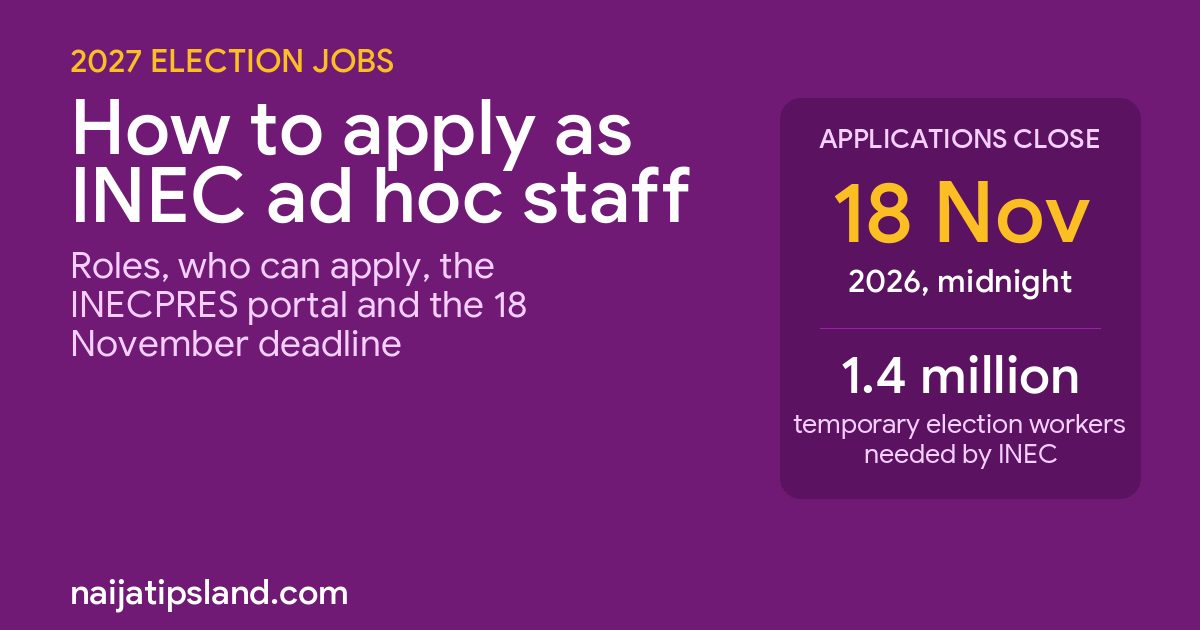
Every general election in Nigeria runs on temporary workers. For the 16 January 2027 presidential and National Assembly elections and the 6 February 2027 governorship and State Assembly elections, INEC says it needs about 1.4 million ad hoc staff across more than 176,000 polling units. They run the polling units, operate the BVAS, count the votes and upload the results.
Applications are open now on INEC’s recruitment portal, INECPRES, and close at midnight on Wednesday, 18 November 2026. This guide explains the roles, who can apply, how to apply step by step, what happens after you apply, what the job pays, and how to avoid the scams that appear every election season.
The short answer
- Where: apply only on INECPRES at pres.inecnigeria.org (web) or through the Android app linked from inecnigeria.org.
- When: the portal opened at 8am on 18 September 2026 and closes at midnight on 18 November 2026.
- Roles: Supervisory Presiding Officer (SPO), Presiding Officer (PO), Assistant Presiding Officer (APO), Registration Area Centre (RAC) Manager, and Registration Area Technical Support (RATECH).
- Who: mainly corps members and recent former corps members, students of federal and state tertiary institutions, and eligible federal and state public servants, depending on the role.
- Cost: applying is free. Anyone asking for money to secure you a slot is a scammer.
- Help: INEC’s helpdesk is 0700-CALL-INEC, available 24 hours.
What ad hoc staff do
Permanent INEC staff cannot run 176,000 polling units on their own, so the commission recruits temporary staff for each election. They are trained, sworn to neutrality and deployed for a few days. Under section 26 of the Electoral Act 2026, election officials take an oath of neutrality, and breaking it is an offence.
On polling day, ad hoc staff set up the polling unit, accredit voters with the BVAS, issue ballot papers, ink fingers, keep order, count the votes in public, fill in Form EC8A and upload the result to IReV. Our guides on how voting works on election day and BVAS and IReV show the process from the voter’s side.
The five roles and who can apply
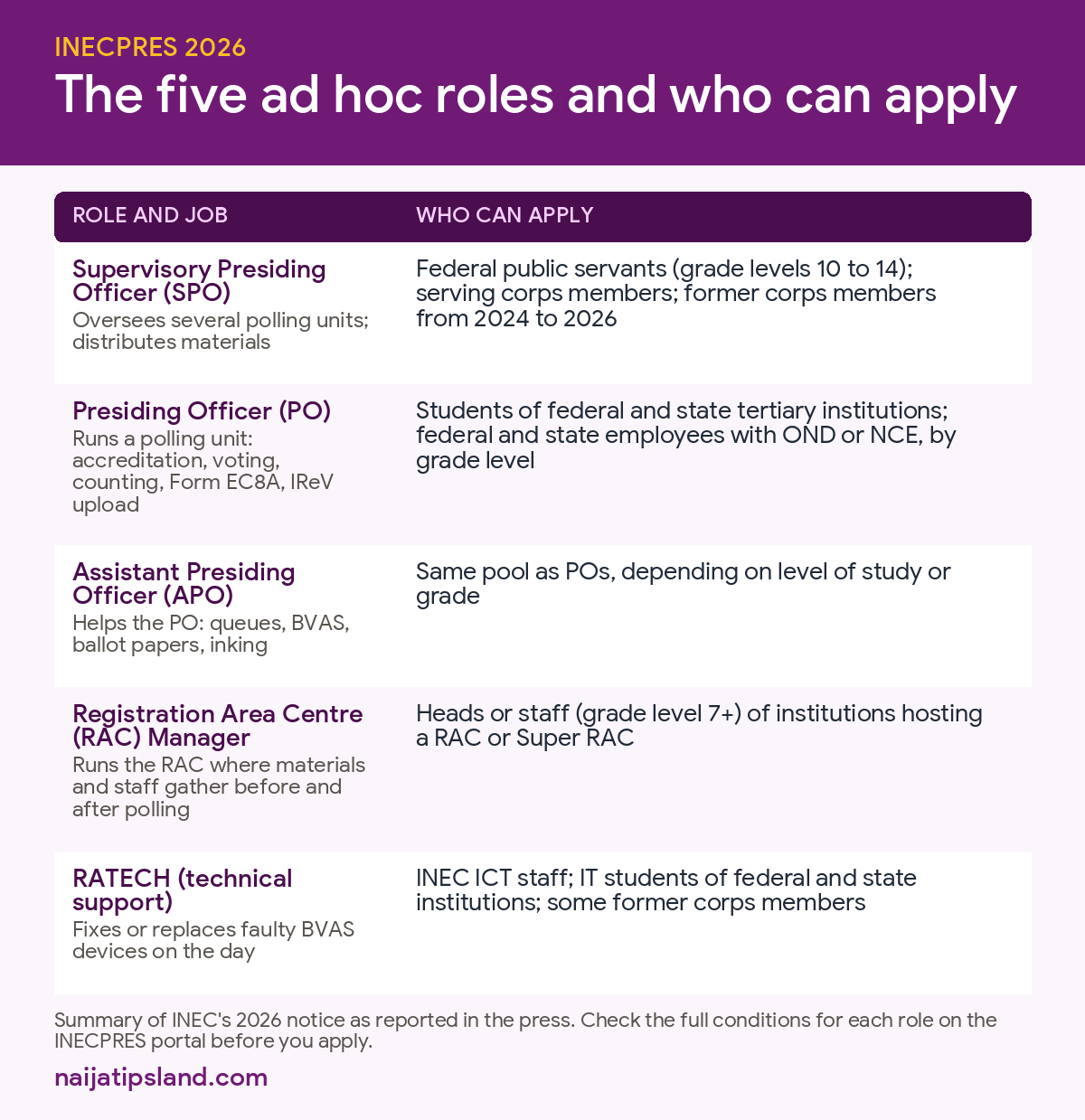
| Role | What the job involves | Who can apply |
|---|---|---|
| Supervisory Presiding Officer (SPO) | Supervises a group of polling units, distributes materials and solves problems on the day | Federal public and civil servants on grade levels 10 to 14; serving corps members; former corps members who served in 2024, 2025 or 2026 |
| Presiding Officer (PO) | Runs a polling unit: accreditation, voting, counting, Form EC8A and result upload | Students of federal and state tertiary institutions (depending on level of study); federal and state employees with OND or NCE, depending on grade level |
| Assistant Presiding Officer (APO) | Supports the PO with queues, BVAS operation, ballot papers and inking | The same pool as POs, depending on level of study or grade |
| Registration Area Centre (RAC) Manager | Runs the RAC, where staff and materials gather before and after polling | Heads and staff (grade level 7 and above) of institutions designated to host a RAC or Super RAC |
| RATECH (technical support) | Fixes or replaces faulty BVAS devices and handles technical problems | INEC ICT staff at state and headquarters level; IT students of federal and state institutions; some former corps members |
Press summaries of INEC’s notice also say that, apart from technical roles, applicants generally need to live in the state they choose, and that registered members of political parties, or anyone who has publicly backed a party or candidate, will not be considered. Read the full conditions for your role on the portal before you apply, and choose only a category you qualify for.
Corps members
Serving corps members have formed the backbone of INEC’s polling unit staff in recent elections, and INEC’s 2027 budget proposal assumed about 450,000 corps members would be engaged. If you are serving, you will also hear about election duty through your NYSC state secretariat. Our guide to NYSC in 2026 covers mobilisation and allowances.
How to apply on INECPRES, step by step

- Open the official portal. On a laptop or desktop, type pres.inecnigeria.org into your browser yourself. On an Android phone, download the INECPRES app only from the link on inecnigeria.org. Some reports list an app download on another domain; to be safe, start from INEC’s own website.
- Read the requirements for each role. Check the eligibility conditions and confirm you qualify for the category you want.
- Register. Create your account with accurate personal details. Use an email address and phone number you control and check regularly.
- Enter your details. Fill in your education, employment status or institution, and any other supporting information requested. Your name and bank details should match your official records, because mismatches have caused payment failures in past elections.
- Review and submit. Check every field for mistakes before you submit.
- Keep your details. Save your login and any application reference, and watch your email and phone for INEC messages.
INEC has urged applicants not to wait for the last days, when the portal is likely to be slow. If you run into technical problems, call the 24-hour helpdesk on 0700-CALL-INEC.
What happens after you apply
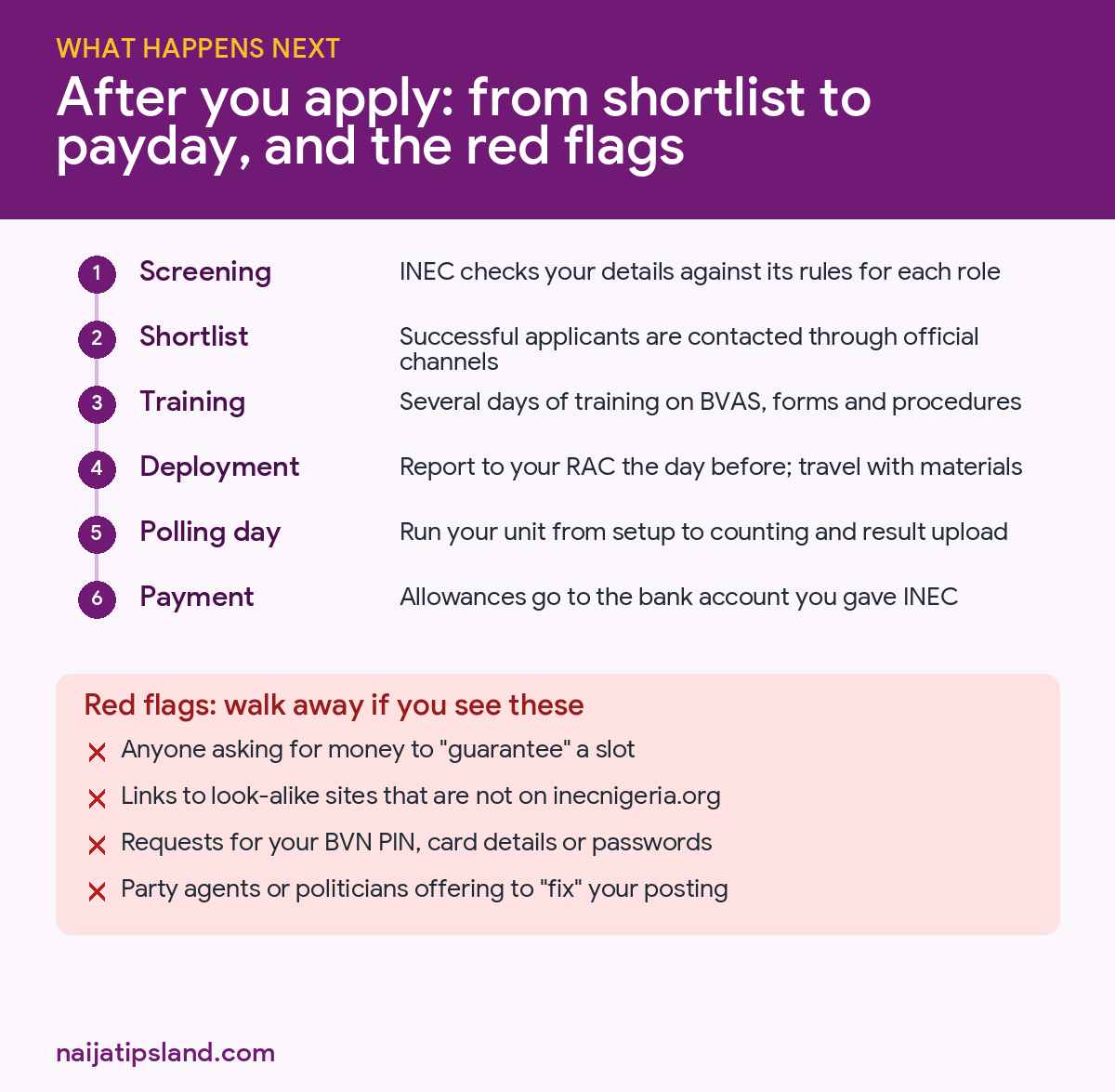
- Screening and shortlisting. INEC checks applications against the rules for each role and contacts successful applicants through official channels. Applying does not guarantee selection.
- Training. Selected staff attend several days of training on the BVAS, election forms and procedures. INEC’s 2027 budget proposal provided for five training days.
- Deployment. Polling unit staff usually gather at their Registration Area Centre the day before the election and travel to their units with the materials early on polling day.
- Polling day. Expect a long day: from setting up before 8:30am to counting, filling in the result sheets and uploading the result to IReV.
- Payment. Allowances are paid to the bank account you give INEC.
How much does INEC pay ad hoc staff?
INEC has not yet published final allowance rates for 2027. In its budget proposal presented in February 2026, the commission set aside N127,000 per corps member or other ad hoc staff member, covering five days of training and two polling days. The breakdown reported included N50,000 for election duty, a N5,000 training allowance and about N9,500 for feeding. Treat these as planning figures: final amounts can differ by role and depend on approved funding.
Late payment has been a common complaint in past elections. After the 2023 elections, some ad hoc staff in Lagos said they were still waiting weeks later. INEC said it had released enough money to pay everyone, that some payments bounced because staff gave wrong account numbers, and that anyone with evidence should complain to their state’s Resident Electoral Commissioner. The lesson: enter your bank details carefully, and keep records of your engagement and duty.
Tips if you are selected
- Take the training seriously. Most polling unit problems, from BVAS errors to wrongly filled result sheets, come from gaps in training. Practise on the BVAS during training sessions, and ask questions about anything you are unsure of.
- Learn the forms. Know how to fill in Form EC8A and how to correct mistakes properly, because errors on result sheets lead to disputes and cancellations.
- Charge everything. Make sure the BVAS is charged and that you know how to reach RATECH support if it fails. Bring a power bank for your own phone.
- Keep your documents. Keep your appointment letter, training attendance record and any duty forms until you have been paid in full.
- Know the voter’s side too. Voters will ask you about phones, party colours and queues. Our guide to what voters can and cannot do on election day covers the rules they are most likely to ask about.
Risks and responsibilities
Election duty is paid work, but it is also a serious public responsibility. You will be handling sensitive materials, sometimes in difficult or remote areas, and your work decides whether thousands of votes count.
- Stay neutral. Do not wear party colours, take money or gifts from politicians, or favour any side. Officials who break their oath of neutrality commit an offence.
- Follow the law on results. A presiding officer who wilfully blocks electronic transmission of results faces a fine of at least N500,000, at least six months in prison, or both (section 60(6) of the Electoral Act 2026).
- Know the security plan. Attend every briefing, know your security personnel and your SPO, and save emergency contacts before polling day.
- Look after yourself. Carry water, food, a power bank and any medication you need.
Avoiding ad hoc recruitment scams
Every election season brings fake “INEC recruitment” sites, WhatsApp messages and agents who claim they can secure postings for a fee. INEC says its official platform is the only legitimate channel and has warned applicants to avoid anyone demanding payment.
- Never pay anyone to apply, to be shortlisted, or to choose your posting.
- Only use links on inecnigeria.org. Check the web address carefully before entering any details.
- Never share your BVN PIN, card details or banking passwords. INEC only needs your account details to pay you.
- Be wary of WhatsApp “shortlists” and screenshots that are not from official INEC channels.
Our guides to recruitment scams in Nigeria and fake job ads explain how to spot and report them.
Frequently asked questions
What is the INEC ad hoc recruitment portal?
It is INECPRES, the INEC Portal for Recruitment of Election Staff, at pres.inecnigeria.org, with an Android app linked from inecnigeria.org.
When is the deadline for INEC ad hoc staff applications?
Midnight on Wednesday, 18 November 2026.
Can I apply if I am not a corps member?
Yes, for some roles. Students of federal and state tertiary institutions and eligible public servants can apply for certain positions, subject to each role’s conditions.
Do I have to pay to apply?
No. Applying is free. Anyone who asks for money to secure a slot is not acting for INEC.
Can a party member work as INEC ad hoc staff?
No. Registered party members and people who have publicly supported a party or candidate are not considered.
How much will INEC pay ad hoc staff in 2027?
Final rates have not been published. INEC’s February 2026 budget proposal set aside N127,000 per ad hoc staff member for five training days and two polling days.
Who do I contact if I have problems with the portal?
Call INEC’s 24-hour helpdesk on 0700-CALL-INEC.
Bottom line
If you qualify, working as INEC ad hoc staff is a chance to earn some money and play a direct part in the 2027 elections. Apply early on the official INECPRES portal, choose a role you qualify for, enter your details carefully, and never pay anyone for a slot. For every other date before the elections, see our 2027 election deadlines page and the 2027 Nigeria Election Hub.
Sources
- Daily Trust: 2027 elections, INEC begins recruitment of ad hoc staff (September 2026)
- TheNigeriaLawyer: INEC opens recruitment portal, sets 18 November deadline (October 2026)
- WithinNigeria: Who can apply for INEC’s 2027 ad hoc staff recruitment (September 2026)
- Legit.ng: INEC opens recruitment portal for ad hoc staff
- Blueprint: How to apply for INEC ad hoc staff recruitment
- Blueprint: INEC budgets N873.78 billion for 2027 general elections (February 2026)
- ICIR: Ad hoc staff lament delay in payment of allowances (March 2023)
- Electoral Act 2026 (full text, via PLAC): sections 26 and 60