

Last updated 22 November 2026. Candidate lists can change through court rulings and withdrawals, and campaign promises change with the weeks, so check INEC’s website for the current list. This guide reports what candidates and the electoral commission have said, and it treats every candidate the same way.
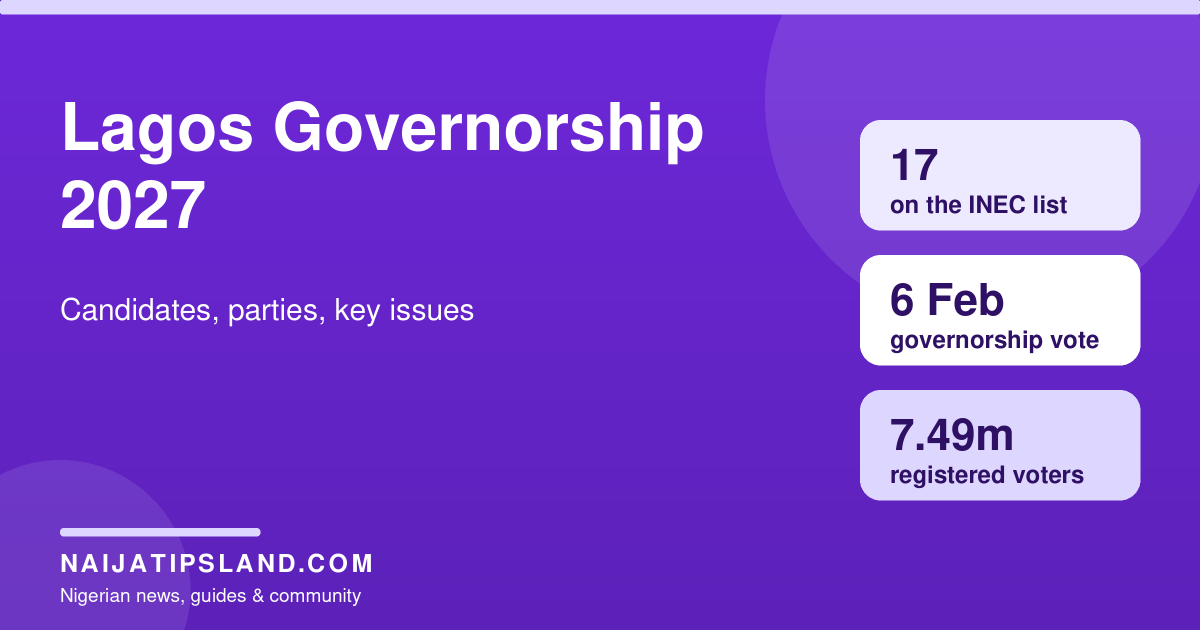
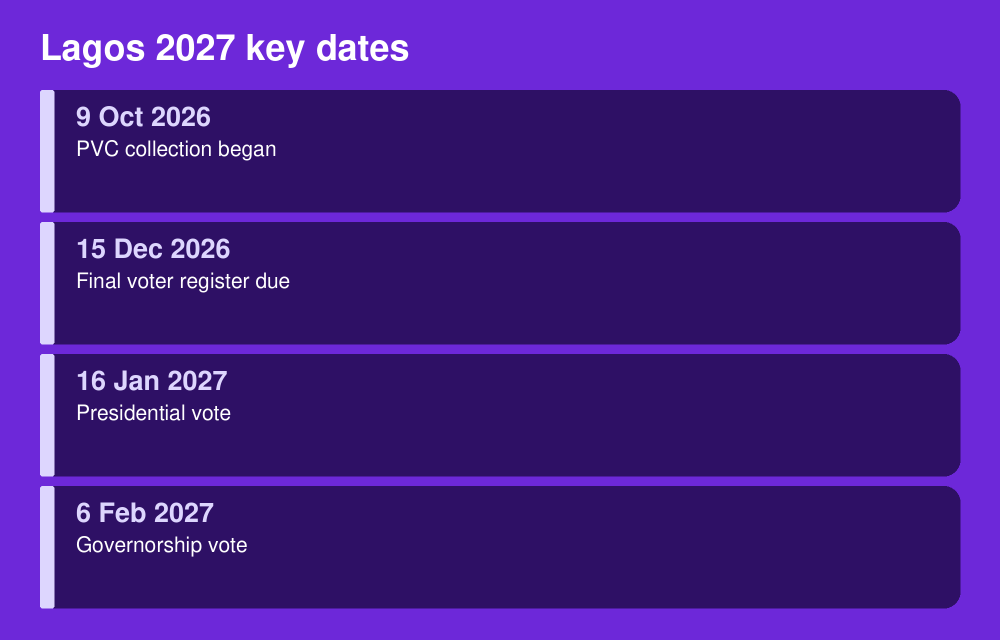
Lagos will have a new governor in May 2027. Babajide Sanwo-Olu was elected in 2019, won again in 2023 and cannot run a third time, so the seat is open for the first time since 2019. The governorship and State House of Assembly elections hold on Saturday 6 February 2027, three weeks after the presidential and National Assembly vote on 16 January. This guide covers who is on the ballot, what the four best-known candidates have promised on rent, transport, flooding, health and schools, how Lagos voted last time, and what you need to do to take part.
When is the Lagos governorship election?
INEC has fixed Saturday 6 February 2027 for governorship elections in 28 of Nigeria’s 36 states, Lagos included, alongside State House of Assembly elections in every state. Eight states (Anambra, Bayelsa, Edo, Ekiti, Imo, Kogi, Ondo and Osun) hold their governorship votes on a different cycle and do not take part. The presidential and National Assembly elections come first, on 16 January 2027. INEC moved both dates forward from the original February and March slots after the Electoral Act 2026 changed the statutory timelines.
For the wider picture, our guide to the 2027 governorship elections in all 28 states lists every race, and the 2027 election deadlines page tracks the INEC calendar.
Who is on the ballot
INEC published its final list of governorship candidates on 10 October 2026, then issued an updated list on 31 October after reviewing complaints from candidates and parties. The updated list has 17 candidates for Lagos. Four of them have drawn most of the attention, mainly because they took part in a televised debate organised by the Nigeria Debate Consortium on Sunday 8 November.
- Obafemi Hamzat, All Progressives Congress (APC). He has been deputy governor since 2019 and is the party’s candidate. Governor Sanwo-Olu endorsed him when his manifesto was unveiled on 30 October, and President Tinubu publicly backed him at the APC South-West rally in Ibadan on 21 November.
- Gbadebo Rhodes-Vivour, African Democratic Congress (ADC). An architect and entrepreneur, he came second in 2023 as the Labour Party candidate and has since moved to the ADC.
- Funso Doherty, Nigeria Democratic Congress (NDC). An investment banker and policy advocate who ran in 2023 under the ADC and now stands for the party Peter Obi joined.
- Adedeji (Deji) Doherty, Peoples Democratic Party (PDP). An engineer and businessman who founded the DAIN Group, a PDP member since 1999 and a former Lagos State chairman of the party.
Two of these men share a surname and they are different people, which has already caused mix-ups in some reports. Funso Doherty is NDC. Deji Doherty is PDP.
The rest of the 17 come from smaller parties. Press profiles name Odunaike Oluwapelumi Olurotimi (Labour Party), Adeyemi Abiola Roseline (Action Peoples Party), Adeoye Adelaja Azeez (Allied Peoples Movement), Bolaji Nasir Adewale (Action Democratic Party), Obadia Akinola (National Democratic Party) and Sol-Nuyi Oluwadamola Adesoca (African Action Congress). I could not confirm the full 17 names from INEC’s own page while writing, so use the commission’s published list if you need every name and spelling.
How Lagos voted in 2023 and before
The numbers give some context, and they do not predict anything. In the 2023 governorship election Sanwo-Olu of the APC polled 762,134 votes. Rhodes-Vivour, then of the Labour Party, polled 312,329. The PDP candidate polled 62,449. In 2015 the APC’s Akinwunmi Ambode beat the PDP’s Jimi Agbaje by 811,994 votes to 659,788, a far closer race. The Guardian describes the APC as having held Lagos for 27 years, and analysts quoted by ThisDay say the opposition vote has often been split, which is a pattern worth watching again this time with ADC, NDC and PDP all fielding candidates.
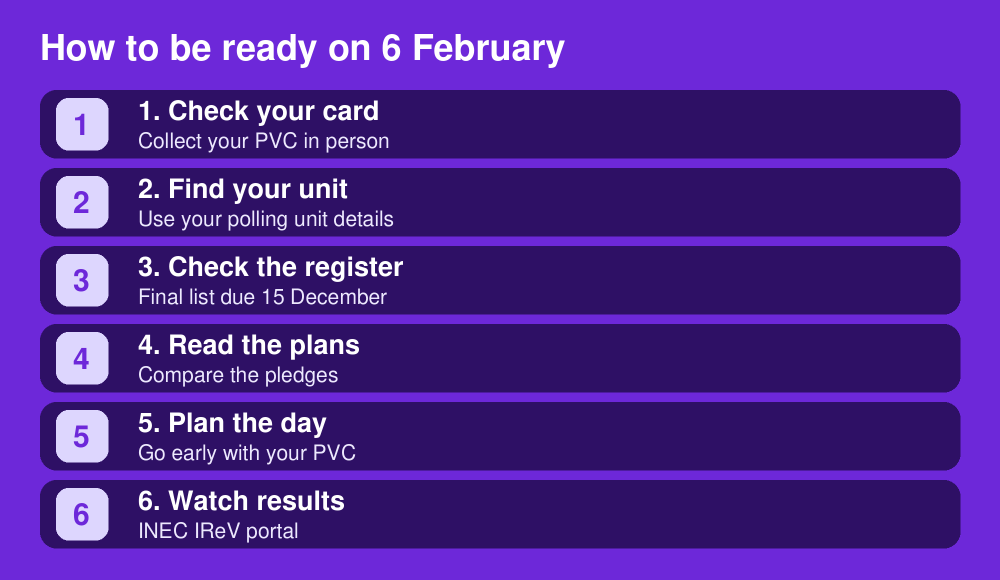
Lagos also has the biggest voter register in the country, with 7,488,633 registered voters in the figures INEC has released, ahead of Kano with 6,570,276. INEC Lagos says the final register will be ready after the claims and objections exercise ends on 15 December 2026.
What the four candidates are promising
These summaries come from the debate on 8 November and from the candidates’ own manifestos as reported by Vanguard, The Guardian, ThisDay, The Sun and The Nation. They are promises, not results. I did not find independent costings for any of them, so read the figures as targets.
Obafemi Hamzat (APC)
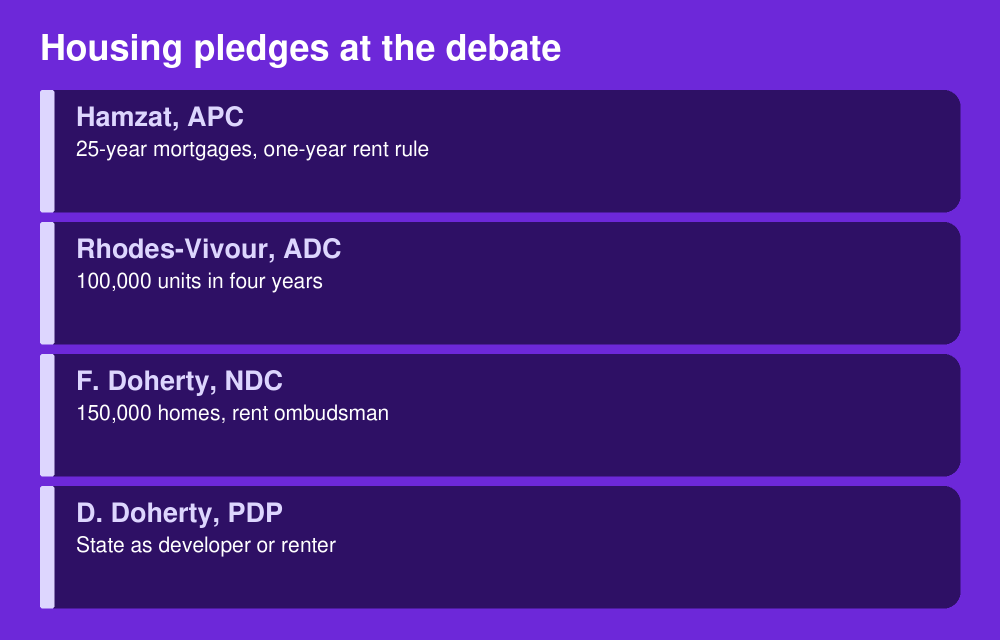
Hamzat’s manifesto is called The Lagos Promise, also written as Ileri Eko. It has 100 points arranged under seven pillars and is built on continuing and extending what the current administration has started. He told the debate that the Sanwo-Olu government built 24 housing estates with about 18,000 units in eight years. For the next term he promised mortgages with a 10 per cent deposit spread over 25 years, completion of ongoing estates, and enforcement of the Lagos law that stops landlords demanding more than one year’s rent upfront.
On transport he pledged to grow the public bus fleet from 1,000 to 4,000 compressed natural gas buses, aiming to move one million passengers a day, plus about 77 electric ferries, a ferry terminal at Oworonshoki, an extension of the Blue Line rail to Okokomaiko and work on the Green Line towards the Lekki Free Trade Zone. He also wants a single payment system across road, rail and water using the Cowry card. On health he promised to raise the number of flagship primary health centres from 87 to 150, open round the clock. On flooding he described the existing drainage network as extensive and said the main need was keeping channels clear of refuse.
Gbadebo Rhodes-Vivour (ADC)
Rhodes-Vivour built his debate case around affordability. He argued that Lagos policy has favoured the wealthy and that the state’s high internally generated revenue is not felt by ordinary residents. He promised more than 100,000 housing units in four years, financed partly through a proposed luxury tax and development of the eastern foreshore, along with limits on rent increases.
His transport plan centres on connecting all rail lines within two and a half years through private investment and infrastructure finance, which he says could repay itself over 30 years without straining the state budget. He also proposed shorter bridges between districts, more water transport, cable cars and cycle lanes. On flooding he promised a wetland protection policy and a technology-driven approach to environmental management, with recycling and waste-to-energy.
Funso Doherty (NDC)
Doherty promised 150,000 affordable homes in a first term and a bigger government role in social housing, arguing private developers cannot meet demand alone. He called arbitrary rent increases “a form of racketeering” and proposed a rent ombudsman’s office to handle tenant complaints. His education pledge was the most specific of the four: free public education, including the removal of exam fees and related charges, within 100 days, plus one affordable daily meal for public school pupils. He also promised free healthcare for poor residents.
On transport he criticised ageing commercial buses and the influence of touts and the informal agbero system, and proposed additional bridges linking parts of Lagos, among them routes connecting Oworonshoki with Epe and Ibeju-Lekki. On flooding he blamed years of building on wetlands and drainage channels and called for proper environmental impact assessments before projects start. He also proposed giving local governments more responsibility for waste collection and recycling.
Adedeji Doherty (PDP)
The PDP candidate presented a 10-point agenda under the campaign line Awaken Lagos, leaning on his record as a businessman. He stressed power supply, debt management, industrialisation, taxation and the cost of doing business, and promised electricity cost relief for residents and businesses through rebates. On housing he proposed that the state act as a major developer or rent properties from landlords and sublet them to residents, aimed at minimum-wage earners. He also proposed building more major bridges.
Where the candidates differ
On housing, all four accept that rent is a problem. Hamzat focuses on enforcing the existing one-year rent law and widening mortgages. Rhodes-Vivour and Funso Doherty set unit targets of 100,000 and 150,000, and the PDP candidate wants the state itself to hold or lease properties. If you are renting now, our guide to the cheapest areas to live in Lagos shows what the market looks like today.
On transport, the split is between expanding the current system (buses, ferries and the existing rail lines) and building new routes with private money. Anyone who commutes should also read our Lagos traffic update for the daily picture.
On flooding, Hamzat stresses maintenance and unblocked drains, while the other three put more weight on wetland protection and planning rules. On schools and health, Funso Doherty makes the boldest free-service promises, and Hamzat’s plan is built around expanding primary health centres and the state health insurance scheme.
One more thing to keep in mind if you buy or rent land in Lagos: flood risk and drainage vary a lot by area, so check a plot properly with our guide to verifying land ownership in Lagos.
How to take part on 6 February
Voter registration for 2027 has closed, and nationwide collection of Permanent Voter Cards began on 9 October 2026. INEC in Lagos said on 6 November that 116,745 of the 177,295 cards for people who registered in 2025 had not been collected. Cards must be collected in person at the INEC local government office, and nobody can collect for you. If you moved house, read how to transfer your PVC to a new polling unit, and for the rules on the day see our election day rules guide. Our voter registration guide explains the card itself.
Nigerians abroad cannot vote in 2027. INEC National Commissioner Rhoda Gumus said on 12 November that the Electoral Act 2026 has no provision for diaspora voting and the law would need amending first. If you live in the UK, you can still follow the race, talk to family at home and help them check their PVC status.
FAQ
When is the Lagos governorship election in 2027?
Saturday 6 February 2027, three weeks after the presidential and National Assembly elections on 16 January 2027.
How many candidates are running for governor of Lagos?
INEC’s updated final list of 31 October 2026 has 17 candidates. Four have the most public attention: Obafemi Hamzat (APC), Gbadebo Rhodes-Vivour (ADC), Funso Doherty (NDC) and Adedeji Doherty (PDP).
Is Governor Sanwo-Olu running again?
No. He is serving his second and final term, which ends in May 2027.
Are Funso Doherty and Deji Doherty the same person?
No. Funso Doherty is the NDC candidate and Adedeji (Deji) Doherty is the PDP candidate.
Can Nigerians in the UK vote in the Lagos election?
No. INEC says the Electoral Act 2026 does not provide for voting abroad, so only people who vote in person at their registered polling unit in Nigeria can take part.
How many registered voters does Lagos have?
The figure INEC has released is 7,488,633, the highest of any state. The final register is due on 15 December 2026.
This article gives general information and is not political endorsement or advice. It reports public statements and official figures, which can change, so confirm details with INEC and the candidates’ own published manifestos.
Sources
- Vanguard: Lagos 2027, candidates unveil plans on housing, transport and others (8 November 2026)
- The Eagle: Hamzat promises 25-year mortgages, one-year rent enforcement, 4,000 buses (9 November 2026)
- ThisDay: As four governorship candidates outline visions for a better Lagos (14 November 2026)
- Hetty’s Media: 2027 Lagos governorship debate (13 November 2026)
- The Guardian Nigeria: Lagos 2027, between Hamzat, APC’s 27-year scorecard and opposition (16 November 2026)
- The Sun: Lagos, Ogun, Oyo 2027, battle for power in the South-West (8 November 2026)
- Lagos Metropolitan: Tinubu raises Hamzat’s hand at Ibadan rally (21 November 2026)
- YNaija: Prospective 2027 Lagos State governors (19 November 2026)
- The Trumpet: 2027 election timetable (14 November 2026)
- Vanguard: INEC struggles to get 14m PVCs to voters (3 November 2026)
- Daily Post: 116,745 PVCs yet to be collected in Lagos (6 November 2026)
- ThisNigeria: INEC rules out diaspora voting in 2027 (12 November 2026)
Join the discussion
Have you tried this, or do you have a question we did not answer? Be the first to share your experience. Leave a comment below. Every comment is read by the editor before it appears.



Editor note: which Lagos issue will decide your vote, rent, transport, flooding or something else? Tell us in the comments. We read every comment and keep the discussion civil, so please argue about policies and leave out personal attacks and any private details. – Ade