Scholarships for Nigerian Students Abroad: Chevening, Commonwealth and More (2026–2027)

Last updated: 14 October 2026. Scholarship dates, eligibility and funding change every cycle, so confirm everything on each provider’s official website. Third-party lists are often out of date. We rewrote this guide for the 2026 to 2027 planning year.
Studying abroad is expensive, and the UK has raised visa fees and tightened its rules, so a scholarship can decide whether you go. The following programmes are open to Nigerians, though competition is stiff and academic strength alone is rarely enough.
Chevening (United Kingdom)
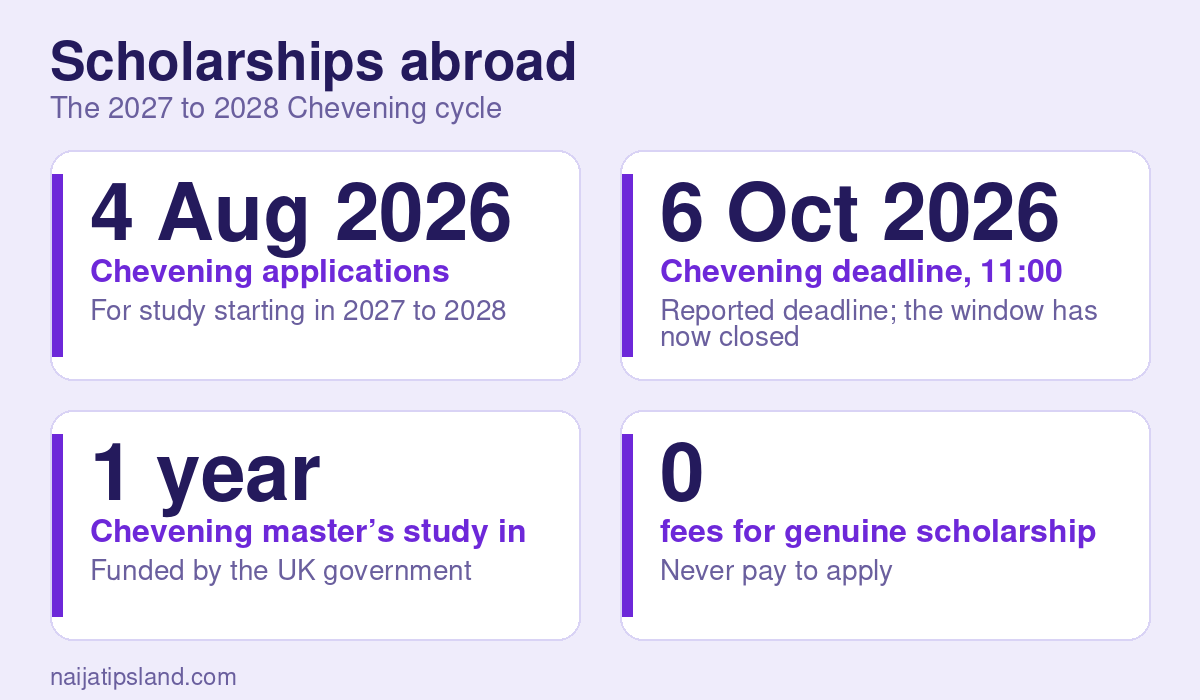
Chevening is the UK government’s international awards scheme, funded by the Foreign, Commonwealth and Development Office and partners. It supports future leaders to take a one-year master’s degree at a UK university. The British High Commission in Abuja opened applications for the 2027 to 2028 cohort on 4 August 2026, and reports gave the deadline as 6 October 2026 at 11:00 UTC, so this cycle has now closed. Chevening cycles usually open around August and close in October or November, so plan ahead for the next one. Typical requirements include Nigerian citizenship, an undergraduate degree, at least two years of work experience and applications to three UK universities. Check the official Chevening website for the exact rules.
Commonwealth Scholarships (United Kingdom)
Funded by the UK government for students from Commonwealth countries, including Nigeria, these scholarships support master’s and PhD study, and the shared scholarship route supports master’s students who could not otherwise afford to study in the UK. Some routes are applied for through nominating bodies or UK universities, so the window and process differ. Reports suggested that 2026 to 2027 applications opened in December 2025 and closed in early 2026, so check the Commonwealth Scholarship Commission’s site for the next call.
Mastercard Foundation Scholars Program
The programme supports academically talented young Africans who face financial barriers, and who are committed to giving back. It works through partner universities, including Pan-Atlantic University in Lagos and institutions abroad. Applications generally go through each partner university, so look for the call for the university you want.
Other programmes worth checking
- DAAD (Germany): several programmes with different deadlines, many between October and January.
- Fulbright (United States): typically opens in the first half of the year for study the following academic year.
- China Scholarship Council, Turkiye Burslari and others: large government programmes with annual calls.
- University scholarships: many universities offer awards for international students. Apply to universities that fund and check their scholarship pages.
For scholarships to study in Nigeria, see our guide on scholarships in Nigeria.
How to build a winning application
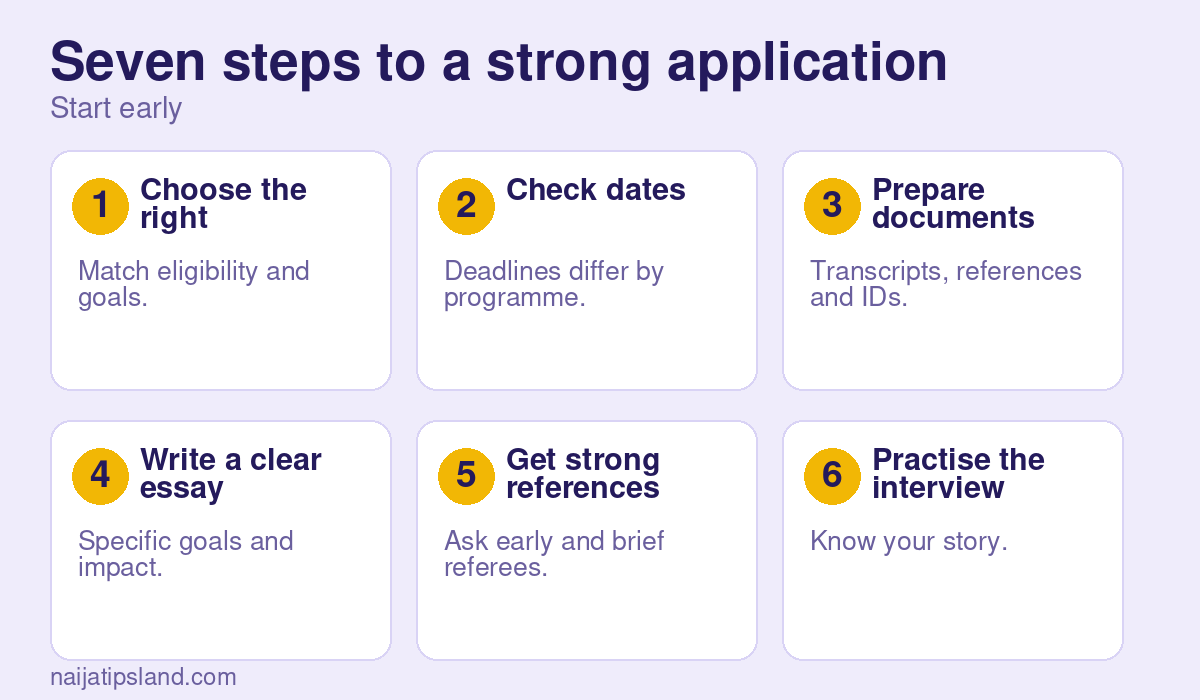
- Know the programme’s goals. Chevening looks for leadership and influence, Commonwealth for development impact, and Mastercard Foundation for giving back.
- Tell a specific story. Describe what you have done, what you will study and what you will do afterwards. Avoid clichés and general statements.
- Show evidence of results: projects, promotions, community work and measurable outcomes.
- Choose referees who know you and give them early notice and a short briefing.
- Prepare English language and documents early. Some programmes accept a degree taught in English instead of a test, but many require IELTS or equivalent, so check.
- Proofread, and ask someone to review your essays.
- Prepare for interviews with real examples. See our guides to common interview questions and communication skills.
Money and visa reality check
A scholarship rarely covers everything, so plan your costs, including visa and health charges. UK fees rose from 8 April 2026, with the student visa now £558. Read our guide on UK visas for Nigerians and our guide on financial planning.
Scholarship scams
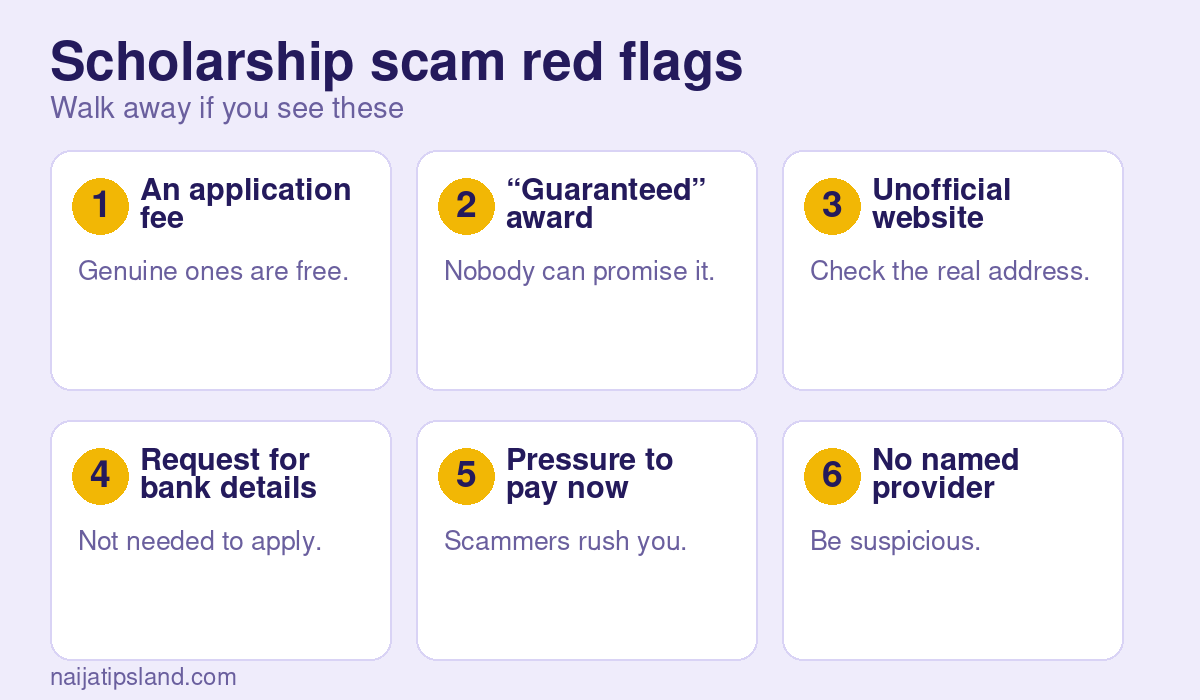
- Genuine scholarships do not charge application fees.
- Be careful with emails and social media posts about “guaranteed” awards or “final notification”.
- Check the web address: Chevening applications are made through its official site.
- Do not send your bank details, BVN or passport copies to unknown people.
See our guides on internet scams and verifying news.
A Realistic Application Plan
- Choose three to five awards that match your field, level and country.
- Check eligibility, deadlines and required documents early.
- Draft your essay, get feedback and revise several times.
- Prepare your references and any test scores, such as English tests.
- Apply on official portals only, and keep records.
Avoid Scholarship Scams
Real scholarships do not charge application fees or guarantee success, and official portals use the institution’s own domain. See internet scams and UK visas for Nigerians.
Related guide (updated 8 November 2026)
IELTS vs PTE vs TOEFL for Nigerians compares the English tests that count for a UK visa, with fees, results times and validity.
Related guide (updated 9 November 2026)
UK Graduate Route Visa for Nigerian Students covers the £937 fee, eligibility, how to apply and the change to 18 months for applications from 1 January 2027.
Related guide (updated 9 November 2026)
Germany Opportunity Card (Chancenkarte) for Nigerians explains the points system, funds, fees and application steps.
Related guide (updated 9 November 2026)
Thinking about Germany? Read our step-by-step guide: How to Study in Germany for Free as a Nigerian (2026): Costs, Visa, Blocked Account and Steps.
Related guide (updated 15 November 2026)
Chevening Scholarship for Nigerians: eligibility, deadlines and how to win explains the 2,800-hour work rule, the three-course requirement and the 2027/28 timeline, and how to prepare for the next round.
Related guide (updated 15 November 2026)
DAAD Scholarship for Nigerians: programmes, stipend and how to apply sets out the main DAAD master’s schemes, the reported EUR 992 monthly rate, the EPOS rules and the application steps.
Related guide (updated 15 November 2026)
Commonwealth Scholarship for Nigerians (2027/28): Eligibility, Funding and How to Apply covers the master’s and PhD awards, the GBP 1,712 monthly stipend, Nigerian nomination through the Federal Scholarship Board or FAWE, and how to prepare for the next round.
Frequently Asked Questions
Is the Chevening deadline for 2027 still open?
The reported deadline was 6 October 2026, so the 2027 to 2028 window has closed. Check the official site for the next cycle.
Can I apply without IELTS?
Some programmes accept a degree taught in English. Check each provider’s language rules.
Do scholarships cover flights?
Many major programmes cover return travel, but you should confirm in the award terms.
Sources
- Legit.ng: UK government opens Chevening scholarship applications for Nigerians
- fundsforNGOs: Chevening Scholarships 2027 to 2028 deadline
- ApplyBoard: Top 5 scholarships for Nigerian students in 2026
- ScholyHub: Best scholarships for Nigerian students, 2026 to 2027
- NaijaSabi: How to get a scholarship to study abroad from Nigeria in 2026
Join the discussion
Have you tried this, or do you have a question we did not answer? Be the first to share your experience. Leave a comment below. Every comment is read by the editor before it appears.