
DAAD Scholarship for Nigerians (2026): Programmes, Stipend, Eligibility and How to Apply

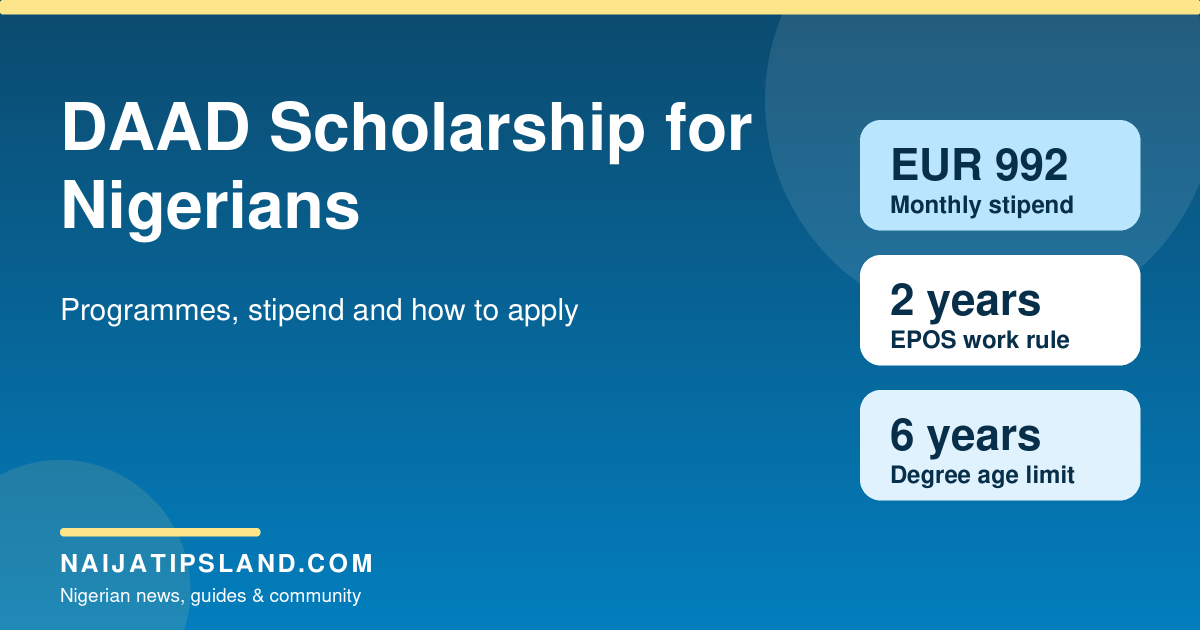
Last updated 15 November 2026. DAAD programmes, rates and deadlines change each year. Some figures below come from third-party guides and are marked as such, so confirm everything in the official DAAD scholarship database before you apply.
The DAAD, or German Academic Exchange Service, is Germany’s main body for funding international students, and it is the first name most Nigerians hear when they ask how to study in Germany with money in hand. The honest picture is mixed. DAAD awards are real and well respected, but they are mostly for postgraduate study, each programme has its own rules and deadline, and many of the 2027 intakes closed in autumn 2026. This guide sets out what exists, what a master’s award reportedly pays, who qualifies, and how to prepare, with a clear note of what we could and could not confirm.
If you want the cheaper route first, read our guide to studying in Germany for free as a Nigerian. If your goal is to work rather than study, see our guide to the Germany Opportunity Card for Nigerians.
What DAAD scholarships can Nigerians apply for?
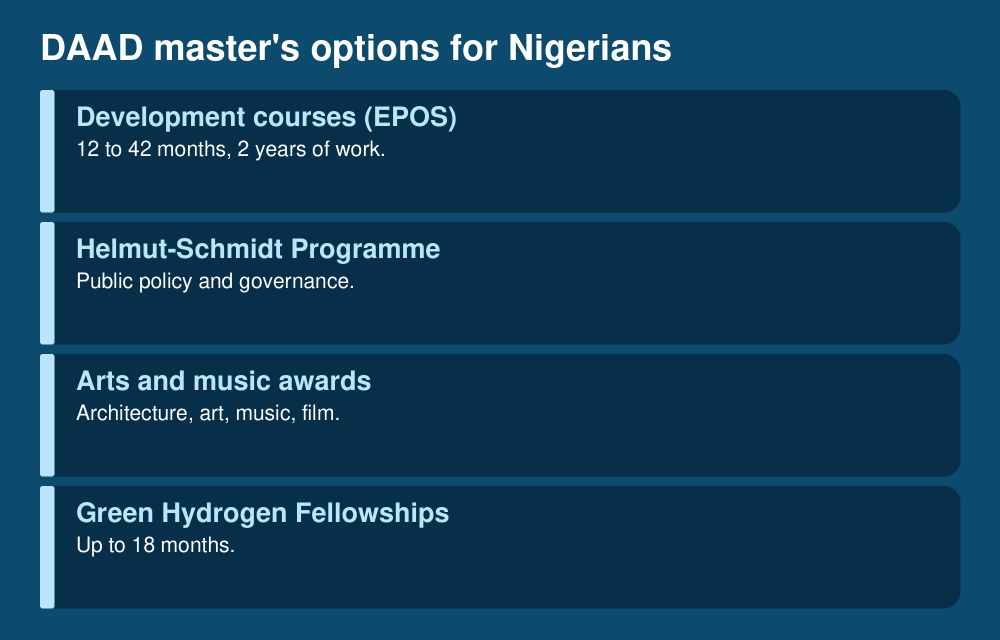
According to a 2026 guide by MyGermanUniversity, there is no DAAD scholarship for a full bachelor’s degree in Germany for Nigerians. The only undergraduate option it lists is a short University Summer Course in language and regional studies. For master’s study, the guide lists seven scholarships, each with its own field and deadline:
- Development-Related Postgraduate Courses (EPOS): for specific master’s programmes at specific German universities, lasting 12 to 42 months. The deadline is set by the programme.
- Helmut-Schmidt Programme: public policy and governance, 12 to 24 months, with a deadline around July.
- Postgraduate studies in architecture, fine art, design, visual communication and film, music, and the performing arts: 10 to 24 months each, with deadlines from September to November.
- ERA Green Hydrogen Fellowships: up to 18 months, with a deadline around November.
The same guide notes that the DAAD In-Country and In-Region programme for Sub-Saharan Africa pays a smaller amount, reported at EUR 280 to EUR 550 a month, but the study takes place in Nigeria or another eligible African country, not in Germany. These are third-party figures, so check the database before you rely on them.
What does the award pay?
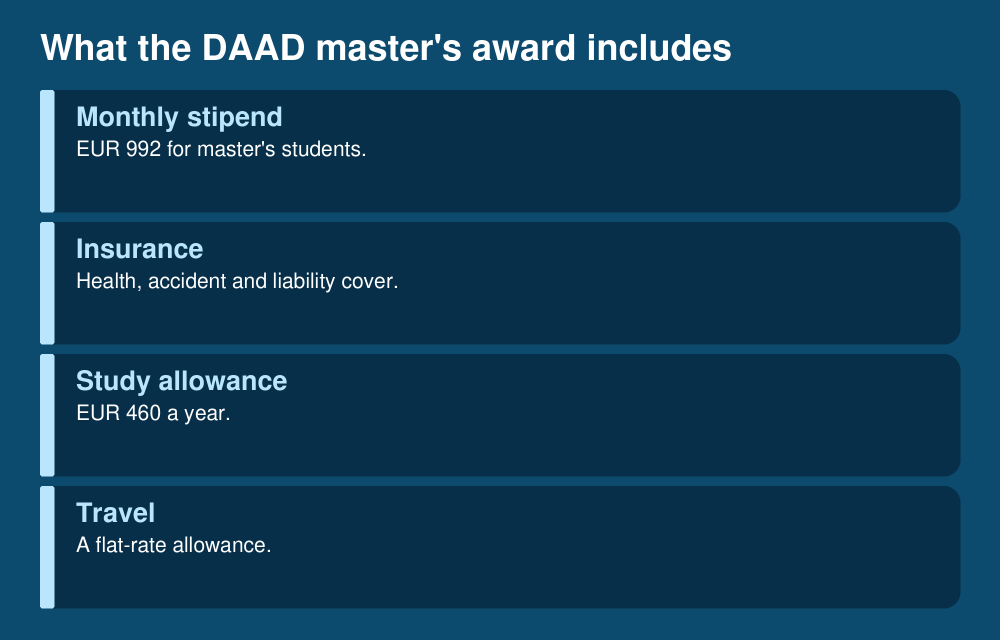
GradGermany, in an article published on 5 September 2026 and last modified on 13 November 2026, reports the DAAD master’s rate at EUR 992 a month, against EUR 1,300 for doctoral candidates. It lists these other benefits:
- Health, accident and personal liability insurance.
- A study allowance of EUR 460 a year.
- A flat-rate travel allowance.
- A monthly rent subsidy in certain circumstances.
- A family allowance if dependants come with you.
- A funded language course, including the TestDaF or DSH test fee.
That article does not say whether tuition is covered, so do not assume it. Public universities in Germany charge low or no tuition for many programmes, but rules vary by state and course, so check the specific programme page. We have used the third-party figures here because we could not open the official DAAD rate page during research, which is why the first line of this guide asks you to verify them.
Who is eligible?
Rules differ by scheme, but the general conditions reported for 2026 are:
- Your most recent degree must have been awarded no more than six years before the deadline.
- You must not have lived in Germany for more than 15 months by the deadline.
- You must meet the programme’s English or German requirement, with language certificates normally dated within the past two years.
- Strong grades. DAAD does not always publish a minimum, though MyGermanUniversity suggests aiming for the equivalent of 2.5 in the German system. Treat that as a guide, not an official cut-off.
The EPOS rules in detail
For the 2027/28 EPOS round, a listing for the MSc Environmental Governance (MEG) at the University of Freiburg set out the official-style conditions. Applicants had to be young professionals from developing countries with a degree no more than six years old and in the upper third of the grading range. They needed at least two years of relevant professional experience after their bachelor’s degree. Internships and volunteer work did not count, and academic employment such as university teaching or research was generally not accepted except in very exceptional cases. The deadline for that programme was 15 October 2026, so it has passed. Applicants also had to complete an online eligibility assessment and send one combined PDF of documents, while referees sent their letters directly.
Other EPOS programmes have their own deadlines, so search the database for the course you want rather than assuming the MEG dates apply.
How to apply
The MyGermanUniversity guide describes this general process, which you should adapt to your programme.
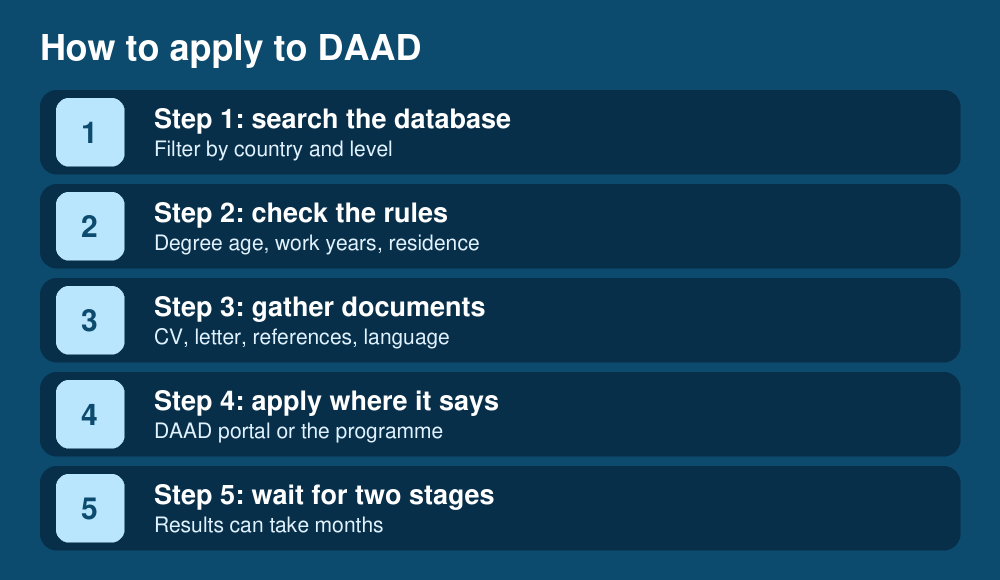
- Find the scholarship in the DAAD scholarship database, using the filters for your country and level of study.
- Check the requirements under the application section of the database entry.
- Collect your documents: the application form, certificates, transcripts, language certificates, a CV, a motivation letter and a recommendation letter. Documents that are not in English or German need certified translations.
- Submit where the entry tells you to. Some awards use the DAAD portal, while others (including EPOS and Helmut-Schmidt) may require you to apply directly to the academic programme.
- Wait for the first-stage result, which can take several months.
- Complete the second stage, which may include an interview or extra documents.
- Receive the final decision.
The guide suggests starting at least two months before the deadline and notes that the whole process takes about seven months, so begin roughly a year before your intended start date. It also estimates a success rate of around 10 per cent for Nigerian applicants based on its own 2023 research. That is an unofficial estimate, so treat it with caution.
Which route fits you?
Because each scheme is narrow, the quickest way to save time is to match your situation to the right door before you write a single document.
- You have two or more years of relevant work and an interest in development, environment or governance: search the EPOS list first. These courses are designed for working professionals, and the work-experience rule is strict, so check your employment history against it line by line.
- You work in public policy, government or civil society: look at the Helmut-Schmidt Programme, whose deadline falls earlier in the year, around July according to the guide we reviewed.
- You are an architect, artist, designer, filmmaker or musician: the arts and music awards are separate schemes with their own portfolios and deadlines between September and November, so start building your portfolio months ahead.
- You are a fresh graduate with no work experience: EPOS is not for you, and a full DAAD award may be hard to find. Your best low-cost option may be to apply to a public university directly and plan your finances, as set out in our study-in-Germany guide, while you gain the work experience that opens the DAAD doors later.
- You want to stay in Nigeria: the in-country scholarships are worth a look because they fund study at African universities.
Whichever route you pick, read the full call for applications on the DAAD page for that scheme. DAAD calls often include rules about the length of your degree, the subject of your degree and the country you live in, and a small mismatch can end an application before anyone reads your motivation letter.
Common mistakes to avoid
- Assuming one DAAD scholarship covers everyone. Each scheme has its own subject, university and deadline.
- Applying for an EPOS course without two full years of relevant work after your bachelor’s degree.
- Using documents that are not certified translations or language certificates that are too old.
- Missing the deadline set by the programme rather than DAAD’s general calendar.
- Paying an agent for a guaranteed award. DAAD does not sell places, and an offer to sell one is a scam.
If you do not get a DAAD award
Many Nigerians study in Germany without a DAAD award, using a blocked account and low public-university fees, which is covered in our study-in-Germany guide. You can also compare awards in our guide to scholarships for Nigerian students abroad, including the Chevening scholarship guide for the UK.
Related guide (updated 15 November 2026)
Commonwealth Scholarship for Nigerians (2027/28): Eligibility, Funding and How to Apply covers the master’s and PhD awards, the GBP 1,712 monthly stipend, Nigerian nomination through the Federal Scholarship Board or FAWE, and how to prepare for the next round.
Frequently asked questions
How much does a DAAD master’s scholarship pay?
A third-party guide updated on 13 November 2026 reports EUR 992 a month for master’s students, plus insurance and allowances. Check the official DAAD database for the current rate.
Can Nigerians get a DAAD scholarship for a bachelor’s degree?
The guides we reviewed list no full bachelor’s scholarship, only a short summer course. Most awards are for master’s and doctoral study.
How much work experience do I need?
For EPOS programmes, at least two years of relevant professional experience after your bachelor’s degree. Other schemes can differ.
What was the DAAD EPOS deadline for 2027/28?
For the MSc Environmental Governance listing, the deadline was 15 October 2026. Other programmes set their own dates.
Can I apply if I already live in Germany?
Generally not if you have lived there for more than 15 months by the deadline.
Do I need German?
It depends on the programme. Many English-taught master’s courses need English only, and some DAAD awards fund a German course.
Do I have to pay to apply?
We found no application fee. Do not pay anyone who promises you an award.
Sources
- MyGermanUniversity: DAAD Scholarship Nigeria
- GradGermany: DAAD Scholarship 2026, EUR 992 a month, insurance and allowances
- Opportunities for Africans: DAAD/EPOS scholarships 2027/2028
- DAAD official website (scholarship database)
Join the discussion
Have you tried this, or do you have a question we did not answer? 1 reader has already shared their view. Naijatipsland members help each other with real, first-hand experience.





Editor’s note: this guide is informational. DAAD rates, programmes and deadlines change every year, and some figures here come from third-party guides, so confirm everything in the official DAAD scholarship database before you apply. – Ade