
Chevening Scholarship for Nigerians (2026): Eligibility, Deadlines and How to Win One

Last updated 15 November 2026. Chevening is run by the UK government, and dates and rules can change. Always confirm on the official Chevening website before you apply.
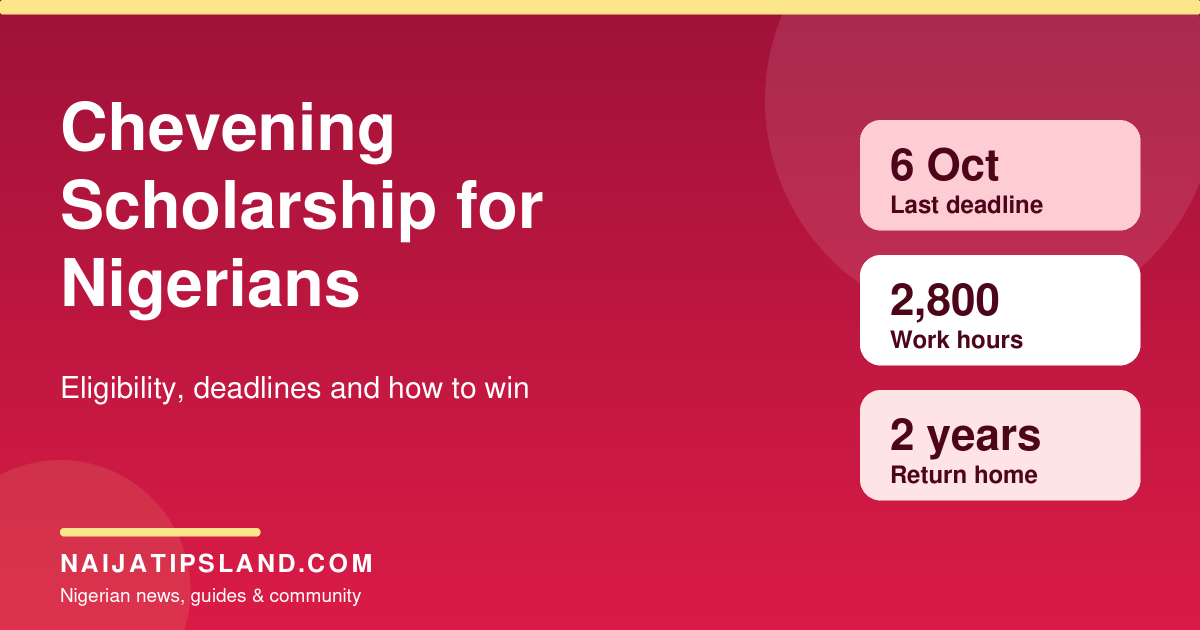
If you are a Nigerian professional who wants a free one-year UK master’s degree, the Chevening Scholarship is one of the best-known routes. It is funded by the UK Foreign, Commonwealth and Development Office (FCDO) and partner organisations, and it is aimed at people who already have work experience and leadership potential. The most important thing to know today is the timing: the 2027/28 Chevening round for Nigeria closed on 6 October 2026, so you cannot apply for it now. This guide explains who is eligible, what the process looks like, and how to prepare properly for the next round.
If you are still comparing awards, our wider guide to scholarships for Nigerian students abroad covers Chevening alongside Commonwealth and other options, and our list of scholarships inside Nigeria may help if you want to study at home.
What is the Chevening Scholarship?
Chevening describes its awards as fully funded and for one year of study in the UK. The scholarship is for one-year taught master’s degrees at UK universities, and Chevening also publishes a separate list of research master’s courses. Chevening’s own pages say it is funded by the FCDO and partner organisations. The exact list of what the award pays for (such as tuition, a living allowance and flights) is set out on Chevening’s benefits and FAQ pages, so check the current figures there rather than relying on a blog, including this one.
Chevening also points out that partner organisations in Nigeria offer additional awards, and that some of these go unfilled. Applying for a partner award where you qualify may improve your chances, so read the Nigeria page for the current list.
Who is eligible? The official criteria
These are the criteria published on Chevening’s eligibility page. You must:
- Be a citizen of a Chevening-eligible country. Nigeria is eligible. If you apply for an award from an eligible developing country, you must live in one while you apply and show a clear intention to support your country of award.
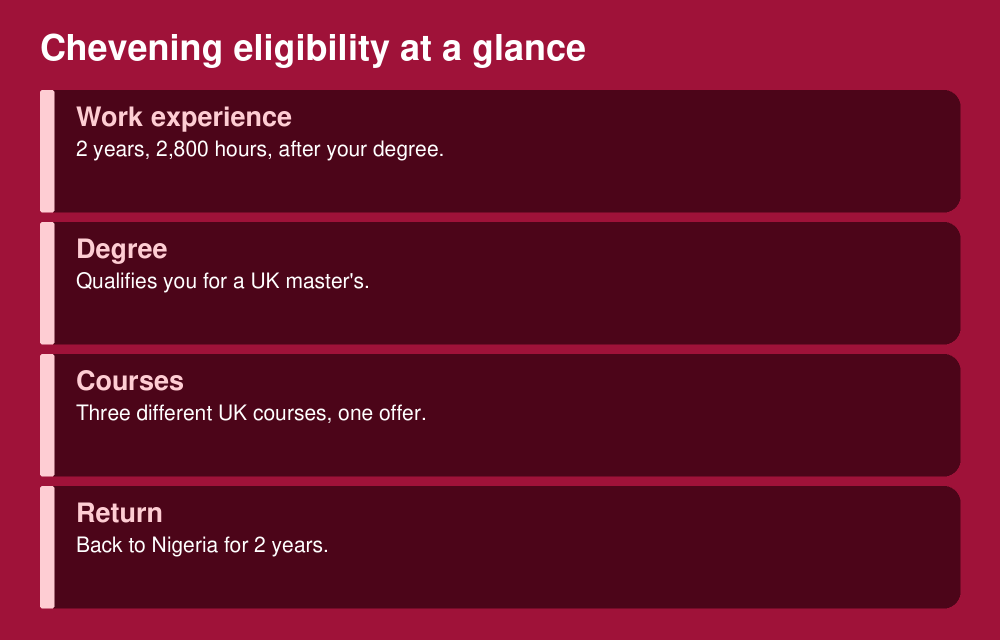
- Commit to returning home. You must return to your country of award for at least two years after the scholarship ends.
- Have at least two years of work experience, totalling 2,800 hours. The experience must come after your undergraduate degree. Work done while you were studying does not count.
- Hold an undergraduate degree that qualifies you for a UK master’s. You must have finished it at least two years before the application deadline. You may apply without the certificate, but you must have it by your interview.
- Apply to three different eligible UK courses. You must receive at least one unconditional offer from these by the deadline in the application timeline.
Who is not eligible?
You cannot apply if you hold British or dual British citizenship (with limited exceptions for British Overseas Territories), if you live in the UK at the time you apply, or if you are an employee, close relative of an employee, or recent former employee of a UK government department, the British Council or a partner UK university. You are also excluded if you have previously studied in the UK on a UK government-funded scholarship. Former Chevening fellows must wait five years after finishing their fellowship before applying again. Having a master’s degree does not stop you from applying for a second UK master’s.
The 2027/28 timeline, and why it matters now
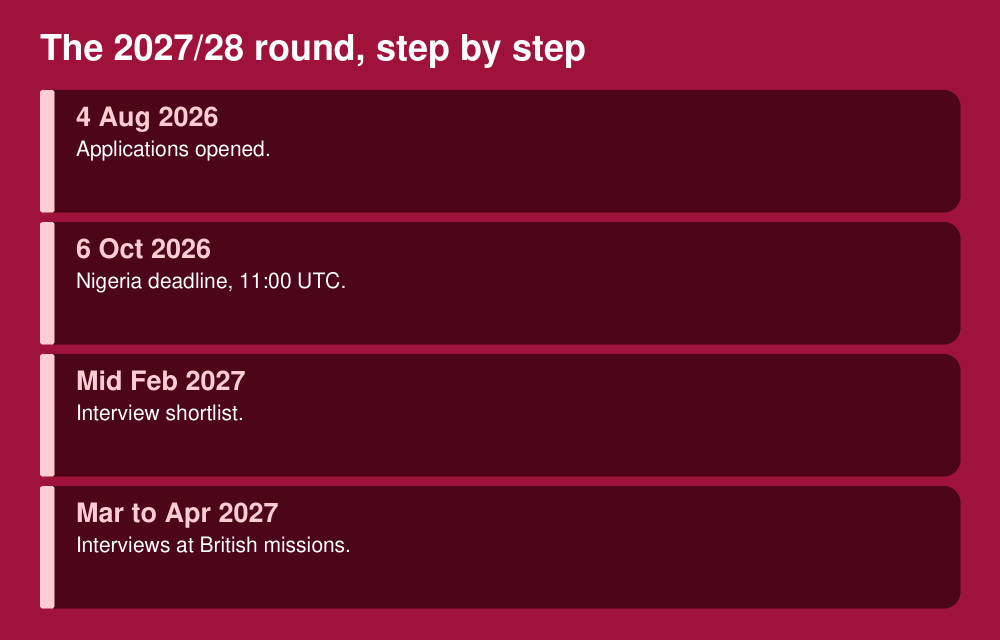
The published timeline for the 2027/28 round was as follows. Dates for the next round have not been announced as we write, and Chevening usually opens applications around August, so watch the official channels from mid-2027.
- 4 August 2026: applications opened.
- 6 October 2026, 11:00 UTC (noon in Nigeria): the Nigeria portal closed. Late submissions were not accepted.
- October 2026: eligibility checks began.
- Mid-October 2026 to January 2027: reading committees assess applications.
- Mid-February 2027: interview shortlist.
- March to April 2027: interviews at British embassies and high commissions. Documents such as references, ID and your degree certificate must be uploaded at least seven working days before your interview.
- From mid-June 2027: results.
- 8 July 2027, 17:00 UK time: deadline for an unconditional UK university offer.
- September or October 2027: studies begin.
The lesson from this timeline is that the application itself is only one part of the work. You need three university applications and at least one unconditional offer, which means your course research, transcripts and personal statements have to be ready well before the scholarship deadline.
How the selection works
Chevening’s application asks for written answers on your leadership, networking, studies and career plans. Chevening says clearly that using artificial intelligence software to generate answers to its essay questions is strictly prohibited, and that applicants must submit their own original work. Applications are then read by a committee, and shortlisted applicants are interviewed. Those selected for interview must upload documents, including references.
Chevening does not publish how many Nigerians apply or how many awards go to Nigeria in each round, so be wary of any website that claims an exact success rate. What you can control is the quality and honesty of your application.
A practical plan for the next round
Whether you start now or in mid-2027, use this order of work.
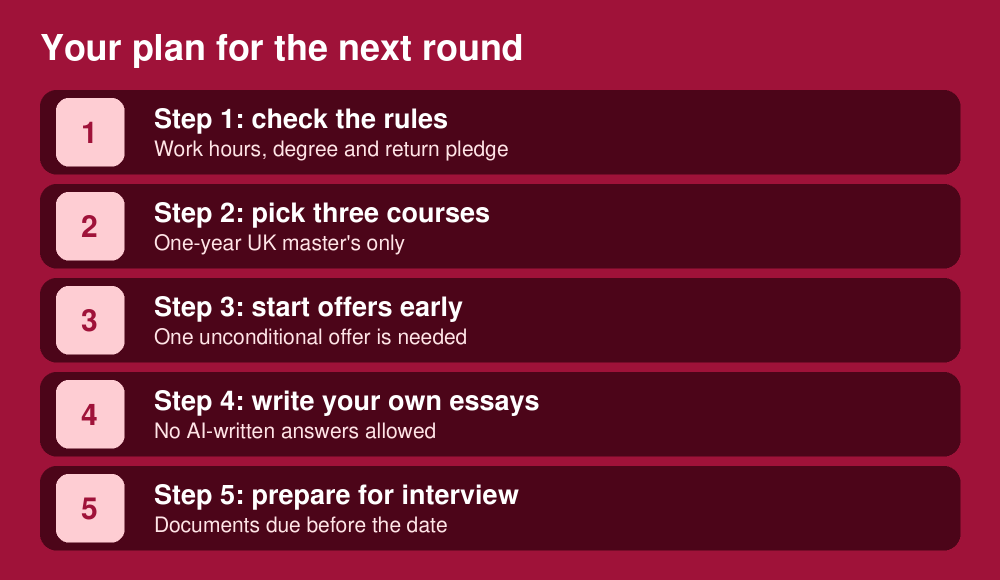
- Count your hours. Add up paid work, self-employment, internships and volunteer roles that came after your first degree, and check them against the 2,800-hour rule using Chevening’s guidance on what counts. Keep letters, contracts or payslips that prove them.
- Choose three UK courses carefully. They must be eligible one-year master’s courses. Pick courses that link to the career you describe in your essays and that you could realistically get into with your degree classification.
- Start university applications early. You need at least one unconditional offer by the July deadline, which can take time if you must still provide transcripts or English test results. Check each university’s English language requirement directly, because Chevening’s eligibility page does not set one.
- Write your own essays. Use real examples from your work and community, with results you can explain. Ask a trusted colleague to read them, but keep the voice yours.
- Choose referees who know your work. References are uploaded before the interview, so tell your referees early and give them the dates.
- Prepare for the interview. Be ready to talk about your plans, your course choices and how you will use what you learn in Nigeria after the two-year return period.
Common mistakes to avoid
- Counting work done while you were still studying toward the 2,800 hours.
- Waiting until the scholarship deadline before you ask a university for an offer.
- Copying essay answers from other blogs or generating them with AI.
- Listing three near-identical courses with no clear reason for your choices.
- Trusting social media pages or agents who claim to guarantee a Chevening award. Chevening does not charge applicants a fee, and nobody can promise you a place.
What happens after you win?
Winners study in the UK for one year. Afterwards you must return to Nigeria for at least two years. If you are thinking about working in the UK after your course instead, our guide to the UK Graduate Route visa for Nigerian students explains the post-study work route, but remember that a Chevening award carries the two-year return commitment, so you should read the rules before you plan anything else. For help with visas generally, see our guide to UK visas for Nigerians and how to avoid rejection.
If you miss out: other options
Chevening is competitive, so it helps to apply for more than one award. Germany funds many programmes, and our guide to studying in Germany for free as a Nigerian shows the low-cost route, while the Commonwealth and university-specific awards are covered in our scholarships guide.
Related guide (updated 15 November 2026)
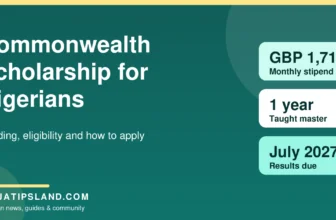
Commonwealth Scholarship for Nigerians (2027/28): Eligibility, Funding and How to Apply covers the master’s and PhD awards, the GBP 1,712 monthly stipend, Nigerian nomination through the Federal Scholarship Board or FAWE, and how to prepare for the next round.
Frequently asked questions
Can I still apply for Chevening 2027/28 from Nigeria?
No. The Nigeria deadline was 6 October 2026 at 11:00 UTC, and Chevening says late submissions are not accepted. The next round is expected to open around August 2027, but confirm on chevening.org.
How much work experience do I need?
At least two years, totalling 2,800 hours, gained after your undergraduate degree. Work done while studying does not count.
Do I need an admission offer before I apply?
You apply to three eligible UK courses and need at least one unconditional offer by the deadline in the application timeline, which for the 2027/28 round was 8 July 2027.
Can I apply if I already have a master’s degree?
Yes. Chevening says holding a master’s degree does not prevent you from applying for a second UK master’s, as long as you meet the other criteria.
Do I have to return to Nigeria after my studies?
Yes, for at least two years after the scholarship ends.
Is there an application fee?
We found no application fee on Chevening’s pages, and you should never pay anyone for a place. If someone asks for money to guarantee an award, treat it as a scam.
Can I use AI to write my essays?
No. Chevening says using AI software to generate answers to its essay questions is strictly prohibited.
Sources
- Chevening: eligibility criteria
- Chevening: application timeline 2027/28
- Chevening: Nigeria page
- Chevening: about the scholarship
- Chevening: applicant FAQs
- Legit.ng: Chevening applications open for Nigerians, deadline announced
Join the discussion
Have you tried this, or do you have a question we did not answer? 1 reader has already shared their view. Naijatipsland members help each other with real, first-hand experience.





Editor’s note: this guide is informational. Chevening dates and rules are set by the UK government and can change, so confirm everything on chevening.org before you act. The 2027/28 Nigeria round closed on 6 October 2026. – Ade