Last updated: 14 October 2026. Network rollouts and device prices change fast, so check coverage and prices locally before you buy. We replaced an earlier, general version with current Nigerian figures.
For most Nigerians, the phone is the computer, the bank branch, the shop and the classroom. Understanding mobile technology helps you choose a phone, a network and a plan that fit your life.
The network picture
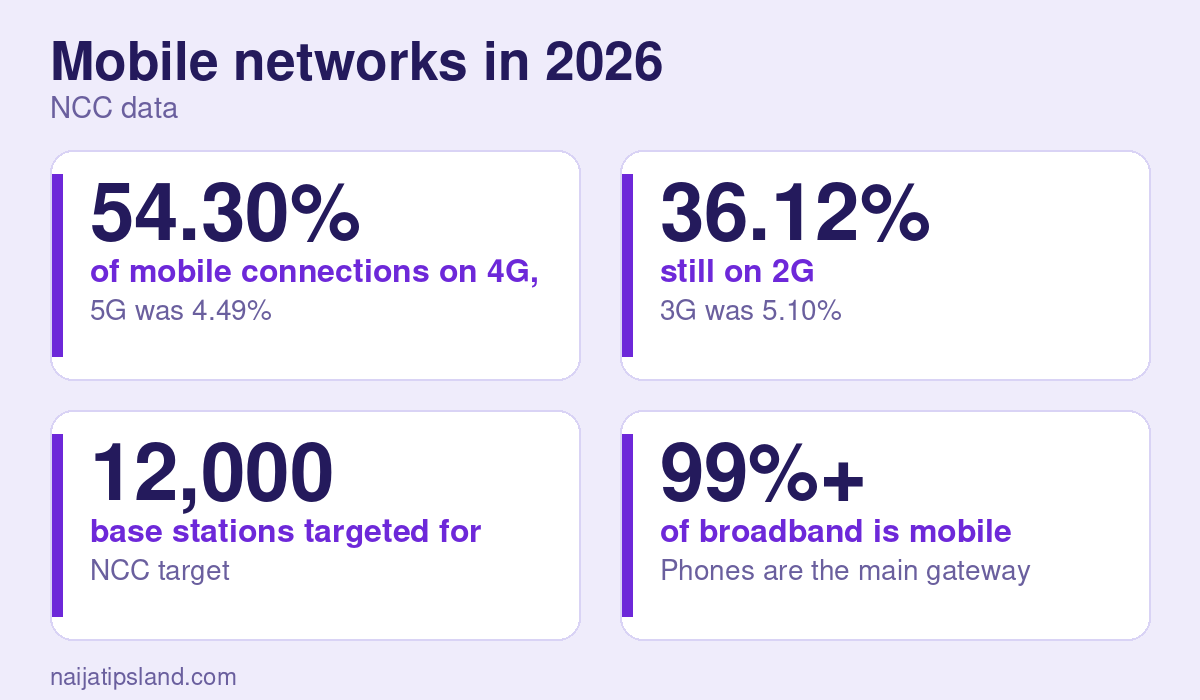
In May 2026, 4G accounted for 54.30% of mobile connections, 2G for 36.12%, 3G for 5.10% and 5G for 4.49%, according to the NCC. By June 2026 the combined share of 4G and 5G had reached 58.92%, up from 54.49% a year earlier. More than 99% of broadband connections are mobile. The NCC has said it plans to upgrade about 12,000 base stations in 2026 to ease congestion and move old 2G and 3G sites to 4G and 5G. See our guide to internet penetration in Nigeria.
5G: promise and limits
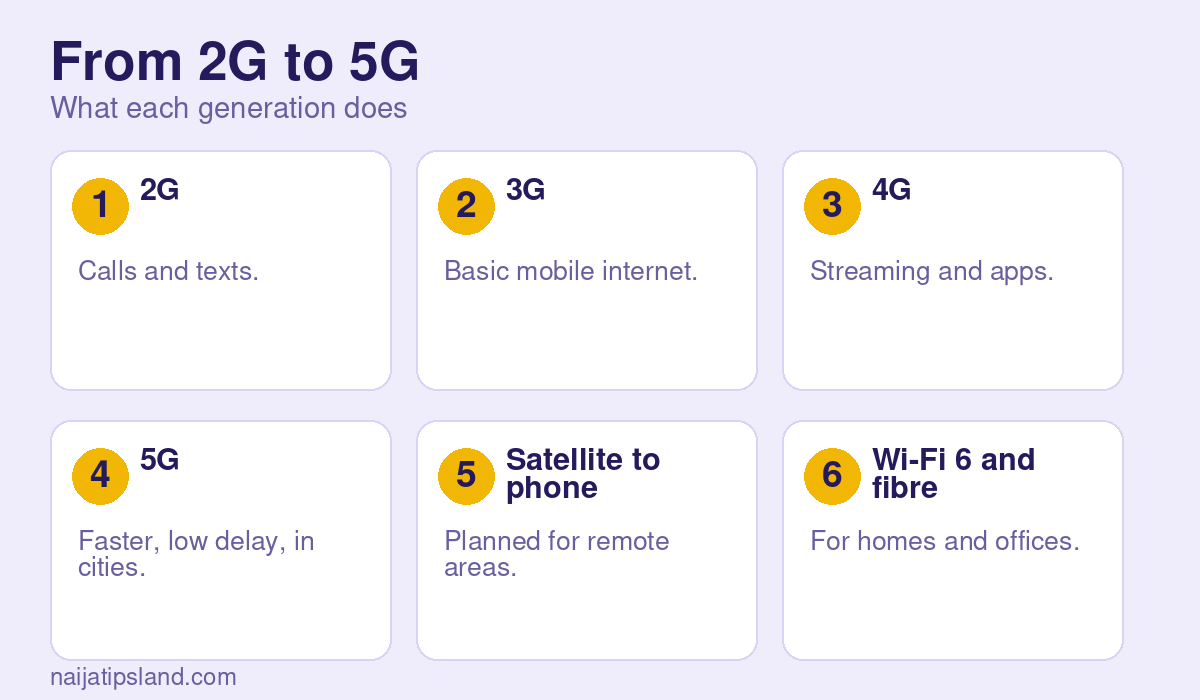
Commercial 5G began in Nigeria in 2022, but four years on it makes up only a single-digit share of connections. The NCC found that large numbers of 5G-capable phones in Lagos and Abuja could not connect to a 5G network, with a coverage gap of around 70.9% in Lagos and 65.6% in Abuja. 4G remains strong and is likely to stay the backbone of the network for years, while 5G grows mostly in cities and in business uses that need very fast speeds or low delay. Before you pay extra for a 5G phone or plan, check whether your area actually has 5G coverage.
Satellite and new technology
The NCC has said direct-to-device satellite services are set to complement terrestrial networks, extending coverage to rural, riverine and border areas where towers cannot reach. Home and business users can also look at fibre and satellite internet. These are still developing and can be costly, so compare options.
Phones, apps and money
- Mobile banking and money transfer have changed how people pay. See our guides on fintech apps and POS businesses.
- Social media and video consume huge amounts of data. See our MTN data guide for ways to save.
- Learning and work now happen on phones. See our guides on remote work and digital skills.
How to buy a phone wisely
- Set a budget and a purpose. A phone for school work, business or photography needs different features.
- Check network compatibility, especially 4G bands used by Nigerian networks, and 5G only if your area has coverage.
- Look at battery, storage and memory, using reviews that test real use.
- Check security updates. Phones that stop getting updates become risky.
- Buy from reputable sellers with a warranty, and avoid unusually cheap “new” phones that may be refurbished, fake or stolen.
- Protect it: set a screen lock, enable find-my-device and back up your data. See online safety tips and SIM registration and replacement.

Looking ahead
Expect gradual growth in 4G and 5G coverage, more satellite links in remote places and a continuing shift from voice to data. Power supply, device prices and tariffs will decide how fast ordinary users benefit. Read more about the digital economy and African tech trends.
Phone Care and Battery Tips
- Avoid leaving your phone in a hot car or in direct sun, since heat damages batteries.
- Use the charger and cable that came with the phone or a good-quality equivalent, and avoid fake chargers.
- Close apps that drain the battery, lower screen brightness and turn on battery saver when you are away from power.
- Keep some free storage so that the phone runs smoothly, and restart it from time to time.
- Use a sturdy case and screen protector, especially if you travel a lot.
If Your Network Is Poor: Simple Troubleshooting
- Switch airplane mode on for ten seconds, then off.
- Restart the phone and check whether the SIM is seated properly.
- Move to a window or a higher place and test again.
- Try another network or another SIM if you have one.
- Update your phone software.
- Complain to your operator, keep a record and escalate to the regulator if the problem continues.
Glossary
- Latency: the delay between sending and receiving data. Lower is better for calls and games.
- Band: the radio frequency a network uses. Phones must support the bands used in your area.
- eSIM: a built-in digital SIM available on some phones. Check whether your operator supports it.
- Roaming: using a network outside your home network or country, which can be costly.
Related: iPhone prices in Nigeria for every model, new and UK-used.
Related: best phones under ₦150,000 and ₦200,000 in Nigeria.
Related: best power banks in Nigeria (2026): prices and real charges.
Frequently Asked Questions
Do I need a 5G phone?
Only if you live where 5G coverage exists and you will use it. 4G is enough for most people today.
Why is my internet slow?
Causes include network congestion, weak signal, an old phone or low data speeds on your plan. Try a different location or network, and report persistent problems to your operator.
What is the most common mobile technology in Nigeria?
4G, at 54.30% of mobile connections in May 2026, although 2G is still sizeable.