
How to Write a News Story: The Inverted Pyramid, Verification and Ethics (Nigerian Guide)


Last updated: 14 October 2026. This is a practical writing guide, not legal advice. Check your outlet’s editorial policy and consult a lawyer on legal risks. We rewrote this guide with a focus on verification and ethics.
A news story tells readers what happened, accurately and fast. In an age of rumours and AI-made fakes, the writers who win trust are those who verify and attribute everything. Whether you write for a newspaper, a blog or a community page, the same basics apply.
1. Start with the facts
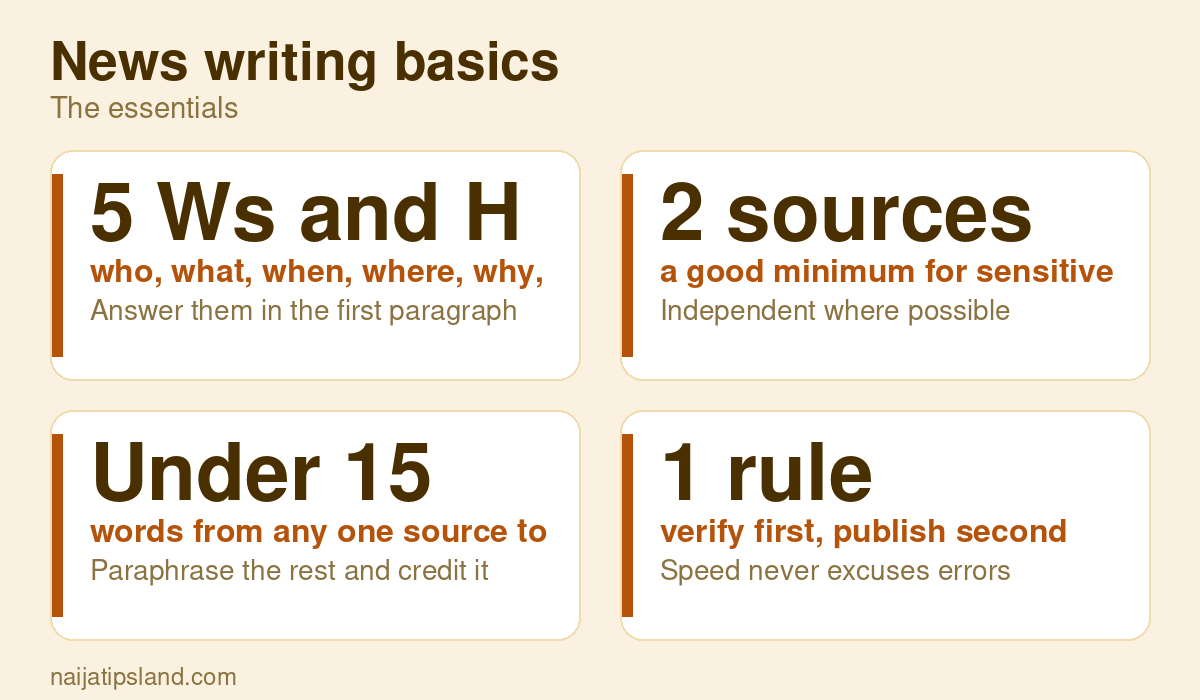
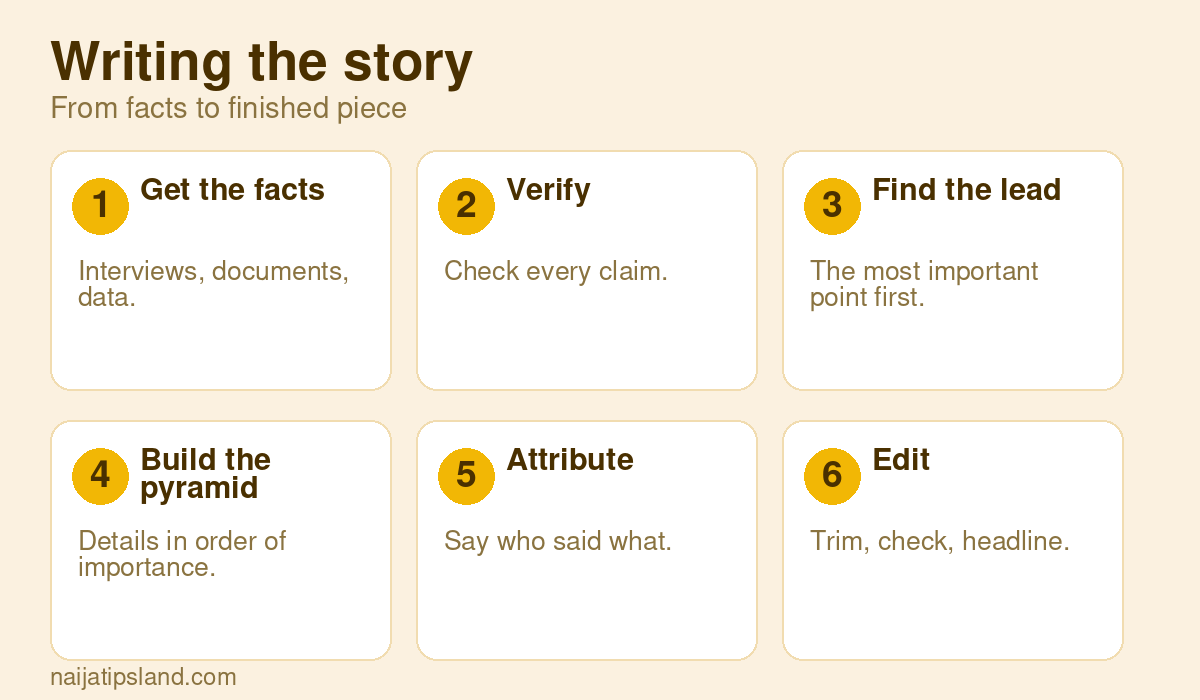
Gather information from interviews, official documents, data and direct observation. Record names, titles, dates and figures carefully. Ask the five Ws and H: who, what, when, where, why and how. If you cannot answer one, say so rather than guessing.
2. Verify before you write
- Confirm the main facts with at least two independent sources, especially for serious claims.
- Find the original document, statement or data. For statistics, check the source, date and definitions.
- Check photos and videos with reverse image search, and be alert to AI-generated content. See our guides on verifying news and fake news.
- Use official channels for official facts, such as INEC, the NBS or the NCC.
3. Write the lead
The lead, or first paragraph, gives the most important information in one or two short sentences. Example: “INEC said on Monday that the national voter register had passed 103 million after a clean-up using its biometric system, and that collection of voter cards would begin on 9 October.” Avoid starting with background or a quote unless it is the story.
4. Use the inverted pyramid
Put the most important facts first, then the next most important, and end with background and minor details. If an editor cuts from the bottom, the story still works. A typical structure:
- Lead: the key news.
- Next paragraph: the most important detail or quote.
- Context: why it matters, what happened before.
- Other views: reaction, opposing views and those affected.
- Background and what happens next.
5. Attribute and quote responsibly
Say where each claim comes from: “the police spokesperson said”, “according to the NBS report”. Use direct quotes sparingly and accurately, and paraphrase the rest. Do not copy other outlets’ articles. Copyright law applies, so write your own version, credit the original and link to it. Anonymous sources should be used only when necessary and when you can explain why.
6. Write clearly
- Short sentences, active verbs and plain words.
- One idea per paragraph.
- Spell out acronyms on first use and explain technical terms.
- Use numbers carefully, with comparisons that make sense.
- Cut adjectives and opinion from news reports.
7. Write an honest headline
A good headline is accurate, specific and short. It should match the story and avoid clickbait. Do not promise what the article does not deliver.
Ethics and the law
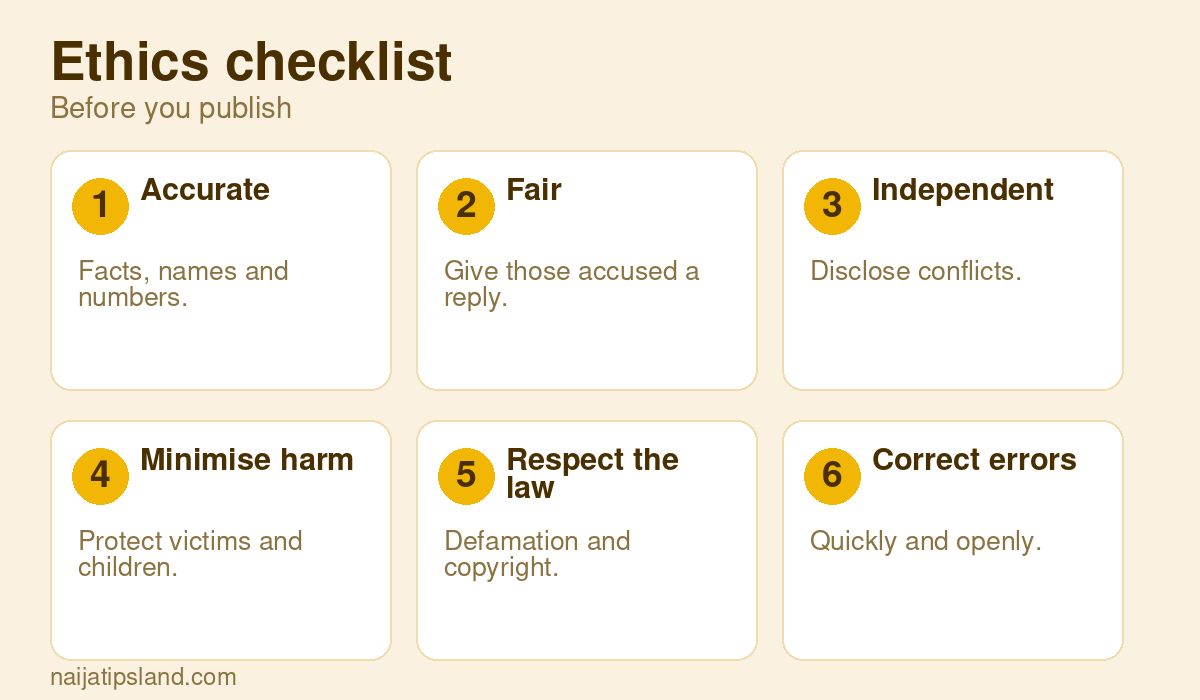
- Fairness: give people you accuse a chance to respond, and report their answer.
- Harm: take extra care with victims of crime, sexual violence and minors. Do not identify them without proper reason and consent.
- Defamation: publishing a false statement that damages someone’s reputation can lead to legal action, so be able to prove what you say.
- Cyber laws: Nigeria’s Cybercrimes Act has been used against journalists, and its provisions on online speech remain debated. See our guide on cybercrime laws.
- Data protection: handle personal data lawfully. See data privacy.
- Corrections: fix errors quickly and openly.
A pre-publication checklist
- ☐ Did I check every name, number, date and quote?
- ☐ Do I have two sources for serious claims?
- ☐ Did I ask the affected people for comment?
- ☐ Is the headline accurate?
- ☐ Are images properly sourced and credited?
- ☐ Have I separated fact from opinion?
Build your skills with our guides on communication skills, following the news and political commentary.
Writing Headlines That Are Honest
- Say what happened, using specific verbs and numbers.
- Avoid exaggeration and avoid a headline that the story does not support.
- Do not repeat a false claim in the headline, even to deny it.
Attribution and Quotes
- Name your sources where you can, and explain why an anonymous source is anonymous.
- Quote accurately and keep context. Do not edit quotes to change their meaning.
- Link or credit the original reporting. See our guide on verifying trends.
Ethics Basics
- Protect children, victims of abuse and people in danger. Do not publish details that identify them.
- Respect privacy and avoid filming or naming people without consent. See data privacy.
- Separate news from opinion and label sponsored content.
- Correct mistakes openly.
An Exercise
Take a press release and rewrite it as a news story: lead with the most important fact, add the who, what, when, where and why, include one independent source and one number, and cut every adjective you cannot support.
Frequently Asked Questions
What is the inverted pyramid?
A structure that puts the most important information first and the least important last.
Can I copy a news article?
No. Write your own version, credit the source and link to it.
How do I avoid spreading fake news?
Verify with primary sources and several independent outlets before you publish.
Sources
- Nairametrics: Nigeria’s voter register surpasses 103 million (example lead)
- ICIR: What to expect in Nigeria’s fact-checking space in 2026
Join the discussion
Have you tried this, or do you have a question we did not answer? Be the first to share your experience. Leave a comment below. Every comment is read by the editor before it appears.