African Tech Trends 2026: Funding, Debt, Fintech and Where Nigeria Stands


Last updated: 14 October 2026. Funding totals differ between trackers because of different definitions, and figures are often revised. We replaced an earlier version with the latest Partech report.
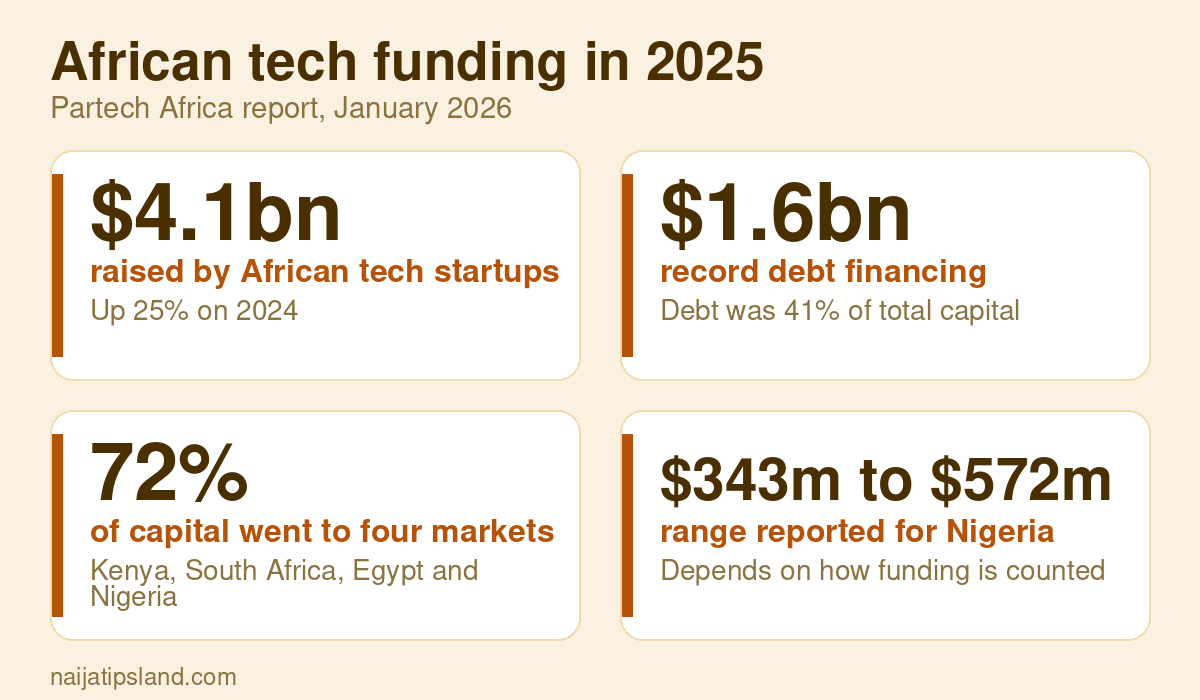
African tech had a recovery year in 2025. According to Partech’s annual Africa Tech Venture Capital Report, released on 22 January 2026, African startups raised $4.1 billion in 2025, up 25% from the year before and the strongest year since 2022. Behind the headline are some important shifts.
1. Debt is catching up with equity
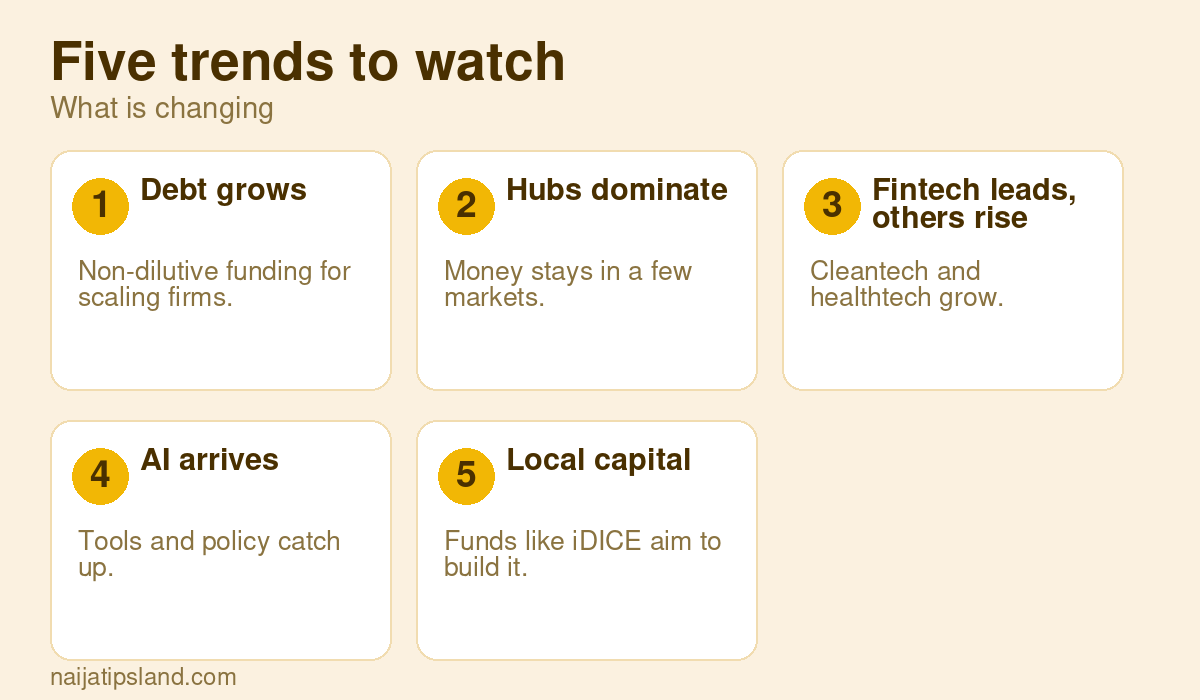
Equity funding reached $2.4 billion, up 8% across 462 deals, while debt financing hit a record $1.6 billion, up 63%. Debt made up 41% of all capital deployed in 2025, against 31% in 2024 and 17% in 2019. That reflects later-stage startups with predictable revenues, such as payments and lending firms, preferring non-dilutive funding. For founders, it means revenue and collateral matter more. See our guides on Nigerian startups and common entrepreneurship mistakes.
2. A few hubs take most of the money
Kenya, South Africa, Egypt and Nigeria absorbed 72% of total capital in 2025. Kenya led on total capital with about $1.04 billion, driven by large debt rounds, while South Africa topped equity funding and deal count. Other reports put Nigeria’s 2025 total between $343 million and $572 million, depending on how deals are counted. Outside the top four, only a few countries passed $50 million in equity. Francophone Africa strengthened its position outside the top four. Concentration worries observers who want a broader spread of capital and stronger local investors.
3. Fintech still leads, but others are rising
Fintech raised $769 million in equity, around 25% of equity funding, but its share fell as other sectors grew: cleantech funding rose 186%, healthtech 232% and enterprise software 55%. Nigeria’s own giants remain in payments. See our guides on fintech apps, what fintech is and cryptocurrency.
4. Local capital and policy are being built
In July 2026 Nigeria announced a $170.6 million fund of funds under the iDICE programme to build domestic venture capital. See our guide on iDICE. The 2022 Nigeria Startup Act provides a policy framework, and regulators are tightening rules on digital assets, payments and data. See data privacy and cybercrime laws.
5. Connectivity and AI
Broadband penetration in Nigeria reached 57.4% in July 2026 and 4G dominates while 5G is slowly expanding. Satellite-to-phone services are planned for remote areas. AI tools are spreading, with policy trying to catch up. See our guides on internet penetration, mobile technology and responsible AI adoption.
Other things to watch
- Stablecoins and tokenisation: naira-linked tokens such as cNGN and regulators’ digital-asset rules. See our guide to blockchain technology.
- E-invoicing and compliance technology: new tax rules create demand for software. See IT business ideas.
- E-commerce and logistics. See Nigeria’s e-commerce market.
- Remote work and talent export. See remote work.
- Cybersecurity: fraud and breaches are costly, so demand for security skills is high. See cyber security.
What it means for you
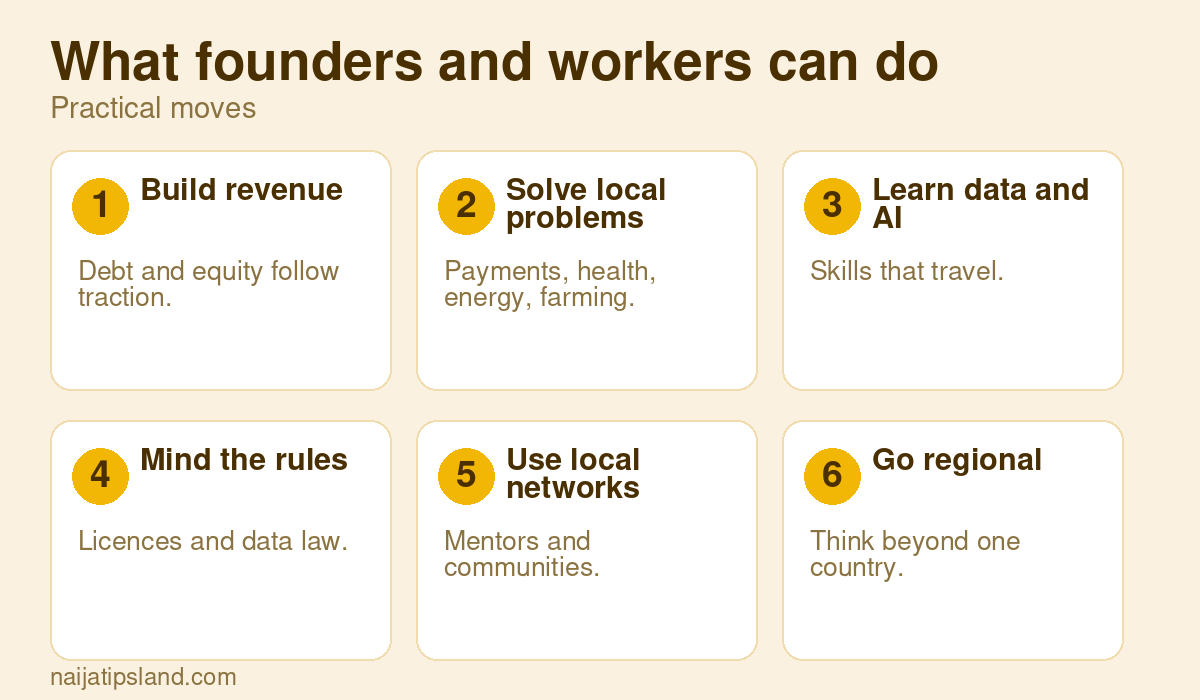
- Founders: build revenue, understand debt versus equity and respect regulation.
- Workers and students: learn skills in data, security, software and product. See our guides on skills in demand and digital skills.
- Everyone: be careful with investment claims about “the next big thing”. See internet scams.
2026 So Far: A Tougher Year for Founders
After 2025, when African startups raised about $4.1 billion according to Partech, 2026 has been more uneven. African startups raised about $1.44 billion in the first half of 2026, slightly more than a year earlier, but the number of disclosed deals fell from 252 to 146. In Nigeria, startup funding was $78.6 million in the first quarter, down 28% year on year, and swung between $115.2 million in June and $4.9 million in July, according to Nairametrics reports. Several Nigerian startups closed, including Gigbanc and Chimoney, citing the difficulty of raising new money.
What the Shift Means
- Debt and grants matter more: with equity scarce, founders are looking at revenue-based finance, grants and development finance. See our guide on iDICE.
- Discipline pays: investors favour firms with revenue, controlled costs and clear paths to profit.
- Hiring is selective: demand for AI, data and security skills continues, while generalist roles face more competition. See career tips.
- Regulation is part of the product: licensing, tax and data rules shape which fintechs can scale. See e-commerce in Nigeria.
What to Watch
- Whether monthly Nigerian funding recovers after July’s low.
- Whether the interest rate cut to 23% in September improves credit for small firms.
- Whether the new iDICE fund of funds starts reaching founders.
- How the 2027 elections affect investor confidence.
Frequently Asked Questions
How much did African startups raise in 2025?
$4.1 billion in equity and debt, according to Partech.
Which countries lead African tech funding?
Kenya, South Africa, Egypt and Nigeria, which together received 72% of capital in 2025.
Why are the figures for Nigeria different in different reports?
Trackers count debt, rounds and company locations differently, so totals vary.
Sources
- Partech: 2025 Africa Tech VC Report, funding rebounds to $4.1 billion
- allAfrica: African tech funding rises to $4.1bn in 2025 as debt takes a larger role
- Startupbusiness: VC in Africa, $4.1 billion in equity and debt in 2025
- allAfrica: Global capital flows to few cities as African startups raise $4.1bn