Data Privacy in Nigeria: Your Rights Under the NDPA 2023 and How to Protect Them

Last updated: 14 October 2026. This is general information, not legal advice. Regulatory rules, deadlines and enforcement decisions change, so confirm details with the Nigeria Data Protection Commission (NDPC). We rewrote this guide around the NDPA 2023 and recent enforcement.
Every time you register for an account, take a loan, visit a clinic or sign up for a SIM, someone holds your personal data. In Nigeria, the Nigeria Data Protection Act 2023 (NDPA) gives you legal rights over that data and sets duties for the organisations that hold it.
What the law is
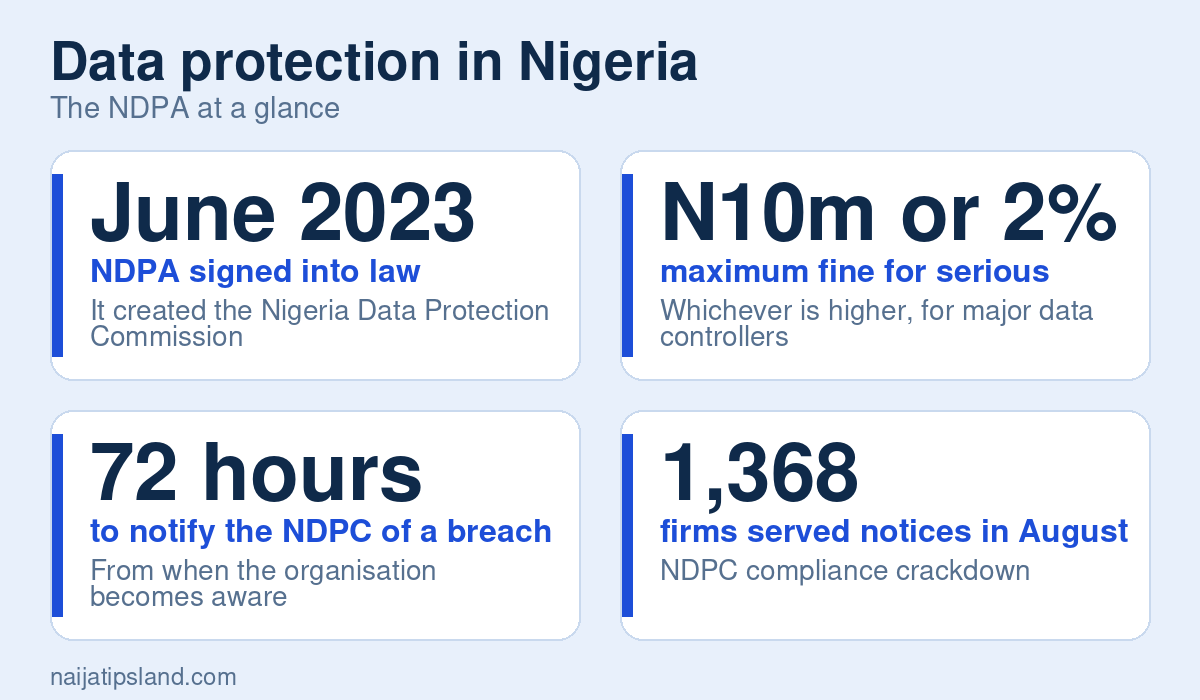
The NDPA received presidential assent in June 2023. It replaced the earlier Nigeria Data Protection Regulation of 2019 as the main law and set up the Nigeria Data Protection Commission as an independent regulator. A General Application and Implementation Directive (GAID) came into effect in September 2025 to spell out the details. The law applies to organisations that process the personal data of people in Nigeria, whether the organisation is a bank, a school, a church, a shop or an app.
What counts as personal data?
Any information that can identify you directly or indirectly: your name, phone number, address, email, BVN and NIN, photographs, location, biometric data, IP address and more. Some data is more sensitive, such as health, religion, political opinions, children’s data and biometrics, and needs stronger protection.
Your rights
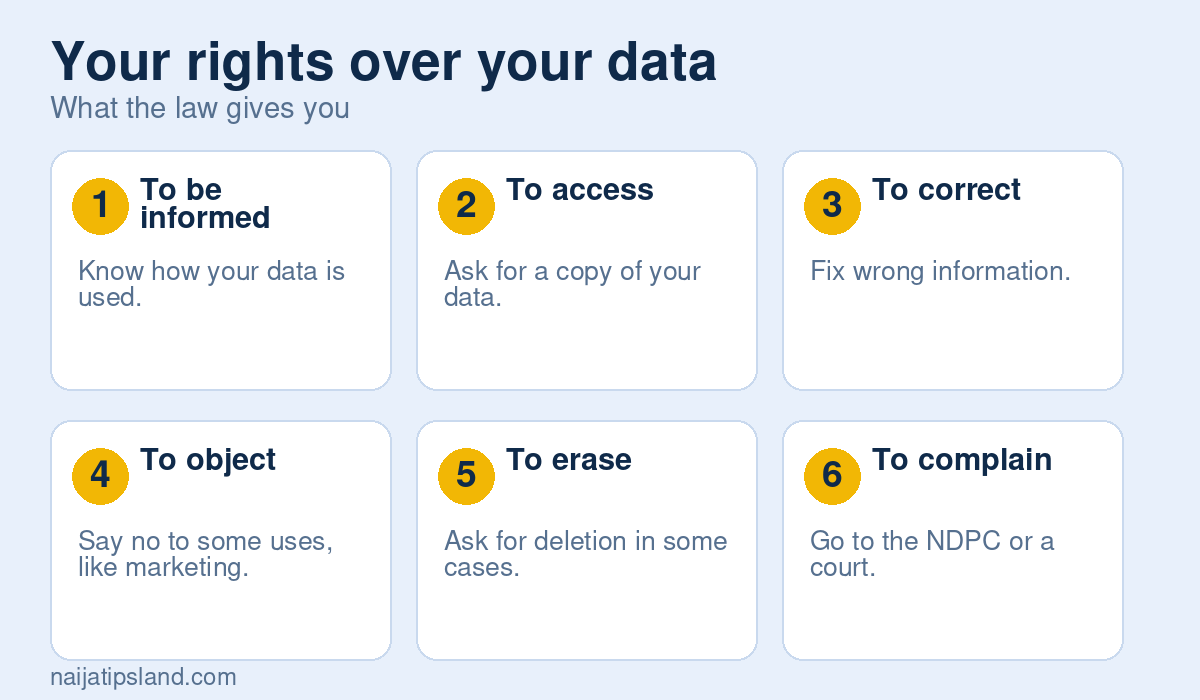
- To be informed about who is collecting your data, why, for how long and who gets it.
- To access the data an organisation holds on you.
- To correct inaccurate data.
- To object to some processing, including direct marketing.
- To erasure in certain circumstances.
- To complain to the NDPC and seek a remedy through the courts.
What organisations must do
- Have a lawful basis, such as your consent, for each use of your data.
- Collect only what is needed and use it for the stated purpose.
- Keep it secure and limit access.
- Appoint a data protection officer where required.
- Notify the NDPC within 72 hours of becoming aware of a breach that is likely to harm people, and tell affected people where required.
- Larger organisations classed as data controllers or processors of major importance must register with the NDPC and file an annual compliance audit return through a licensed compliance organisation. The NDPC extended the 2026 filing deadline from 31 March to 30 May 2026.
Penalties and enforcement
For serious breaches, the NDPC can fine a major data controller up to the higher of ₦10 million or 2% of its annual gross revenue, and can issue enforcement orders. In August 2025 it served compliance notices on 1,368 organisations, naming them in newspapers, and in an earlier case it fined Fidelity Bank ₦555.8 million, which it said was its largest penalty at that time. The NDPC has also warned content creators against filming and posting people without consent. Courts have also questioned parts of the Commission’s guidance, so details on registration and transfers can change.
Data breaches are common
One analysis counted about 119,000 data breaches in Nigeria in the first quarter of 2025, and the Corporate Affairs Commission confirmed in April 2026 that attackers had gained unauthorised access to parts of its systems. Estimates of losses vary, and the Nigerian Communications Commission has put annual losses from online fraud at around $500 million. See our guides on cyber security and cybercrime laws.
How to protect your own data
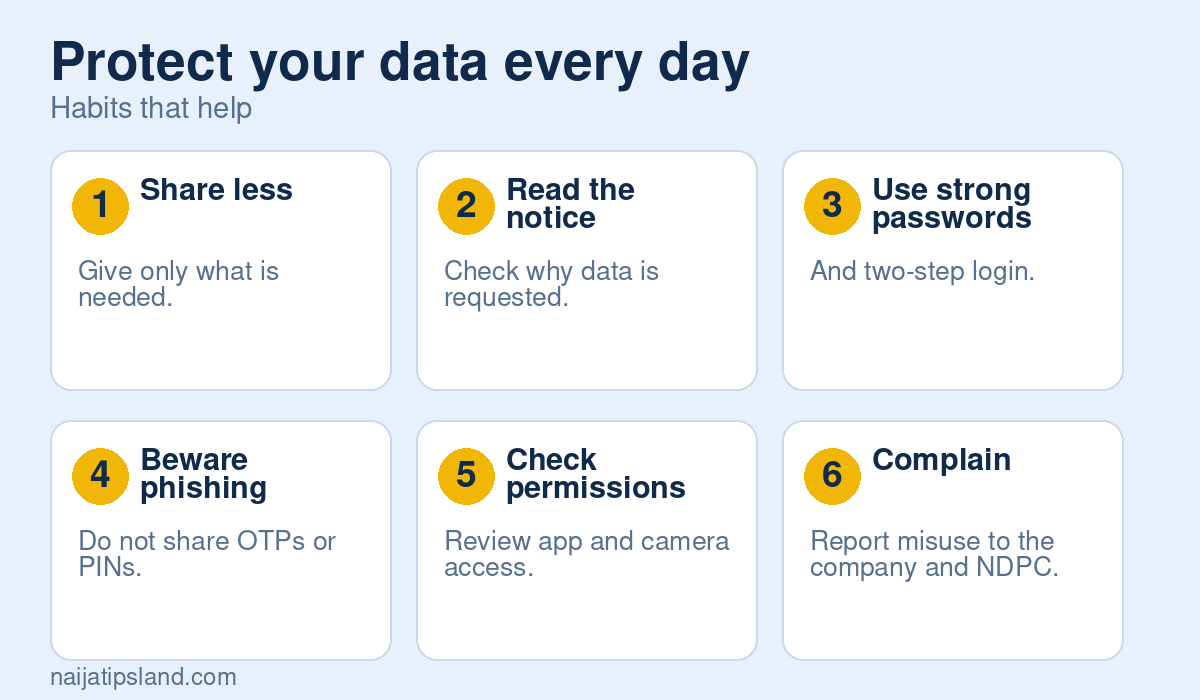
- Share less. Ask why a form needs your data, and refuse what is not needed.
- Read the privacy notice or at least ask how your data will be used and kept.
- Use strong, unique passwords and two-step login, and never share OTPs or PINs. See online safety tips.
- Be careful with your NIN and BVN. Do not give them to strangers or unofficial websites. See our guide on digital identity.
- Check app permissions for contacts, camera, location and storage, especially with loan apps. Digital lenders are banned from harassing borrowers through your contact list. See how to save money for safer options.
- Opt out of marketing you did not ask for.
How to make a complaint
- Write to the organisation’s data protection officer, saying what happened and what you want.
- Keep copies of your messages.
- If there is no good response, complain to the NDPC through its official channels, and consider a court action or legal advice.
Frequently Asked Questions
Does the NDPA protect me from spam calls and messages?
It gives you the right to object to direct marketing, and organisations need a lawful basis to contact you.
Can a company keep my data forever?
No. Data should be kept only as long as needed for the purpose or required by law.
Who regulates data protection in Nigeria?
The Nigeria Data Protection Commission.
Sources
- Global Law Experts: Nigeria data protection compliance 2026
- Global Law Experts: NDPC audit return, Nigeria
- TheCable: NDPC fines Fidelity Bank N555m
- allAfrica: Nigeria targets 1,368 firms in data protection crackdown
- Templars: Navigating the enforcement framework under the Data Protection Act 2023
- Medium: What Nigeria’s cybersecurity crisis means for your data privacy obligations
Related guide (updated 8 November 2026)
Thinking about a VPN? Read our guide: Best VPN for Nigeria (2026): Prices, Legality, Speed and What to Avoid.
Join the discussion
Have you tried this, or do you have a question we did not answer? Be the first to share your experience. Leave a comment below. Every comment is read by the editor before it appears.