Last updated: 13 October 2026. Market figures are estimates from research firms and differ because they count different things. We removed claims in an earlier version that we could not source.
Shopping this November? Read our Black Friday 2026 guide to spot real deals and avoid scams.
Nigerians shop on their phones. They browse a marketplace app during a break, order from a seller they found on Instagram, pay by bank transfer and wait for a rider. That is mobile-first e-commerce, and it is growing even though inflation and delivery problems make it hard. If you want to sell, or just buy smartly, it helps to see the market clearly.
How big is it?
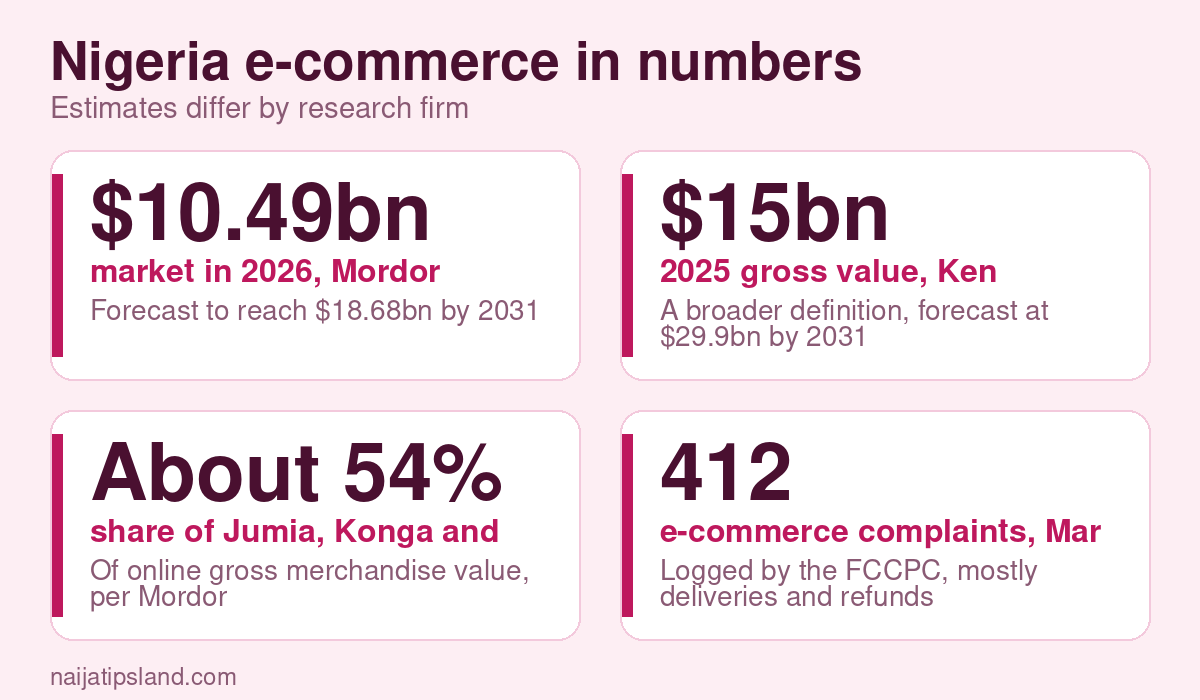
It depends on who is counting. Mordor Intelligence estimates Nigeria’s e-commerce market at $9.35 billion in 2025, $10.49 billion in 2026 and $18.68 billion by 2031, a growth rate of about 12.2% a year, which is where the headline in our title comes from. Ken Research puts gross value at about $15 billion in 2025, rising to $29.9 billion by 2031 at a similar rate, because it measures a broader basket. Both agree on the direction: steady double-digit growth, tempered by inflation and exchange rate swings.
Who leads
Mordor says Jumia, Konga and Temu together accounted for roughly 54% of online gross merchandise value in 2024. Temu, which entered Nigeria in late 2024 with aggressive prices, has intensified competition. Jumia has reported that its Nigerian orders rose 30% year on year in the third quarter of 2025 and 33% in the fourth. Classified sites such as Jiji and the many social sellers on WhatsApp and Instagram make up a large part of the market that never shows in company reports.
How people pay
Payments are the strongest part of the system. The instant payment platform processed about 11.27 billion transactions in 2024, and transfers, cards, payment links and wallets are all common. Research firms expect digital payment to rise as a share of online orders, and buy now pay later is forecast to be the fastest-growing segment, though that raises the need for caution on credit. See our guides to fintech apps and what fintech is.
The hard parts
- Delivery: addresses are inconsistent, roads and traffic are unpredictable and costs vary. Many sellers use pickup points or riders and show delivery fees clearly.
- Trust: the FCCPC logged 412 e-commerce complaints between March and August 2025, mostly failed deliveries, delayed refunds and counterfeit goods. Individual losses were small, but they happen often.
- Costs: fuel, packaging and platform fees squeeze margins. See our guide on the fuel subsidy debate.
- Cash flow: inflation means that stock bought today costs more tomorrow, so price carefully.
The rules
The Federal Competition and Consumer Protection Act 2018 sets rules on fair dealing, and lawyers note that blanket “no refund” policies can clash with it. Buyers can report problems on the FCCPC complaint portal. The Nigeria Data Protection Act 2023 covers customer data, and advertising rules apply to promotions. Register your business with the CAC. See our guide on registering a business name, and check your tax position in our VAT guide.

A seller’s playbook
- Pick a niche you understand, such as fashion, beauty, phone accessories or food, and know your competitors’ prices.
- Start where your customers are: a marketplace for reach, social media for relationships, and your own shop page when you have repeat buyers.
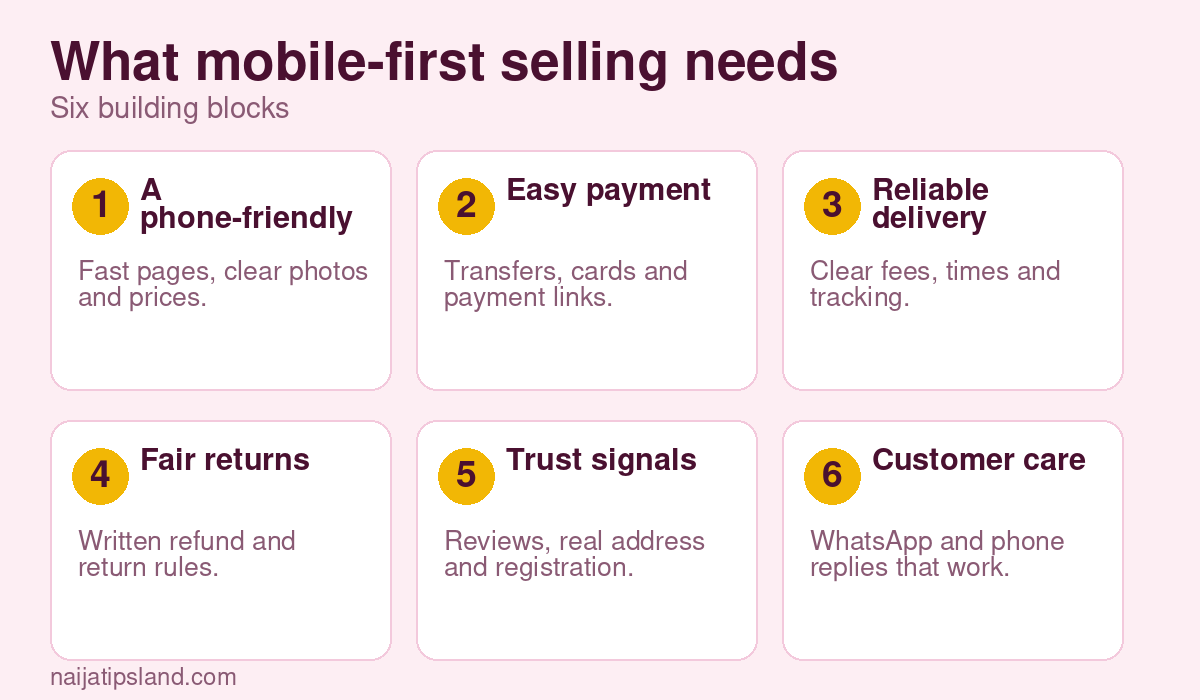
- Show real photos, prices and delivery times. Vague listings lose trust.
- Accept traceable payments and confirm the money in your own app before dispatch.
- Write your return and refund rules and keep them fair and visible.
- Track costs weekly, including delivery, fees and unsold stock, and reprice when costs change.
- Collect reviews and answer messages quickly.
A buyer’s checklist
- Check reviews and the seller’s address and contact details.
- Prefer payment on delivery or platform-protected payments for new sellers.
- Keep chats and receipts, and report fraud to your bank and the FCCPC.
- Avoid sellers who insist on transfers to personal accounts with deals that look too good. Read our guide on internet scams.
Pricing in an Inflation Economy: A Worked Example (Hypothetical)
Suppose you buy a pair of sneakers for ₦8,000 and plan to sell them online. Delivery to the customer costs you ₦1,500, packaging ₦300, a payment fee is about ₦200 and a marketplace takes a 10% commission, roughly ₦1,300 at the selling price. To make ₦2,000 profit, the price needs to be about ₦13,300 (8,000 plus 1,500 plus 300 plus 200 plus 1,300 plus 2,000). If your supplier raises the price to ₦9,000 next month and you do not reprice, your profit is gone. Build a simple costing sheet, update it weekly and keep a buffer for returns.
Common Mistakes to Avoid
- Competing only on price. Buyers also look at trust, speed and service.
- Promising delivery dates you cannot keep.
- Taking orders without confirming stock.
- Mixing business and personal money in one account.
- Ignoring complaints. Reply quickly and fix problems in public.
- Borrowing from loan apps to buy stock. See our guide to common money mistakes.
Delivery Tips That Save Money
- Group orders by area so one rider can deliver several parcels.
- Use pickup points for customers who can collect.
- Tell buyers the delivery fee and time before they pay.
- Photograph parcels before dispatch, and keep rider contact details.
- Use sturdy, simple packaging. Damaged goods are a leading cause of returns.
Where Social Selling Fits
Social platforms are where many Nigerian shops are born. Treat them like a shop window: post consistent photos, answer questions fast, show real customers’ feedback with permission, and move serious buyers to a clear order process with a written price, delivery fee and payment account. Our guide to social media growth shows how to build an audience without gimmicks.
Payment Methods Compared
- Bank transfer: the most common. It is quick and cheap, but sellers must confirm the credit in their own app and watch for fake alerts.
- Card payments: convenient for larger orders and repeat buyers, with fees charged to the seller and sometimes failed attempts at checkout.
- Wallets and payment links: useful on social media, because the buyer pays without sharing account details in chat.
- Cash on delivery: reassures new buyers, but it adds cash handling and the risk of refused parcels. Use it with deposits for bulky or custom items.
- Buy now, pay later: can lift sales, but the seller should confirm who bears the risk, and the buyer should read the total cost. See our guide to common money mistakes.
Mobile-First Basics for Your Shop Page
- Keep pages light, because many buyers use limited data and slow connections.
- Put the price, delivery fee and a buy or message button near the top.
- Use square, well-lit photos that load quickly, and show the item in use.
- Make contact easy with a tap-to-chat button and a working phone number.
- Test your page on a low-cost phone before you promote it.
Frequently Asked Questions
How big is e-commerce in Nigeria?
Estimates vary: about $10.49 billion in 2026 on Mordor’s measure, and about $15 billion in 2025 on a broader one.
Which platforms are biggest?
Jumia, Konga and Temu together accounted for about 54% of online gross merchandise value in 2024, according to Mordor, with social sellers adding a lot more.
Do I need to register my online business?
It is strongly advisable. Registration helps you open accounts, build trust and meet legal and tax duties.
Where can I report a bad online seller?
To your bank, to the platform, and to the FCCPC through its complaint portal.
Sources
- Nexdigm (citing Mordor Intelligence): Nigeria e-commerce market size and share
- Onlinemarktplatz: Nigeria e-commerce forecast to $18.68bn
- Ken Research: Nigeria e-commerce and online retail market, 2026 to 2031
- Ken Research: Nigeria FMCG e-commerce and last-mile market (Jumia order growth)
- TechCabal: How banks and fintechs refunded Nigerians N10 billion in six months
- The Guardian: FCCPC receives 9,091 complaints in 6 months
- Templars: The legality of no-refund policies under Nigerian consumer protection law
- Leadership: E-payments hit N3.46 quadrillion (with NIBSS 2024 figures)