
Submit Post
Date: June 9, 2026 6:32 pm. Number of posts: 3,962. Number of users: 3,457.

Common Entrepreneurship Mistakes That Kill Startups


TL;DR:

  • Common startup mistakes include poor product-market fit, cash flow mismanagement, and lack of operational systems. Addressing these issues early improves survival odds and prevents common failures. Building validated demand, managing cash carefully, and documenting processes are essential for sustainable growth.

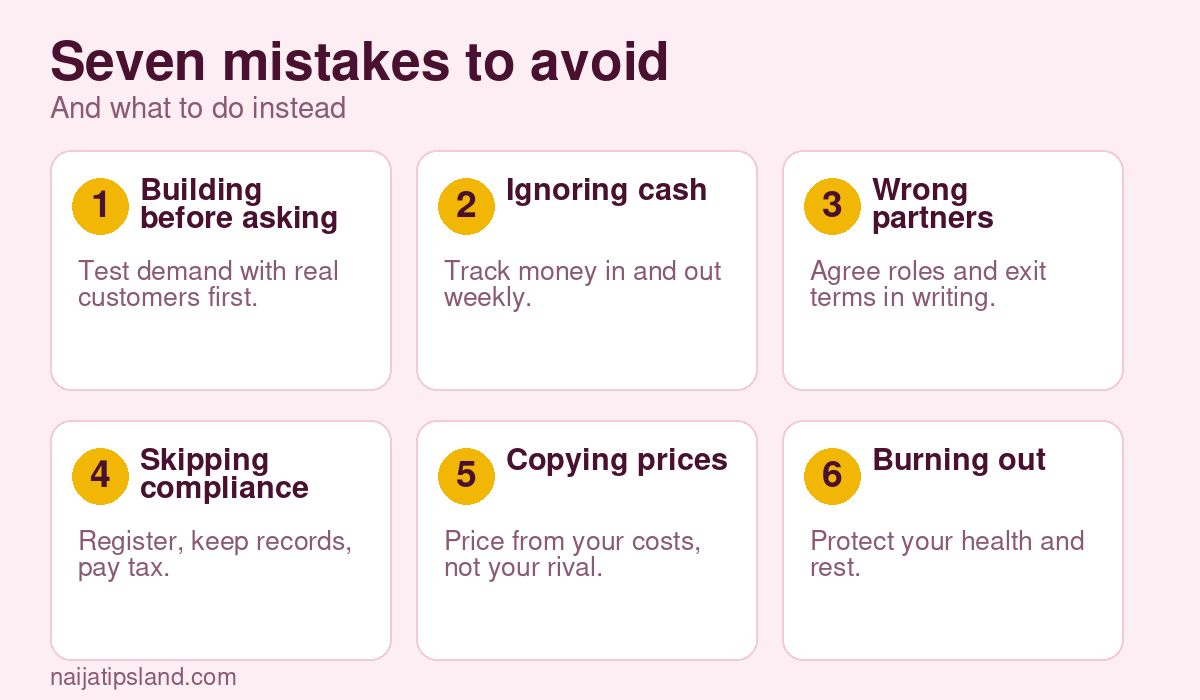
Common entrepreneurship mistakes are specific, recurring errors that cause startups to fail or stall, including poor product-market fit, cash flow mismanagement, and the absence of repeatable processes. According to CB Insights’ analysis of over 400 VC-backed startups, 43% of failures trace back to poor product-market fit alone. The Kauffman Foundation’s 2025 National Indicators report confirms that startups carry a 77.9% one-year survival rate, meaning roughly one in five new businesses does not survive its first year. These numbers are not meant to discourage you. They exist to show that understanding these entrepreneurial pitfalls before you hit them is the single most effective thing you can do to improve your odds.

1. Common entrepreneurship mistakes: ignoring product-market fit

Poor product-market fit is the leading root cause of startup failure, not bad marketing or weak execution. CB Insights found that 43% of startup shutdowns cite this as the primary reason. That means nearly half of all failed founders built something the market did not want badly enough to pay for consistently.

Startup founder analyzing product-market fit data

The mistake is not building a bad product. The mistake is building before validating. Many founders rely on personal enthusiasm and early encouragement from friends rather than adversarial evidence. Adversarial validation means actively seeking reasons your idea will fail, not reasons it will succeed. Tools like customer discovery interviews, landing page tests, and pre-sale campaigns give you real market signals before you invest months of development.

Pro Tip: Before writing a single line of code or ordering inventory, run a 30-day pre-sale test. If you cannot get 10 paying customers from your network, your pitch or product needs work before you scale outreach.

2. Treating revenue as the same thing as cash flow

A business can show profit on paper and still run out of money. This is one of the most misunderstood common business errors among first-time founders. Cash flow is about timing: when money actually enters and leaves your account, not when it is earned or owed.

The gap between receivables and payables kills startups quietly. You pay your supplier in 30 days, but your client pays you in 60. That 30-day gap is a cash hole. Cash flow timing mismatches between receivables and payables are one of the most cited operational causes of early-stage failure. Zyro Magazine recommends building a three-month operating expense reserve and separating personal and business accounts from day one.

Practical steps to protect your cash position include setting invoice terms at Net 15 or Net 30 instead of Net 60, tracking cash weekly rather than monthly, and flagging billing exceptions before they compound. These are not complex financial controls. They are habits that prevent avoidable crises.

Cash Flow RiskPractical Fix
Receivables lag payables by 30+ daysSet invoice terms to Net 15 or Net 30
No operating reserveBuild a 3-month expense buffer before scaling
Mixed personal and business fundsOpen a dedicated business account from day one
Untracked billing exceptionsReview exceptions weekly, not quarterly

3. Skipping market research before launch

Launching without thorough market research is one of the most frequent entrepreneurship blunders, and it compounds every other mistake on this list. Without knowing your customer’s actual behavior, spending habits, and alternatives, you are guessing at pricing, positioning, and product features.

Market research does not require a large budget. Surveys through Google Forms, competitor analysis using tools like SEMrush or SimilarWeb, and structured interviews with 20 to 30 potential customers give you enough data to make informed decisions. The goal is to understand what your customer already buys, what they wish existed, and what price they associate with the solution you are offering.

Nigerian startups, in particular, operate in markets where consumer behavior differs significantly from Western benchmarks. Studying real Nigerian startup examples gives you context that generic business advice cannot provide.

4. Underpricing your product or service

Underpricing is a startup mistake to avoid that many founders make out of fear. They worry that charging too much will drive customers away, so they set prices low to compete. The result is a business that attracts price-sensitive customers, struggles to cover costs, and cannot invest in growth.

Pricing is also a signal. A low price communicates low value to buyers who have no other reference point. Research consistently shows that buyers in B2B markets especially use price as a proxy for quality and reliability. Set your price based on the value you deliver, not the cost you incur. If your product saves a client 10 hours per week, pricing it at the cost of one hour of their time is not aggressive. It is rational.

5. Trying to do everything alone

Solo execution is one of the most damaging entrepreneurial pitfalls because it feels like discipline but functions like a bottleneck. When you handle sales, product, operations, finance, and customer support simultaneously, none of those functions receives the attention it needs.

The solution is not hiring immediately. It is identifying which tasks only you can do and delegating or automating everything else. Platforms like Zapier, Notion, and Trello allow one-person teams to build repeatable workflows without additional headcount. Systematized workflows are what separate founders who scale from founders who burn out.

6. Failing to systematize operations after early traction

This is the mistake most startup advice ignores. Once you reach around a dozen customers, founder-led support stops scaling and causes information loss. Mercury’s research on early-stage operational bottlenecks shows that undocumented processes become a direct source of confusion and inefficiency at this stage.

Here is what breaks down when you do not document early:

  • Customer segmentation becomes informal, and you lose track of which customers are high-value versus high-maintenance.
  • Support responses become inconsistent because each interaction depends on whoever handles it that day.
  • Edge case feedback from customers piles up without a system to triage it into product decisions.
  • Onboarding takes longer with each new customer because no repeatable process exists.
  • Billing exceptions go unresolved because no one owns the process end to end.

Documented workflows and customer segmentation by behavior and value, not just by company logo or size, are what allow a startup to grow past its founding team.

7. Mismanaging fundraising timing and process

Fundraising errors are a category of startup mistakes to avoid that receive less practical attention than they deserve. The most common error is rushing warm introductions. Sending an intro request the same week you meet someone gives that contact no time to form a genuine opinion of you or your business.

Nurturing investor contacts over days to weeks before requesting introductions is the standard advice from experienced founders on GeekWire. The second error is failing to compress meetings into a structured sprint. When investor meetings are spread over three months, early investors lose momentum and enthusiasm before late investors have even been contacted.

The third and most costly error is not requesting written commitments. A verbal “yes” from an investor is not a commitment. Securing written agreements at the end of each meeting eliminates ambiguity and protects your fundraising timeline.

  1. Nurture investor relationships for at least two to four weeks before requesting introductions.
  2. Compress all investor meetings into a two to three week sprint to maintain momentum.
  3. Request a written commitment or a clear next step at the end of every meeting.
  4. Treat your fundraise like a campaign with a defined start date, end date, and target amount.

Pro Tip: Track every investor interaction in a simple CRM like Airtable or HubSpot. Log the date of first contact, last touchpoint, and current status. Founders who treat fundraising as a structured process close rounds faster than those who rely on memory and email threads.

8. Overreliance on venture capital as the only funding path

Many first-time founders assume that venture capital is the default funding model for any serious startup. This is a frequent entrepreneurship blunder that narrows your options before you have fully explored them. VC funding is appropriate for a specific type of business: one with a large addressable market, a scalable model, and a path to rapid growth.

Revenue-based financing, angel investors, grants, and bootstrapping are all legitimate paths depending on your business model and market. Nigerian entrepreneurs, in particular, have access to funding programs through the Bank of Industry, the Tony Elumelu Foundation, and various government-backed SME schemes. Knowing which capital source fits your stage and model is as important as knowing how to pitch.

9. Poor timing on launch and market entry

Timing is one of the most underappreciated variables in startup success. Launching too early means your product is not ready and your first impressions are permanently damaged. Launching too late means a competitor has already captured the market you were building for.

The right timing requires reading market signals, not just internal readiness. If your target customer is not yet experiencing the problem you solve acutely, no amount of marketing will accelerate adoption. Conversely, if the market is already moving and you are still in development, you are losing ground daily. Launch timing and planning directly influence whether early momentum builds or collapses.

Key takeaways

Avoiding common entrepreneurship mistakes requires fixing product-market fit first, managing cash flow with discipline, and systematizing operations before growth exposes every gap.

PointDetails
Product-market fit is primaryValidate demand with paying customers before scaling any other function.
Cash flow timing matters mostBuild a 3-month reserve and use Net 15 or Net 30 invoice terms from day one.
Systematize at the dozen-customer markDocument workflows and segment customers before informal methods break down.
Fundraising needs structureCompress meetings into sprints and always secure written commitments.
Capital exhaustion is a symptomRunning out of money follows earlier errors in fit, pricing, or operations.

What Naijatipsland has learned about startup mistakes

The pattern Naijatipsland sees most often among aspiring entrepreneurs is not a lack of ambition. It is a gap between enthusiasm and execution discipline. Founders who fail rarely do so because their idea was bad. They fail because they skipped the unglamorous work: validating assumptions, tracking cash weekly, and writing down how things get done.

The operational mistakes, specifically the ones that appear after the first ten or twelve customers, are the ones that catch founders off guard. Nobody warns you that the informal system that worked perfectly for your first five clients will collapse under the weight of your fifteenth. That transition point is where most startups quietly begin to struggle, long before any visible crisis appears.

On fundraising, the mistake Naijatipsland observes most is treating investor relationships as transactional rather than relational. Founders who reach out cold, pitch immediately, and expect a decision within days are misreading how capital allocation actually works. Investors fund people they trust. Trust takes time and repeated contact to build.

The most practical advice: treat your startup like a system, not a personal project. Document everything early. Track your cash obsessively. Validate before you build. And when you raise money, run it like a campaign with a clear timeline and written outcomes at every stage.

— Naijatipsland

Build your entrepreneurship knowledge with Naijatipsland

Naijatipsland covers the business and entrepreneurship topics that matter most to Nigerian founders and small business owners. Whether you are navigating your first funding conversation, trying to understand why your cash flow does not match your revenue, or looking for real examples of startups that have succeeded in the Nigerian market, the platform has content built for your context.

https://naijatipsland.com

Explore the financial mistakes millennials make to sharpen your personal and business financial discipline. For a broader view of how media and entrepreneurship intersect in Nigeria, the DevReporting and PDM-Network journalism initiative shows how structured, funded projects create real impact. Naijatipsland is your resource for staying informed, connected, and ahead of the mistakes that hold most founders back.

FAQ

What is the number one cause of startup failure?

Poor product-market fit causes 43% of startup failures according to CB Insights. It is the most cited root cause, ahead of running out of capital or team problems.

Is running out of money the main reason startups fail?

Running out of capital appears in 70% of failure cases but is typically a symptom of earlier errors in product fit, pricing, or operations. Fixing the root cause prevents the capital crisis.

When should a startup start documenting its processes?

Mercury’s research shows that founder-led support stops scaling around the dozen-customer mark. You should document workflows and customer segments before you reach that point, not after problems appear.

How do you avoid common cash flow mistakes in a startup?

Separate your business and personal accounts immediately, set invoice terms to Net 15 or Net 30, and track your cash position every week. Building a three-month operating reserve gives you time to respond to gaps before they become crises.

What is the biggest fundraising mistake first-time founders make?

Rushing warm introductions without nurturing the relationship first is the most common error. Compressing investor meetings into a structured sprint and securing written commitments at each stage significantly improves fundraising outcomes.

NTL
We will be happy to hear your thoughts

      Leave a reply

      Nigeria's Fast-Growing Online Forum for News & Discussions
      Logo
      1